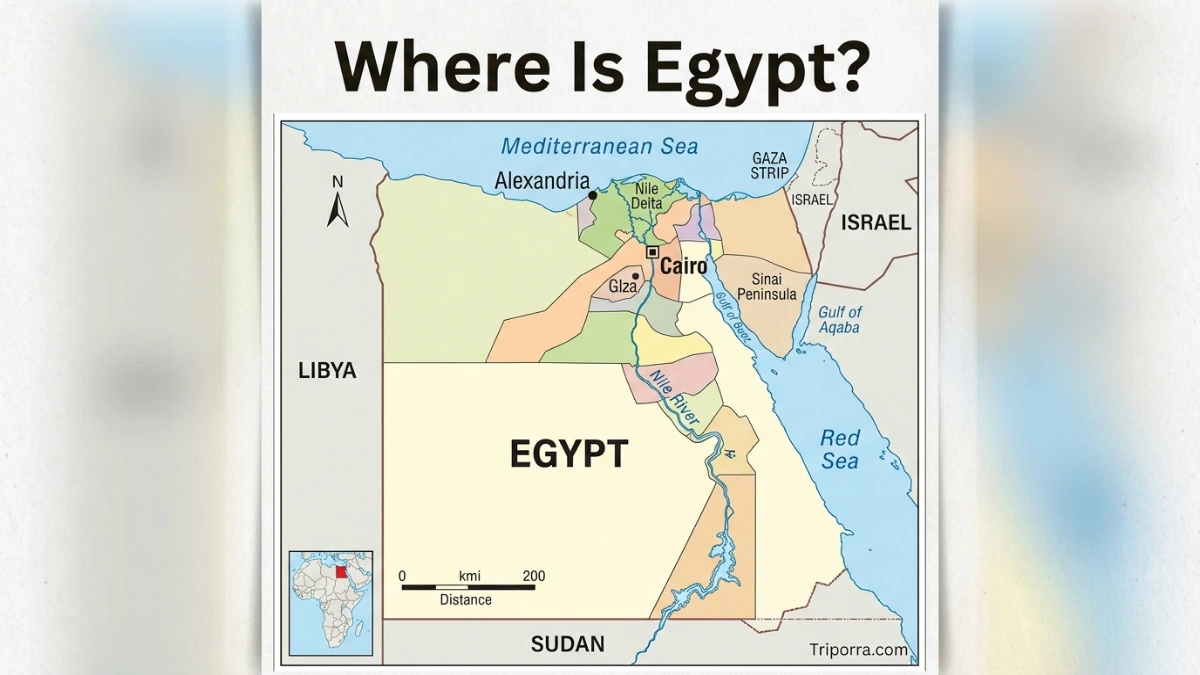
It is a country located in northeastern Africa, with a small portion of its territory, the Sinai Peninsula, extending into Asia. It sits between the Mediterranean Sea to the north and the Red Sea to the east, making it one of the world’s most strategically important countries.
Known for the Pyramids of Giza, the Nile River, ancient pharaohs, and thousands of years of history, Egypt connects Africa, Asia, and the Middle East through its unique geographic position.
____________________________________________________________________________
Featured Snippet Answer
It is located in northeastern Africa, bordered by Libya to the west, Sudan to the south, Israel and the Gaza Strip to the northeast, the Mediterranean Sea to the north, and the Red Sea to the east. It is famous for ancient civilizations, the Nile River, the Pyramids of Giza, and the Suez Canal, a major global trade route.
Where Is Egypt Located?
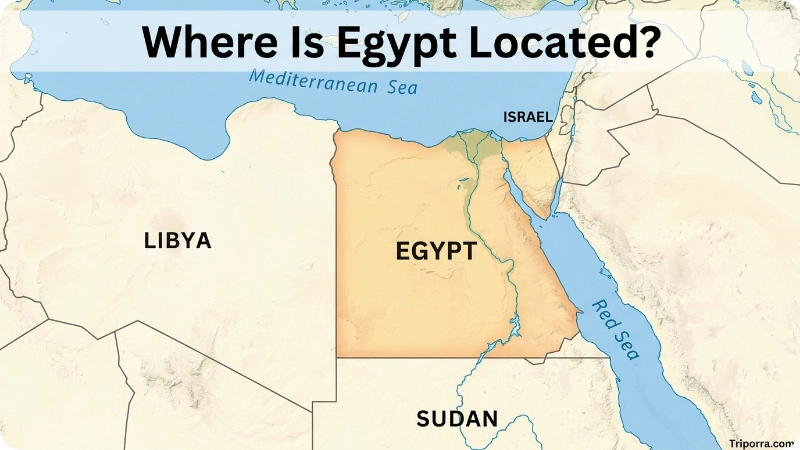
It occupies a strategic position at the crossroads of Africa and Asia. Most of the country lies in North Africa, while the Sinai Peninsula lies in Western Asia.
Its location has made it a center of trade, culture, and political influence for thousands of years.
Administrative Hierarchy
- Country: Egypt
- Continent: Africa (with part in Asia)
- Subregion: North Africa
- Capital City: Cairo
- Government Type: Unitary presidential republic
- Administrative Divisions: Governorates
Borders
It shares land borders with:
- Libya to the west
- Sudan to the south
- Israel to the northeast
- Gaza Strip to the northeast
It also has coastlines along:
- Mediterranean Sea
- Red Sea
- Gulf of Suez
- Gulf of Aqaba
Quick Facts Table
Egypt Quick Facts
| Fact | Details |
|---|---|
| Official Name | Arab Republic of Egypt |
| Country | Egypt |
| Region | North Africa and Western Asia (Sinai Peninsula) |
| Capital City | Cairo |
| Population | Approximately 115+ million people |
| Area | About 1,001,450 km² (386,662 sq mi) |
| Time Zone | UTC+2 |
| Coordinates | Approximately 26°N, 30°E |
| Largest City | Cairo |
| Nearby Major Cities | Cairo, Alexandria, Giza, Luxor, Aswan |
| Official Language | Arabic |
| Currency | Egyptian Pound (EGP) |
| Government Type | Republic |
| Known For | Pyramids of Giza, Nile River, Ancient Egypt, Suez Canal, and pharaonic history |
| Neighboring Countries | Libya, Sudan, Israel, and the State of Palestine (Gaza Strip) |
| Major Water Bodies | Mediterranean Sea, Red Sea, and Nile River |
| Famous Landmarks | Great Pyramid of Giza, Sphinx, Valley of the Kings, Abu Simbel, and the Egyptian Museum |
Egypt Overview
It is a transcontinental country located primarily in North Africa, with the Sinai Peninsula extending into Western Asia. It is one of the world’s oldest civilizations and is famous for its ancient monuments, the Nile River, and the strategically important Suez Canal. Cairo, the capital and largest city, serves as Egypt’s political, cultural, and economic center.
Egypt on the Map
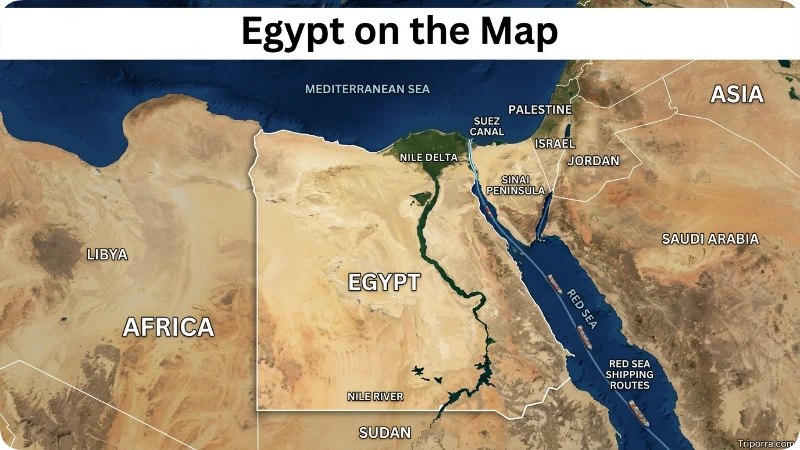
Picture Africa on a world map. Egypt occupies the northeastern corner of the continent.
To understand its location:
- The Mediterranean Sea lies directly north.
- Sudan stretches along the southern border.
- Libya lies to the west.
- Israel sits to the northeast.
- Saudi Arabia is across the Red Sea to the east.
The Nile River flows from south to north through the country before emptying into the Mediterranean Sea. Most major cities are concentrated along this river and its fertile delta.
Egypt’s position creates a natural bridge between Africa and Asia. The Sinai Peninsula connects the African mainland to the Asian continent, making Egypt a transcontinental country.
Which Region Does Egypt Belong To?
Geographically, It belongs to North Africa.
Politically and culturally, it is often associated with:
- North Africa
- The Arab World
- The Middle East
- The African Union
Because the Sinai Peninsula lies east of the Suez Canal, a portion of Egypt is technically located in Asia. This gives Egypt a unique identity among countries in the region.
The country is divided into multiple governorates, with Cairo serving as the national capital and largest urban center.
How Does Egypt Compare to Nearby Places?
It is one of the largest and most populous countries in the Middle East and North Africa.
Egypt & Libya
- Egypt has a much larger population.
- Tourism infrastructure is more developed.
- Urban areas are denser.
Egypt vs Sudan
- Egypt is more urbanized.
- It receives more international tourists.
- Transportation networks are more extensive.
Compared to Israel
- Egypt is significantly larger in land area.
- It has a much bigger population.
- Ancient archaeological sites cover a wider geographic area.
Compared to Morocco
- Egypt’s tourism is heavily focused on ancient history.
- Morocco attracts visitors for its cities, mountains, and Atlantic coastline.
- Both are among Africa’s most visited countries.
How to Reach Egypt
It is accessible from nearly every part of the world.
By Air
Major international airports include:
- Cairo International Airport
- Hurghada International Airport
- Sharm El Sheikh International Airport
- Alexandria Borg El Arab Airport
- Luxor International Airport
Direct flights connect Egypt to Europe, Asia, Africa, and the Middle East.
By Road
Land crossings exist from:
- Sudan
- Israel
Road travel is common within the country, particularly between major cities.
By Rail
It operates one of Africa’s oldest railway systems. Rail lines connect cities such as:
- Cairo
- Alexandria
- Luxor
- Aswan
By Sea
Passenger and cargo services operate through ports on both the Mediterranean and Red Sea coasts.
Why Is Egypt Famous?
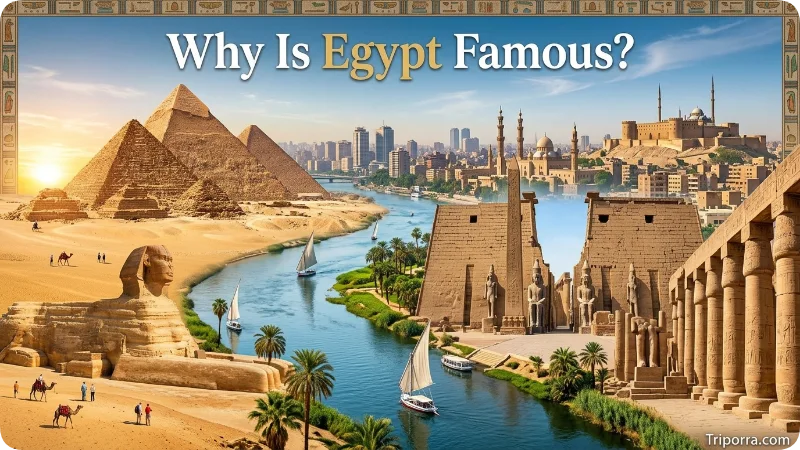
Few countries have influenced world history as much as Egypt.
Ancient Civilization
Egypt is known for:
- The Pyramids of Giza
- The Great Sphinx
- Valley of the Kings
- Ancient temples
- Pharaohs and dynasties
The Nile River
The Nile is often called the lifeline of Egypt. It supports agriculture, transportation, and population centers.
Suez Canal
The Suez Canal connects the Mediterranean Sea with the Red Sea.
This artificial waterway is among the world’s most important shipping routes, allowing ships to avoid sailing around Africa.
Cultural Influence
It has long been a major center for:
- Arabic literature
- Film production
- Music
- Education
- Islamic scholarship
History of Egypt
Egypt’s history spans more than five thousand years.
Ancient Egypt
The civilization of Ancient Egypt emerged along the Nile River around 3100 BCE.
Notable achievements included:
- Monumental architecture
- Writing systems
- Mathematics
- Astronomy
- Medicine
Greek and Roman Periods
After Alexander the Great’s conquest, Egypt became part of the Hellenistic world and later the Roman Empire.
Islamic Era
Arab Muslim forces entered Egypt in the 7th century CE, bringing Arabic language and Islamic culture.
Ottoman and Modern Periods
It later became part of the Ottoman Empire before moving toward modern statehood.
Contemporary Egypt
Today, Egypt remains a major political, economic, and cultural power in Africa and the Middle East.
Climate and Weather
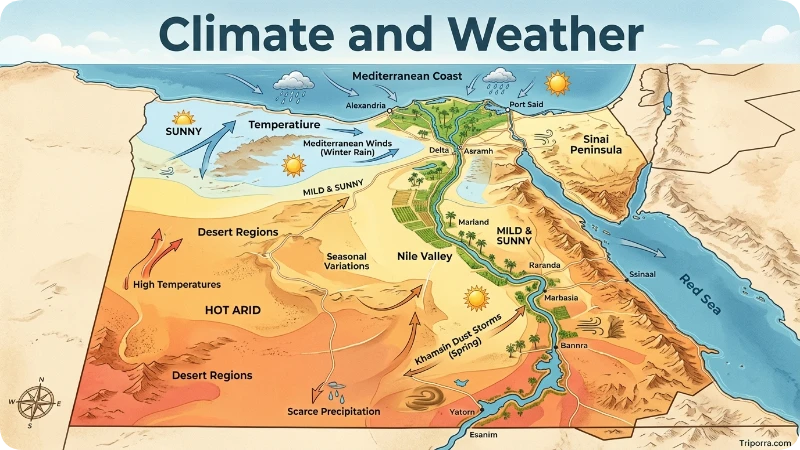
It has a predominantly desert climate.
Summer
- Very hot and dry
- Temperatures often exceed 40°C (104°F) in some regions
Winter
- Mild and pleasant
- Cooler evenings
- Popular season for tourism
Coastal Areas
Mediterranean cities such as Alexandria experience cooler temperatures and slightly more rainfall.
Desert Regions
Large parts of Egypt receive very little rain throughout the year.
Things to See and Do Nearby
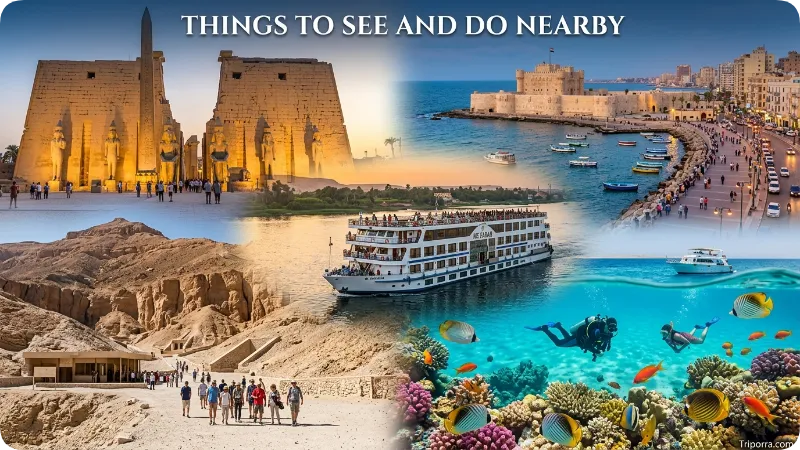
It offers a remarkable variety of attractions.
Pyramids of Giza
The country’s most famous landmark and one of the Seven Wonders of the Ancient World.
Cairo
Visitors can explore:
- Egyptian Museum
- Historic mosques
- Markets and bazaars
- Islamic Cairo
Luxor
Known as the world’s greatest open-air museum.
Highlights include:
- Karnak Temple
- Luxor Temple
- Valley of the Kings
Aswan
Popular for:
- Nile cruises
- Philae Temple
- Scenic river views
Sharm El Sheikh
A major Red Sea resort destination famous for:
- Diving
- Snorkeling
- Coral reefs
Alexandria
Offers a blend of Mediterranean culture and Egyptian history.
Best Time to Visit
Peak Season (October–April)
- Comfortable temperatures
- Ideal sightseeing conditions
- Most popular tourist period
Shoulder Season (May and September)
- Fewer crowds
- Good weather in many regions
Off-Season (June–August)
- Extremely hot in many inland areas
- Lower accommodation prices
For most travelers, winter and early spring provide the best balance of weather and sightseeing opportunities.
Common Misconceptions
Egypt Is Entirely in Africa
Not exactly. While most of Egypt lies in Africa, the Sinai Peninsula is located in Asia.
Egypt Is Only Desert
Although much of the land is desert, the Nile Valley and Nile Delta are fertile and support millions of people.
The Pyramids Are the Only Attraction
Egypt offers beaches, diving, museums, temples, modern cities, and cultural experiences beyond the pyramids.
Cairo and Giza Are the Same City
They are neighboring cities within the greater metropolitan area but are separate administrative entities.
Places Related to Egypt
People researching Egypt often also search for:
- Cairo
- Giza
- Alexandria
- Luxor
- Aswan
- Sinai Peninsula
- Red Sea
- Nile River
- Sudan
- Libya
- Israel
- Saudi Arabia
- Jordan
- Suez Canal
These locations help explain Egypt’s geographic and historical significance.
What Else Do People Want to Know?
Is Egypt Safe for Tourists?
Millions of visitors travel to Egypt each year. Travelers should follow current government travel advisories and local guidance.
Is Egypt Expensive?
Egypt is often considered affordable compared to many European and North American destinations.
What Language Is Spoken?
Arabic is the official language. English is commonly used in tourist areas.
What Currency Is Used?
The Egyptian Pound (EGP) is the national currency.
Can You Visit the Pyramids Year-Round?
Yes. However, cooler months generally provide a more comfortable experience.
____________________________________________________________________________
FAQs
Where is Egypt located exactly?
Egypt is located in northeastern Africa, with the Sinai Peninsula extending into Asia.
What countries border Egypt?
Egypt borders Libya, Sudan, Israel, and the Gaza Strip.
Is Egypt in Africa or the Middle East?
Geographically, Egypt is in Africa, but it is often considered part of the Middle East due to cultural, political, and historical connections.
What sea is north of Egypt?
The Mediterranean Sea lies along Egypt’s northern coastline.
What sea is east of Egypt?
The Red Sea borders Egypt to the east.
What is the capital of Egypt?
Cairo is the capital and largest city of Egypt.
Why is Egypt important geographically?
Egypt controls the Suez Canal and serves as a bridge between Africa and Asia.
What continent is the Sinai Peninsula in?
The Sinai Peninsula is part of Asia.
What is Egypt most famous for?
Egypt is famous for the Pyramids of Giza, the Nile River, ancient civilization, and the Suez Canal.
How far is Egypt from Europe?
Southern Europe is only a short distance across the Mediterranean Sea. Flights between Egypt and many European cities often take two to five hours.
What is the largest city in Egypt?
Cairo is the country’s largest city and economic center.
Does the Nile River run through Egypt?
Yes. The Nile flows through Egypt from south to north before reaching the Mediterranean Sea.
____________________________________________________________________________
Conclusion
Egypt is a transcontinental country located primarily in northeastern Africa, with the Sinai Peninsula extending into Asia. Bordered by Libya, Sudan, Israel, the Mediterranean Sea, and the Red Sea, it occupies one of the most important geographic positions on Earth. From the Pyramids of Giza and the Nile River to the Suez Canal and vibrant modern cities, Egypt remains a place of enormous historical, cultural, and economic significance. Whether you’re studying geography, planning a trip, or exploring world history, understanding where Egypt is helps explain why it has shaped civilizations for thousands of years.

About Leo Sterling
Leo Sterling is a geography and travel writer at Triporra.com who believes understanding a place starts with knowing exactly where it is. He turns geographic details on countries, regions, islands, and cities into clear, engaging content for everyday readers.
For Leo, a good location article does more than mark a spot on a map. It shows what borders a place, which region it belongs to, and how it connects to the world around it—an approach reflected in guides like where is Anguilla, where solid research meets a simple, conversational style.
Whether readers are planning a trip, studying, or just curious, Leo’s goal is the same: deliver accurate, easy-to-understand information without unnecessary complexity.
Areas of Focus: Geography | Countries & Regions | Caribbean Islands | Travel Destinations | Location Research | “Where Is?” Content