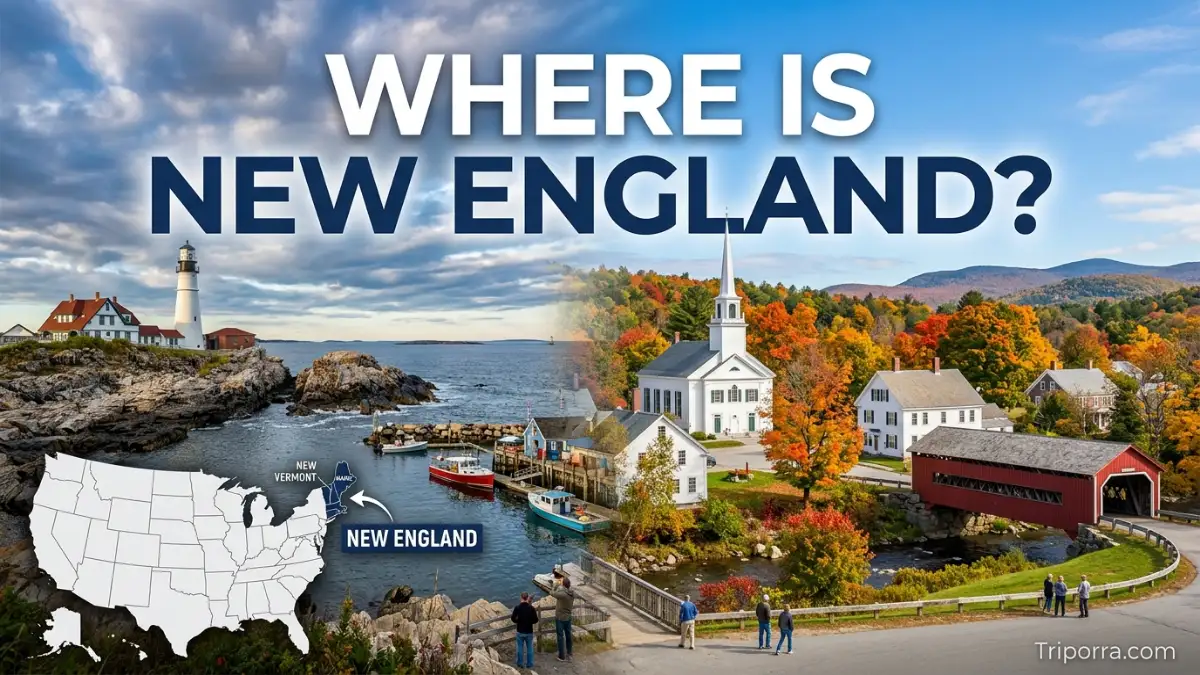
New England is one of the most historically important and geographically distinctive regions in the United States. Located in the northeastern corner of the country, it includes six states: Maine, New Hampshire, Vermont, Massachusetts, Rhode Island, and Connecticut. The region is known for its charming coastal towns, rocky shorelines, forest-covered mountains, colorful autumn foliage, and deep connections to early American history.
From the colonial streets of Boston and historic villages of Massachusetts to the rugged landscapes of Maine and the Green Mountains of Vermont, New England offers a unique mix of culture, nature, and tradition. It is home to some of the nation’s oldest cities, world-renowned universities, famous landmarks, and scenic destinations.
Whether you are researching geography, planning a trip, studying American history, or simply wondering where New England is located, understanding this region helps explain its lasting influence on the United States.
Featured Snippet Answer
New England is located in the northeastern corner of the United States and includes six states: Maine, New Hampshire, Vermont, Massachusetts, Rhode Island, and Connecticut. The region borders Canada to the north, the Atlantic Ocean to the east and southeast, and New York State to the west. New England is known for its colonial history, vibrant fall colors, coastal towns, and major cultural centers such as Boston.
Where Is New England Located?
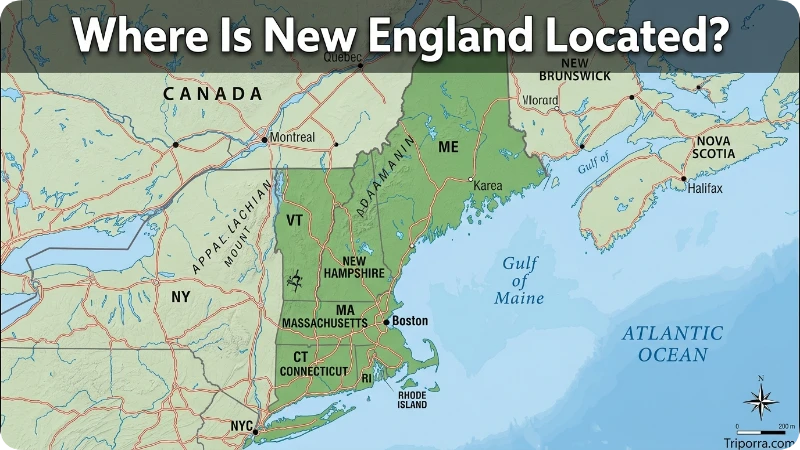
New England occupies the northeastern part of the United States in North America. It forms one of the country’s most historically significant regions and was among the first areas settled by English colonists.
The region consists of:
- Maine
- New Hampshire
- Vermont
- Massachusetts
- Rhode Island
- Connecticut
Geographically, New England lies between Canada and the Atlantic Ocean. It is bordered by:
- Canada to the north
- New York State to the west
- Atlantic Ocean to the east and southeast
Boston, Massachusetts, serves as the region’s largest city and economic center.
Quick Facts About New England
| Fact | Details |
|---|---|
| Official Name | New England |
| Country | United States |
| Region Type | Cultural and Geographic Region |
| States Included | Maine, New Hampshire, Vermont, Massachusetts, Rhode Island, Connecticut |
| Largest City | Boston, Massachusetts |
| Approximate Population | About 15 million people |
| Approximate Area | 186,458 km² (71,991 sq mi) |
| Time Zone | Eastern Time Zone (ET) |
| Coordinates (Approximate Center) | 43°N, 71°W |
| Nearby Major Cities | Boston, Providence, Hartford, Portland |
| Primary Language | English |
| Currency | United States Dollar (USD) |
| Known For | Colonial history, fall foliage, seafood, prestigious universities, and coastal towns |
| Founded By | Early English settlers in the 17th century |
| Famous Universities | Harvard University, Yale University, MIT, Dartmouth College, Brown University |
| Major Industries | Education, healthcare, technology, tourism, finance, and fishing |
| Popular Attractions | Acadia National Park, Cape Cod, Freedom Trail, White Mountains, Newport Mansions |
| Climate | Four distinct seasons with cold winters and warm summers |
New England on the Map
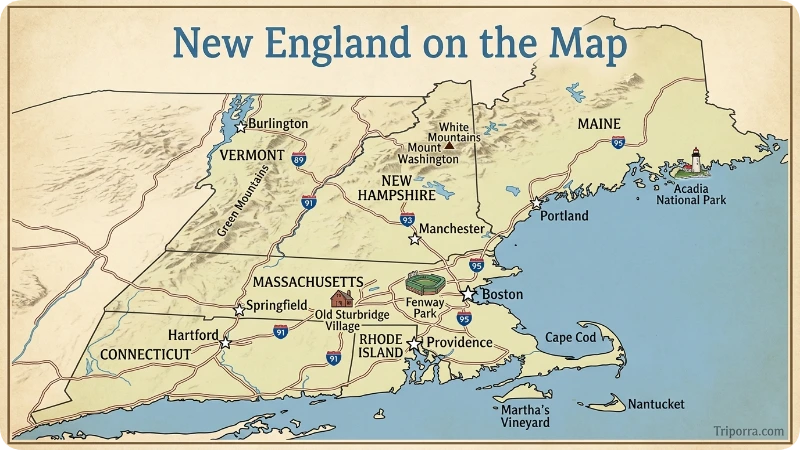
Picture the northeastern corner of the United States. New England stretches from the Canadian border in the north to Long Island Sound in the south.
Maine occupies the easternmost section and extends toward the Atlantic Ocean. Vermont and New Hampshire sit inland, separated by the Connecticut River in many places. Massachusetts lies farther south and includes Cape Cod, one of America’s best-known peninsulas.
Rhode Island and Connecticut form the southern portion of the region.
If you drive from New York City to Boston, you enter New England through Connecticut. Continuing north takes you into New Hampshire, Vermont, and Maine.
Which Region Does New England Belong To?
New England is one of the major geographic and cultural regions of the United States.
Unlike a state, province, or territory, New England is a multi-state region recognized for shared historical, cultural, and economic characteristics.
Administratively:
- Country: United States
- Region: New England
- States: Six member states
The region played a central role during the colonial era and the American Revolution, which helped shape a common regional identity that remains strong today.
How Does New England Compare to Nearby Places?
New England differs from neighboring regions in several ways.
Compared with New York
- Generally smaller cities outside Boston
- More colonial-era architecture
- Greater concentration of small coastal towns
- Stronger regional traditions tied to early American history
Compared with the Mid-Atlantic Region
- Cooler climate
- More rugged coastline
- Smaller states
- Earlier European settlement history
Comparison With Other U.S. Regions
- Shorter summers
- Colder winters
- Distinct autumn foliage season
- Different historical development patterns
Many visitors choose New England for scenic drives, historic sites, and outdoor recreation rather than large metropolitan experiences.
How to Reach New England
Because New England covers six states, there are many transportation options.
Major Airports
International travelers often arrive through:
- Boston Logan International Airport (BOS)
- Bradley International Airport (Connecticut)
- Portland International Jetport (Maine)
- Manchester-Boston Regional Airport (New Hampshire)
- T.F. Green Airport (Rhode Island)
By Road
Major highways include:
- Interstate 95
- Interstate 90 (Massachusetts Turnpike)
- Interstate 89
- Interstate 91
Driving is one of the most popular ways to explore the region, especially during autumn.
By Rail
Amtrak serves several major destinations, including:
- Boston
- Providence
- New Haven
- Hartford
International Access
Travelers from Europe often find Boston among the easiest entry points due to numerous direct flights.
Why Is New England Famous?
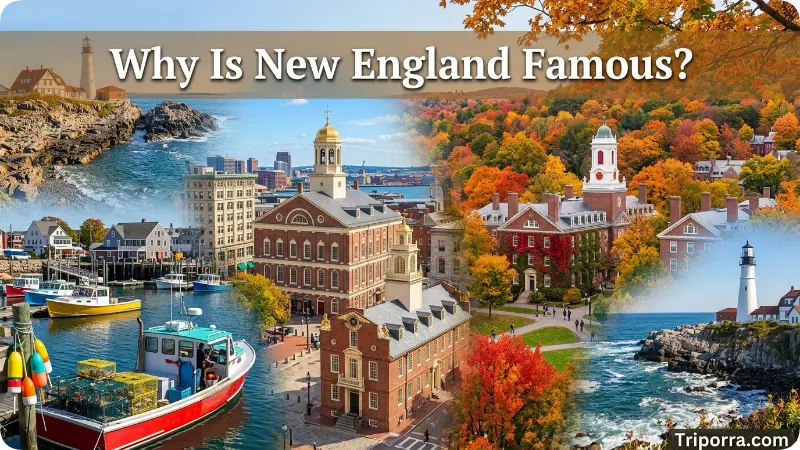
The region is famous for a combination of history, education, nature, and culture.
Colonial History
Many of America’s earliest English settlements were established here during the 1600s.
American Revolution
Several key events occurred in Massachusetts and surrounding areas, including:
- Boston Tea Party
- Battles of Lexington and Concord
- Bunker Hill
Universities
The region hosts world-renowned institutions such as:
- Harvard University
- Yale University
- Massachusetts Institute of Technology (MIT)
- Dartmouth College
- Brown University
Fall Foliage
Every autumn, forests across Vermont, New Hampshire, and Maine display spectacular colors that attract visitors from around the world.
Seafood
New England is famous for:
- Lobster
- Clam chowder
- Oysters
- Scallops
History of New England
Long before European arrival, Indigenous peoples lived throughout the region, including communities such as the Wampanoag, Narragansett, Penobscot, and Abenaki.
European settlement began in the early 17th century.
Early Colonial Era
The Pilgrims established Plymouth Colony in present-day Massachusetts in 1620.
Soon afterward, additional settlements spread throughout the region.
Growth and Trade
New England developed a strong economy based on:
- Fishing
- Shipbuilding
- Trade
- Manufacturing
American Revolution
The region became a center of resistance to British rule.
Many events that sparked American independence occurred in and around Boston.
Modern Era
Today, New England remains an important center for:
- Education
- Healthcare
- Technology
- Tourism
- Finance
Climate and Weather
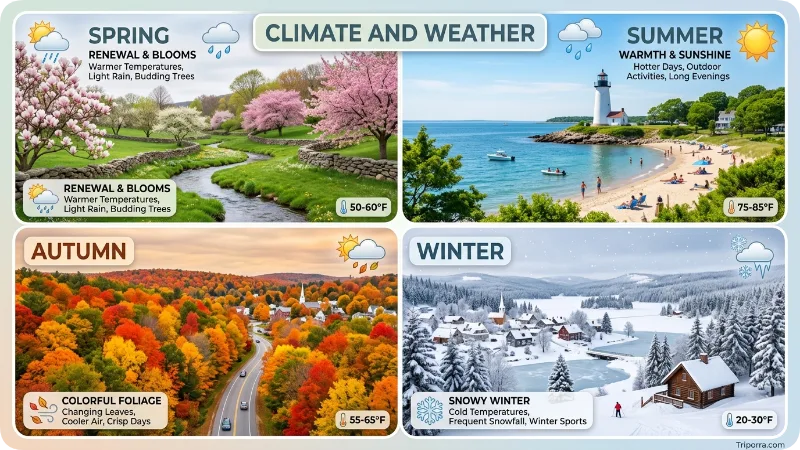
New England experiences four distinct seasons.
Spring
- March to May
- Mild temperatures
- Blooming flowers
- Increasing rainfall
Summer
- June to August
- Warm temperatures
- Popular beach season
- Outdoor festivals
Autumn
- September to November
- Cool, comfortable weather
- Peak foliage season
Winter
- December to February
- Snowfall common
- Ski resorts active
- Cold temperatures inland
Northern areas such as Maine, Vermont, and New Hampshire generally experience colder winters than coastal Connecticut and Rhode Island.
Things to See and Do Nearby
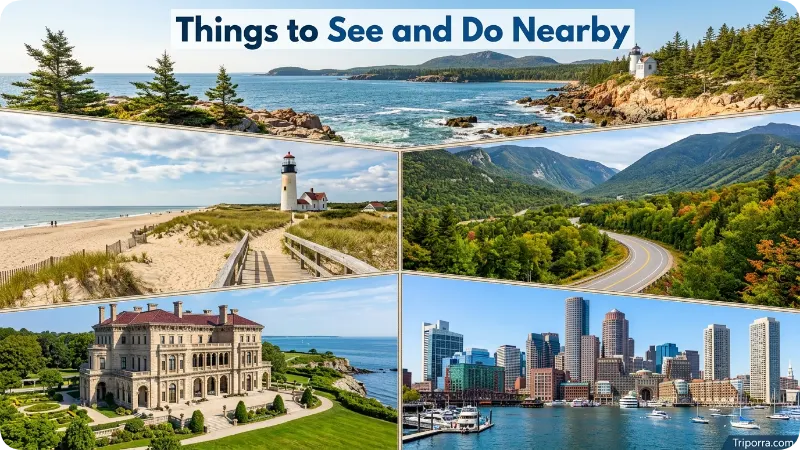
The region offers a remarkable variety of attractions.
Boston, Massachusetts
Highlights include:
- Freedom Trail
- Faneuil Hall
- Boston Harbor
- Fenway Park
Cape Cod
Known for:
- Beaches
- Lighthouses
- Seafood restaurants
- Whale watching
Acadia National Park
Located in Maine, it features:
- Rocky coastlines
- Hiking trails
- Scenic mountain views
White Mountains
New Hampshire’s White Mountains provide:
- Hiking
- Scenic railways
- Skiing
- Wildlife viewing
Green Mountains
Vermont’s Green Mountains are famous for:
- Fall colors
- Ski resorts
- Rural scenery
Newport, Rhode Island
Visitors enjoy:
- Historic mansions
- Coastal walks
- Sailing culture
Best Time to Visit
The ideal time depends on your interests.
Fall (September–October)
Best for:
- Leaf-peeping
- Scenic drives
- Photography
Summer (June–August)
Best for:
- Beaches
- Coastal towns
- Outdoor recreation
Winter (December–March)
Best for:
- Skiing
- Snowboarding
- Winter festivals
Spring (April–May)
Best for:
- Smaller crowds
- Gardens
- Moderate weather
Many travelers consider autumn the most beautiful season in New England.
Common Misconceptions
New England Is Not a State
Many international visitors assume it is a state. In reality, it is a region consisting of six states.
It Is Not the Same as England
Despite the name, New England is part of the United States, not the United Kingdom.
Boston Is Not the Entire Region
Boston is the largest city, but New England includes thousands of towns, rural communities, mountains, forests, and coastal areas.
Not All Areas Have Harsh Winters
Coastal Connecticut and Rhode Island often experience milder winters than northern inland areas.
Places Related to New England
People researching this region often explore:
- Boston
- Cape Cod
- Martha’s Vineyard
- Nantucket
- Acadia National Park
- White Mountains
- Green Mountains
- Long Island Sound
- New York State
- Atlantic Canada
These destinations help define the region’s cultural and geographic identity.
What Else Do People Want to Know?
Is New England Safe?
Most parts of the region are considered safe for travelers. As with any destination, awareness and standard precautions are recommended.
Is It Expensive?
Major cities such as Boston can be costly, while many smaller towns offer more affordable options.
Is Public Transportation Available?
Urban areas have good transportation networks, while rural destinations are easier to explore by car.
What Is the Local Culture Like?
The culture reflects centuries of history, strong educational traditions, maritime heritage, and community-focused lifestyles.
Do People Visit Year-Round?
Yes. Each season offers different experiences, from skiing in winter to beach vacations in summer.
FAQs
Is New England a state or a region?
It is a geographic and cultural region of the United States made up of six states.
What states are part of New England?
Maine, New Hampshire, Vermont, Massachusetts, Rhode Island, and Connecticut.
Where is New England located in the United States?
It occupies the northeastern corner of the country.
What is the largest city in New England?
Boston, Massachusetts.
Why is New England called New England?
English settlers named the area after England during the colonial period.
Does New England border Canada?
Yes. Maine, New Hampshire, and Vermont share borders with Canada.
What is New England known for?
Colonial history, universities, seafood, coastal towns, and autumn foliage.
Is New York part of New England?
No. New York is a neighboring state but is not part of the New England region.
What is the best month to visit New England?
October is often considered the best month because of the fall colors.
Does New England have beaches?
Yes. Massachusetts, Rhode Island, Connecticut, and Maine have popular coastal beaches.
What language is spoken in New England?
English is the primary language.
How many people live in New England?
The region has an approximate population of around 15 million residents.
Conclusion
New England is a historic region in the northeastern United States that includes Maine, New Hampshire, Vermont, Massachusetts, Rhode Island, and Connecticut. Bordered by Canada, New York, and the Atlantic Ocean, it combines colonial heritage, scenic coastlines, mountain landscapes, prestigious universities, and vibrant cultural traditions. Whether you are studying geography, planning a vacation, or exploring American history, New England remains one of the country’s most influential and recognizable regions.

Elena Rostova bridges the gap between premium hospitality and authentic local experiences. Armed with a background in luxury hospitality management and a passion for fine architecture, she spent years evaluating elite resorts before transitioning into travel journalism. Elena heads the luxury and boutique travel vertical on Triporra.com. Her meticulous guides strip away the guesswork from high-end travel, showcasing unique five-star escapes, fine regional dining, and bespoke private tours that elevate a standard vacation into an unforgettable journey.