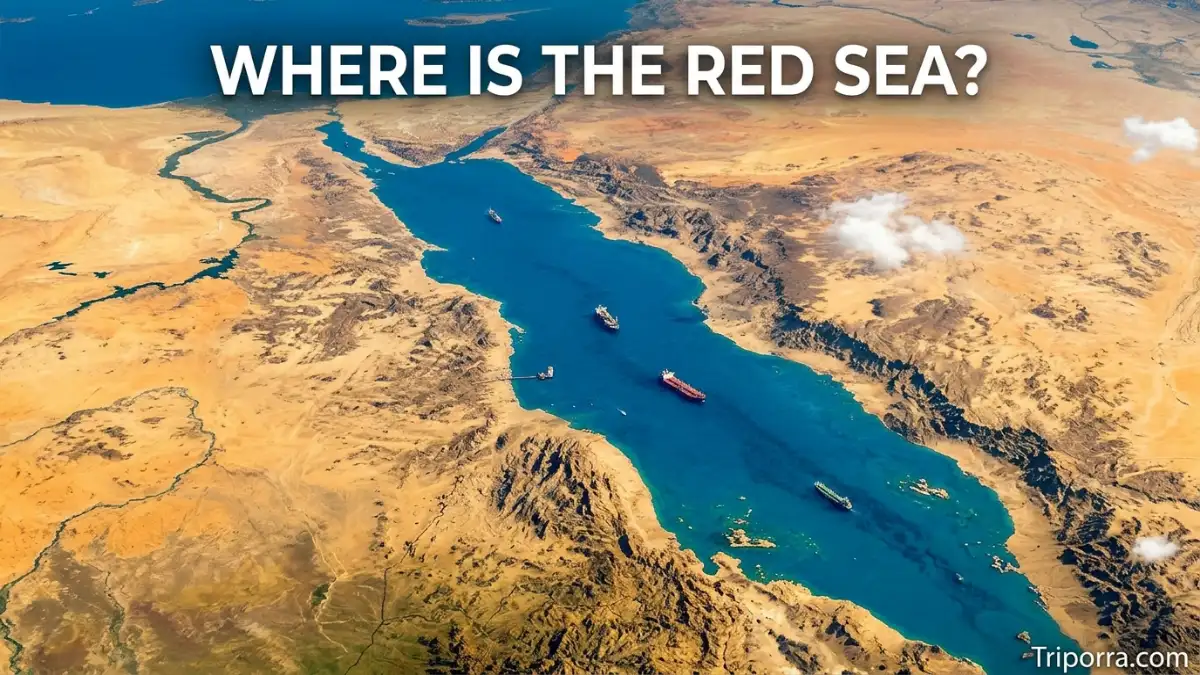
It is a large seawater inlet of the Indian Ocean located between northeastern Africa and the Arabian Peninsula. It stretches from the Suez Canal in Egypt in the north to the Bab el-Mandeb Strait, which connects it to the Gulf of Aden and the Arabian Sea, in the south.
If you are looking at a world map, the Red Sea lies between countries such as Egypt, Sudan, Eritrea, and Djibouti on the African side and Saudi Arabia and Yemen on the Asian side. It is one of the world’s most important waterways, serving as a major route for international trade and shipping while also being famous for its coral reefs, marine life, and historical significance.
Quick Facts About the Red Sea
| Fact | Details |
| Name | Red Sea |
| Type | Marginal Sea of the Indian Ocean |
| Location | Between Africa and Asia |
| Continent | Africa and Asia |
| Northern Connection | Suez Canal and Gulf of Suez |
| Southern Connection | Bab el-Mandeb Strait and Gulf of Aden |
| Length | Approximately 2,250 km (1,400 miles) |
| Maximum Width | About 355 km (221 miles) |
| Surface Area | Around 438,000 sq km (169,100 sq mi) |
| Maximum Depth | About 3,040 meters (9,970 feet) |
| Average Depth | Around 490 meters (1,608 feet) |
| Coordinates | Approximately 20°N, 38°E |
| Bordering Countries | Egypt, Sudan, Eritrea, Djibouti, Saudi Arabia, Yemen |
| Famous For | Coral reefs, marine biodiversity, shipping routes, biblical history |
| Major Ports | Jeddah, Port Sudan, Suez, Aqaba, Yanbu |
| UNESCO Sites Nearby | Historic Jeddah and several coastal heritage sites |
Where Is the Red Sea Located?
It is located between Africa and Asia, making it one of the most strategically important bodies of water on Earth.
To understand its location:
- West: Egypt, Sudan, Eritrea, and Djibouti
- East: Saudi Arabia and Yemen
- North: Gulf of Suez, Gulf of Aqaba, and the Sinai Peninsula
- South: Bab el-Mandeb Strait and Gulf of Aden
The sea acts as a natural boundary separating northeastern Africa from the Arabian Peninsula.
Red Sea on a World Map
On a world map, the Red Sea appears:
- East of the Sahara Desert
- West of Saudi Arabia
- North of the Arabian Sea
- South of the Mediterranean region
- Between Africa and the Middle East
It forms part of one of the world’s busiest maritime corridors linking Europe, Asia, and Africa.
Red Sea on a Regional Map
Within the Middle East and North Africa (MENA) region, the Red Sea serves as a central waterway connecting:
- Mediterranean Sea
- Suez Canal
- Indian Ocean
- Arabian Sea
- Gulf of Aden
This position gives it immense geopolitical and economic importance.
Which Countries Border the Red Sea?
Six countries have coastlines along the Red Sea.
African Countries
Egypt
Egypt occupies the northwestern coastline and controls the entrance to the Suez Canal.
Sudan
Sudan has a long Red Sea coastline and hosts Port Sudan, the country’s main seaport.
Eritrea
Eritrea’s coastline includes many islands and diverse marine ecosystems.
Djibouti
Djibouti lies near the southern entrance to the Red Sea and serves as an important shipping hub.
Asian Countries
Saudi Arabia
Saudi Arabia has the longest Red Sea coastline and several major cities along its shores.
Yemen
Yemen occupies the southeastern coastline near the Bab el-Mandeb Strait.
Why Is It Called the Red Sea?
The exact origin of the name remains uncertain, but several theories exist.
Algae Theory
One popular explanation involves seasonal blooms of algae called Trichodesmium erythraeum, which can temporarily give the water a reddish-brown appearance.
Ancient Directional System
Ancient cultures sometimes associated colors with cardinal directions. Red may have represented the south, making the Red Sea the “southern sea.”
Mountain Reflection Theory
Some researchers suggest that nearby reddish mountains reflected onto the water, contributing to the name.
Regardless of the origin, the sea is not normally red and usually appears deep blue.
Geography of the Red Sea
It is among the most unique marine environments in the world.
Length and Width
- Length: About 2,250 kilometers
- Maximum Width: About 355 kilometers
The sea narrows significantly in some areas and widens in others.
Depth
The central trench reaches depths exceeding 3,000 meters.
The deep basin was formed through tectonic activity associated with continental drift.
Tectonic Formation
It lies along a major geological rift where:
- African Plate
- Arabian Plate
are slowly moving apart.
Scientists estimate the plates separate by several millimeters each year.
The Red Sea Rift Valley
It is actually a young ocean basin forming through tectonic processes.
Millions of years ago, Africa and Arabia were connected.
As tectonic forces pulled them apart:
- Cracks formed in Earth’s crust.
- The land sank.
- Ocean water flooded the basin.
- A sea gradually developed.
Many geologists consider the Red Sea an example of a future ocean in formation.
Climate of the Red Sea Region
Its region experiences a predominantly hot and arid climate.
Temperature
Average air temperatures:
| Season | Average Temperature |
| Winter | 20–30°C (68–86°F) |
| Summer | 30–45°C (86–113°F) |
Rainfall
Rainfall is generally low.
Many coastal areas receive less than 100 mm of rain annually.
Humidity
Humidity levels can be very high, especially during summer.
Marine Ecosystems and Biodiversity
It is famous for possessing some of the healthiest coral reef systems in the world.
Coral Reefs
More than:
- 200 species of hard coral
- Thousands of reef-associated species
inhabit its waters.
Fish Species
Marine life includes:
- Clownfish
- Butterflyfish
- Angelfish
- Barracudas
- Groupers
- Tuna
Large Marine Animals
Visitors may encounter:
- Dolphins
- Dugongs
- Whale sharks
- Manta rays
- Sea turtles
Its biodiversity makes it one of the world’s premier diving destinations.
History of the Red Sea
The Red Sea has played a major role in human civilization for thousands of years.
Ancient Egypt
Ancient Egyptians used the Red Sea for:
- Trade
- Exploration
- Naval expeditions
Records suggest voyages to the mysterious Land of Punt traveled through these waters.
Biblical Significance
It occupies an important place in religious traditions.
In the Book of Exodus, Moses is described as leading the Israelites across waters traditionally associated with the Red Sea.
The event remains one of the most famous stories in Judaism, Christianity, and Islam.
Greek and Roman Periods
The Greeks and Romans developed trade routes linking:
- Europe
- Africa
- India
- Arabia
through Red Sea ports.
Islamic Era
The sea became vital for pilgrimage routes to Mecca and international commerce.
The Red Sea and Global Trade
It is one of the world’s most important shipping corridors.
Connection to the Suez Canal
The Suez Canal links:
- Mediterranean Sea
- Red Sea
allowing ships to travel between Europe and Asia without sailing around Africa.
Economic Importance
Approximately 10–15% of global trade passes through the Red Sea region.
Major cargo includes:
- Oil
- Natural gas
- Manufactured goods
- Food products
- Consumer goods
Any disruption can affect global supply chains.
Major Cities Along the Red Sea
Jeddah, Saudi Arabia
Jeddah is one of the largest cities on the Red Sea and serves as the gateway to Mecca.
Highlights
- Historic Jeddah
- Corniche waterfront
- King Fahd Fountain
Hurghada, Egypt
Hurghada is among Egypt’s most popular resort destinations.
Attractions
- Diving
- Snorkeling
- Beach resorts
Sharm El Sheikh, Egypt
Located near the Sinai Peninsula, Sharm El Sheikh is internationally renowned for marine tourism.
Port Sudan
Sudan’s primary seaport and an important commercial center.
Aqaba, Jordan
Although located on the Gulf of Aqaba, Aqaba provides Jordan’s only access to the Red Sea system.
Famous Attractions Around the Red Sea
Ras Mohammed National Park
Located in Egypt, this protected area is famous for:
- Coral reefs
- Marine biodiversity
- Diving opportunities
Giftun Islands
Popular for snorkeling and beach excursions.
Farasan Islands
Located off Saudi Arabia’s coast and known for wildlife and pristine beaches.
Sinai Peninsula
A region rich in natural beauty and historical significance.
Historic Jeddah
A UNESCO World Heritage Site featuring centuries-old architecture and cultural heritage.
Things to Do at the Red Sea
Visitors enjoy a wide variety of activities.
Scuba Diving
It is often ranked among the best diving destinations on Earth.
Popular dive sites include:
- Blue Hole
- Brothers Islands
- Elphinstone Reef
Snorkeling
Clear water and colorful reefs make snorkeling accessible for beginners.
Sailing
Many travelers explore the coastline by yacht or boat.
Wildlife Watching
Common sightings include:
- Dolphins
- Turtles
- Whale sharks
Beach Vacations
Resorts along Egypt and Saudi Arabia attract millions of tourists annually.
How to Get to the Red Sea
By Air
Major airports include:
| Airport | Country |
| Hurghada International Airport | Egypt |
| Sharm El Sheikh International Airport | Egypt |
| King Abdulaziz International Airport | Saudi Arabia |
| Aqaba Airport | Jordan |
| Port Sudan Airport | Sudan |
By Road
Many coastal cities are connected through modern highway networks.
By Sea
Cruise ships and ferries operate throughout parts of the region.
Best Time to Visit the Red Sea
October to April
This is generally considered the best period.
Advantages include:
- Pleasant temperatures
- Excellent diving conditions
- Comfortable sightseeing weather
May to September
Temperatures can become extremely hot, especially inland.
However, water activities remain popular.
Red Sea vs Mediterranean Sea
| Feature | Red Sea | Mediterranean Sea |
| Location | Africa-Asia boundary | Europe-Africa boundary |
| Salinity | Higher | Lower |
| Water Temperature | Warmer | Cooler |
| Coral Reefs | Extensive | Limited |
| Biodiversity | Tropical marine life | Temperate marine life |
| Major Connection | Indian Ocean | Atlantic Ocean |
Red Sea vs Arabian Sea
| Feature | Red Sea | Arabian Sea |
| Size | Smaller | Much larger |
| Location | Between Africa and Arabia | Northern Indian Ocean |
| Coral Reefs | Extensive | Less concentrated |
| Trade Importance | Extremely high | Very high |
10 Interesting Facts About the Red Sea
- It is one of the world’s warmest seas.
- It is one of the saltiest bodies of seawater.
- More than 2,000 kilometers long.
- It separates Africa from Asia.
- The Suez Canal connects it to the Mediterranean Sea.
- It hosts hundreds of coral species.
- Whale sharks regularly visit its waters.
- Ancient Egyptians sailed it over 4,000 years ago.
- It is forming through tectonic plate movement.
- It remains one of the world’s busiest shipping routes.
FAQAs
Where is the Red Sea located?
It is located between northeastern Africa and the Arabian Peninsula, connecting the Suez Canal in the north with the Gulf of Aden in the south.
Which countries border the Red Sea?
Egypt, Sudan, Eritrea, Djibouti, Saudi Arabia, and Yemen border the Red Sea.
Is the Red Sea part of the Indian Ocean?
Yes. It is considered a marginal sea connected to the Indian Ocean through the Gulf of Aden.
Why is the it famous?
It is famous for coral reefs, marine biodiversity, historical significance, and global shipping routes.
Is the Red Sea actually red?
No. The water is generally blue. The name likely comes from algae blooms, ancient naming traditions, or nearby mountains.
What is the deepest point of the Red Sea?
The deepest point reaches approximately 3,040 meters (9,970 feet).
Can you swim in the Red Sea?
Yes. Swimming, snorkeling, and diving are among the most popular activities.
What is the best Red Sea destination for tourists?
Popular destinations include Sharm El Sheikh, Hurghada, Jeddah, Aqaba, and the Farasan Islands.
Is the Red Sea safe for diving?
Yes. It is considered one of the world’s top diving destinations, though divers should always follow local safety guidelines.
What connects the Red Sea to the Mediterranean Sea?
The Suez Canal connects the Red Sea to the Mediterranean Sea.
What animals live in the Red Sea?
Marine life includes dolphins, whale sharks, sea turtles, dugongs, reef fish, rays, and hundreds of coral species.
How important is the Red Sea for global trade?
It is extremely important because it links the Suez Canal and the Indian Ocean, carrying a significant share of international shipping traffic.
Conclusion
The Red Sea is a strategically important body of water located between Africa and Asia, bordered by Egypt, Sudan, Eritrea, Djibouti, Saudi Arabia, and Yemen. Stretching approximately 2,250 kilometers, it connects the Suez Canal in the north to the Gulf of Aden in the south, making it one of the world’s most vital maritime corridors. Beyond its economic importance, the Red Sea is renowned for its spectacular coral reefs, diverse marine ecosystems, ancient trade routes, biblical associations, and world-class tourism destinations. Whether viewed on a world map, explored through its rich history, or visited for diving and adventure, the Red Sea remains one of the most fascinating and significant geographic features on Earth.

About Leo Sterling
Leo Sterling is a geography and travel writer at Triporra.com who believes understanding a place starts with knowing exactly where it is. He turns geographic details on countries, regions, islands, and cities into clear, engaging content for everyday readers.
For Leo, a good location article does more than mark a spot on a map. It shows what borders a place, which region it belongs to, and how it connects to the world around it—an approach reflected in guides like where is Anguilla, where solid research meets a simple, conversational style.
Whether readers are planning a trip, studying, or just curious, Leo’s goal is the same: deliver accurate, easy-to-understand information without unnecessary complexity.
Areas of Focus: Geography | Countries & Regions | Caribbean Islands | Travel Destinations | Location Research | “Where Is?” Content