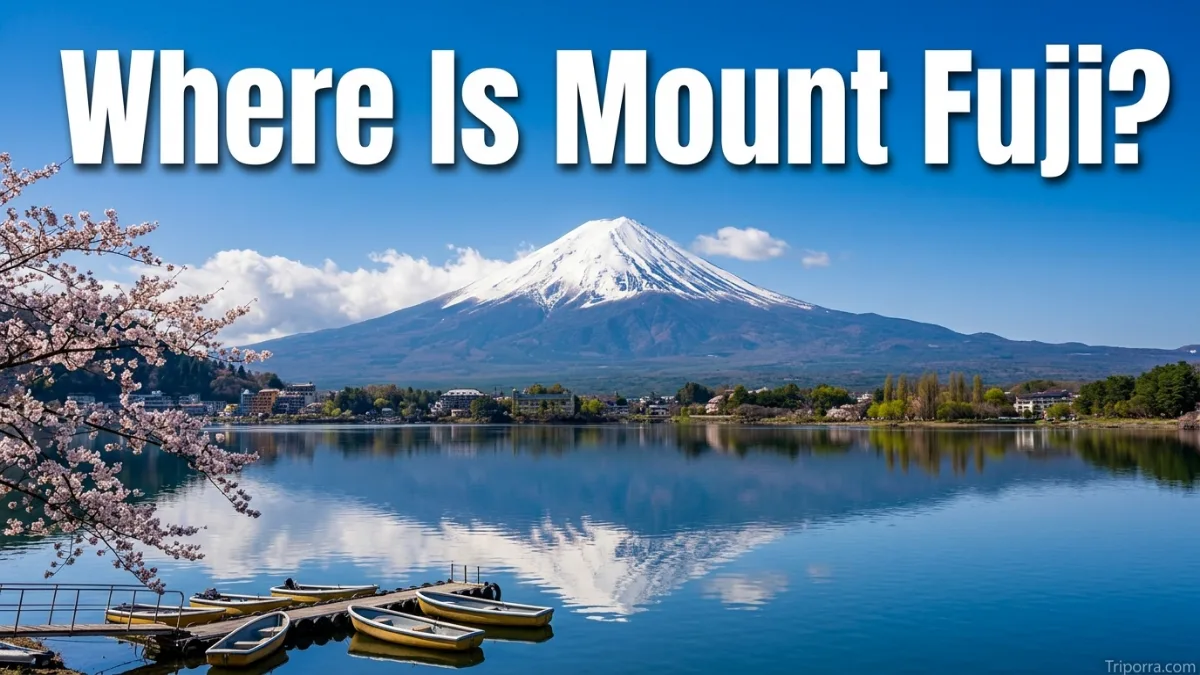
Mount Fuji is the tallest mountain in Japan and one of the country’s most famous landmarks. It is on the island of Honshu, about 100 kilometres (62 miles) southwest of Tokyo. The mountain sits between Yamanashi and Shizuoka prefectures and can be seen from many places on a clear day.
People from around the world visit Mount Fuji to enjoy its beautiful views, learn about its history, and climb to the top during the official climbing season. It is also an important cultural and spiritual symbol of Japan.
Featured Snippet
Mount Fuji is in central Japan on the island of Honshu. It stands between Yamanashi and Shizuoka prefectures, about 100 kilometres (62 miles) southwest of Tokyo. At approximately 3,776 metres (12,389 feet), it is Japan’s highest mountain and an active stratovolcano. It is also a UNESCO World Heritage Site known for its cultural importance.
Quick Facts
| Fact | Information |
|---|---|
| Official Name | Mount Fuji (Fujisan) |
| Country | Japan |
| Region | Yamanashi and Shizuoka Prefectures |
| Mountain Type | Active stratovolcano (composite volcano) |
| Elevation | Approximately 3,776 metres (12,389 feet) |
| Age | Approximately 100,000 years (current volcano) |
| Last Eruption | Hōei Eruption (1707–1708) |
| Coordinates | Approximately 35.36° N, 138.73° E |
| Time Zone | Japan Standard Time (JST, UTC+9) |
| Nearest Major City | Tokyo (about 100 km / 62 miles away) |
| UNESCO Status | UNESCO World Heritage Site (since 2013) |
| Known For | Japan’s tallest mountain, active volcano, cultural and spiritual symbol |
| Official Language | Japanese |
| Best Time to Visit | July–August for climbing; October–February for clear views |
| Annual Visitors | Hundreds of thousands of climbers and millions of tourists each year |
Where Is Mount Fuji?
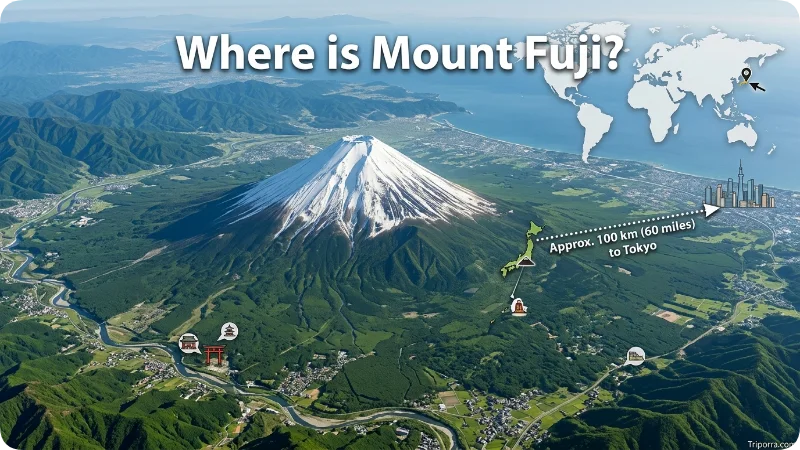
Mount Fuji is in central Japan on the island of Honshu, which is Japan’s largest island. The mountain stands between Yamanashi Prefecture and Shizuoka Prefecture. It is about 100 kilometres (62 miles) southwest of Tokyo, making it easy to visit from the capital.
The area around the mountain has forests, lakes, small towns, and hot springs. The Fuji Five Lakes area is on the northern side and is one of the best places to enjoy the view. Many visitors stay here before climbing the mountain or taking photos.
Travellers often overlook how close Mount Fuji is to Tokyo. Many people think it is far away, but you can usually reach the area in about two to three hours by train, bus, or car.
Administrative Status
Many people ask what city Mount Fuji is in. The mountain is not located inside a single city. Instead, it lies between Yamanashi Prefecture and Shizuoka Prefecture.
Several nearby cities provide easy access to Mount Fuji, including Fujiyoshida, Fujinomiya, Gotemba, and Fuji City. These cities have train stations, hotels, restaurants, and transport links for visitors.
Most climbers begin their journey from Fujiyoshida or Fujinomiya, depending on which climbing route they choose.
Both Yamanashi and Shizuoka prefectures work together to protect Mount Fuji and manage tourism.
If you are visiting from another country, you only need to follow Japan’s normal visa and entry rules. There are no extra permits needed just to visit the area. However, some climbing rules and fees may apply during the official climbing season.
The mountain follows Japan Standard Time (JST), which is UTC+9. Japan does not use daylight saving time.
Mount Fuji on the Map
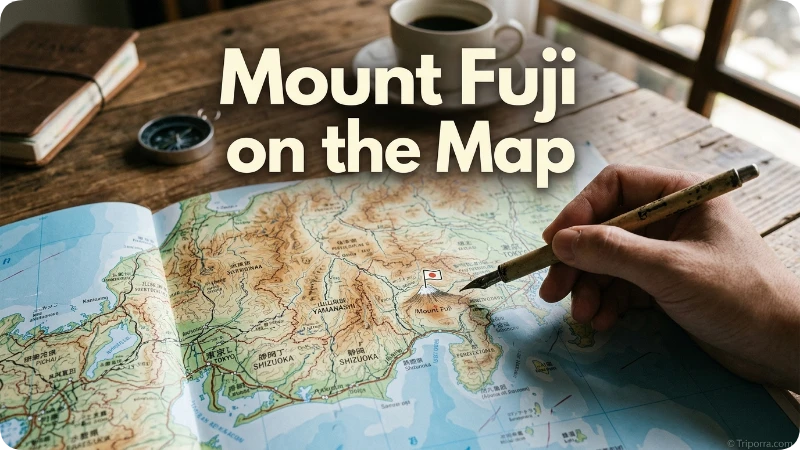
Mount Fuji is in the middle of Japan’s main island. It is southwest of Tokyo and northeast of the city of Shizuoka. The mountain is also not far from the Pacific coast.
It is surrounded by forests, lakes, volcanic land, and national parks. The famous Fuji Five Lakes are to the north, while Suruga Bay lies to the south.
What most guides miss is that you cannot always see Mount Fuji, even if you are nearby. Clouds often cover the summit, especially in summer. Winter usually offers much clearer views.
Why Is Mount Fuji Famous?
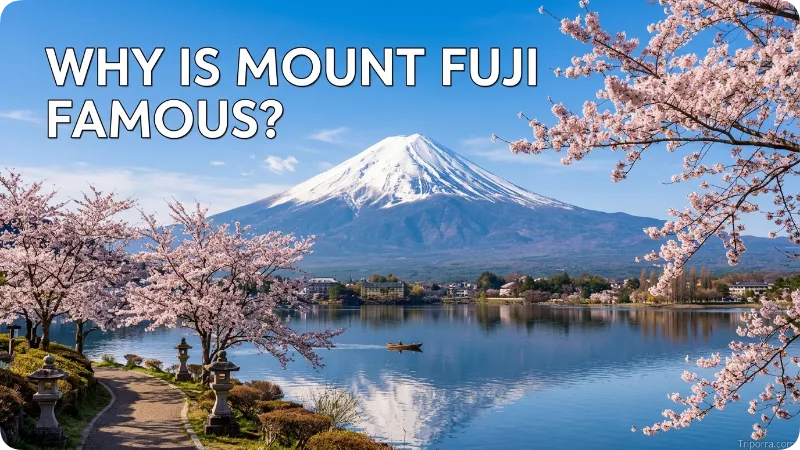
Mount Fuji is famous because it is the highest mountain in Japan. It rises to about 3,776 metres (12,389 feet) and has a beautiful cone shape that is recognised around the world.
The mountain is also important in Japanese culture and religion. For hundreds of years, people have climbed Mount Fuji as part of a spiritual journey. Today, many shrines around the mountain are still active places of worship.
In 2013, UNESCO added Mount Fuji to its World Heritage List because of its cultural value. The mountain has inspired famous paintings, poems, books, and photographs for many generations.
Every year, thousands of people climb Mount Fuji during the summer. Others visit to enjoy the lakes, forests, hot springs, and amazing views.
One fact many people get wrong is that Mount Fuji is not an extinct volcano. It is still an active volcano, although it has not erupted since 1707.
Travellers often overlook another interesting fact. Many of the famous photos of Mount Fuji are not taken from the mountain itself. Instead, they are taken from nearby places like Lake Kawaguchi or Chureito Pagoda, where the whole mountain can be seen.
History
Mount Fuji was formed by volcanic eruptions over hundreds of thousands of years. Layers of lava and ash slowly built the mountain into the shape we see today.
The last major eruption happened in 1707. This event is called the Hōei Eruption. It covered nearby areas with volcanic ash, and some ash even reached what is now Tokyo.
For many years, Mount Fuji has been a sacred place. Pilgrims climbed the mountain to pray and show their faith. Many shrines around the mountain were built to honour it.
Mount Fuji became even more famous after it appeared in the artwork Thirty-Six Views of Mount Fuji by the Japanese artist Katsushika Hokusai. These prints helped people around the world recognise the mountain.
How Old Is Mount Fuji?
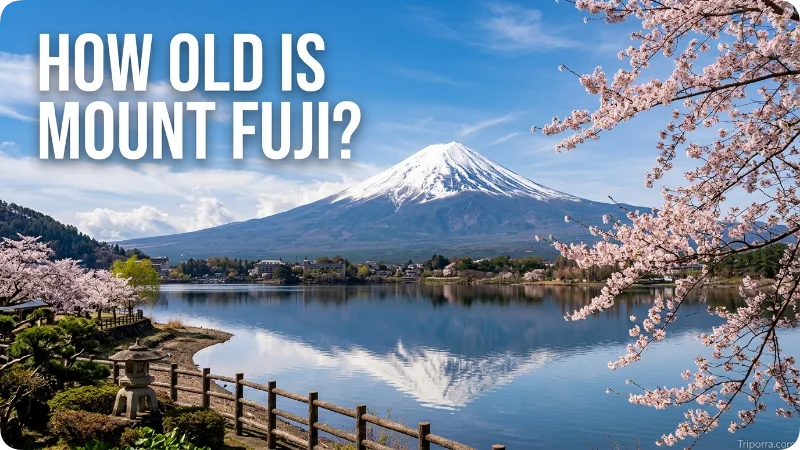
Mount Fuji is approximately 100,000 years old in its current form, although volcanic activity in the area began several hundred thousand years earlier. Scientists believe the mountain was formed through several stages of volcanic eruptions, creating the nearly symmetrical cone seen today.
The present-day volcano, often called “New Fuji,” developed after older volcanoes beneath it became inactive. Over thousands of years, repeated lava flows and ash deposits gradually built Japan’s tallest mountain.
Even though Mount Fuji looks peaceful today, it remains an active volcano that is carefully monitored by Japanese scientists.
What Type of Volcano Is Mount Fuji?
Mount Fuji is an active stratovolcano, also known as a composite volcano. This type of volcano is formed by many layers of hardened lava, volcanic ash, and rock built up over thousands of years.
Stratovolcanoes are known for their steep sides and cone-shaped appearance. Mount Fuji is one of the world’s best-known examples because of its nearly perfect shape.
Although it has not erupted since the Hōei Eruption in 1707, experts still classify Mount Fuji as an active volcano because future eruptions remain possible.
Climate & Weather
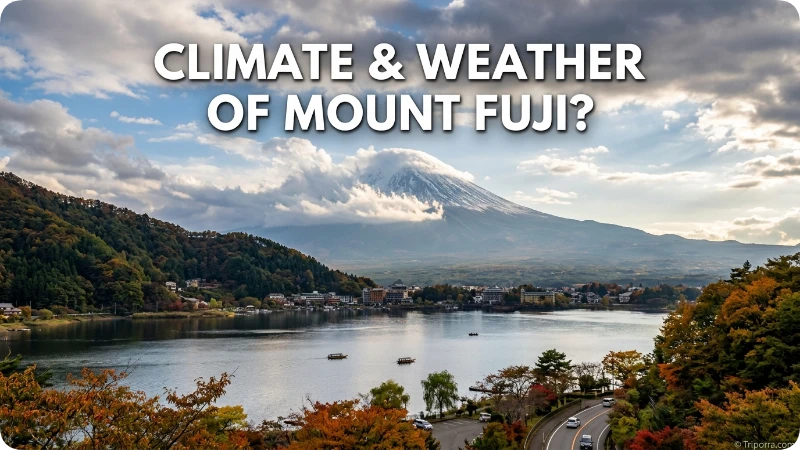
Mount Fuji has four seasons, and the weather changes a lot throughout the year.
Summer is warm at the base of the mountain, but the summit can still be very cold. Winter brings heavy snow to the upper slopes, giving Mount Fuji its famous white peak.
Spring is a great time to see cherry blossoms, while autumn brings colourful leaves to the forests around the mountain.
A seasonal trap catches many first-time visitors. July and August are the best months for climbing because the trails are open, but they are also the busiest months. If you want clear photos, late autumn and winter usually have the best weather.
Things to See & Do
Nature
- Visit the Fuji Five Lakes.
- Walk through Aokigahara Forest.
- See the beautiful Shiraito Falls.
- Explore the clear springs at Oshino Hakkai.
Best Viewpoints
- Chureito Pagoda
- Lake Kawaguchi
- Lake Yamanaka
Culture
- Visit Fujisan Hongū Sengen Taisha Shrine.
- Learn more at the Fujisan World Heritage Center.
Outdoor Activities
- Climb Mount Fuji during the official season.
- Ride a bike around Lake Kawaguchi.
- Enjoy hiking trails near the mountain.
- Relax in a traditional hot spring with views of Mount Fuji.
Best Time to Visit
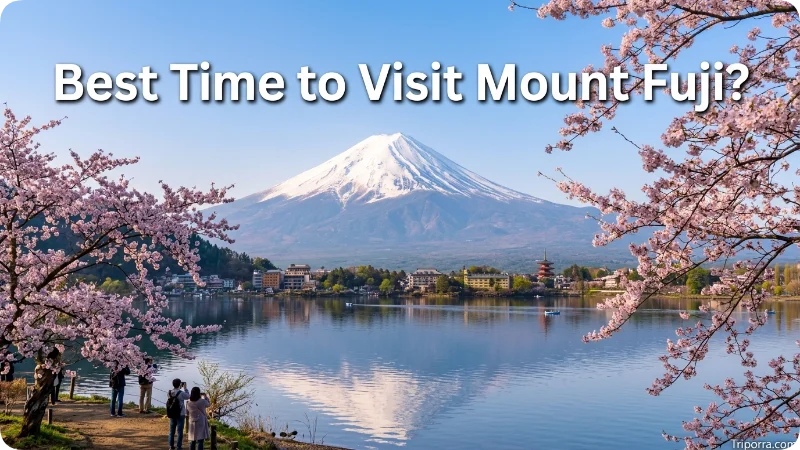
The best time to visit depends on what you want to do.
If you want to climb the mountain, visit between early July and early September. During this time, the trails and mountain huts are open. However, this is also the busiest season.
If your goal is photography, late autumn and winter are often better. The skies are clearer, and the mountain is usually covered with snow.
Spring is another popular time because cherry blossoms bloom while the mountain still has snow on its peak.
If you want fewer crowds, October and November are good choices. The weather is cooler, and many viewing spots are still easy to reach.
Common Misconceptions
Some people think Mount Fuji is completely inside one prefecture. In fact, it sits between Yamanashi and Shizuoka prefectures.
Another common mistake is believing that Mount Fuji is extinct. It is still an active volcano, even though it has not erupted since 1707.
Many people also think the mountain is covered in snow all year. The snow usually melts during the summer climbing season.
Another common misunderstanding is that Mount Fuji is located in Tokyo. While the mountain can be seen from many parts of Tokyo on clear days, it is actually about 100 kilometres (62 miles) southwest of the city and lies in Yamanashi and Shizuoka prefectures.
Great! Here’s the rest of the article in the same simple, human-friendly (Grade 6–8) style.
Interesting Facts About Mount Fuji
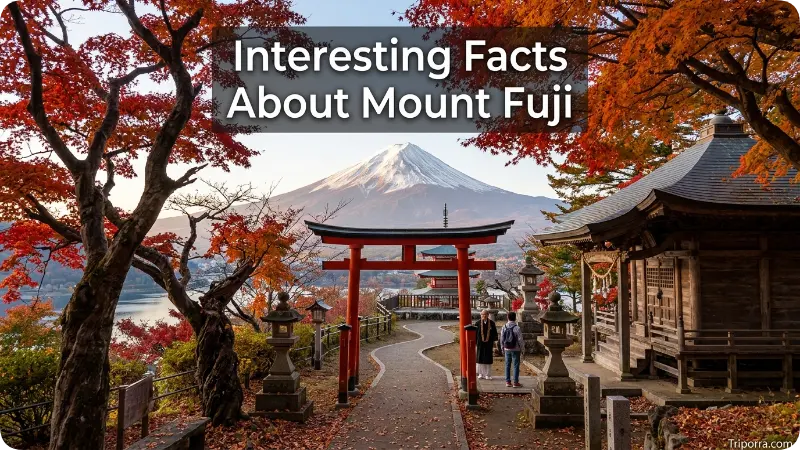
Mount Fuji has many interesting facts beyond its beautiful appearance.
- It is Japan’s highest mountain at approximately 3,776 metres (12,389 feet).
- It is one of Japan’s Three Holy Mountains.
- Mount Fuji became a UNESCO World Heritage Site in 2013 because of its cultural importance.
- More than 200,000 people climb the mountain during a normal climbing season.
- The mountain has inspired famous artists, poets, photographers, and writers for centuries.
- Mount Fuji’s nearly perfect cone shape was created by repeated volcanic eruptions over thousands of years.
- It is one of the most photographed natural landmarks in the world.
These facts help explain why Mount Fuji is one of Japan’s most recognised symbols.
Related Places
Fuji Five Lakes
The Fuji Five Lakes are on the northern side of Mount Fuji. They include Lake Kawaguchi, Lake Yamanaka, Lake Sai, Lake Shoji, and Lake Motosu. These lakes are popular for boating, camping, fishing, and taking photos of the mountain. Many visitors stay in this area because it has hotels, restaurants, and beautiful viewpoints.
Hakone
Hakone is about an hour from Mount Fuji and is one of Japan’s most popular holiday areas. It is known for its hot springs, museums, and scenic views. On clear days, you can see Mount Fuji from Lake Ashi or while riding the Hakone Ropeway.
Aokigahara Forest
Aokigahara Forest grows on old lava from past volcanic eruptions. It has walking trails, caves, and unique plants. Many people visit to explore nature and learn about the area’s volcanic history. Stay on the marked paths and follow local safety signs.
Mishima
Mishima is an important transport hub in Shizuoka Prefecture. Many visitors arrive here by Japan’s high-speed train before travelling to Mount Fuji. The city is also known for its clear spring water and peaceful parks.
Suruga Bay
Suruga Bay is south of Mount Fuji. On sunny days, you can enjoy amazing views of the mountain rising behind the coastline. The bay is also famous for fresh seafood and beautiful sunsets.
What Else Do People Want to Know?
Many visitors wonder if Mount Fuji is safe to visit. The answer is yes. The area is generally very safe, and Japan has good transport and visitor facilities. If you plan to climb, always check the weather and follow the safety rules because conditions can change quickly.
Another common question is about the cost. You can visit many viewpoints for free, while transport, accommodation, and activities will affect your total budget. Day trips from Tokyo are popular because they are easy to plan.
People also ask if they need a visa. This depends on your nationality. You should check Japan’s latest entry rules before travelling.
What most guides miss is that the weather can change several times in one day. Even if the morning is sunny, clouds may hide the summit later. If you want the best chance of seeing the mountain clearly, start your visit early.
Travellers often overlook the small villages around Mount Fuji. These quieter places offer local food, traditional inns, and peaceful views that are often less crowded than the main tourist spots.
FAQs
Where is Mount Fuji located?
Mount Fuji is in central Japan on the island of Honshu. It stands between Yamanashi and Shizuoka prefectures, about 100 kilometres (62 miles) southwest of Tokyo.
How high is Mount Fuji?
Mount Fuji is approximately 3,776 metres (12,389 feet) above sea level, making it the tallest mountain in Japan.
Is Mount Fuji an active volcano?
Yes. Mount Fuji is an active volcano, but it has not erupted since the Hōei Eruption in 1707.
Can anyone climb Mount Fuji?
Most healthy adults can climb Mount Fuji during the official climbing season. There are several routes with different difficulty levels, but good preparation is important.
How far is Mount Fuji from Tokyo?
The mountain is about 100 kilometres (62 miles) from central Tokyo. Most people can reach the area in two to three hours by train, bus, or car.
What is the best month to visit Mount Fuji?
If you want to climb, July and August are the best months. If you want clear views and fewer crowds, October, November, and winter are often better.
Can you see Mount Fuji from Tokyo?
Yes. On clear days, Mount Fuji can be seen from many places in Tokyo, especially during winter when the air is less humid.
Why is Mount Fuji important?
Mount Fuji is important because it is Japan’s highest mountain and a symbol of the country’s culture, history, and religion. It is also a UNESCO World Heritage Site.
Is Mount Fuji in Tokyo?
No. Mount Fuji is not in Tokyo. It is located about 100 kilometres (62 miles) southwest of Tokyo between Yamanashi and Shizuoka prefectures. On clear days, the mountain can be seen from many places in Tokyo.
What city is Mount Fuji in?
Mount Fuji is not inside a single city. It stretches across Yamanashi and Shizuoka prefectures. Nearby cities such as Fujiyoshida, Fujinomiya, Gotemba, and Fuji City serve as the main gateways for visitors.
What type of volcano is Mount Fuji?
Mount Fuji is an active stratovolcano, also called a composite volcano. It was formed by layers of lava, ash, and volcanic rock over thousands of years and last erupted in 1707.
How old is Mount Fuji?
Scientists estimate that the current Mount Fuji is about 100,000 years old. Earlier volcanic activity in the area began several hundred thousand years before the modern mountain formed.
Is Mount Fuji taller than Mount Everest?
No. Mount Fuji is approximately 3,776 metres (12,389 feet) tall, while Mount Everest stands at about 8,849 metres (29,032 feet). Everest is more than twice as high as Mount Fuji and is the tallest mountain above sea level on Earth.
Is there snow on Mount Fuji all year?
No. Snow covers the summit for much of the year, but much of it melts during the summer climbing season.
Do you need a guide to climb Mount Fuji?
A guide is not required for most people, but joining a guided climb can make the trip safer and more enjoyable, especially for first-time visitors.
Closing
Mount Fuji is much more than Japan’s tallest mountain. It is a place where nature, history, and culture come together. Whether you visit for the views, the hiking trails, the lakes, or the local traditions, there is something to enjoy in every season.
Now that you know where is Mount Fuji, planning your trip becomes much easier. Visit during the season that matches your interests, take time to explore the nearby towns and lakes, and enjoy one of Japan’s most famous natural landmarks.

Silas Vance is a geography enthusiast, travel researcher, and location-focused content writer dedicated to helping readers better understand the world around them on triporra.com. He specializes in creating informative guides about cities, countries, islands, landmarks, universities, and other notable destinations. His work combines geographic accuracy, historical context, and practical insights to answer location-based questions in a simple and engaging way.