Budapest is the capital and largest city of Hungary, in the central part of the country. It spreads across both banks of the Danube River, where the Buda Hills meet the flatter Pest plain. Its river setting, thermal waters, layered history, and national institutions make it Hungary’s main political and cultural centre.
Featured snippet
Where is Budapest? It is in Central Europe, in north-central Hungary, on both sides of the Danube River. Buda occupies the hillier western bank, while Pest covers the flatter eastern bank. The city is Hungary’s capital and is known for its Parliament, castle district, bridges, and thermal baths.
Quick Facts
FactDetailsOfficial nameBudapestCountryHungaryRegionCentral Hungary; a separate capital-level statistical regionPopulationApproximately 1.69 millionArea525 square kilometresCoordinatesApproximately 47.50° N, 19.04° ETime zoneCentral European Time; Central European Summer Time in warmer monthsNearest major cityBratislava, SlovakiaKnown forDanube views, Parliament, Buda Castle, thermal baths and historic bridgesLanguageHungarianCurrencyHungarian forint, or HUF
Hungary’s statistical office lists the capital as a 525-square-kilometre region with 23 districts. Recent official data puts its population at roughly 1.69 million. Hungary uses the forint rather than the euro.
Where Is Budapest?
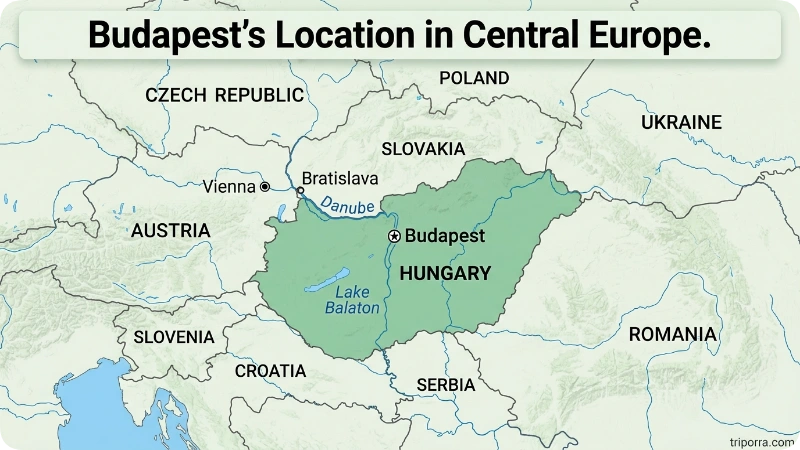
The city lies in north-central Hungary, within the Carpathian Basin. The Danube enters from the north, passes through the centre, and continues south. Buda rises into wooded hills on the western side, while Pest spreads across a broad, mostly flat plain on the east.
It is roughly 200 kilometres southeast of Bratislava and about 240 kilometres east-southeast of Vienna by road. Lake Balaton lies around 100 kilometres to the southwest. These distances make the Hungarian capital easy to combine with other Central European stops, but it deserves several days on its own.
Travellers often overlook how much the river shapes daily movement. A hotel that appears close on a map may involve a bridge crossing, a steep Buda climb, or a longer tram connection than expected.
Administrative Status
Budapest is both Hungary’s capital and a separate territorial unit rather than part of Pest County. It has 23 districts with local administrations, while city-wide matters are handled by the capital’s municipal government. Hungary belongs to the EU and the Schengen Area. EU citizens can normally travel with a valid passport or national identity card. Other visitors may need a Schengen visa; a short-stay visa generally covers up to 90 days in any 180-day period. Local time is CET in winter and CEST during daylight-saving months.
Budapest on the Map
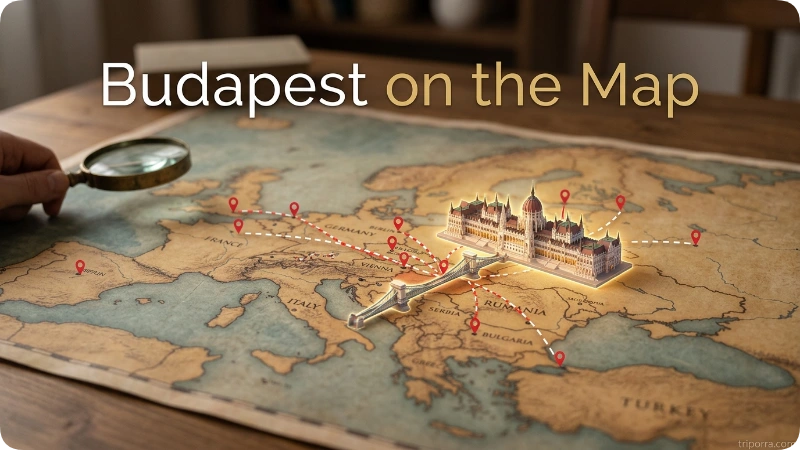
On a map of Europe, the city sits east of Vienna, southeast of Bratislava, south of Slovakia, and well north of Serbia. Within Hungary, it is near the north-central zone rather than directly in the geographic middle.
The Danube divides the landscape without acting as an administrative border. Buda is west of the river, Pest is east, and Óbuda forms part of the northern Buda side. Margaret Island sits between the two main banks. What most guides miss is that “Buda” is not shorthand for the whole capital; it is one historic side of a three-part city.
Why Is Budapest Famous?
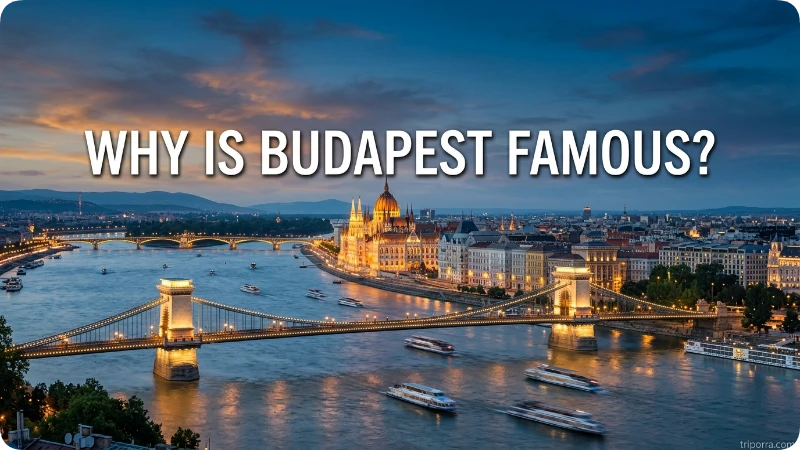
The strongest draw is its Danube cityscape. From Castle Hill, the view reaches across the river to Parliament, bridges, domes, and rows of nineteenth-century buildings. UNESCO protects the Banks of the Danube, the Buda Castle Quarter, and Andrássy Avenue as one World Heritage property because they show major stages of the city’s development.
Thermal bathing is another defining feature. Hot mineral water rises under the city, supporting bath complexes such as Széchenyi, Rudas, and Gellért. Residents use them for exercise, rest, social time, and wellness, so bathing is more than a visitor activity.
Architecture gives each district a different feel. Castle Hill has medieval street patterns and later Baroque buildings. Central Pest has civic buildings, courtyards, cafés, synagogues, and apartment blocks from the city’s rapid nineteenth-century growth. Andrássy Avenue links the inner city with Heroes’ Square and City Park, while the historic M1 metro runs below much of it.
Hungarian food, classical music, ruin pubs, markets, and river cruises add variety. Yet the appeal comes from the contrast between formal landmarks and ordinary street life. A tram ride along the Danube can explain the city’s shape better than a rushed attraction list.
A Brief History
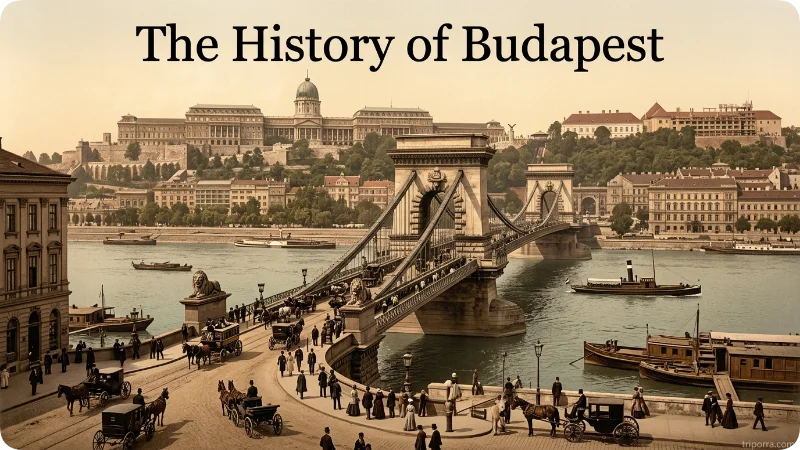
People have lived around this section of the Danube since prehistoric times. The Romans developed Aquincum north of the present centre, leaving roads, baths, military remains, and an amphitheatre. During the Middle Ages, Pest grew on the eastern plain, while Buda formed around a fortified royal centre on the western bank.
Pest was devastated during the Mongol invasion of 1241–42. Soon after, King Béla IV strengthened Buda Castle. Buda later became a royal seat and an important centre of Gothic and Renaissance culture. Ottoman forces captured it in 1541 and ruled for nearly 150 years; some Turkish-era bath traditions survive.
The Chain Bridge opened in 1849 as the first permanent bridge linking Buda and Pest. In 1873, Buda, Pest, and Óbuda united to form modern Budapest. The city then grew quickly as a major Austro-Hungarian centre. Parliament, Andrássy Avenue, the Opera House, and the Millennium Underground came from this era.
War, occupation, the Holocaust, the 1956 uprising, and communist rule left deep marks. Since 1989, restored buildings and new cultural spaces have added another layer without removing the older ones.
Climate and Weather of Budapest
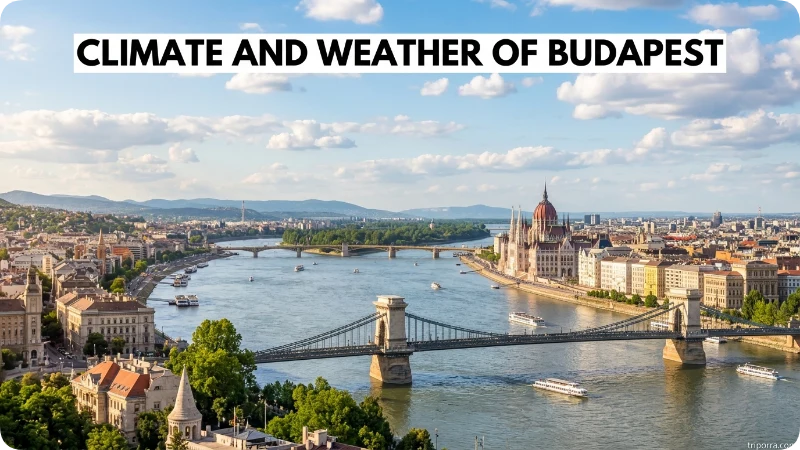
The city has four clear seasons with continental and milder western influences. Winters are cold and often grey, though long periods of snow are not guaranteed. Hungary’s January average is near 0°C, with typical minimums around -3°C. July and August average about 22°C, and daytime highs can reach around 29°C or more during heat spells.
Spring changes quickly from cool rain to warm afternoons. Early autumn is often mild; late autumn becomes darker and damp. A seasonal trap is booking an older apartment in July or August without checking for reliable air conditioning. Another is expecting long sightseeing days in December, when daylight is limited.
Things to See and Do
River and Historic Views
Hungarian Parliament Building: See it from Kossuth Square, then cross to Buda for the full-building view. Parliament stands on the Pest side, a fact many visitors remember wrongly.
Buda Castle Quarter: Walk around the Royal Palace, castle walls, and old streets. Early morning or late afternoon is usually calmer.
Fisherman’s Bastion and Matthias Church: The terraces frame wide views over the Danube and Pest, while the church adds patterned roof tiles and royal history.
Shoes on the Danube Bank: This memorial honours Jewish victims killed during World War II. Treat it as a place for quiet reflection.
Baths, Parks, and Local Landscapes
Széchenyi Thermal Bath: A large historic complex in City Park with outdoor pools used even in cold weather.
Margaret Island: A green Danube island for walking, cycling, gardens, and a break from traffic.
Gellért Hill: The slopes offer broad views, but routes are steep and access may change during restoration work.
Culture, Food, and Evening Life
Great Market Hall: Browse produce, paprika, sausages, pastries, and souvenirs, but compare prices at tourist-facing stalls.
Dohány Street Synagogue and Jewish Quarter: The synagogue, memorial spaces, courtyards, restaurants, and nightlife represent very different chapters of local history.
Hungarian State Opera and Andrássy Avenue: The avenue shows the scale and ambition of nineteenth-century Pest, even without an opera ticket.
Best Time to Visit
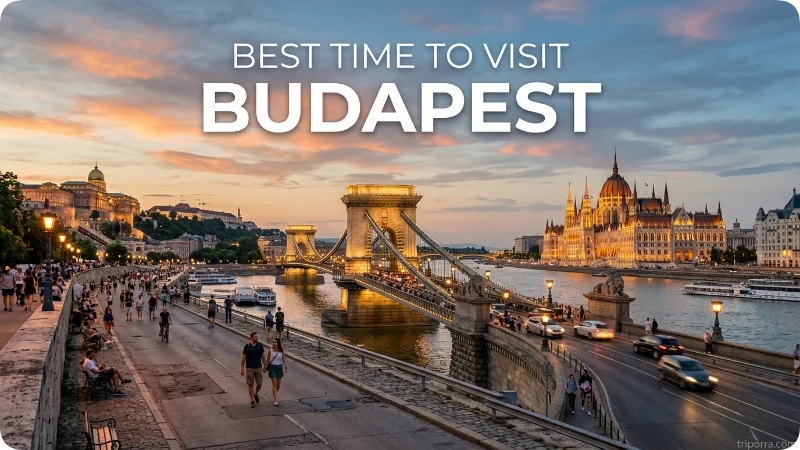
May, June, September, and early October usually offer mild weather, long walking days, and manageable crowds. May can be rainy, while June may already feel hot. September often brings warm afternoons and cooler evenings.
July and August offer festivals and late sunsets, but heat, higher room rates, and crowded attractions are drawbacks. Large events can tighten accommodation supply. Winter has lower demand outside Christmas and New Year, plus warm thermal pools. The trade-off is short daylight, cold wind near the river, and fewer outdoor options.
Travellers often overlook late October and early November. Weather is less predictable, yet museums, cafés, baths, and concerts keep the city interesting.
Common Misconceptions
Budapest was not formed from only Buda and Pest. Óbuda, meaning “Old Buda,” was the third city in the 1873 union. Another common error is placing Parliament in Buda; it is on the Pest bank.
The two sides also differ in shape. Buda is hillier and greener, while central Pest is flatter and easier to cover by tram, metro, or foot. The name is pronounced roughly “BOO-dah-pesht,” with the final sound closer to “pesht” than the English word “pest.”
Related Places
Szentendre: A small Danube town north of the capital, known for narrow streets, galleries, and churches.
Visegrád: A Danube Bend town associated with a hilltop citadel and wide river views.
Esztergom: A historic city near Slovakia with a major basilica above the Danube.
Lake Balaton: Hungary’s largest lake lies southwest of the capital and suits an overnight or longer stay.
Vienna and Bratislava: Both capitals are reachable overland, but each deserves more than a rushed checklist visit.
What Else Do People Want to Know?
Budapest is generally manageable for visitors, but petty theft can occur on crowded transport, at stations, markets, and major sights. Check menu prices in nightlife areas, use established taxi services, and keep control of bank cards and drinks.
The city can suit both mid-range and budget trips, but the central districts are not uniformly cheap. Public transport, bakeries, markets, and lunch menus can control a budget; river-view dining and short-notice rooms can raise it quickly.
The 100E Airport Express links the airport with the city centre and operates around the clock. Accessibility varies because steep Buda streets, old buildings, and historic stations may involve steps.
A simple jó napot for hello and köszönöm for thank you is appreciated. Pay in forints unless the foreign-currency conversion shown by a payment terminal is clearly favourable.
FAQs
Is Budapest Cheap?
Yes, Budapest is one of Europe’s more affordable capitals, with reasonably priced food, public transport, and attractions compared to many Western European cities.
Where Is Budapest Located in the World?
Budapest is located in central Europe on the Danube River. It is the capital and largest city of Hungary.
Which Country Is Budapest In?
Budapest is in Hungary, where it serves as the country’s political, cultural, and economic center.
Where Is Budapest in Europe?
Budapest is in Central Europe, between Vienna (Austria) and Belgrade (Serbia), along the Danube River.
What Is the Currency of Budapest, Hungary?
The official currency of Budapest is the Hungarian Forint (HUF), although some tourist businesses may also accept euros.
Is Budapest in Germany?
No, Budapest is not in Germany. It is the capital city of Hungary, a neighboring country in Central Europe.
Where Is Budapest Stadium?
Budapest’s main stadium, Puskás Aréna, is located in the eastern part of Budapest and hosts football matches, concerts, and major events.
What Is Budapest Near?
Budapest is near Austria, Slovakia, Serbia, Croatia, Romania, Slovenia, and Ukraine, making it a popular stop for travelers exploring Central Europe.
Is the airport close to downtown?
The airport is southeast of the centre. The direct airport bus is usually the simplest public-transport option.
Are thermal baths open in winter?
Major bath complexes normally operate throughout the year. Check the chosen bath’s current schedule before visiting.
Closing
Budapest matters because the Danube, hills, historic districts, and modern capital functions meet in one place. Its layout becomes easier once you understand Buda, Pest, and Óbuda. Plan at least three days, choose accommodation with transport and terrain in mind, and leave room for one slow experience: a thermal bath, an evening tram ride, or a walk beside the river.

Elena Rostova bridges the gap between premium hospitality and authentic local experiences. Armed with a background in luxury hospitality management and a passion for fine architecture, she spent years evaluating elite resorts before transitioning into travel journalism. Elena heads the luxury and boutique travel vertical on Triporra.com. Her meticulous guides strip away the guesswork from high-end travel, showcasing unique five-star escapes, fine regional dining, and bespoke private tours that elevate a standard vacation into an unforgettable journey.