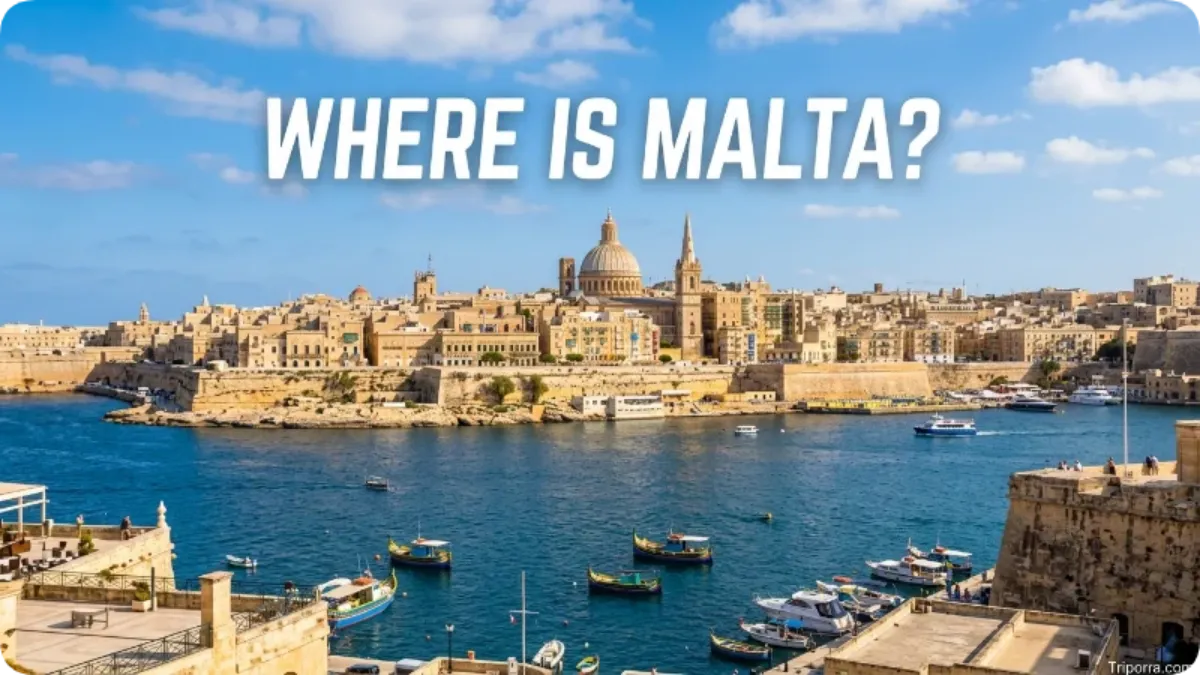
Where is Malta? Malta is a small island country in the central Mediterranean Sea, south of Sicily, east of Tunisia, and north of Libya. It matters because this tiny European nation sits between Europe and North Africa, making it a historic sea crossroads, a popular travel destination, and one of the European Union’s smallest member states. Malta is not a city or a single island only. It is officially the Republic of Malta, an independent country made up of an archipelago, with the main islands of Malta, Gozo, and Comino. Valletta is the capital, and Maltese and English are official languages.
Featured Snippet Answer
Malta is an island country in Southern Europe, located in the central Mediterranean Sea south of Sicily, Italy, and north of Libya. Officially the Republic of Malta, it is an EU member state with Valletta as its capital. Malta is known for historic cities, ancient temples, clear water, diving, and a strategic sea location.
____________________________________________________________________________
Where Is Malta Located?

Malta is located in Southern Europe, in the Mediterranean Sea. On a map, it appears below the Italian island of Sicily and above the North African coast. Because it is surrounded by water, Malta has no land borders with any country. Its nearest major landmass is Sicily to the north.
The country is part of Europe politically and culturally, even though it lies close to North Africa. Malta joined the European Union on 1 May 2004, uses the euro, and is part of the Schengen Area. These facts make it easier for many European travelers to understand Malta’s travel and administrative position.
Geographically, Malta’s coordinates are often given around 35°50′ N, 14°35′ E. Its total land area is about 316 square kilometers, making it one of the smallest countries in Europe by area.
Quick Facts About Malta
Quick Answer: Where Is Malta?
Malta is an independent island country in the central Mediterranean Sea in Southern Europe. It lies about 93 km (58 miles) south of Sicily (Italy) and north of Libya. The country consists of three main inhabited islands—Malta, Gozo, and Comino—and its capital city is Valletta.
| Fact | Details |
|---|---|
| Official Name | Republic of Malta |
| Country Type | Independent island country |
| Continent/Region | Southern Europe, Mediterranean Sea |
| Capital | Valletta |
| Area | About 316 km² (122 sq mi) |
| Population | About 574,250 (2025 estimate) |
| Time Zone | CET / CEST |
| Coordinates | Approximately 35°50′N, 14°35′E |
| Nearby Places | Sicily (Italy), Tunisia, Libya |
| Official Languages | Maltese and English |
| Currency | Euro (€) |
| EU Status | EU member since 2004; Eurozone member since 2008 |
| Known For | Valletta, Gozo, Comino, Blue Lagoon, diving, ancient temples, and historic limestone cities |
In short: Malta is a small European island nation located between Sicily and North Africa in the Mediterranean Sea, known for its rich history, stunning coastline, and strategic location connecting Europe, Africa, and the Middle East.
____________________________________________________________________________
Malta on the Map
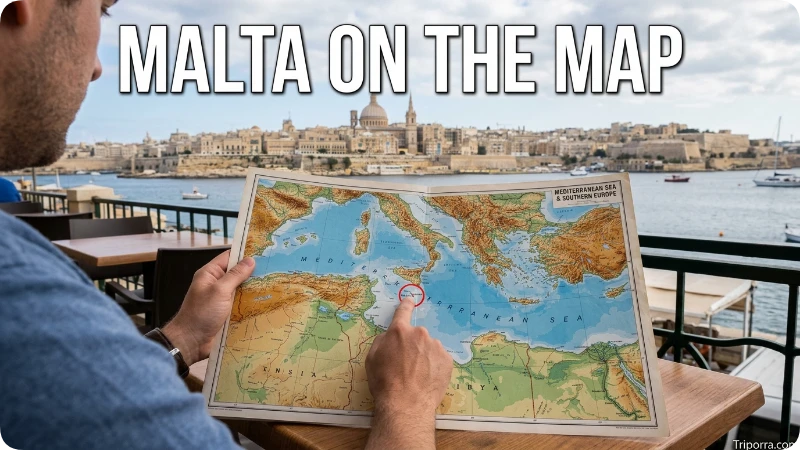
Picture the Mediterranean Sea as a wide blue space between southern Europe and North Africa. Italy forms a long boot shape in the north. Just below Sicily, and far above Libya, you will find Malta as a compact group of islands.
The main island of Malta sits to the south of Sicily. Gozo lies northwest of the main island, while Comino sits between Malta and Gozo. Valletta, the capital, is on the eastern side of the main island, facing one of the best-known natural harbors in the Mediterranean.
Malta does not share land borders because it is an island nation. Its boundaries are maritime, meaning the sea defines its edges. The country’s coastline, cliffs, bays, rocky shores, and harbors have shaped its history, defense, trade, and tourism. The terrain is mostly low, rocky, and made up of flat to broken plains with many coastal cliffs.
____________________________________________________________________________
Which Region Does Malta Belong To?
Malta belongs to Southern Europe and is commonly grouped with Mediterranean European countries. Politically, it is an independent republic and a member of the European Union. The European Union describes Malta as a single-chamber parliamentary republic, where the president’s role is largely ceremonial and the prime minister is the head of government.
Inside the country, Malta is organized through local and regional government. There are 68 local councils and 6 regional councils across Malta and Gozo, according to Malta’s Local Councils’ Association.
The six official regions are Gozo, Southern, Port, Western, Eastern, and Northern. Malta’s local government site lists these regional public bodies, while the European Committee of the Regions explains that the regional council system was increased to six regions following changes to the Local Government Act.
This matters because Malta is small, but it is still a fully organized country with national government, regional councils, local councils, and internationally recognized state status.
____________________________________________________________________________
How Does Malta Compare to Nearby Places?
Malta is much smaller than Sicily, Tunisia, or mainland Italy, but it is easier to travel around once you arrive. A visitor can often cross much of the main island by car in under an hour, depending on traffic. That makes it feel more compact than many Mediterranean destinations.
Compared with Sicily, Malta is smaller, denser, and more focused on short stays, beaches, diving, and historic city breaks. Sicily has large cities, mountains, long driving distances, and a wider rural interior. Malta feels more like a tightly packed island country where old towns, harbors, beaches, and archaeological sites sit close together.
Gozo, Malta’s sister island, is quieter and more rural than the main island. Travelers often visit Gozo for coastal walks, small villages, cliffs, churches, and a slower pace. Comino is much smaller and best known for the Blue Lagoon and boat trips rather than city life.
Against nearby North African destinations, Malta has a strong European administrative framework, English is widely used, and the euro is the currency. Its position between Europe and Africa gives it a mixed cultural flavor, but legally and politically it is part of the European Union.
____________________________________________________________________________
How to Reach Malta
Most international visitors arrive by air through Malta International Airport, located in Luqa. The airport is the country’s main air gateway, and Malta Public Transport operates Airport Direct routes connecting the airport with popular areas such as St. Julian’s, Sliema, Gżira, Msida, Rabat, Buġibba, Mellieħa, Ċirkewwa, Valletta, and the Gozo Fast Ferry connection.
Public buses are widely used on Malta and Gozo. Malta Public Transport also highlights ferry options, including Valletta Ferry services to Sliema and the Three Cities, plus Gozo High Speed services between Malta and Gozo. For island-to-island travel, ferries are important. The government’s public transport page lists Valletta ferry routes between Sliema and Valletta and between Cospicua and Valletta. These are useful for visitors staying near the harbor area because ferries can be faster and more scenic than road travel during busy hours. There is no national rail system in Malta. Travel is mainly by bus, ferry, taxi, rental car, private transfer, walking, and boat tours. Roads can be busy, especially around Valletta, Sliema, St. Julian’s, and airport routes, so travelers should allow extra time.
____________________________________________________________________________
Why Is Malta Famous?
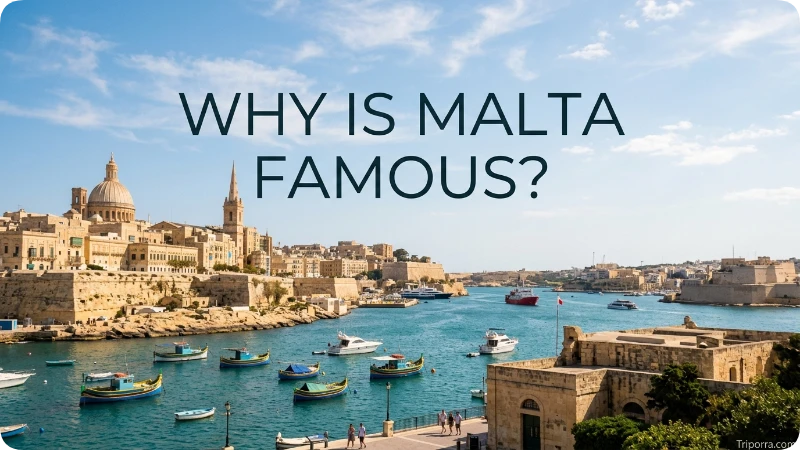
Malta is famous for its historic cities, ancient temples, clear Mediterranean water, diving sites, Catholic traditions, film locations, and compact island travel. The official tourism site promotes Malta, Gozo, and Comino for history, culture, gastronomy, diving, churches, family activities, and short breaks.
Valletta is a major reason Malta is well known. The capital is small but full of stone streets, harbor views, churches, museums, balconies, fortifications, and historic buildings. Its setting beside the Grand Harbour gives visitors a strong sense of Malta’s maritime past.
Ancient history is another major attraction. The Ħal Saflieni Hypogeum is an underground prehistoric burial complex in Paola that was in use between about 4000 BC and 1500 BC, according to Heritage Malta. UNESCO describes the Hypogeum as a major subterranean structure excavated around 2500 BC and later used as a necropolis.
Malta is also known for diving. VisitMalta notes that the country has more than 120 dive sites and good visibility, which makes it popular with divers who enjoy reefs, caves, wrecks, and underwater landscapes.
Economically, Malta is known for services, tourism, finance, IT, professional services, and recreation. The European Commission states that Malta’s strong economic performance is rooted in services sectors such as recreational, professional, IT, and financial services, while tourism performed strongly in 2025 and was expected to keep momentum in 2026.
____________________________________________________________________________
History of Malta
Malta’s history is much larger than its size. The islands have been shaped by prehistoric communities, Phoenicians, Romans, Arabs, Normans, the Knights of St. John, French forces, British rule, World War II, independence, and modern European integration.
The prehistoric period left some of Malta’s most important sites. The Hypogeum and the megalithic temple culture show that people built complex stone structures on the islands thousands of years ago. Heritage Malta says the Hypogeum was used over a long prehistoric period and covers around 500 square meters.
Later, Malta’s position in the Mediterranean made it useful for trade, defense, and naval power. The Knights of St. John shaped Valletta and many of the island’s fortifications. British rule added another layer to the country’s language, law, education, and military history.
Modern Malta became independent from Britain in 1964, later became a republic, and joined the European Union in 2004. Its modern identity blends Maltese language and traditions with English use, European institutions, Catholic heritage, Mediterranean food, and global tourism.
____________________________________________________________________________
Climate and Weather
Malta has a Mediterranean climate, with mild, rainy winters and hot, dry summers. This climate helps explain why the country is popular for beaches, boat trips, outdoor dining, diving, and winter sun breaks.
Summer can feel hot, sunny, and dry, especially from June to September. July and August are usually the hottest and busiest months for tourists. Beaches, ferries, boat trips, and coastal towns become lively, but sightseeing can feel tiring in the middle of the day.
Winter is mild compared with much of northern Europe. Rain is more likely in the cooler months, and the sea may be too cool for casual swimming, but the weather can still be pleasant for walking, museums, churches, cafes, and historical sites.
Spring and autumn are often the most comfortable seasons for exploring. The weather is usually warm enough for outdoor plans but not as intense as peak summer.
____________________________________________________________________________
Things to See and Do Nearby
Valletta should be high on most travel plans. The city is compact, walkable, and full of views over the Grand Harbour and Marsamxett Harbour. Visitors often explore St. John’s Co-Cathedral, Upper Barrakka Gardens, museums, forts, cafes, and narrow streets lined with traditional balconies.
Mdina, often called the Silent City, offers a different atmosphere. It is an old walled town with quiet lanes, stone palaces, and views across the island. Rabat, next to Mdina, has catacombs, churches, and a more local feel.
The Three Cities—Birgu, Senglea, and Cospicua—sit across the Grand Harbour from Valletta. They are excellent for harbor walks, maritime history, and traditional streets. Ferries from Valletta can make this area easy to reach.
Gozo is ideal for a day trip or a slower stay. Visitors go for Victoria, the Citadel, coastal cliffs, beaches, churches, villages, and rural views. Comino is best known for boat trips and the Blue Lagoon, though it can get crowded in high season.
For nature and sea views, consider Dingli Cliffs, Blue Grotto, Golden Bay, Għajn Tuffieħa Bay, Marsaxlokk fishing village, and coastal walking routes. Diving, snorkeling, kayaking, boat tours, and harbor cruises are also popular. VisitMalta’s tourism content highlights swimming spots, diving, family activities, gastronomy, nightlife, and cultural attractions across the islands.
____________________________________________________________________________
Best Time to Visit
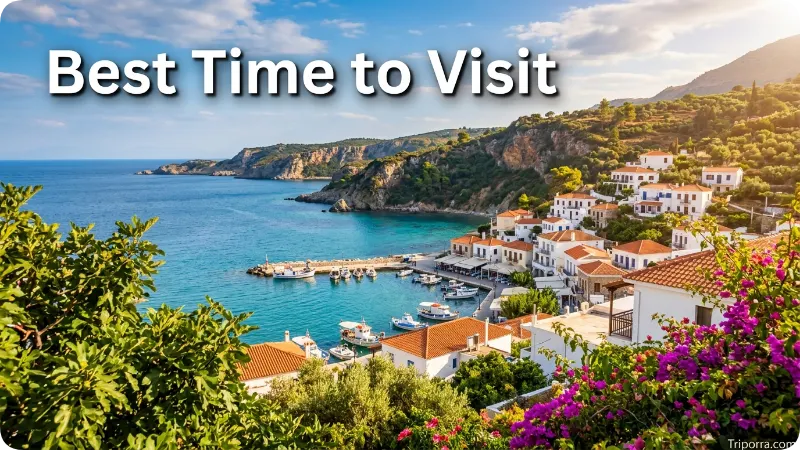
The best time to visit Malta depends on what you want to do.
For beach holidays, June to September offers warm seas and strong summer energy. July and August are the peak months, so expect higher prices, more crowds, and hotter days.
____________________________________________________________________________
Common Misconceptions
A common mistake is thinking Malta is part of Italy. It is not. Malta is an independent country, although it is close to Sicily and has many historical links with Italy and the wider Mediterranean.
Another misunderstanding is that Malta is only one island. The country includes the main island of Malta, Gozo, Comino, and smaller uninhabited islets.
Some people assume Malta is in North Africa because it lies close to Libya and Tunisia. Geographically, it is in the Mediterranean between Europe and North Africa, but politically it is a European country and an EU member state.
English-speaking travelers sometimes think language will be difficult. Maltese is the national language, but English is also an official language under Malta’s constitutional language rules, which makes travel easier for many visitors.
____________________________________________________________________________
Did You Mean a Different Place?
Most searches for Malta refer to the Republic of Malta in the Mediterranean Sea. However, several other places share the name, including:
- Malta, New York, United States
- Malta, Montana, United States
- Malta, Illinois, United States
- Malta, Ohio, United States
- Malta, Idaho, United States
- Malta, Austria
- Malta, a municipality in Paraíba, Brazil
These places are not the same as the country of Malta. If someone says they are traveling to Malta for beaches, Valletta, Gozo, or the Blue Lagoon, they almost always mean the Mediterranean country.
____________________________________________________________________________
Places Related to Malta
Several nearby or connected places often appear in travel searches:
Valletta is the capital and a UNESCO-listed historic city. It is the best base for museums, harbor views, churches, and ferry connections.
Gozo is Malta’s quieter sister island. It is popular for day trips, rural stays, walking, churches, cliffs, and local food.
Comino is the small island between Malta and Gozo. It is famous for the Blue Lagoon and boat excursions.
Sliema and St. Julian’s are busy coastal areas known for hotels, restaurants, shopping, nightlife, and sea views.
Mdina and Rabat are inland historic areas with old streets, churches, catacombs, and quiet corners.
Marsaxlokk is a fishing village known for colorful boats, seafood restaurants, and a popular market.
Sicily is Malta’s closest major neighbor to the north. Many travelers combine Malta and Sicily in one Mediterranean trip.
____________________________________________________________________________
What Else Do People Want to Know?
Malta is practical for first-time visitors because the country is small, English is official, the euro is used, and international access is simple through Malta International Airport. Safety is another common concern. The U.S. Department of State places Malta at Level 1, advising travelers to exercise normal precautions. Still, normal city and tourist-area care is wise, especially around crowded buses, nightlife zones, beaches, and markets.
Costs vary by season. Summer usually costs more because of high demand for flights, hotels, sea-view stays, and boat trips. Winter and shoulder months can be better for budget travelers.
Local culture is polite, family-oriented, and shaped by Catholic festivals, village feasts, fireworks, Mediterranean food, and bilingual daily life. Visitors should dress respectfully in churches, be patient with traffic, and avoid treating small residential streets like theme-park spaces.
Accessibility depends on the area. Newer hotels, airport facilities, and main transport services may be easier to use, while older streets in Valletta, Mdina, and village centers can have steps, slopes, and uneven stone paving.
____________________________________________________________________________
FAQs
What is the currency of Malta?
Malta uses the euro (€) as its official currency, having adopted it in 2008.
Where is Malta located in Europe?
Malta is a small island country in Southern Europe, located in the Mediterranean Sea between Sicily (Italy) and North Africa.
Where is Malta located on the map?
Malta appears in the central Mediterranean Sea, about 93 km (58 miles) south of Sicily and 288 km (179 miles) north of Libya.
Where is Malta located and what language is spoken there?
Malta is in Southern Europe in the Mediterranean Sea, and its official languages are Maltese and English.
What is Malta famous for?
Malta is famous for its historic cities, ancient temples, crystal-clear beaches, and filming locations such as Game of Thrones.
Is Malta in Spain?
No, Malta is not part of Spain. It is an independent island nation in the Mediterranean Sea, south of Italy.
Is Malta safe?
Yes, Malta is generally considered a safe country with low crime rates, making it a popular destination for tourists and students.
What language is spoken in Malta?
The official languages of Malta are Maltese and English, and both are widely used in daily life, education, and business.
Does Malta have beaches?
Yes. Malta has sandy beaches, rocky swimming spots, bays, and clear-water areas. Popular places include Golden Bay, Għajn Tuffieħa, Mellieħa Bay, St. Peter’s Pool, and the Blue Lagoon.
Is Malta safe for tourists?
Malta is generally considered safe for normal travel. The U.S. Department of State advises travelers to exercise normal precautions, while Canada advises normal security precautions and notes that petty crime can occur in crowded tourist areas.
____________________________________________________________________________
Conclusion: Why Malta’s Location Matters
Malta is a small but important island country in the central Mediterranean Sea. Its position south of Sicily and north of Libya explains much of its history, culture, economy, and travel appeal. It is European, Mediterranean, multilingual, and easy to explore in a short trip.
For travelers, Malta offers a rare mix: ancient temples, fortified cities, harbor views, clear water, island-hopping, English-language convenience, and strong links to both Europe and the wider Mediterranean. Once you understand where Malta sits on the map, its story becomes much easier to see.

Silas Vance is a geography enthusiast, travel researcher, and location-focused content writer dedicated to helping readers better understand the world around them on triporra.com. He specializes in creating informative guides about cities, countries, islands, landmarks, universities, and other notable destinations. His work combines geographic accuracy, historical context, and practical insights to answer location-based questions in a simple and engaging way.