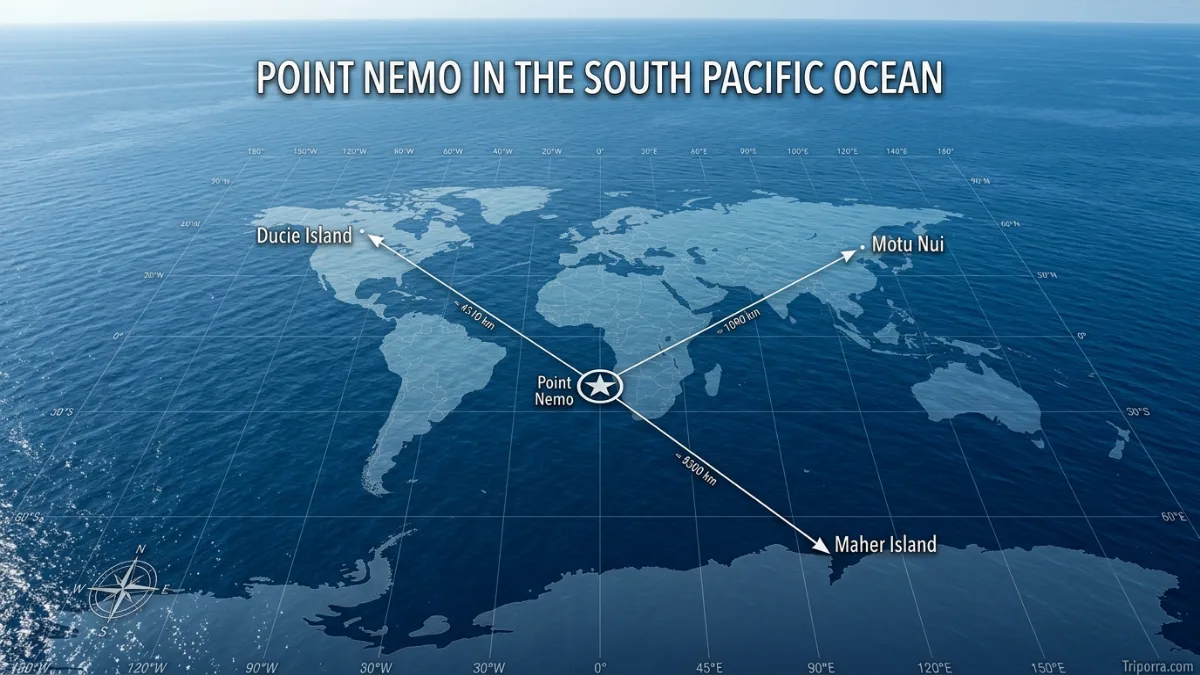
Point Nemo is the most remote place on Earth’s oceans. It is located in the South Pacific Ocean at approximately 48°52.6′S, 123°23.6′W, about 2,688 kilometers (1,670 miles) from the nearest land in every direction. Known as the Oceanic Pole of Inaccessibility, this isolated point is farther from any coastline than any other location on the planet.
Unlike a city, island, or tourist destination, Point Nemo is only a geographic coordinate in open water. It has no residents, no government, and no facilities. Its extreme isolation has made it famous as the spacecraft cemetery, where space agencies guide retired spacecraft and satellites into the ocean after their missions end.
Although almost nobody visits Point Nemo, this remote part of the Pacific helps scientists study Earth’s oceans and represents one of the last truly untouched regions of our planet.
Featured Snippet
Point Nemo is located in the South Pacific Ocean at approximately 48°52.6′S, 123°23.6′W. It is the Oceanic Pole of Inaccessibility, meaning it is the point in the world’s oceans farthest from any land. The nearest land lies about 2,688 kilometers (1,670 miles) away in three different directions, making Point Nemo the most remote place on Earth.
Quick Facts About Point Nemo
| Fact | Information |
|---|---|
| Official Name | Point Nemo (Oceanic Pole of Inaccessibility) |
| Country | None (Located in international waters) |
| Region | South Pacific Ocean |
| Population | None (No permanent human settlement) |
| Area | Not applicable |
| Elevation | Sea level |
| Coordinates | Approximately 48°52.6′S, 123°23.6′W |
| Time Zone | No official time zone |
| Nearest Major City | None (The closest inhabited locations are thousands of kilometers away) |
| Known For | The most remote point on Earth from any landmass; also known as the spacecraft cemetery area |
| Language | None |
| Currency | None |
Where Is Point Nemo?
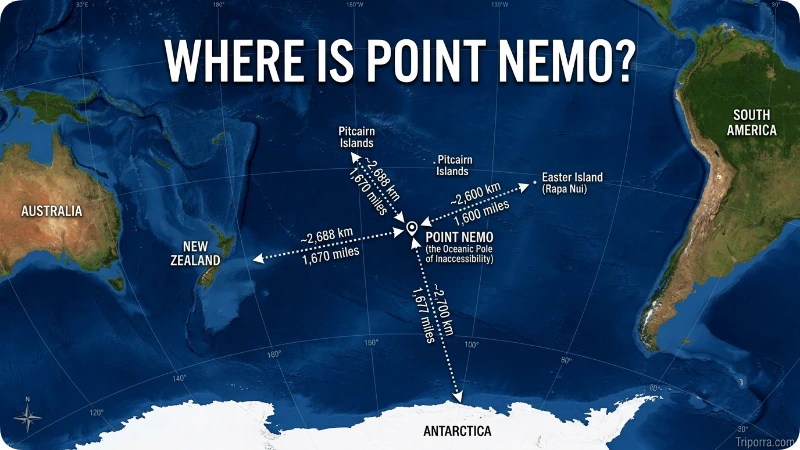
Point Nemo is located in the South Pacific Ocean, thousands of kilometers from the nearest inhabited land. Unlike islands or coastal regions, it exists only as a geographic coordinate in open water. The point is approximately halfway between New Zealand and South America, although it remains much closer to neither because of the immense size of the Pacific Ocean.
The three nearest pieces of land are all tiny, isolated islands. To the north lies Ducie Island, part of the Pitcairn Islands. To the northeast is Motu Nui near Easter Island, while Maher Island off Antarctica lies to the south. Each is roughly the same distance away—about 2,688 kilometers (1,670 miles).
Because Point Nemo is in international waters, no country owns it. Ships rarely pass nearby, and aircraft seldom fly overhead because there are few practical routes across this part of the Pacific.
Travellers often overlook how enormous the Pacific Ocean truly is until they see Point Nemo on a map. It represents one of the few places where human activity is almost nonexistent.
Administrative Status
Point Nemo has no political administration because it lies in international waters beyond the territorial seas and exclusive economic zones of every nation. International maritime law, particularly the United Nations Convention on the Law of the Sea (UNCLOS), governs activities in this area rather than any single country’s laws.
There are no visas, border controls, ports, or customs offices because Point Nemo is not part of any nation. It has no official local time zone, so research vessels and ships typically use Coordinated Universal Time (UTC) or their own onboard time.
Its remote location also means there are no permanent facilities, emergency services, or infrastructure nearby.
Point Nemo on the Map
Point Nemo lies in the central South Pacific Ocean, southwest of South America and southeast of New Zealand. It is far from every continent and sits in one of the least-traveled parts of the world’s oceans.
Looking west, the nearest significant landmass is New Zealand, while South America lies far to the east. Antarctica is located well to the south, and the tropical islands of Polynesia are far to the north.
One commonly misunderstood fact is that Point Nemo is not marked by an island, buoy, or platform. It is simply a set of geographic coordinates floating in open ocean. What most guides miss is that if you visited the location, every direction around you would look exactly the same—an uninterrupted horizon of water.
Point Nemo is approximately 2,688 kilometers (1,670 miles) away from the nearest land in every direction. This extreme distance makes it the most isolated point in Earth’s oceans.
The three closest pieces of land are:
| Location | Direction | Distance |
|---|---|---|
| Ducie Island (Pitcairn Islands) | North | About 2,688 km |
| Motu Nui near Easter Island | Northeast | About 2,688 km |
| Maher Island (Antarctica) | South | About 2,688 km |
Unlike many remote places that are separated from civilization by mountains or deserts, Point Nemo is surrounded only by open ocean. A ship traveling there must cross thousands of kilometers without nearby ports, islands, or rescue facilities.
Why Is Point Nemo Famous?
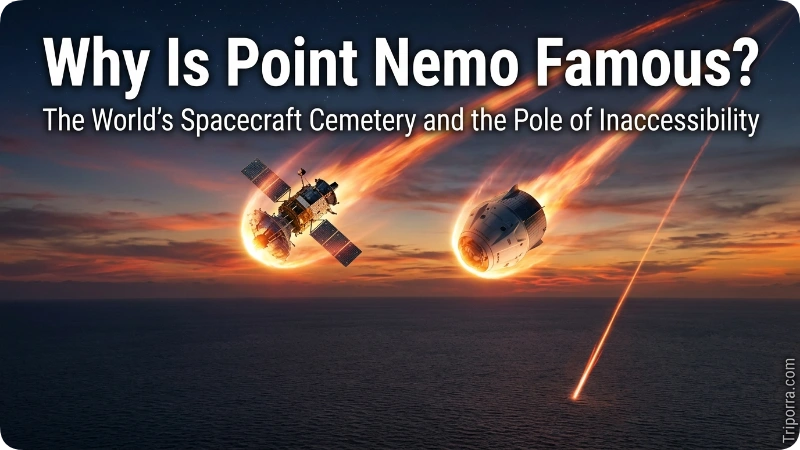
Point Nemo is famous because it is the most remote point in Earth’s oceans. No other location is farther from land. This extraordinary isolation has made it important for science, navigation, and even space exploration.
One reason it attracts worldwide attention is its nickname, the spacecraft cemetery. Space agencies deliberately guide old satellites, cargo spacecraft, and parts of space stations into the waters surrounding Point Nemo after their missions end. Since the area is so remote, the risk of debris harming people or property is extremely low.
More than 260 spacecraft have been directed toward this region over the years. Parts of Russian Progress spacecraft, European cargo vehicles, and other retired orbital equipment have ended their journeys in nearby waters. Even sections of space stations have been intentionally deorbited into this remote part of the Pacific.
Another reason Point Nemo fascinates researchers is its unique marine environment. Because it is so far from continents, relatively few nutrients reach these waters. As a result, marine life is less abundant than in many coastal regions. Scientists study the area to better understand ocean circulation, ecosystems, and the effects of climate change on remote marine environments.
A commonly repeated myth says Point Nemo is the deepest place in the ocean. That is incorrect. The deepest known point is the Challenger Deep in the Mariana Trench, thousands of kilometers away. Point Nemo is famous because of its isolation, not its depth.
Astronauts aboard the International Space Station are sometimes closer to Point Nemo than any humans on Earth when they pass overhead. Since the station orbits roughly 400 kilometers above Earth, while the nearest land is about 2,688 kilometers away, this unusual fact has become one of the location’s most interesting claims to fame.
History
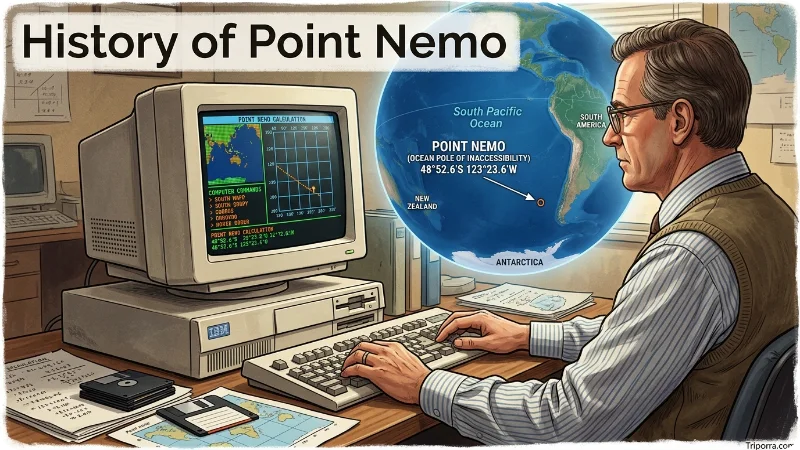
Point Nemo did not exist as a named location until modern geographic analysis became possible through satellite technology and advanced mapping.
In 1992, Croatian-Canadian survey engineer Hrvoje Lukatela calculated the exact location using computer models that measured the greatest possible distance from land. His work identified the Oceanic Pole of Inaccessibility, giving the world a precise coordinate for the most isolated place on Earth.
Who Discovered Point Nemo?
This calculation was possible because of advances in satellite mapping and computer-based geographic analysis. Before modern technology, identifying the most remote point in the ocean was extremely difficult because it required comparing distances from thousands of coastlines worldwide.
The name “Point Nemo” comes from the Latin word nemo, meaning “no one.” It also references Captain Nemo, the fictional submarine captain from Jules Verne’s novel Twenty Thousand Leagues Under the Seas. The name suits the area’s complete lack of permanent human presence.
Since its discovery, Point Nemo has become increasingly important in space operations. International space agencies recognized that its isolation made it the safest place for controlled spacecraft re-entry. Over time, the surrounding waters developed a reputation as the world’s primary spacecraft disposal zone.
Today, Point Nemo appears in documentaries, educational materials, scientific studies, and discussions about space exploration. Although few people will ever travel there, it remains one of Earth’s most remarkable geographic locations.
Climate & Weather
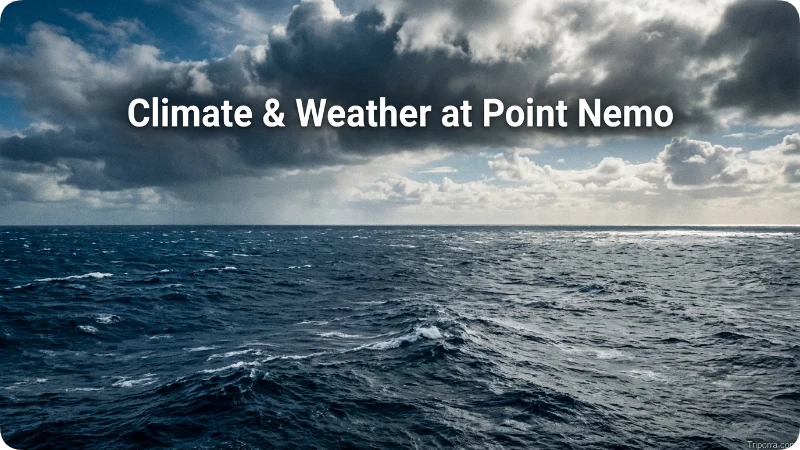
Point Nemo has a cool oceanic climate shaped almost entirely by the surrounding Pacific Ocean. Temperatures remain relatively stable compared with many land areas because the ocean absorbs and releases heat slowly.
Sea surface temperatures generally range from about 41°F to 68°F (5°C to 20°C) depending on the season and ocean currents. Strong winds and large swells are common throughout the year, creating challenging conditions for ships.
There is no true dry season. Rainfall occurs regularly, and weather systems move freely across the open ocean without mountains or coastlines to interrupt them.
One seasonal trap many people overlook is the Southern Hemisphere calendar. Summer occurs from December through February, while winter lasts from June through August. Anyone studying or navigating the area must remember that the seasons are opposite those in Europe and North America.
Things to See & Do
Although Point Nemo has no tourist attractions, the surrounding ocean is important for scientific research and exploration.
Ocean Research
Scientists study the waters around Point Nemo to understand ocean circulation, marine ecosystems, and climate patterns. Because the region is far from major human activity, it provides valuable information about natural ocean conditions.
Spacecraft Monitoring
The area is famous among space researchers because retired spacecraft are guided into the surrounding Pacific waters during controlled re-entry missions.
Virtual Exploration
Most people experience Point Nemo through interactive maps, satellite images, documentaries, and scientific studies rather than by physically traveling there.
Best Time to Visit
There is no practical tourist season for Point Nemo because no cruise ships, ferries, or commercial tours operate to this remote location.
For scientific expeditions, the Southern Hemisphere summer—from December through February—generally provides milder sea conditions and longer daylight hours. Even then, rough seas remain common, and weather can change quickly.
The shoulder months of October, November, March, and April often balance moderate conditions with fewer severe storms, although accessibility still depends entirely on specialized research vessels.
During the Southern Hemisphere winter, stronger storms, colder temperatures, and larger ocean swells create even more challenging conditions.
What most guides miss is that reaching Point Nemo is far more difficult than visiting Antarctica. Even experienced sailors require extensive planning, specialized equipment, and favorable weather windows.
Can You Visit Point Nemo?
Yes, it is technically possible to visit Point Nemo because it lies in international waters. However, reaching it is extremely difficult and requires careful planning.
There are no airports, hotels, ports, or visitor facilities nearby. Anyone attempting the journey would need a specialized vessel capable of crossing thousands of kilometers of open ocean.
A trip to Point Nemo usually requires:
- A research vessel or private expedition ship
- Experienced ocean crew
- Satellite communication equipment
- Emergency planning
- Large fuel and supply capacity
Unlike popular remote destinations such as Antarctica, Point Nemo has no tourism infrastructure. Most people explore this location through maps, documentaries, and scientific research rather than visiting in person.
Common Misconceptions
Many people believe Point Nemo is an island. It is not. It is simply an imaginary point marked by geographic coordinates in open ocean.
Another misconception is that Point Nemo belongs to a country. Because it lies in international waters, no nation owns or governs it.
Some also think it is the deepest point in Earth’s oceans. In reality, the Mariana Trench holds that distinction.
Finally, despite its name, Point Nemo has no connection to the animated character Nemo from Finding Nemo. The name comes from the Latin word for “no one” and the famous fictional Captain Nemo.
Is Point Nemo Dangerous?
Point Nemo is not dangerous because of wildlife or political problems. Its main challenge is extreme isolation.
The biggest risks come from:
- Being thousands of kilometers from the nearest land
- Lack of nearby rescue services
- Unpredictable ocean weather
- Strong winds and large waves
- Limited communication options
If someone became stranded near Point Nemo, rescue would be extremely difficult because specialized ships or aircraft would need to travel a very long distance to reach the area.
Related Places
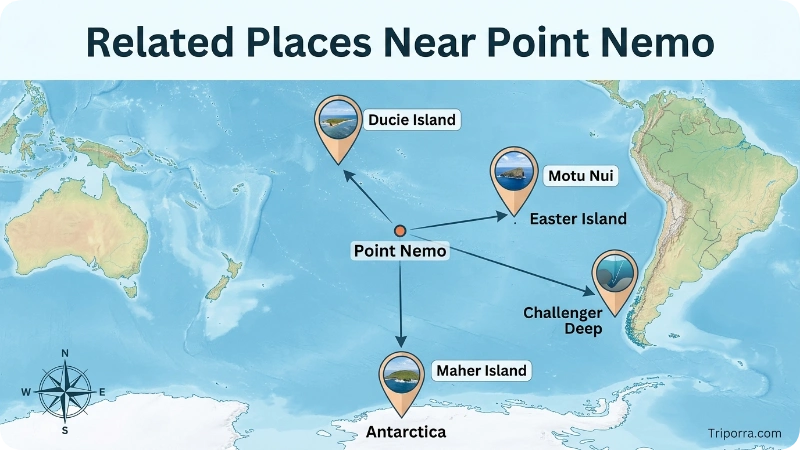
Although Point Nemo stands alone in the middle of the South Pacific, several other locations help explain its geography and why it is so unique.
Ducie Island (Pitcairn Islands)
Ducie Island is one of the three nearest land areas to Point Nemo, located approximately 2,688 kilometers (1,670 miles) away. This tiny coral atoll has no permanent residents and is known mainly for its seabird colonies and protected marine environment.
Motu Nui (Near Easter Island)
Motu Nui is a small rocky islet southwest of Easter Island (Rapa Nui). It is another of the closest pieces of land to Point Nemo and played an important role in the traditional Birdman ceremonies of the Rapa Nui people.
Maher Island (Antarctica)
Maher Island lies off the coast of Antarctica and forms the southern reference point for Point Nemo’s remarkable isolation. Its icy environment contrasts sharply with the open Pacific waters surrounding Point Nemo.
Challenger Deep
People often confuse Challenger Deep with Point Nemo. Challenger Deep, located in the Mariana Trench, is the deepest known point in Earth’s oceans, while Point Nemo is simply the point farthest from any land.
Easter Island (Rapa Nui)
Easter Island is famous for its giant moai statues and Polynesian history. Although it is one of the world’s most isolated inhabited islands, it is still much more accessible than Point Nemo.
What Else Do People Want to Know?
Many people wonder whether anyone can visit Point Nemo. In theory, yes, because it lies in international waters. In practice, reaching it is extremely difficult. No commercial cruises or regular expeditions travel there, and visitors would need a specially equipped vessel capable of crossing thousands of kilometers of open ocean.
Safety is another common concern. The area has no nearby ports, hospitals, rescue stations, or communication infrastructure beyond satellite systems. Weather conditions can change rapidly, making careful planning essential for any expedition.
Cost is also a major factor. A private voyage to Point Nemo would cost tens of thousands—or even hundreds of thousands—of dollars depending on the ship, crew, fuel, and expedition length.
Since Point Nemo belongs to no country, travelers do not need a visa specifically for the location. However, any voyage usually departs from countries such as Chile, New Zealand, or French Polynesia, so their entry requirements still apply.
Accessibility remains the biggest challenge. Unlike famous remote destinations such as Antarctica or the Galápagos Islands, Point Nemo has no visitor facilities, no landing sites, and no tourism services. Most people experience it through maps, documentaries, and scientific publications rather than in person.
FAQs
1. Where is Point Nemo located?
Point Nemo is located in the South Pacific Ocean at approximately 48°52.6′S, 123°23.6′W. It is the point in the ocean farthest from any land.
2. Why is Point Nemo called the most remote place on Earth?
It is approximately 2,688 kilometers (1,670 miles) from the nearest land in every direction, making it the ocean’s point of greatest isolation.
3. Does Point Nemo belong to any country?
No. Point Nemo lies in international waters, so no country has sovereignty over it.
4. Can tourists visit Point Nemo?
Technically yes, but there are no commercial tours or visitor facilities. Only specialized expeditions or private vessels can realistically reach it.
5. Why do spacecraft fall near Point Nemo?
Space agencies use the surrounding waters as a controlled re-entry zone because the area is so remote that falling debris poses very little risk to people.
6. Is Point Nemo the deepest place in the ocean?
No. The deepest known place is Challenger Deep in the Mariana Trench. Point Nemo is famous for its distance from land, not its depth.
7. Are there animals living near Point Nemo?
Yes. Marine life exists throughout the region, including fish, seabirds, microorganisms, and occasional marine mammals, although biodiversity is generally lower than in nutrient-rich coastal waters.
8. Why is Point Nemo named “Nemo”?
“Nemo” comes from the Latin word meaning “no one.” It also references Captain Nemo, the fictional explorer created by Jules Verne.
9. What is the nearest land to Point Nemo?
The nearest land consists of Ducie Island, Motu Nui near Easter Island, and Maher Island off Antarctica. Each is approximately the same distance away.
10. Do people live at Point Nemo?
No. Point Nemo has no islands, settlements, or permanent population. It is simply a geographic coordinate in the open ocean
11.How long does it take to reach Point Nemo?
The travel time depends on the departure location, vessel speed, and weather conditions. A specialized ship traveling from places such as Chile, New Zealand, or French Polynesia may need several days or weeks because Point Nemo is thousands of kilometers from the nearest land.
12.Is Point Nemo closer to space than land?
Yes. Astronauts aboard the International Space Station can sometimes be closer to Point Nemo than humans on Earth’s surface. The ISS orbits about 400 kilometers above Earth, while the nearest land from Point Nemo is about 2,688 kilometers away.
13.What is the closest island to Point Nemo?
The closest land areas to Point Nemo are Ducie Island in the Pitcairn Islands, Motu Nui near Easter Island, and Maher Island near Antarctica. Each is approximately 2,688 kilometers away.
14.Are there fish near Point Nemo?
Yes. Marine life exists around Point Nemo, including fish, seabirds, microorganisms, and marine mammals. However, the waters contain fewer nutrients than coastal areas, so biodiversity is lower compared with oceans closer to continents.
Closing
Point Nemo is unlike any other place on Earth. Located in the heart of the South Pacific Ocean, it is the most remote point from land and serves as a fascinating example of how vast our planet really is.
Its importance goes far beyond geography. Scientists study its isolated waters, while space agencies use the surrounding ocean as the safest place for controlled spacecraft re-entry. These roles have made Point Nemo one of the world’s best-known yet least visited locations.
Whether you were curious about its exact location, its unusual history, or why old spacecraft end up nearby, Point Nemo offers a rare look at one of Earth’s last truly isolated places. It reminds us that even in the age of satellites and global travel, parts of our planet remain astonishingly distant.

Silas Vance is a geography enthusiast, travel researcher, and location-focused content writer dedicated to helping readers better understand the world around them on triporra.com. He specializes in creating informative guides about cities, countries, islands, landmarks, universities, and other notable destinations. His work combines geographic accuracy, historical context, and practical insights to answer location-based questions in a simple and engaging way.