If you are wondering where Abu Dhabi is, it is the capital of the United Arab Emirates (UAE) and one of the country’s most important cities. Abu Dhabi sits on an island in the Persian Gulf, just off the southeastern coast of the Arabian Peninsula, and bridges connect the city to the mainland and nearby islands.
Abu Dhabi is more than the political capital of the UAE. It is also a major center for government, business, culture, tourism, and energy. The city is known for its modern skyline, grand mosques, waterfront setting, museums, beaches, and large oil and natural gas reserves. Its location also places it within easy reach of other major Gulf cities, including Dubai.
In this guide, you’ll learn exactly where Abu Dhabi is located, which country and continent it belongs to, what surrounds it, how far it is from Dubai, and why its geographic location matters. You’ll also find clear information about Abu Dhabi’s islands, coastline, climate, transportation, and the best-known landmarks that help you understand the city beyond its location on a map.
Featured Snippet:
It is located in the western part of the United Arab Emirates on the Arabian Peninsula. It sits along the coast of the Persian Gulf and is the capital of both the Abu Dhabi Emirate and the UAE. The city is about 140 kilometers southwest of Dubai and is known as the country’s government and cultural center.
Quick Facts About Abu Dhabi
| Fact | Details |
| Official Name | Emirate of Abu Dhabi / Abu Dhabi City |
| Country | United Arab Emirates |
| Region | Arabian Peninsula, Middle East |
| Population | Approximately 1.5 million in the city area |
| Area | City area is approximately 970 sq km; emirate area is much larger |
| Coordinates | Approximately 24.45° N, 54.38° E |
| Time Zone | Gulf Standard Time (UTC+4) |
| Nearest Major City | Dubai (approximately 140 km northeast) |
| Known For | UAE capital, Sheikh Zayed Grand Mosque, oil industry, culture |
| Language | Arabic (English widely used) |
| Currency | UAE Dirham (AED) |
Where Is Abu Dhabi Located?
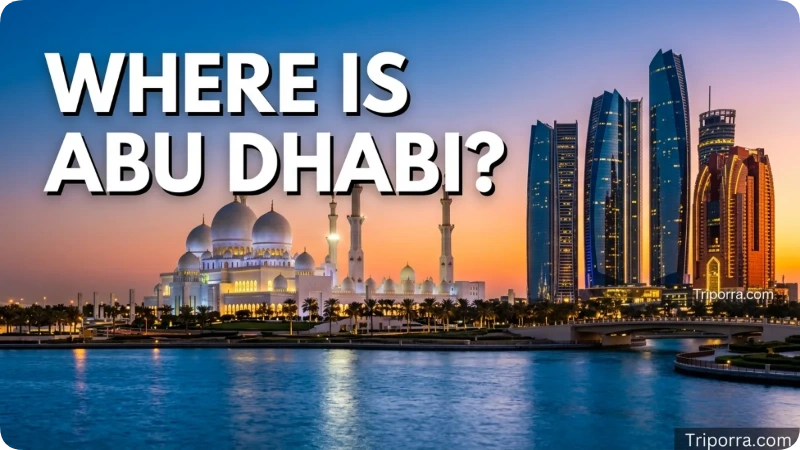
It is located in the United Arab Emirates, a country on the southeastern side of the Arabian Peninsula. The city lies along the southern coast of the Persian Gulf and is part of the larger Abu Dhabi Emirate, which covers most of the UAE’s land area.
The city itself sits on Abu Dhabi Island, which is separated from the mainland by a narrow channel. Several bridges, including Maqta Bridge and Sheikh Zayed Bridge, connect the island to surrounding areas.
Abu Dhabi’s Strategic Geographic Location
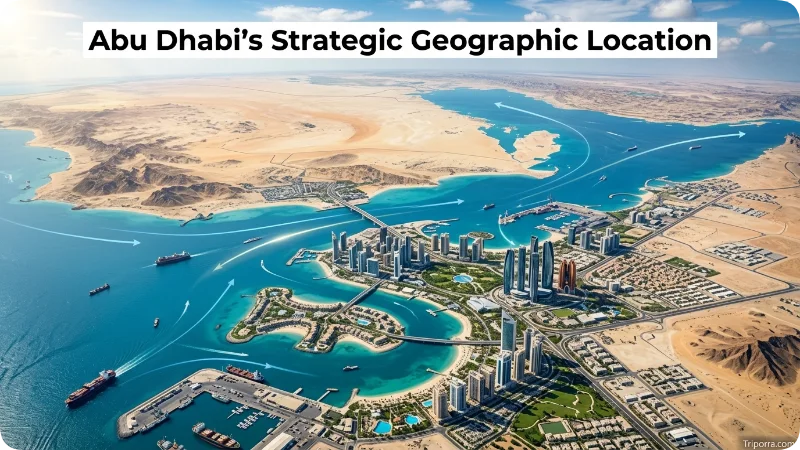
Abu Dhabi’s position on the Persian Gulf has made it one of the Middle East’s most important cities for trade, shipping, and energy exports. Its coastal location provides direct access to international sea routes, while its position between Europe, Asia, and Africa makes it a convenient hub for business and tourism.
The city is located in the Northern Hemisphere at approximately 24.45° north latitude and 54.38° east longitude. Although it is surrounded by desert landscapes, its coastline stretches along the warm waters of the Persian Gulf, creating natural harbors, islands, beaches, and mangrove ecosystems.
Geographically, it is in the western region of the UAE. It shares the country with six other emirates, including Dubai, Sharjah, Ajman, Fujairah, Ras Al Khaimah, and Umm Al Quwain.
Travellers often overlook that it is not just a city but also an entire emirate. The emirate includes large desert areas, islands, and smaller towns such as Al Ain and Madinat Zayed. Many visitors only think of the capital city, but the wider region covers a large and diverse landscape.
A common mistake is confusing Abu Dhabi with Dubai. While Dubai is the UAE’s largest tourism and business hub, Abu Dhabi is the political capital where the federal government is based.
Administrative Status
It is both a city and the capital of the Emirate of Abu Dhabi. It is also the capital of the United Arab Emirates, making it the location of major government offices, ministries, and diplomatic missions.
The Emirate of Abu Dhabi is one of the seven emirates that make up the UAE federation. The local government manages areas such as infrastructure, tourism, planning, and natural resources.
The city follows Gulf Standard Time (UTC+4) throughout the year and does not use daylight saving time.
For international visitors, entry rules depend on nationality. Many travellers can enter the UAE without arranging a visa in advance, while others need approval before arrival. The city is well connected through air travel, especially through Abu Dhabi International Airport.
Is Abu Dhabi a City or an Emirate?
Many people think it refers only to the capital city, but the name actually describes both a city and an emirate. Abu Dhabi City is the capital of the United Arab Emirates, while the Emirate of Abu Dhabi is the country’s largest emirate, covering about 87% of the UAE’s total land area.
Besides the capital, the emirate includes destinations such as Al Ain, Liwa Oasis, Sir Bani Yas Island, and hundreds of smaller islands along the Persian Gulf.
Is Abu Dhabi a City or an Emirate?
Many people think Abu Dhabi refers only to the capital city, but the name actually describes both the city and the emirate. Abu Dhabi City is the capital of the United Arab Emirates, while the Emirate of Abu Dhabi is the country’s largest emirate, covering nearly 87% of the UAE’s total land area.
The emirate includes major destinations such as Al Ain, Liwa Oasis, Sir Bani Yas Island, and hundreds of smaller islands along the Gulf coast.
Abu Dhabi on the Map
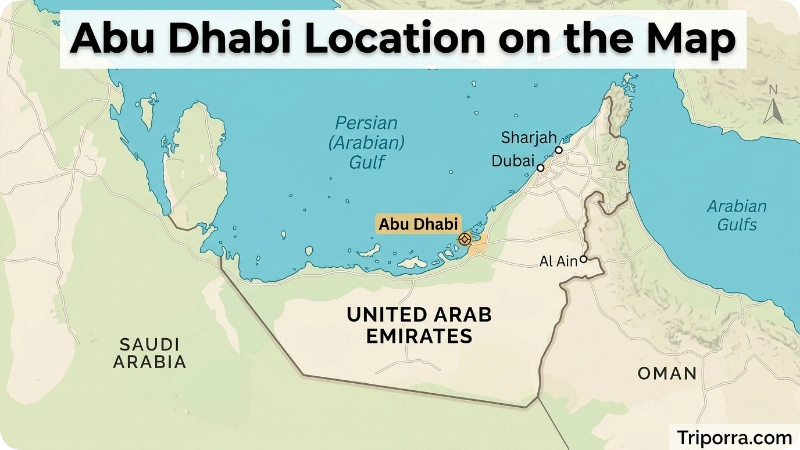
It is located on the western side of the UAE, facing the Persian Gulf. It is surrounded by coastal waters to the north and desert landscapes to the south.
From Dubai, Abu Dhabi is approximately 140 kilometers southwest by road. The journey usually takes around 1.5 to 2 hours depending on traffic and the route used.
From Al Ain, another major city in the Abu Dhabi Emirate, the capital is approximately 160 kilometers northwest.
The city is close to the borders of Saudi Arabia and Oman through the wider UAE territory. The western part of the emirate extends toward Saudi Arabia, while Oman lies to the east.
What most guides miss is that Abu Dhabi’s geography is shaped by hundreds of islands and coastal areas. Places such as Saadiyat Island and Yas Island are part of the city’s expansion and tourism development.
Which Countries Are Close to Abu Dhabi?
It is located in the southeastern part of the Arabian Peninsula. Saudi Arabia borders the emirate to the south and west, while Oman lies to the east through the UAE. Across the Persian Gulf are nearby countries including Qatar, Bahrain, Iran, and Kuwait.
Its location allows Abu Dhabi to serve as an important transportation and trade hub connecting the Middle East with Asia, Europe, and Africa.
Why Is Abu Dhabi Famous?
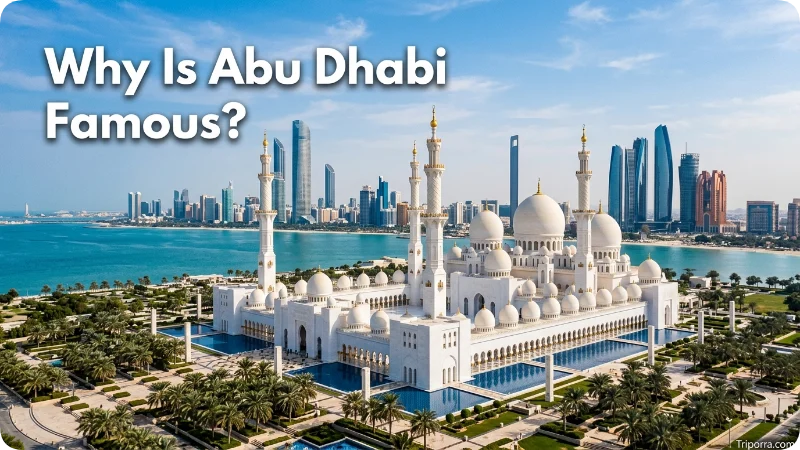
It is famous mainly because it is the capital of the UAE and a major center for government, energy, culture, and international events. The city’s importance grew rapidly after oil was discovered in the region during the 20th century.
One of its most recognized landmarks is the Sheikh Zayed Grand Mosque, a huge white marble mosque known for its detailed architecture, large prayer hall, and impressive design features. It attracts visitors from around the world and represents the cultural identity of the UAE.
The city is also known for its connection to the oil industry. Abu Dhabi holds a large share of the UAE’s oil reserves, and energy resources have played a major role in funding its modern development.
Beyond oil, it has invested heavily in tourism, museums, entertainment, and environmental projects. Saadiyat Island has become a cultural district with attractions such as the Louvre Abu Dhabi, while Yas Island is known for entertainment venues and family attractions.
Travellers often overlook Abu Dhabi’s natural side. The city is not only about skyscrapers and luxury hotels. Nearby areas include desert landscapes, mangrove forests, wildlife reserves, and quiet beaches.
The city also has a different atmosphere compared with Dubai. Dubai is often associated with shopping, nightlife, and tall buildings, while Abu Dhabi has a slower pace with more government, cultural, and family-focused spaces.
Some visitors expect Abu Dhabi to be completely covered by desert, but the city itself has many green areas, waterfront parks, and landscaped streets. Large urban planning projects have transformed the coastline into attractive public spaces.
Why Is Abu Dhabi Economically Important?
It is the economic powerhouse of the United Arab Emirates because it holds most of the country’s proven oil reserves. Revenue from the energy sector has helped fund roads, hospitals, schools, modern infrastructure, and large tourism projects.
Today, it is also expanding into industries such as renewable energy, finance, technology, artificial intelligence, manufacturing, and logistics. This economic diversification aims to reduce dependence on oil while supporting long-term growth.
History of Abu Dhabi
Abu Dhabi’s history goes back thousands of years, with evidence of human settlement in the region dating to ancient times. Early communities depended on fishing, pearl diving, and trade along the Gulf coast.
The modern city began developing in the 18th century when the specific group settled on Abu Dhabi Island. The discovery of fresh water sources helped establish the settlement.
In the 19th century, Abu Dhabi became an important center for pearl diving. Pearls from the Gulf were highly valued and formed a major part of the local economy.
The discovery of oil in the mid-20th century changed Abu Dhabi dramatically. Oil exports began in the 1960s, bringing major economic growth and allowing large investments in roads, buildings, healthcare, and education.
In 1971, Abu Dhabi became the capital of the newly formed United Arab Emirates. Since then, the city has continued expanding as a political, economic, and cultural center.
Today, Abu Dhabi combines traditional Emirati culture with modern architecture. Historic sites, museums, and cultural events continue to connect the city with its past.
| Year | Event |
|---|---|
| Ancient times | Early settlements based on fishing and pearl diving developed along the Gulf coast. |
| 1761 | Freshwater was discovered on Abu Dhabi Island. |
| 1793 | The Bani Yas group permanently settled on the island. |
| 1958 | Commercial oil was discovered in Abu Dhabi. |
| 1962 | The first shipment of crude oil was exported. |
| 1971 | Abu Dhabi became the capital of the newly formed United Arab Emirates. |
| Today | The city is a global center for government, business, tourism, and culture. |
Culture and Local Traditions in Abu Dhabi
It blends traditional Emirati customs with a modern international lifestyle. Islam plays an important role in daily life, and visitors are encouraged to dress modestly when visiting mosques and government buildings.
Arabic is the official language, but English is widely spoken in hotels, restaurants, shopping malls, and tourist attractions. The city also celebrates cultural festivals, traditional crafts, and Emirati hospitality, giving visitors opportunities to learn more about local heritage.
Climate & Weather

It has a hot desert climate with very warm summers and mild winters. Rainfall is limited, and most days of the year are sunny.
Summer lasts roughly from June to September. Temperatures often rise above 40°C during the hottest months, and humidity can make coastal areas feel even warmer.
Winter, from November to March, is the most comfortable season. Daytime temperatures are usually around 24°C to 30°C, making outdoor activities easier.
Spring and autumn can still be hot, especially during the daytime, but evenings are often more pleasant.
A seasonal trap for visitors is underestimating the heat in April, May, and October. These months may look like the start or end of the cooler season, but outdoor activities in the afternoon can still be uncomfortable.
The city’s coastal location creates humidity, especially at night. Travellers planning desert trips should remember that desert temperatures can change quickly after sunset.
What Is the Hottest Month in Abu Dhabi?
July and August are usually the hottest months in Abu Dhabi. Daytime temperatures often rise above 42°C (108°F), while high humidity along the coast can make conditions feel even hotter.
January is generally the coolest month of the year, making it one of the best times for sightseeing, beaches, and other outdoor activities.
Things to See & Do in Abu Dhabi
Nature Attractions
Mangrove National Park
This protected coastal area offers kayaking opportunities and a chance to see Abu Dhabi’s natural environment. It is a surprising contrast to the city’s urban landscape.
Jubail Mangrove Park
A boardwalk through mangrove forests allows visitors to explore local wildlife and coastal ecosystems.
Liwa Desert
Located in the southern part of the emirate, Liwa is famous for huge sand dunes and traditional desert landscapes.
Cultural Attractions
Sheikh Zayed Grand Mosque
One of the most famous landmarks in the UAE, this mosque is known for its architecture, artwork, and peaceful surroundings.
Louvre Abu Dhabi
Located on Saadiyat Island, this museum displays international art and connects cultures from different parts of the world.
Qasr Al Watan
This presidential palace offers visitors insight into UAE governance, architecture, and national heritage.
Entertainment & Family Attractions
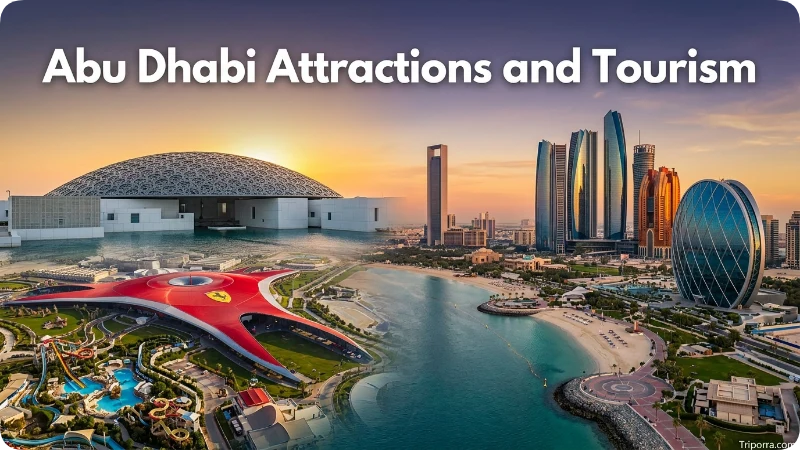
Yas Island
A major entertainment area featuring theme parks, beaches, hotels, and events.
Ferrari World Abu Dhabi
A large indoor theme park known for Ferrari-inspired attractions and family activities.
Warner Bros. World Abu Dhabi
An indoor entertainment park with themed areas based on popular characters.
Corniche Beach and Waterfront
A popular public area with walking paths, beaches, gardens, and views of the Gulf.
Best Time to Visit Abu Dhabi
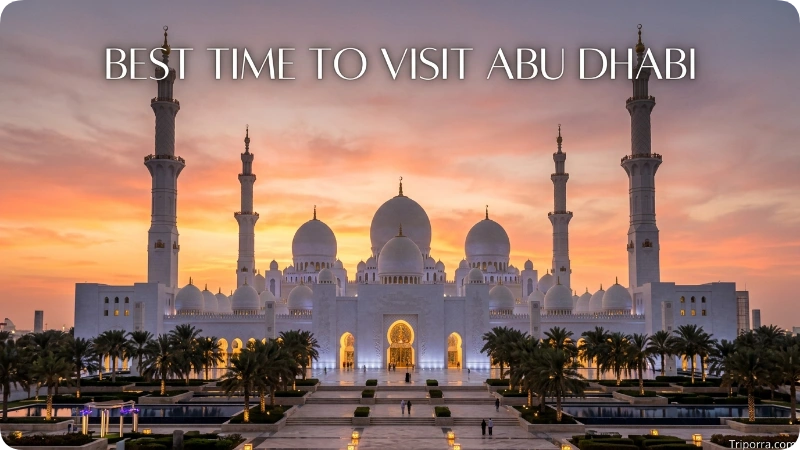
The best time to visit Abu Dhabi is usually from November to March when the weather is cooler and outdoor activities are more comfortable. During this period, temperatures are generally pleasant for sightseeing, beaches, desert trips, and walking tours.
The peak travel season is from December to February. Many international visitors choose these months because the weather is ideal. However, hotels and attractions can become more expensive, and popular places may be crowded during holidays and major events.
The shoulder seasons, especially March and November, can be a good choice for travellers who want fewer crowds while still enjoying comfortable weather. These months offer a balance between good temperatures and lower travel costs.
The summer months from June to September are the cheapest time to visit, but the extreme heat can limit outdoor activities. Many attractions remain open because of indoor facilities and air conditioning, but desert tours and long outdoor walks may be less enjoyable.
Travellers often overlook early mornings and evenings as the best times for outdoor experiences. Even during warmer months, sunrise visits to places like the Corniche or desert areas can provide a more comfortable experience.
How to Reach Abu Dhabi
It is easy to reach by air, road, and sea. Zayed International Airport connects the city with destinations across the Middle East, Europe, Asia, Africa, and North America.
Visitors traveling from Dubai can drive along Sheikh Zayed Road (E11), with the journey usually taking between 90 minutes and two hours depending on traffic. Intercity buses also operate regularly between Abu Dhabi, Dubai, Al Ain, and other UAE cities, while taxis and ride-hailing services are widely available.
Common Misconceptions About Abu Dhabi
One common misunderstanding is that Abu Dhabi and Dubai are the same place. They are separate cities and separate emirates within the United Arab Emirates. Dubai is northeast of Abu Dhabi, while the capital city lies farther west along the Gulf coast.
Another frequent mistake is thinking Abu Dhabi is only a city. The name also refers to the largest emirate in the UAE, which includes large desert regions, islands, and other cities such as Al Ain.
Some visitors believe Abu Dhabi is only a business and government destination. While it is the political center of the UAE, it also has beaches, museums, wildlife areas, entertainment parks, and cultural attractions.
A naming confusion happens because people sometimes use “Abu Dhabi” to describe the entire UAE capital area. However, the city, island, and emirate have different geographic meanings.
Related Places Near Abu Dhabi
Dubai
Dubai is the UAE’s most famous tourism city and is located northeast of Abu Dhabi. It is known for shopping, skyscrapers, beaches, and attractions such as the Burj Khalifa.
Al Ain
Al Ain is an inland city within the Abu Dhabi Emirate. Known as the “Garden City,” it is famous for oases, mountains, and traditional Emirati heritage.
Yas Island
Yas Island is a modern entertainment district near Abu Dhabi city. It includes theme parks, hotels, beaches, and event venues.
Saadiyat Island
Saadiyat Island is a cultural destination featuring museums, beaches, and luxury developments. It is located close to central Abu Dhabi.
Liwa Oasis
Liwa Oasis lies in the southern part of the Abu Dhabi Emirate. It is known for date farms, desert scenery, and some of the largest sand dunes in the world.
Traditional Food to Try in Abu Dhabi
It offers a mix of traditional Emirati dishes and international cuisine. Popular local foods include Harees, Machboos, Thareed, Luqaimat, and grilled seafood, all of which reflect the region’s history and culture.
Because it is home to people from many countries, visitors can also find restaurants serving Middle Eastern, Asian, European, and international dishes throughout the city.
Is Abu Dhabi Safe for Tourists?
It is widely regarded as one of the safest major cities in the world. Strict laws, low crime rates, and well-maintained public spaces contribute to a secure environment for both residents and visitors.
Travelers should still follow local laws, respect cultural customs, avoid public intoxication, and dress appropriately when visiting religious sites or government buildings.
What Else Do People Want to Know About Abu Dhabi?
It is considered one of the safer major cities in the Middle East, with strict laws and a low crime rate. Visitors should still follow local rules, especially regarding public behavior, photography, and cultural customs.
The cost of visiting Abu Dhabi depends on travel style. Luxury hotels and fine dining can be expensive, but budget-friendly hotels, public transport, and affordable restaurants are available.
English is widely spoken in hotels, shopping areas, and tourist attractions. Arabic remains the official language and is commonly used in government and local communities.
Public transport options include buses and taxis. Many visitors also use rental cars because attractions across the emirate can be spread out.
Visitors should respect local traditions. Modest clothing is recommended in public areas, especially when visiting religious sites such as mosques.
One fact many travel articles miss is that Abu Dhabi can work well as both a short city break and a longer trip. A two- or three-day visit can cover major attractions, while a longer stay allows exploration of desert areas and nearby cities.
FAQs
1. Is Abu Dhabi a country?
No, it is not a country. It is a city and an emirate within the United Arab Emirates.
2. Is Abu Dhabi the capital of the UAE?
Yes, it is the capital city of the United Arab Emirates and the location of the country’s federal government offices.
3. How far is Abu Dhabi from Dubai?
It is approximately 140 kilometers southwest of Dubai. The drive usually takes around 1.5 to 2 hours depending on traffic.
4. What continent is Abu Dhabi in?
It is located in Asia, specifically in the Middle East region on the Arabian Peninsula.
5. What is Abu Dhabi famous for?
It is famous for the Sheikh Zayed Grand Mosque, oil resources, government institutions, museums, islands, and cultural attractions.
6. Is Abu Dhabi better than Dubai for tourists?
It depends on what visitors want. Dubai is more focused on shopping and entertainment, while Abu Dhabi offers more cultural sites, beaches, and government landmarks.
7. What currency is used in Abu Dhabi?
The UAE Dirham (AED) is the official currency used in Abu Dhabi.
8. Does Abu Dhabi have beaches?
Yes, Abu Dhabi has several beaches, including public beaches along the Corniche and private beaches on islands and resorts.
9. What is the best month to visit Abu Dhabi?
The months from November to March are generally considered the best because temperatures are cooler and outdoor activities are easier.
10. Is Abu Dhabi expensive to visit?
It can be expensive, especially for luxury experiences, but travellers can also find affordable accommodation, food, and activities.
FAQ 11. Can you drink alcohol in Abu Dhabi?
Yes. Alcohol is available in licensed hotels, restaurants, bars, and private clubs. Drinking alcohol in public places or being intoxicated in public is prohibited under UAE law.
12. How many days are enough for Abu Dhabi?
Most visitors spend two to four days exploring Abu Dhabi. This provides enough time to visit major attractions such as Sheikh Zayed Grand Mosque, the Louvre Abu Dhabi, Yas Island, and the Corniche while also enjoying a desert experience.
13. Is Abu Dhabi worth visiting?
Yes. it offers a combination of cultural landmarks, museums, beaches, family attractions, modern architecture, and desert adventures. It appeals to travelers looking for both relaxation and authentic Emirati experiences.
14. Can you visit Abu Dhabi without visiting Dubai?
Yes. Abu Dhabi has its own international airport and enough attractions to enjoy as a standalone destination. Many visitors spend their entire trip in Abu Dhabi without traveling to Dubai.
15. Does Abu Dhabi have a desert?
Yes. Most of the Emirate of Abu Dhabi is covered by the Arabian Desert. Visitors can explore areas such as Liwa Oasis, where activities include dune bashing, camel riding, sandboarding, and overnight desert camping.
Conclusion
It is the capital of the United Arab Emirates and is located on the southeastern coast of the Arabian Peninsula along the Persian Gulf. While many people recognize it for its modern skyline and energy industry, the city also stands out for its cultural landmarks, museums, beaches, islands, and desert landscapes.
Understanding the difference between Abu Dhabi the city and Abu Dhabi the emirate helps explain its importance within the UAE. Whether you’re researching its location, planning a trip, or learning about the Middle East, Abu Dhabi offers a unique combination of history, culture, modern development, and natural beauty.

About Leo Sterling
Leo Sterling is a geography and travel writer at Triporra.com who believes understanding a place starts with knowing exactly where it is. He turns geographic details on countries, regions, islands, and cities into clear, engaging content for everyday readers.
For Leo, a good location article does more than mark a spot on a map. It shows what borders a place, which region it belongs to, and how it connects to the world around it—an approach reflected in guides like where is Anguilla, where solid research meets a simple, conversational style.
Whether readers are planning a trip, studying, or just curious, Leo’s goal is the same: deliver accurate, easy-to-understand information without unnecessary complexity.
Areas of Focus: Geography | Countries & Regions | Caribbean Islands | Travel Destinations | Location Research | “Where Is?” Content