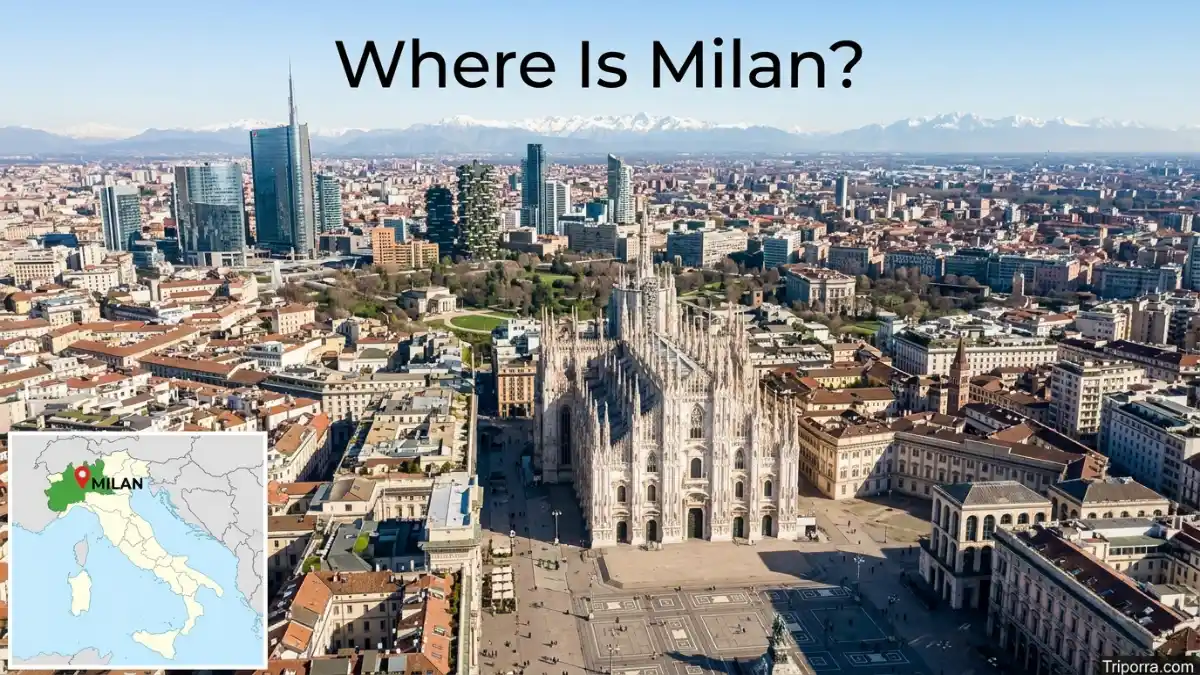
Milan, also called Milano in Italian, is a major city in northern Italy, in the Lombardy region of Europe. It sits in the Po Valley, about 50 kilometers (31 miles) from the Swiss border and roughly 140 kilometers (87 miles) south of the Alps. Milan is the capital of Lombardy and one of Italy’s most important cities for finance, fashion, business, design, and culture.
Milan is famous for the Milan Cathedral (Duomo di Milano), luxury fashion, historic architecture, world-class art, and football clubs such as AC Milan and Inter Milan. Its central location also makes it an important transportation hub and a convenient base for visiting Lake Como, Lake Maggiore, the Italian Alps, and other cities in northern Italy.
Featured Snippet Answer
It is located in northern Italy in the Lombardy region, approximately 140 kilometers (87 miles) south of the Alps. It is Italy’s second-largest city after Rome and is internationally famous for fashion, finance, business, art, architecture, and attractions such as the Milan Cathedral (Duomo di Milano) and Leonardo da Vinci’s The Last Supper.
Where Is It Located?
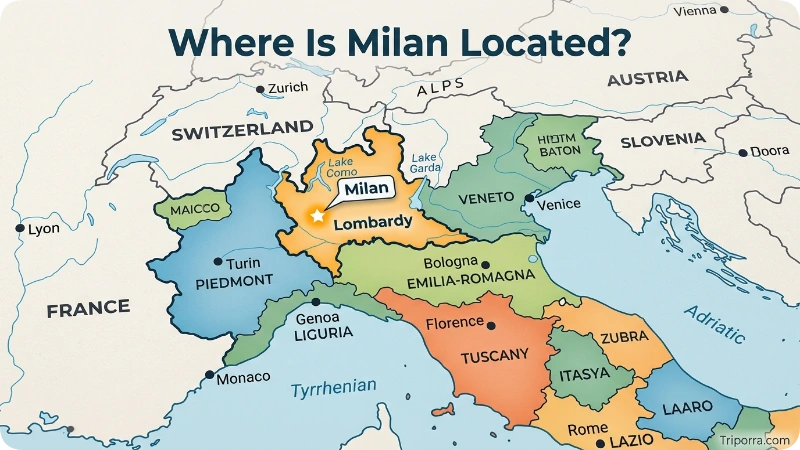
Milan is situated in the northwestern part of Italy within the region of Lombardy, the country’s most populous and economically productive region.
It is in Europe, in the northern part of Italy. It sits in the Lombardy region on the Po Valley, south of the Alps and relatively close to the Swiss border. Its location places it in one of Europe’s major economic and transportation areas.
The city lies in the broad Po River Plain, a fertile lowland stretching across northern Italy. Although the city itself is not located directly on the coast, it enjoys a strategic position between central Europe and the Mediterranean region.
Administratively, It serves as:
- A city in northern Italy
- The capital of the Lombardy region
- The center of the Metropolitan City of Milan
- One of Europe’s leading economic and cultural centers
Its location has helped it develop into a major crossroads for trade, transportation, finance, and international business.
Quick Facts
| Fact | Details |
|---|---|
| Official Name | Milan (Milano in Italian) |
| Country | Italy |
| Region | Lombardy |
| Population | Approximately 1.3–1.4 million (city) |
| Metropolitan Population | Over 3 million |
| Time Zone | Central European Time (CET/CEST) |
| Coordinates | Approximately 45.46° N, 9.19° E |
| Nearby Major Cities | Turin, Bergamo, Brescia, Verona, Genoa |
| Known For | Fashion, finance, football, architecture, and design |
| Official Language | Italian |
| Currency | Euro (€) |
On the Map
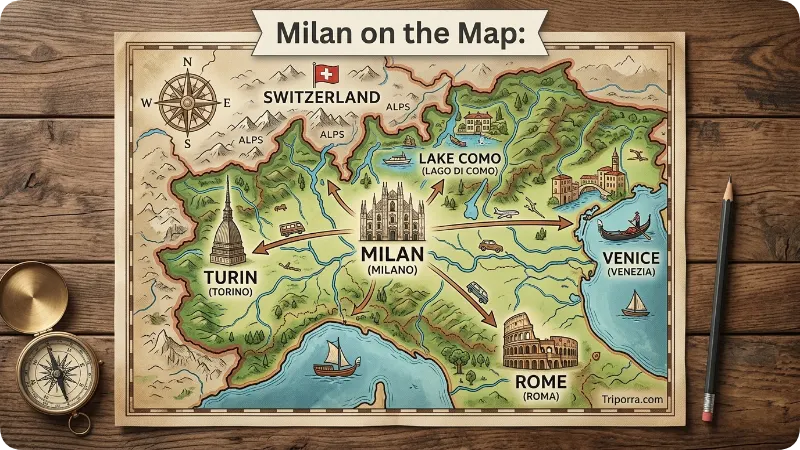
Visualizing Milan’s position is fairly simple.
Imagine northern Italy as a broad plain bordered by the Alps to the north. It sits in that plain, roughly midway between western and eastern northern Italy.
Key geographic references include:
- About 50 km (31 miles) from the Swiss border
- Around 140 km (87 miles) south of the Alps
- Approximately 480 km (298 miles) northwest of Rome
- Around 145 km (90 miles) east of Turin
- Roughly 150 km (93 miles) from Lake Garda
- About a 2-hour drive from many Alpine destinations
Its central location makes it one of the most accessible cities in Italy for both domestic and international travelers.
Which Region Does It Belong To?
It belongs to the Lombardy region, known in Italian as Lombardia.
Lombardy is one of Italy’s 20 administrative regions and is considered the country’s economic powerhouse. The region contains several important cities, including:
- Milan
- Bergamo
- Brescia
- Monza
- Como
- Mantua
- Pavia
As the regional capital, it hosts many governmental institutions, major corporations, universities, and financial organizations.
The city’s influence extends far beyond regional boundaries, making it one of Europe’s most significant urban centers.
How Does Milan Compare to Nearby Places?
Many travelers compare it with other famous Italian destinations.
Milan vs Rome
Rome serves as Italy’s political capital and is renowned for ancient history and archaeological sites. Milan, on the other hand, is known for business, fashion, and modern economic influence.
Milan vs Venice
Venice attracts visitors with canals and historic architecture. Milan offers a larger urban experience with world-class shopping, museums, and business districts.
Milan vs Turin
Turin lies west of Milan and shares an industrial heritage. Milan is generally larger, more international, and more influential in finance and fashion.
Milan vs Florence
Florence is famous for Renaissance art and architecture. It combines historic attractions with a modern skyline and international business atmosphere.
For travelers seeking a mix of history, shopping, culture, and urban energy, Milan often stands apart from other Italian cities.
How to Reach Milan
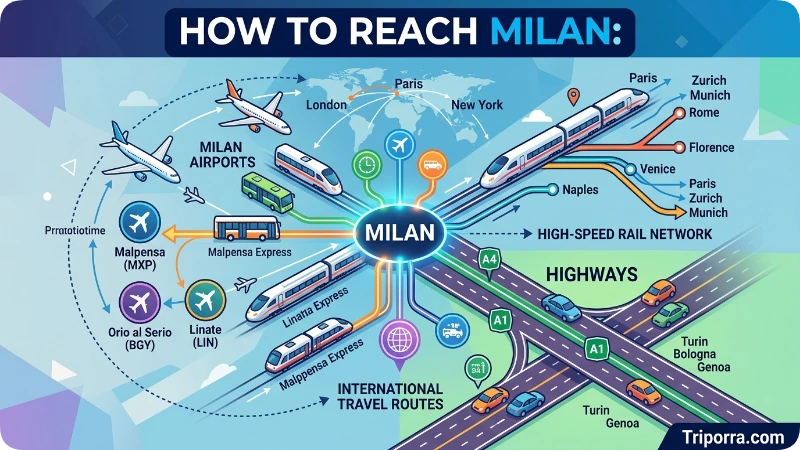
Reaching it is straightforward due to its excellent transportation network.
By Air
It is served by three major airports:
Malpensa Airport (MXP)
- Largest international airport
- Main gateway for long-haul flights
- About 50 km from the city center
Milan Linate Airport (LIN)
- Closest airport to downtown Milan
- Popular for domestic and European routes
Milan Bergamo Airport (BGY)
- Major hub for low-cost airlines
- Located near Bergamo
- Frequently used by budget travelers
By Train
Milan Centrale is one of Europe’s busiest railway stations.
High-speed rail links connect Milan to:
- Rome
- Florence
- Venice
- Turin
- Naples
- Bologna
International rail services also connect Milan with Switzerland and other European destinations.
By Road
Major highways connect it to:
- Switzerland
- France
- Austria
- Southern Italy
Driving times include:
- Turin: about 1.5–2 hours
- Verona: about 2 hours
- Genoa: about 2 hours
- Lake Como: about 1 hour
Why Is it Famous?
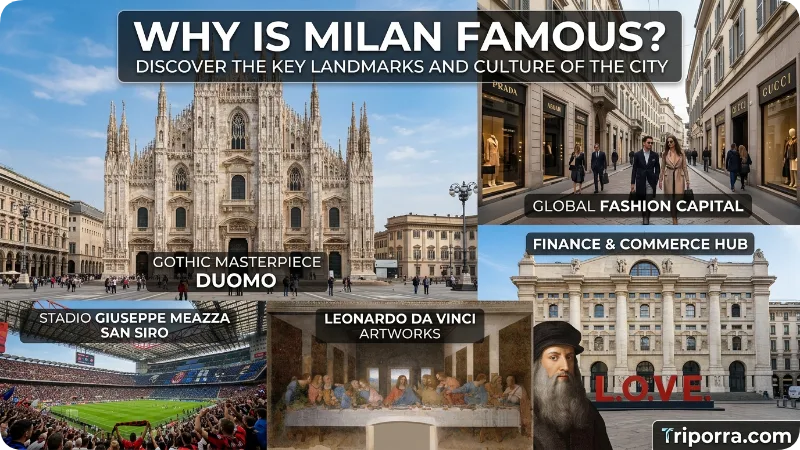
It has earned global recognition in several fields.
Fashion Capital
The city is one of the world’s leading fashion centers alongside Paris, London, and New York.
Luxury brands associated with Milan include:
- Prada
- Armani
- Versace
- Dolce & Gabbana
- Moschino
Financial Center
It hosts Italy’s stock exchange and many of the country’s largest banks and corporations.
Historic Landmarks
Famous attractions include:
- Duomo di Milano
- Galleria Vittorio Emanuele II
- Sforza Castle
- Teatro alla Scala
- Santa Maria delle Grazie
Art and Culture
Leonardo da Vinci’s masterpiece The Last Supper attracts visitors from around the world.
Football
It is home to two internationally recognized clubs:
- AC Milan
- Inter Milan
Both teams play at San Siro Stadium, one of football’s most iconic venues.
History
The history of it stretches back more than two thousand years.
The settlement originated as a Celtic community before becoming part of the Roman Empire around the 2nd century BCE.
During Roman times, it grew rapidly and eventually became one of the empire’s most important cities.
Major historical periods include:
Roman Era
It served as an imperial capital during the late Roman Empire.
Middle Ages
The city developed into a powerful commercial and political center.
Renaissance
The ruling Sforza family transformed it into a center of art, architecture, and innovation.
Modern Era
Industrialization in the 19th and 20th centuries helped it become Italy’s leading economic city.
Today, it remains a symbol of innovation, commerce, and culture.
Climate and Weather
It experiences a humid subtropical climate with four distinct seasons.
Spring (March–May)
- Mild temperatures
- Blooming parks and gardens
- Popular sightseeing season
Summer (June–August)
- Warm to hot conditions
- Temperatures often exceed 30°C (86°F)
- Busy tourist period
Autumn (September–November)
- Comfortable temperatures
- Fewer crowds
- Excellent for city exploration
Winter (December–February)
- Cool and sometimes foggy
- Occasional snowfall
- Christmas markets and seasonal events
Weather can change quickly, so visitors should check forecasts before traveling.
Things to See and Do Nearby
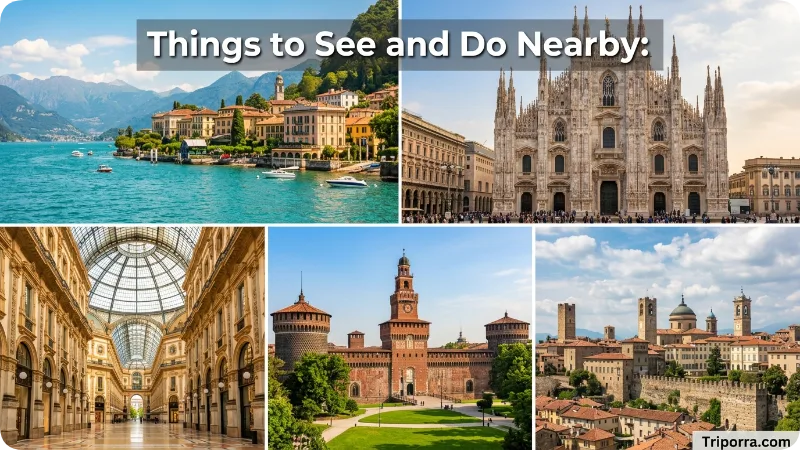
Milan serves as an excellent base for exploring northern Italy.
Duomo di Milano
One of the world’s largest Gothic cathedrals and the city’s most famous landmark.
Galleria Vittorio Emanuele II
Historic shopping arcade featuring luxury boutiques and elegant architecture.
The Last Supper
Leonardo da Vinci’s renowned mural located at Santa Maria delle Grazie.
Lake Como
About an hour from it by train, Lake Como is famous for scenic villages and mountain views.
Sforza Castle
Historic fortress housing museums and art collections.
San Siro Stadium
A must-visit destination for football enthusiasts.
Lake Maggiore
Popular for lakeside towns, gardens, and mountain scenery.
Bergamo
A charming nearby city known for its medieval upper town.
Best Time to Visit
The ideal time depends on personal travel preferences.
Best Overall
April to June and September to October offer pleasant weather and comfortable sightseeing conditions.
Best for Shopping
Fashion enthusiasts often visit during:
- Milan Fashion Week (February)
- Milan Fashion Week (September)
Best for Budget Travelers
November through March generally offers lower accommodation prices, excluding holiday periods.
Best for Outdoor Exploration
Late spring and early autumn provide excellent conditions for walking and day trips.
Common Misconceptions
Several misunderstandings surround Milan.
Milan Is Italy’s Capital
This is false. Rome is Italy’s capital city.
Milan Is in Southern Italy
It is located in northern Italy, close to the Alps and Switzerland.
Milan Is Only About Fashion
Fashion is important, but Milan is also a major center for finance, history, education, design, sports, and technology.
Milan Is a Coastal City
The city is inland and does not sit on the Mediterranean coast.
Did You Mean a Different Place?
Although the Italian city is the most famous location with this name, several other places are also called Milan, including:
- Milan, Ohio, United States
- Milan, Tennessee, United States
- Milan, Michigan, United States
- Milan, New Mexico, United States
Searches for “where is Milan” usually refer to Milan, Italy.
Places Related to Milan
People searching for Milan often look for these nearby or connected destinations:
- Rome
- Venice
- Florence
- Turin
- Lake Como
- Lake Garda
- Bergamo
- Verona
- Genoa
- Switzerland
These locations are easily accessible from Milan and often form part of broader northern Italy travel itineraries.
What Else Do People Want to Know?
Is Milan Safe?
Yes, it is generally considered safe for tourists, though visitors should remain aware of pickpocketing in crowded areas.
Is Milan Expensive?
Compared with many Italian cities, it tends to be more expensive, especially in central districts and luxury shopping areas.
Do People Speak English?
English is commonly spoken in tourist areas, hotels, restaurants, and major attractions.
Is Public Transportation Good?
The city has an extensive network of metros, buses, and trams that make getting around easy.
Is Milan Good for Families?
Yes. Museums, parks, shopping districts, and nearby lakes offer activities suitable for all ages.
FAQs
What are the best things to do in Milan?
Visit the Duomo di Milano, see Leonardo da Vinci’s The Last Supper, shop in the Galleria Vittorio Emanuele II, and explore historic neighborhoods and museums.
Is Milan a country?
No. It is a city in Italy, not a country. It is the capital of the Lombardy region and one of Italy’s largest and most important cities. Milan is also a major European center for fashion, finance, business, art, and design.
Where is Milan, Italy, on the map?
Milan is in northern Italy, in the Lombardy region, about 140 km (87 miles) south of the Swiss border.
What state is Milan in?
It is in Lombardy, a region in northern Italy. Italy uses regions rather than U.S.-style states for this level of administration. Milan is the capital of the Lombardy region and the center of the Metropolitan City of Milan.
Are Milan and Rome close?
Milan and Rome are in the same country but are not especially close. They are about 480 kilometers (298 miles) apart by straight-line distance, with Milan in northern Italy and Rome in central Italy. High-speed trains and flights make travel between the two cities convenient.
What is Milan famous for?
It is famous for fashion, luxury shopping, world-class art, the Duomo cathedral, and being Italy’s financial and business hub.
Milan is the capital of which country?
Milan is not a national capital; it is a major city in Italy and the capital of the Lombardy region.
Where is Milan Cortina?
Milan-Cortina refers to the 2026 Winter Olympics hosted across Milan and Cortina d’Ampezzo in northern Italy. Milan served as one of the main host cities, while Cortina d’Ampezzo hosted events in the Italian Alps. The two locations are in northern Italy, but they are in different parts of the region.
What is the population of Milan?
Milan has a population of approximately 1.4 million people, while its metropolitan area is home to over 3 million residents.
Are Milan and Milano the same?
Yes. Milan and Milano are the same city. Milan is the English name, while Milano is the city’s Italian name. Both refer to the major city in northern Italy’s Lombardy region.
What is the area of Milan?
The city of Milan covers an area of approximately 181 square kilometers (70 square miles).
What language is spoken in Milan?
Italian is the official language, though English is widely understood in tourist areas.
What is the population of Milan?
The city has approximately 1.3–1.4 million residents, while the metropolitan area exceeds 3 million.
Can you visit Lake Como from Milan?
Yes. Lake Como is easily reachable by train in about one hour.
Conclusion
Milan is a major city in northern Italy’s Lombardy region, positioned between the Alps and the fertile Po Valley. Known worldwide for fashion, finance, football, architecture, and cultural landmarks, it serves as one of Europe’s most influential urban centers. Whether you’re interested in history, luxury shopping, art, business, or exploring nearby lakes and mountains, Milan offers an excellent gateway to both Italy and the wider European continent.

About Leo Sterling
Leo Sterling is a geography and travel writer at Triporra.com who believes understanding a place starts with knowing exactly where it is. He turns geographic details on countries, regions, islands, and cities into clear, engaging content for everyday readers.
For Leo, a good location article does more than mark a spot on a map. It shows what borders a place, which region it belongs to, and how it connects to the world around it—an approach reflected in guides like where is Anguilla, where solid research meets a simple, conversational style.
Whether readers are planning a trip, studying, or just curious, Leo’s goal is the same: deliver accurate, easy-to-understand information without unnecessary complexity.
Areas of Focus: Geography | Countries & Regions | Caribbean Islands | Travel Destinations | Location Research | “Where Is?” Content