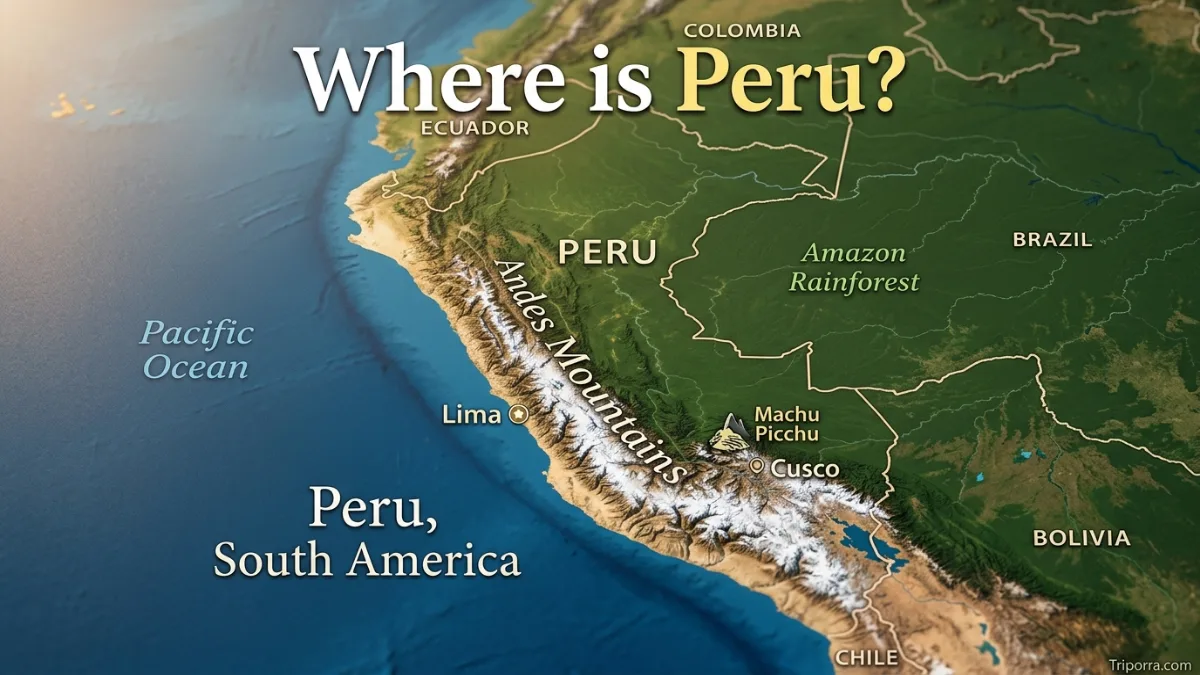
If you are asking “where is Peru,” the simple answer is this: Peru is a country on the western side of South America, along the Pacific Ocean. It sits south of Ecuador and Colombia, west of Brazil and Bolivia, and north of Chile. Peru matters because it connects dramatic coast, high Andes mountains, Amazon rainforest, ancient Inca history, and world-famous places like Machu Picchu.
Featured Snippet Answer
Peru is a sovereign country in western South America. It borders Ecuador, Colombia, Brazil, Bolivia, and Chile, with the Pacific Ocean on its western side. Its capital is Lima, and it is known for Machu Picchu, the Andes Mountains, Amazon rainforest, Inca history, rich food culture, and diverse landscapes.
Where Is Peru Located?
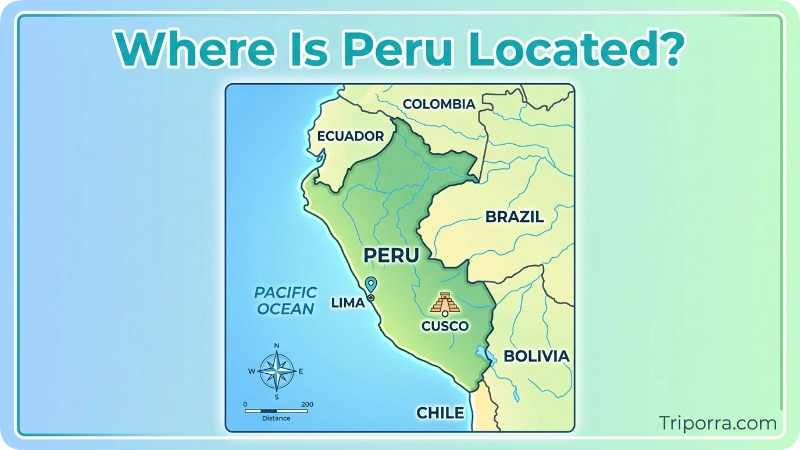
Peru is located in the Southern Hemisphere, on the central-western coast of South America. Its long western edge faces the Pacific Ocean, while its eastern side reaches into the Amazon Basin. The country is part of Latin America and is one of the largest countries on the continent by area.
Geographically, Peru is easy to picture as three long natural bands. The first is the dry Pacific coast, where Lima and several large cities are found. The second is the Andes mountain region, where Cusco, Machu Picchu, and Lake Titicaca are located. The third is the Amazon rainforest, which covers a large part of the east and includes cities such as Iquitos and Puerto Maldonado. Peru’s geography is commonly described through these coast, highland, and jungle regions.
Quick Facts About Peru
| Fact | Details |
|---|---|
| Official Name | Republic of Peru |
| Country Type | Sovereign Country |
| Continent | South America |
| Capital | Lima |
| Region | Latin America / Western South America |
| Population | Around 34.6 million people (2025 estimate) |
| Time Zone | Peru Time (PET), UTC−5 |
| Coordinates | Approximately 10°S, 76°W |
| Nearby Major Cities | Lima, Cusco, Arequipa, Trujillo, Chiclayo, Iquitos |
| Known For | Machu Picchu, Andes Mountains, Amazon Rainforest, Inca Heritage, Lima Cuisine |
| Official / Major Languages | Spanish; Quechua, Aymara, and other Indigenous languages in regions where they are spoken |
| Currency | Peruvian Sol (PEN) |
| Bordering Countries | Ecuador, Colombia, Brazil, Bolivia, Chile |
| Coastline | Pacific Ocean |
| Government Type | Unitary Presidential Republic |
| Highest Point | Huascarán (6,768 m / 22,205 ft) |
| World Region | Western South America |
| Famous Landmark | Machu Picchu |
| Population Source | UNFPA 2025 estimate; World Bank recorded 34.2 million people in 2024 |
Peru on the Map
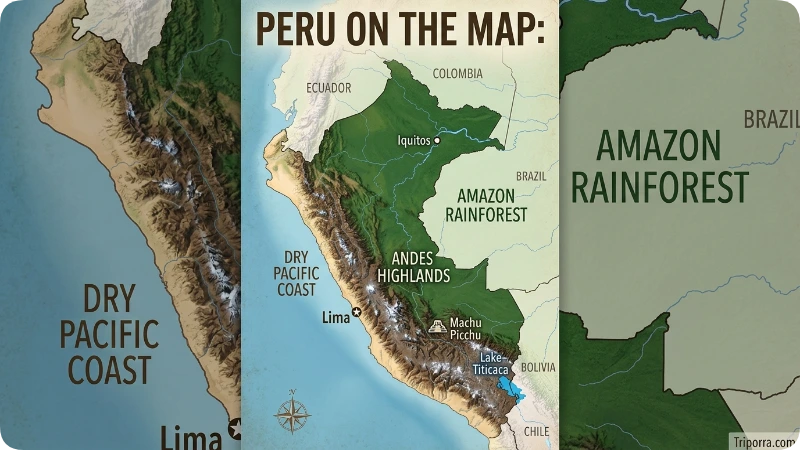
On a map of South America, Peru appears on the left side of the continent. It has a long coastline along the Pacific Ocean. To the north are Ecuador and Colombia. Brazil lies to the east, Bolivia sits to the southeast, and Chile is to the south.
The Andes Mountains run roughly north to south through the country, close to the coast but not directly on it. East of those mountains, the land drops into the Amazon rainforest. This makes Peru one of the most varied countries in the world in a small visual space: desert coast on one side, snowy peaks in the middle, and tropical forest on the other.
Lima, the capital, is on the central coast. Cusco is inland in the Andes, southeast of Lima. Machu Picchu is near Cusco, above the Urubamba River valley. Lake Titicaca lies farther southeast, along the border area with Bolivia. Iquitos, one of the main Amazon cities, is in the far northeast and is famous because it is not connected to the rest of the country by normal long-distance roads.
Which Region Does Peru Belong To?
Peru belongs to South America and the wider Latin American region. Politically, it is an independent republic. Administratively, Peru is not divided into “states” like the United States. Instead, it has departments or regional governments, provinces, and districts.
At the regional level, Peru includes 24 departments with regional governments, along with the Constitutional Province of Callao. Lima also has a special role because it is the national capital and the country’s largest urban center. Provinces and districts handle more local matters, such as municipal services and local planning.
This matters for travelers and students because names can be confusing. “Cusco” can mean the city, the province, or the wider region. “Lima” can mean the city, the province, or the metropolitan area. “Callao” is next to Lima and includes the main port and the area of Lima’s international airport.
How Does Peru Compare to Nearby Places?
Peru is larger than many people expect. It is the third-largest country in South America after Brazil and Argentina. Its size and landscape make it very different from its neighbors. Ecuador is smaller and lies directly north. Bolivia has highland culture and Lake Titicaca connections but no ocean coast. Chile is long and narrow, with a very different desert-and-southern landscape pattern. Brazil is much larger and holds the biggest share of the Amazon Basin.
For tourism, Peru is one of South America’s best-known destinations because it combines famous archaeological sites, mountain trekking, Amazon nature, colonial cities, coastal food culture, and ancient civilizations in one country. A visitor can eat seafood in Lima, fly to Cusco in about an hour and a half, explore the Sacred Valley, visit Machu Picchu by train, and then travel to the Amazon for wildlife experiences. Lima-to-Cusco flights are commonly listed at about 1 hour and 20–25 minutes.
Compared with nearby countries, Peru is especially famous for Inca history. Cusco was a major Inca center, and Machu Picchu is one of the world’s most recognized archaeological sites.
How to Reach Peru
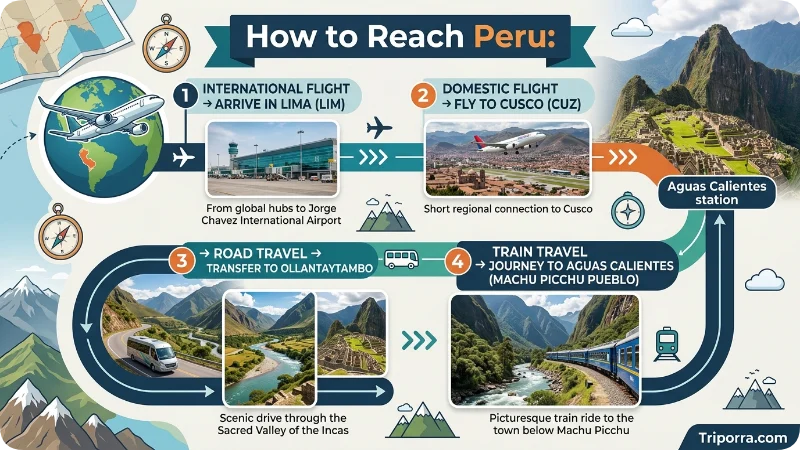
Most international travelers arrive by air. Jorge Chávez International Airport in Lima is the main gateway for long-distance flights from North America, Europe, and other parts of Latin America. From Lima, travelers can take domestic flights to Cusco, Arequipa, Iquitos, Puno/Juliaca, and other regional cities.
Cusco’s Alejandro Velasco Astete Airport is the main air gateway for travelers heading to Machu Picchu and the Sacred Valley. From Cusco, many visitors travel by road to Ollantaytambo, then continue by train to Aguas Calientes, also called Machu Picchu Pueblo. PeruRail notes that trains to Machu Picchu commonly depart from Ollantaytambo and Poroy in the Cusco area and arrive at Aguas Calientes. Road travel is possible from neighboring countries, but distances can be long. Long-distance buses connect Peru with Ecuador, Bolivia, Chile, and other parts of South America. Inside Peru, buses are common for travel between coastal cities and some mountain routes, though mountain roads can be slow because of curves, altitude, weather, and landslides during rainy months.
There is no single simple rail network across the whole country. Trains are most useful for special routes, especially in the Cusco and Machu Picchu area.
Why Is Peru Famous?
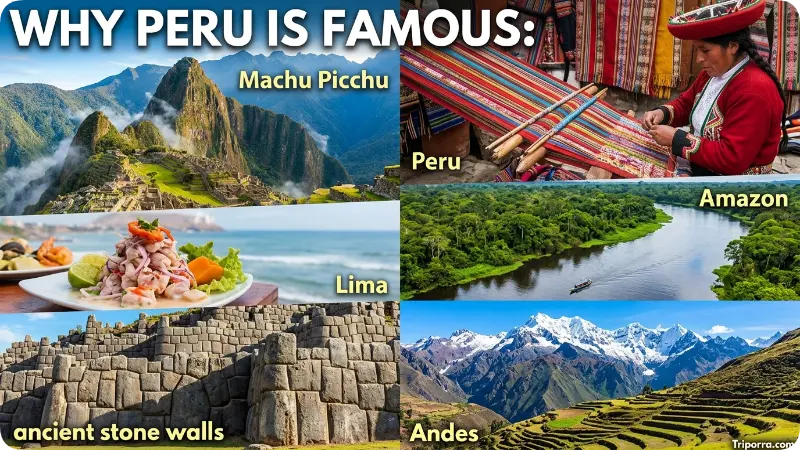
Peru is famous for history, food, nature, mountains, and culture. Its biggest global symbol is Machu Picchu, the 15th-century Inca site high in the Andes. UNESCO describes the Historic Sanctuary of Machu Picchu as a mixed World Heritage property with both cultural and natural value, covering mountain slopes, peaks, valleys, and the famous citadel above 2,400 meters.
The country is also known for Cusco, the Sacred Valley, the Nazca Lines, Lake Titicaca, Arequipa, Colca Canyon, the Amazon rainforest, and Lima’s food scene. Peru’s official tourism website highlights Machu Picchu but also points to other major heritage places such as Kuelap, Chavín de Huántar, Caral, Chan Chan, the Nasca Lines, and Sipán.
Food is another major reason people search for Peru. Dishes like ceviche, lomo saltado, anticuchos, causa, and ají de gallina are widely known. Lima is often seen as one of Latin America’s most important food cities, with influences from Indigenous, Spanish, African, Chinese, Japanese, and Andean traditions.
Peru’s economy is also important in the region. Mining, agriculture, fishing, services, and tourism all play major roles. OECD research notes that Peru is one of the largest fish producers in the Americas, with major marine capture and aquaculture activity.
History of Peru
Peru’s history is much older than the modern country. Long before Spanish rule, the area was home to many advanced civilizations, including Caral, Chavín, Moche, Nazca, Wari, Chimú, and the Inca. These cultures built cities, roads, temples, irrigation systems, textiles, pottery, and works of art that still shape Peru’s identity.
The Inca Empire became the most famous pre-colonial power in the region. Its capital was Cusco, and its road network connected large parts of the Andes. Machu Picchu was built in the 15th century and later abandoned after the Spanish conquest of the Inca Empire in the 16th century.
Spain controlled Peru for almost three centuries. Lima became one of the most important cities in Spanish South America. Peru declared independence in 1821, and the independence process was consolidated after later military victories. Today, Peru is a modern republic with a strong Indigenous heritage, colonial history, and growing global interest in tourism, food, archaeology, and biodiversity.
Climate and Weather
Peru does not have one simple climate. The coast, Andes, and Amazon each feel different.
The coastal region is mostly dry, especially around Lima and farther south. Lima often has cloudy, mild weather for much of the year, with very little rain. Northern beaches are warmer and sunnier.
The Andes have a dry season and a rainy season. May to September is usually the best-known dry period for Cusco, Machu Picchu, trekking, and mountain travel. Nights can be cold, especially at high altitude. November to March is wetter in many mountain areas, with January and February often bringing heavier rain.
The Amazon is hot and humid for most of the year. Rain can happen in any month, but many jungle areas are wetter from roughly November to April. Travel conditions can change with river levels, road conditions, and local weather.
Recent travel weather can also be affected by El Niño-related rains, flooding, and landslides. Travelers should check official weather and travel advisories close to departure, especially if visiting during the rainy season.
Things to See and Do Nearby
Peru has enough attractions for many different travel styles.
Machu Picchu is the most famous stop. Most people reach it from Cusco through the Sacred Valley and Aguas Calientes. Tickets and train plans should be arranged early in busy months.
Cusco is worth time on its own. The city has Inca walls, Spanish colonial buildings, markets, churches, museums, and nearby sites such as Sacsayhuamán. UNESCO lists the City of Cuzco as a World Heritage property.
The Sacred Valley includes places such as Ollantaytambo, Pisac, Chinchero, Moray, and Maras. It is easier on the body than Cusco for some travelers because parts of the valley are lower in altitude.
Lima offers coastal views, museums, historic plazas, Miraflores, Barranco, and strong food culture. Many travelers spend at least one full day there before flying to Cusco.
Arequipa is known for white volcanic stone buildings and access to Colca Canyon. Puno and Lake Titicaca attract visitors interested in high-altitude lake culture. The Amazon areas near Iquitos, Tambopata, and Manu are popular for wildlife, rivers, lodges, and rainforest experiences.
Best Time to Visit
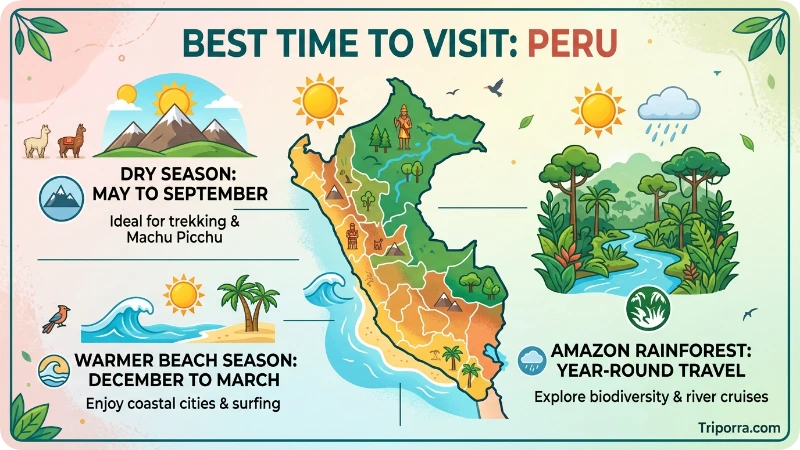
For first-time visitors focused on Cusco, Machu Picchu, and the Andes, May to September is usually the safest weather choice because it is the dry season in the highlands. June, July, and August are busy, so prices and crowds can rise.
April, May, September, and October can be excellent shoulder months. These months often balance clearer weather with fewer visitors than the peak summer travel period.
For the coast, including Lima and northern beaches, December to March is warmer and better for beach weather. For the Amazon, travel is possible year-round, but visitors should choose timing based on whether they prefer easier dry-season walking or higher-water river access.
Budget travelers may find better deals during wetter months, especially from January to March in some tourist areas. The trade-off is less predictable weather and possible transport delays.
Common Misconceptions
One common mistake is thinking Peru is only Machu Picchu. Machu Picchu is important, but the country also has deserts, beaches, cloud forests, volcanoes, Amazon rivers, major cities, and many cultures.
Another mix-up is assuming Lima is near Machu Picchu. Lima is on the coast, while Machu Picchu is far inland near Cusco. Most travelers fly from Lima to Cusco, then continue by road and train.
The question “where is Peru” can also lead people to smaller places with the same name. Did you mean a different place?
Peru, Indiana is a city in the U.S. state of Indiana and is especially known for its circus heritage. Meanwhile, Peru, Illinois lies in LaSalle and Bureau counties in northern Illinois. Farther east, Peru, New York is a town in Clinton County near the scenic Adirondack region.
The main subject of this article is the country of Peru in South America.
Places Related to Peru
Several places are closely linked to Peru in search results and travel planning.
Lima is the capital and main international entry point. Cusco is the historic Andean city used as the base for Machu Picchu trips. Machu Picchu is the famous Inca citadel near Aguas Calientes. Sacred Valley is a scenic and cultural region between Cusco and Machu Picchu. Lake Titicaca lies in the high Andes near the Bolivia border. Arequipa is a major southern city near volcanoes and Colca Canyon. Iquitos is a major Amazon city in northeastern Peru. Nazca is known for the Nazca Lines in the desert. Paracas is a coastal area known for wildlife, beaches, and desert scenery.
What Else Do People Want to Know?
Travelers often ask if Peru is safe. The practical answer is that many people visit without major problems, but caution is important. Current government travel advice from the United States, United Kingdom, Canada, and Australia recommends increased or high caution in Peru because crime, civil unrest, protests, roadblocks, and localized risks can affect travel. Some border or remote areas may have stronger warnings, so checking your own government’s latest advice before travel is wise.
Cost depends on travel style. Peru can be affordable for backpackers using buses, simple guesthouses, and local food. It can also be expensive if you choose luxury trains, high-end hotels, private tours, and peak-season Machu Picchu arrangements.
Altitude is another key issue. Cusco is high enough that some visitors feel headaches, tiredness, or shortness of breath during the first day. Taking it slow, drinking water, eating light meals, and avoiding a packed first-day plan can help. People with health concerns should ask a medical professional before high-altitude travel.
Local culture is warm, varied, and region-based. Spanish is the main language, but Quechua, Aymara, and many Indigenous languages are important in different communities. Learning a few Spanish phrases and respecting local customs will make travel smoother.
FAQs
Where Is Peru Located in the World?
Peru is located on the western coast of South America, bordered by Ecuador, Colombia, Brazil, Bolivia, Chile, and the Pacific Ocean.
What Is the Currency of Peru?
The official currency of Peru is the Peruvian Sol (PEN), which is used for all everyday transactions across the country.
What Is the Capital of Peru?
The capital of Peru is Lima, the country’s largest city and its political, cultural, and economic center.
Where Is Peru on a Map?
Peru appears on the western side of South America along the Pacific Ocean, between Ecuador and Chile.
Which Continent Is Peru In?
Peru is located in South America, one of the 12 independent countries on the continent.
Where Is Machu Picchu in Peru?
Machu Picchu is located in the Cusco Region of southeastern Peru, high in the Andes Mountains.
Is Peru in Europe?
No, Peru is not in Europe. It is a country in South America.
Where Is Lima, Peru?
Lima is located on Peru’s central Pacific coast and serves as the country’s capital and largest city.
Is Peru a country or a city?
Peru is a country. There are also cities and towns named Peru in the United States, but the best-known Peru is the South American country.
How far is Lima from Cusco?
The flight from Lima to Cusco usually takes about 1 hour and 20–25 minutes. Driving or going by bus takes much longer because of mountain roads.
Is Peru good for first-time travelers?
Yes, Peru can be a good first South America trip if you plan carefully. Popular routes like Lima, Cusco, Sacred Valley, and Machu Picchu have strong tourism services.
What is Peru most famous for?
Peru is most famous for Machu Picchu, Inca history, the Andes, Amazon rainforest, Lima’s food scene, and ancient sites such as the Nazca Lines.
Conclusion: Why Peru’s Location Matters
Peru is a country on the western coast of South America, facing the Pacific Ocean and stretching inland across the Andes into the Amazon rainforest. Its location explains why it has such varied weather, landscapes, cultures, foods, and travel experiences.
For travelers, Peru is more than one famous ruin. It is Lima’s coast, Cusco’s mountain history, the Sacred Valley’s villages, Lake Titicaca’s highland culture, Arequipa’s volcanic scenery, and the Amazon’s wildlife. Understanding its map makes planning easier and helps you see why Peru remains one of the most fascinating countries in Latin America.

Elena Rostova bridges the gap between premium hospitality and authentic local experiences. Armed with a background in luxury hospitality management and a passion for fine architecture, she spent years evaluating elite resorts before transitioning into travel journalism. Elena heads the luxury and boutique travel vertical on Triporra.com. Her meticulous guides strip away the guesswork from high-end travel, showcasing unique five-star escapes, fine regional dining, and bespoke private tours that elevate a standard vacation into an unforgettable journey.