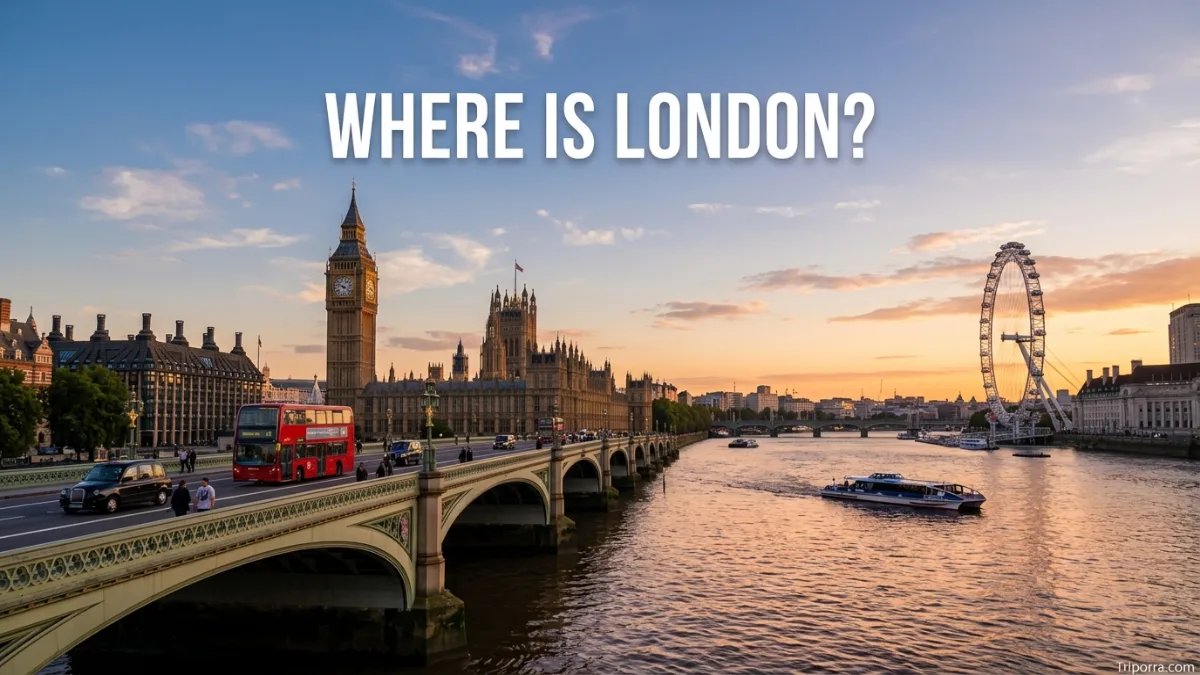
Where is it ? It is in south-east England, in the United Kingdom, on the River Thames. It is the capital of both England and the UK, and it matters because it is a major center for government, travel, finance, history, education, culture, and tourism.
For most travelers and students, “London” means the large capital area known as Greater London. This includes central places such as Westminster, the City of London, Camden, Southwark, Kensington, Greenwich, and many outer boroughs.
Featured Snippet Answer
Where is London? It is in south-east England, in the United Kingdom, on the River Thames. Administratively, the wider capital is Greater London, made up of 32 London boroughs plus the City of London. The city is known for Parliament, Buckingham Palace, Tower Bridge, museums, finance, theatre, and global travel links.
Where Is it Located?
It is located in Europe, in the United Kingdom, within the constituent country of England. More specifically, it lies in south-east England along the River Thames, which runs west to east through the city before flowing toward the Thames Estuary and the North Sea.
The capital is not a “state” like places in the United States. In UK terms, London is a region of England and a large urban area. The modern administrative area is commonly called Greater London. It covers the 32 London boroughs and the separate City of London Corporation area. London City Hall explains that London has 33 local government authorities: 32 boroughs and the City of London Corporation.
London’s coordinates are about 51°30′N, 0°08′W, which places it north of the equator and very close to the Prime Meridian at Greenwich. Its time zone is Greenwich Mean Time in winter and British Summer Time during daylight saving time.
Quick Facts About it
| Fact | Detail |
|---|---|
| Official Name | London / Greater London |
| Country | United Kingdom |
| Constituent Country | England |
| Region | Greater London |
| Population | Approximately 8.95 million (2023 official mid-year estimate) |
| Time Zone | Greenwich Mean Time (GMT) / British Summer Time (BST) |
| Coordinates | Approximately 51°30′N, 0°08′W |
| Nearby Major Places | Reading, Oxford, Cambridge, Brighton, Windsor |
| Known For | UK Government, River Thames, Financial District, Museums, Royal Landmarks, Theatre, History |
| Main Language | English |
| Currency | Pound Sterling (GBP) |
| River | River Thames |
| Continent | Europe |
| Major Airport | Heathrow Airport (LHR) |
| Government Status | Capital City of the United Kingdom and England |
| Famous Landmarks | Buckingham Palace, Big Ben, Tower Bridge, London Eye, Tower of London |
| Economy | Finance, Tourism, Media, Technology, Education |
| Founded By | Romans (as Londinium) |
| UNESCO Sites | Tower of London, Maritime Greenwich, Westminster Palace and Abbey |
| Climate | Temperate Oceanic Climate |
| Nickname | The Big Smoke, The Square Mile (for the financial district) |
Population Note: London’s official population was estimated at 8.95 million people in the 2023 mid-year estimate published by the Greater London Authority’s London Datastore.
London on the Map
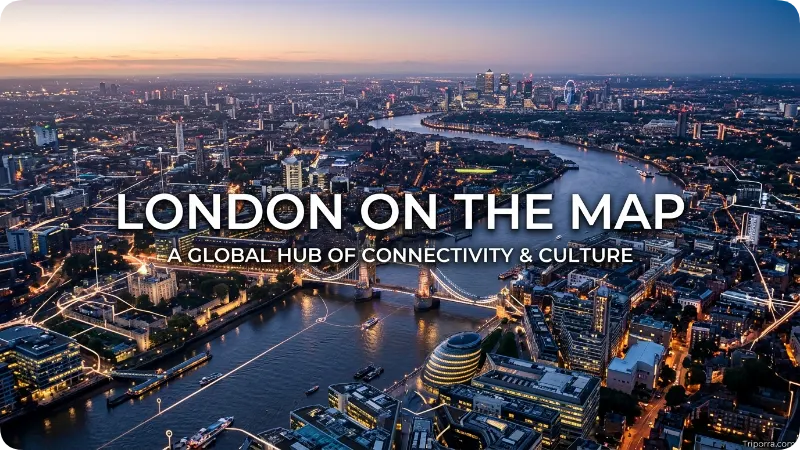
On a map of the UK, It sits in the lower right part of England. Scotland is far to the north, Wales is to the west, and continental Europe lies across the English Channel to the south-east.
The River Thames is the easiest natural feature to follow. It enters the London area from the west, passes famous riverside landmarks such as Westminster, the London Eye, the City of London, Tower Bridge, and Greenwich, then continues east toward the estuary.
Imagine England as a tilted rectangle. It is not in the middle of that rectangle. It is closer to the south-east corner, not far from the coast by UK standards. That position helps explain why it became a powerful port and trading center. The Thames gave ships access inland, while roads and later railways connected the capital to the rest of Britain.
Nearby places also help you picture the location. Oxford is northwest of it, Cambridge is north, Brighton is south on the coast, and Windsor is west. Paris is across the Channel and can be reached by international rail through the Channel Tunnel.
Which Region Does it Belong To?
It belongs to the London region of England. In everyday speech, people often say “London” to mean the whole capital city. In government terms, it is more exact to say Greater London.
Greater London is not the same as the City of London. This is a common source of confusion. The City of London is the old historic and financial center, sometimes called the “Square Mile.” It is only a small part of the wider capital. Greater London is much larger and includes boroughs such as Westminster, Camden, Islington, Hackney, Lambeth, Southwark, Greenwich, Croydon, Ealing, Barnet, and many more.
The Greater London Authority gives citywide strategic direction, while borough councils handle many local services. Local government in London includes 32 boroughs and the City of London Corporation.
This layered structure is why it can feel like many towns joined together. Each borough has its own local identity, high streets, parks, schools, and council services, while the whole area works as one global capital.
How Does it Compare to Nearby Places?
It is much larger and busier than nearby cities such as Oxford, Cambridge, Brighton, or Reading. Those places are famous in their own right, but they are smaller, easier to cross, and more focused on a few main districts.
Oxford and Cambridge are known for their historic universities. Brighton is known for its seaside setting. Windsor is famous for Windsor Castle and royal history. Reading is a major town west of the capital with strong rail links. London, by comparison, has national government, major airports, world museums, a huge public transport network, global finance, West End theatre, Premier League football clubs, royal landmarks, and many neighborhoods with different cultures.
Access also sets London apart. Many UK train routes point toward the capital. International flights arrive at major airports around the city, and Eurostar trains connect it with continental Europe. Transport for London also provides information for visitors on airports, rail, coaches, buses, river services, maps, payment, and accessibility. For travelers, this means it can be a full trip by itself or a base for day trips. A visitor might spend several days in the capital and still not see everything.
How to Reach it

It is one of the easiest cities in Europe to reach. International visitors usually arrive by air, train, coach, or car.
The main airport for many long-haul flights is Heathrow, west of central London. Other major airports serving the capital include Gatwick, Stansted, Luton, London City Airport, and Southend. These airports are not all inside central London, but they are connected to the city by train, coach, taxi, or road.
Rail travel is also important. Major its stations include King’s Cross, St Pancras International, Paddington, Waterloo, Victoria, Liverpool Street, London Bridge, Euston, and Marylebone. St Pancras International is especially important for Eurostar services to Europe.
Inside the city, travelers use the Underground, Elizabeth line, Overground, buses, trams in parts of south London, river boats, taxis, cycling routes, and walking. Transport for London offers visitor guidance on getting around, payment methods, transport accessibility, and journey planning. Driving is possible, but it is usually not the easiest option for tourists. Central London has busy roads, parking limits, congestion charges, and emission rules. Public transport is often faster and simpler.
Why Is it Famous?
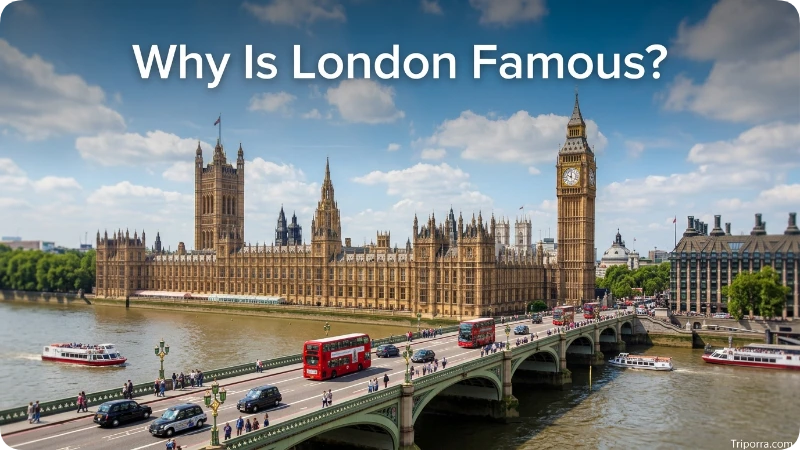
It is famous because it combines history, power, culture, and modern life in one large city.
Politically, it is the home of the UK Parliament, 10 Downing Street, and many national institutions. Culturally, it has world-known museums, galleries, theatres, music venues, festivals, bookshops, markets, and restaurants. Economically, it is one of the world’s major financial and business centers, especially around the City of London and Canary Wharf.
Tourism is another major reason people know London. Popular sights include Buckingham Palace, Tower Bridge, the Tower of London, Westminster Abbey, the Houses of Parliament, Big Ben, the British Museum, the National Gallery, Hyde Park, Greenwich, Camden Market, and the London Eye. Visit London, the official visitor guide, highlights attractions, theatre, royal sites, sightseeing, restaurants, tours, and family activities for first-time and returning visitors. London is also famous for diversity. People from many countries live, study, work, and visit there. This is why you can hear many languages, eat food from around the world, and find neighborhoods with very different styles.
History
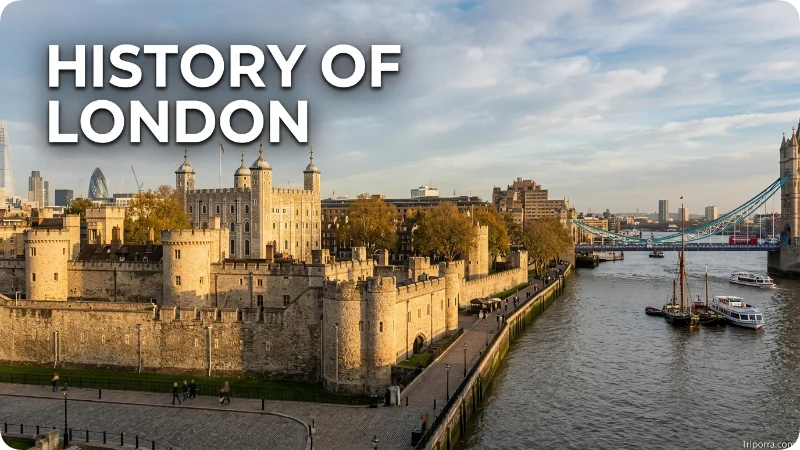
London’s story goes back nearly 2,000 years. The Romans founded a settlement called Londinium around 47–50 CE, in the area that is now the City of London. The London Museum explains that Roman Londinium laid the foundations for the modern city and lasted for about 350 years.
The location was practical. The Thames gave access to trade and transport, and the land near the river made it possible to build a crossing and connect roads. Over time, London grew into a major settlement.
During the medieval period, it became an important center for trade, religion, law, and royal power. Westminster developed as a place of government and monarchy, while the City of London grew as a commercial center.
The city faced major disasters. The Great Fire of London in 1666 destroyed much of the old city, but rebuilding changed the skyline and street pattern. Later, the Industrial Revolution and the British Empire made London one of the world’s largest and most influential cities.
Modern London grew far beyond the old Roman and medieval center. Railways, suburbs, migration, business, and government shaped the city into the large capital region seen today.
Climate and Weather
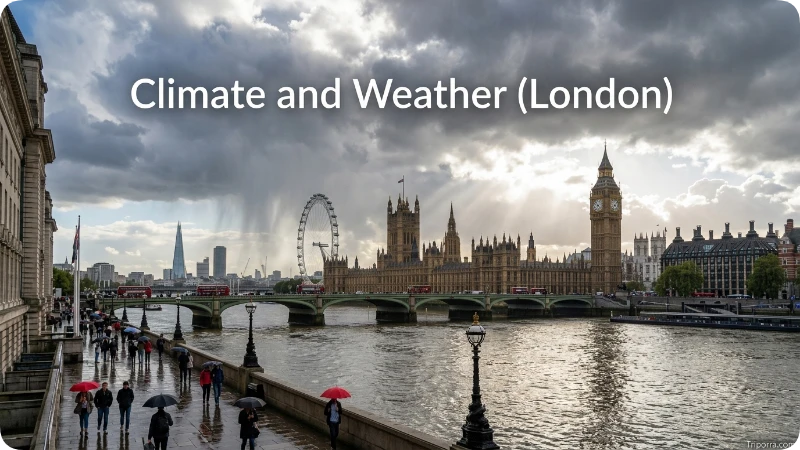
It has a mild, temperate climate compared with many places at similar northern latitudes. Winters are usually cool rather than extremely cold. Summers are often mild to warm, though heatwaves can happen. Rain is possible in any season, so visitors should pack a light rain jacket or umbrella.
The Met Office provides long-term climate averages for UK locations, including climate variables such as temperature, frost, sunshine, and rainfall. Its climate pages use official station data and long-term averages to help people understand typical weather patterns. Spring can be a pleasant time, with flowers in parks and longer daylight. Summer brings outdoor events, busy attractions, and higher hotel prices. Autumn often has cooler air, golden leaves, and fewer crowds than peak summer. Winter is dark early, but Christmas lights, indoor museums, theatres, and markets make it a popular season for city breaks.
The practical rule is simple: dress in layers. London weather can change during the day.
Things to See and Do Nearby
It has enough attractions for a week or more. First-time visitors usually start with central landmarks.
Westminster is a strong starting point. You can see the Houses of Parliament, Big Ben, Westminster Abbey, St James’s Park, and Buckingham Palace in the same general area. Across the river, the South Bank offers the London Eye, riverside walks, theatres, food spots, and views back toward Parliament.
The City of London is best for older streets, St Paul’s Cathedral, finance towers, Roman history, and the Tower of London. Nearby Tower Bridge is one of the most photographed bridges in the world.
Museum lovers have many choices. The British Museum, Natural History Museum, Science Museum, Victoria and Albert Museum, National Gallery, Tate Modern, and Museum of London Docklands are major names. Families often enjoy the Science Museum, Natural History Museum, London Transport Museum, parks, river boats, and theatre shows.
Green spaces are another reason London is easy to enjoy. Hyde Park, Regent’s Park, Greenwich Park, Richmond Park, Hampstead Heath, and St James’s Park give visitors room to walk, rest, and see views.
Day trips are also simple. Windsor, Oxford, Cambridge, Brighton, Canterbury, and Stonehenge are common choices, depending on your time and interests.
Best Time to Visit
The best time to visit London depends on what you want.
Late spring and early autumn are often the most comfortable seasons. May, June, September, and early October can offer good weather, long enough daylight, and slightly lighter crowds than the busiest summer weeks.
Summer is best for outdoor events, parks, river walks, festivals, and long evenings. It is also one of the busiest and most expensive times. Book hotels and major attractions early.
Winter can be a good choice for museums, theatre, shopping, Christmas lights, and lower crowd levels after the holiday period. Days are shorter, and weather can feel damp, but many indoor attractions work well in winter.
Budget travelers may prefer January, February, or parts of November, outside major holidays. Families often travel during school breaks, so prices can rise at those times.
Common Misconceptions
Many people confuse London with several related places and terms.
First, London is not a country. It is a city and capital region in England, which is part of the United Kingdom.
Second, England and the UK are not the same thing. England is one constituent country of the UK. The United Kingdom includes England, Scotland, Wales, and Northern Ireland.
Third, Greater London and the City of London are different. Greater London is the wider capital area. The City of London is the small historic and financial district.
Fourth, London Bridge and Tower Bridge are not the same. Tower Bridge is the famous bridge with two towers. London Bridge is plainer and sits nearby on the Thames.
Fifth, “London” can also refer to other places. London, Ontario, is a city in Canada. Statistics Canada recorded London, Ontario’s 2021 population as 422,324. (Statistics Canada) London, Ohio, is a city in Madison County, United States, with a 2020 population of 10,279. There are also other smaller places named London or New London in different countries.
Places Related to London
Several places are closely connected to London in geography, history, or travel.
City of London is the ancient core and financial district. It has Roman roots, medieval streets, modern towers, and major business offices.
City of Westminster is the area most linked with UK government, Parliament, Buckingham Palace, Westminster Abbey, and many famous tourist sights.
Greenwich is known for maritime history and the Prime Meridian. It helps explain why the world uses Greenwich Mean Time.
Canary Wharf is a modern business district in east London. It has tall office buildings, shopping areas, docks, and fast transport links.
Windsor sits west of London and is strongly linked to the royal family because of Windsor Castle.
Oxford and Cambridge are famous university cities and common day trips from the capital.
Brighton is a seaside city south of London and a popular escape for coastal walks, food, and beach views.
What Else Do People Want to Know?
It is generally easy for visitors, but planning helps.
Safety is similar to other large global cities. Most tourist areas are well used, but pickpocketing can happen in busy places. Keep your phone and wallet secure, especially on public transport, bridges, markets, and crowded streets.
Cost can vary a lot. London can be expensive for hotels, restaurants, taxis, and major attractions. At the same time, many parks, walking routes, markets, and some museums can help travelers control their budget.
Accessibility has improved, but not every old station or building is step-free. Transport for it provides accessibility information for visitors, which is useful for wheelchair users, older travelers, families with strollers, and anyone who needs easier routes. Local culture is polite but fast-moving. People often stand on the right on escalators, queue for service, tap in and out on public transport where required, and keep voices lower on commuter trains. Londoners may seem busy, but many will help if you ask clearly and politely.
FAQs
1. Where is London on a world map?
It is in north-western Europe, in the United Kingdom. On a UK map, it is in south-east England along the River Thames.
2. Is London in England or the United Kingdom?
It is in both. It is the capital of England and also the capital of the United Kingdom.
3. Is London a city or a country?
It is a city and capital region, not a country. The country is the United Kingdom.
4. What county is London in?
Modern London is mainly Greater London. The small City of London is its own special local authority area and ceremonial county, separate from the wider Greater London ceremonial county.
5. What river runs through London?
The River Thames runs through London from west to east. Many famous landmarks sit close to the river.
6. Is London close to Paris?
London and Paris are in different countries, but they are well connected. Eurostar trains link London with Paris through the Channel Tunnel.
7. What is the difference between London and Greater London?
London is the everyday name for the capital. Greater London is the wider administrative region made up of 32 boroughs plus the City of London.
8. What is the City of London?
The City of London is the historic core and financial district. It is much smaller than Greater London and has its own local government structure.
9. What language is spoken in London?
English is the main language. Because London is very international, many other languages are also spoken across the city.
10. What currency does it use?
London uses the pound sterling, written as GBP or £.
11. Is it safe for tourists?
It is generally safe for tourists, but visitors should take normal big-city care. Watch your belongings, plan late-night travel, and stay aware in crowded areas.
12. What is it best known for?
It is best known for the UK Parliament, Buckingham Palace, Tower Bridge, the River Thames, museums, West End theatre, finance, royal history, parks, and global culture.
Conclusion: London’s Location and Why It Matters
It is in south-east England, in the United Kingdom, on the River Thames. It is the capital of England and the UK, and the wider modern city is best understood as Greater London: 32 boroughs plus the City of London.
Its location helped it grow from Roman Londinium into a major port, government center, business hub, and world travel destination. Today, its matters because it connects history with modern life. Visitors come for royal landmarks, museums, theatre, shopping, parks, food, football, river views, and day trips across southern England.
For anyone studying geography, planning a trip, or checking a map, the key point is clear: London is the UK capital in south-east England, shaped by the Thames and known across the world.

Silas Vance is a geography enthusiast, travel researcher, and location-focused content writer dedicated to helping readers better understand the world around them on triporra.com. He specializes in creating informative guides about cities, countries, islands, landmarks, universities, and other notable destinations. His work combines geographic accuracy, historical context, and practical insights to answer location-based questions in a simple and engaging way.