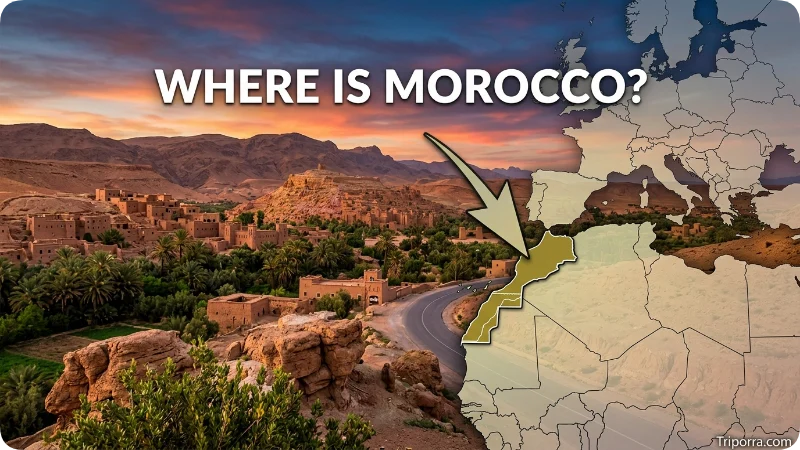
It is a country in Northwest Africa, located at the northwestern corner of the African continent. It borders the Atlantic Ocean to the west, the Mediterranean Sea to the north, Algeria to the east, and the territory of Western Sahara to the south.
Known for its historic cities, Sahara Desert landscapes, mountain ranges, colorful markets, and cultural heritage, Morocco serves as a gateway between Africa and Europe. Its strategic position has made it an important crossroads for trade, travel, and cultural exchange for centuries.
Featured Snippet Answer
It is a country in Northwest Africa, bordered by the Atlantic Ocean, the Mediterranean Sea, Algeria, and Western Sahara. Its capital city is Rabat, while Casablanca is its largest city. Morocco is famous for its historic medinas, Sahara Desert, Atlas Mountains, diverse culture, and location near southern Europe across the Strait of Gibraltar.
____________________________________________________________________________
Where Is Morocco Located?
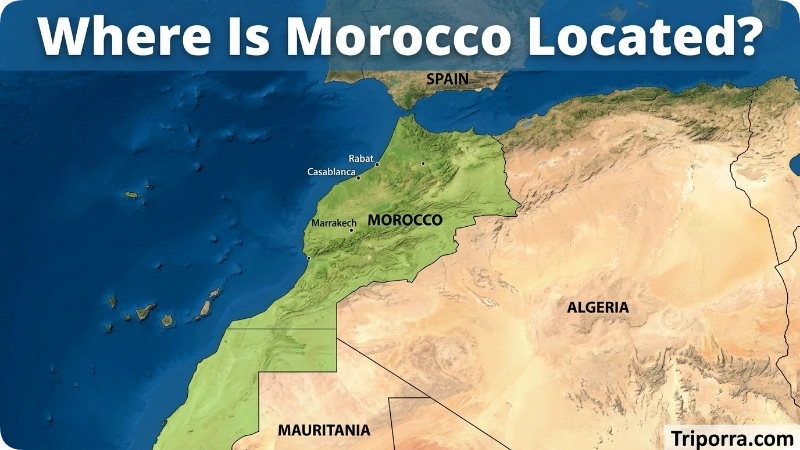
It is situated in the Maghreb region of North Africa, occupying the continent’s northwestern corner. It lies just south of Europe, separated from Spain by the Strait of Gibraltar, which is only about 14 kilometers (9 miles) wide at its narrowest point.
Administrative Hierarchy
- Continent: Africa
- Region: North Africa (Maghreb)
- Country: Kingdom of Morocco
- Capital: Rabat
- Largest City: Casablanca
Morocco’s location gives it coastlines on both the Atlantic Ocean and the Mediterranean Sea, making it one of the most geographically diverse countries in Africa.
Quick Facts Table
Quick Facts About Morocco
| Fact | Details |
|---|---|
| Official Name | Kingdom of Morocco |
| Continent | Africa |
| Region | North Africa (Maghreb) |
| Capital City | Rabat |
| Largest City | Casablanca |
| Population | Approximately 38 million+ |
| Time Zone | UTC+1 |
| Coordinates | Approximately 32°N, 6°W |
| Major Cities | Rabat, Casablanca, Marrakech, Tangier, Fes |
| Official Languages | Arabic and Amazigh (Berber) |
| Widely Spoken Languages | French and Spanish (in some regions) |
| Currency | Moroccan Dirham (MAD) |
| Known For | Sahara Desert, Atlas Mountains, historic cities, markets, and rich culture |
____________________________________________________________________________
Morocco on the Map
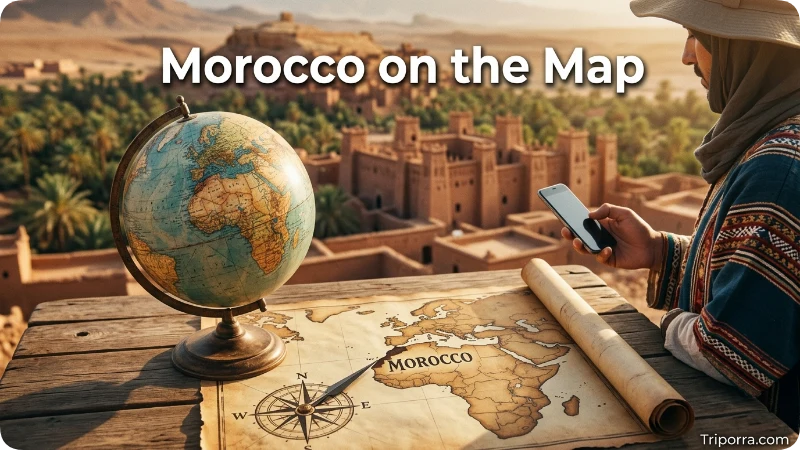
Imagine standing at the meeting point of Africa and Europe. It occupies the northwestern edge of Africa, with thousands of kilometers of coastline stretching along both the Atlantic Ocean and the Mediterranean Sea.
To the north lies Spain across the Strait of Gibraltar. On a clear day, parts of Europe can be visible from northern Morocco. Algeria forms Morocco’s eastern border, while Western Sahara lies to the south.
Several major geographic features help define the country:
- The Atlas Mountains run through central Morocco.
- The Rif Mountains rise in the north.
- The Sahara Desert extends into southeastern areas.
- Long Atlantic beaches stretch along the western coast.
This combination of mountains, desert, coastline, and fertile plains creates remarkable geographic diversity.
____________________________________________________________________________
Which Region Does Morocco Belong To?
It belongs to the Maghreb, a region of North Africa that traditionally includes:
- Morocco
- Algeria
- Tunisia
- Libya
- Mauritania (often included geographically)
Politically and economically, Morocco is an independent sovereign state governed as a constitutional monarchy.
The country is divided into administrative regions, including:
- Casablanca-Settat
- Rabat-Salé-Kénitra
- Marrakech-Safi
- Fès-Meknès
- Tangier-Tetouan-Al Hoceima
- Souss-Massa
- Drâa-Tafilalet
These regions help manage local governance and development across the country.
____________________________________________________________________________
How Does Morocco Compare to Nearby Places?
Compared with neighboring countries, Morocco offers a unique combination of accessibility, cultural attractions, and varied landscapes.
How Morocco Differs from Algeria
- Morocco attracts more international tourists.
- Algeria is geographically larger.
- Morocco has more developed tourism infrastructure.
How Morocco Differs from Tunisia
- Both are major North African destinations.
- Morocco has larger mountain systems and broader geographic diversity.
- Tunisia is generally smaller and easier to explore quickly.
Morocco As compared to Spain
- Spain lies directly north across the Strait of Gibraltar.
- It offers a distinctly North African and Arab-Amazigh cultural experience.
- Travel between the two countries can take less than an hour by ferry.
Morocco in Comparison to Egypt
- Egypt is famous for ancient pyramids and the Nile.
- It is known for medieval cities, mountain landscapes, and desert experiences.
- Both rank among Africa’s most visited countries.
____________________________________________________________________________
How to Reach Morocco
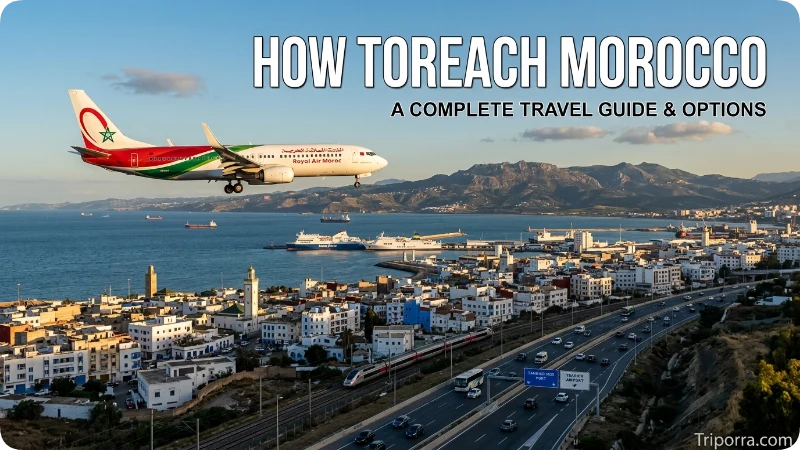
It is one of Africa’s most accessible countries for international travelers.
By Air
Major international airports include:
- Mohammed V International Airport (Casablanca)
- Marrakech Menara Airport
- Rabat-Salé Airport
- Tangier Ibn Battouta Airport
- Fès–Saïs Airport
Direct flights connect Morocco with:
- Europe
- North America
- Middle East
- Africa
By Ferry
Travelers can reach Morocco by ferry from Spain.
Popular ferry routes include:
- Algeciras to Tangier Med
- Tarifa to Tangier
- Almería to Nador
Some crossings take less than one hour.
By Road
Road connections exist with neighboring Algeria, though border access has historically been restricted and travelers should verify current conditions before planning.
By Rail
It has one of Africa’s most developed rail networks.
Major rail links connect:
- Casablanca
- Rabat
- Tangier
- Meknes
- Fes
- Marrakech
The country also operates Africa’s first high-speed rail service between Tangier and Casablanca.
____________________________________________________________________________
Why Is Morocco Famous?
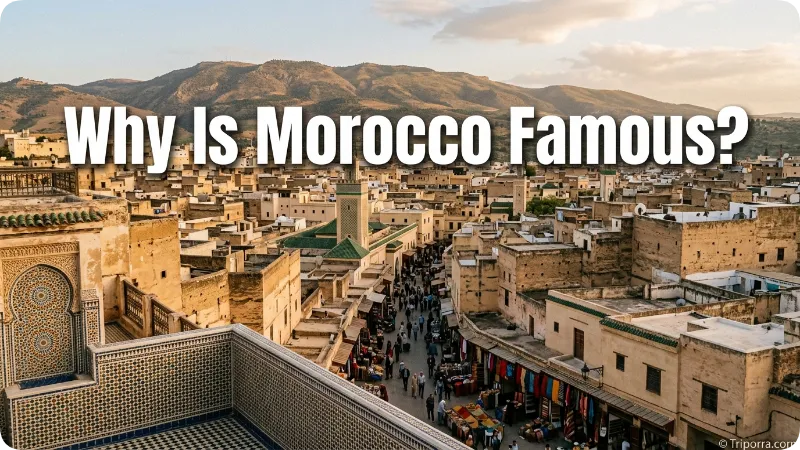
It is known worldwide for its cultural heritage, architecture, landscapes, and cuisine.
Historic Cities
Morocco’s famous historic cities include:
- Marrakech
- Fes
- Rabat
- Meknes
- Tangier
Their old medinas contain centuries-old markets, mosques, palaces, and traditional homes.
Sahara Desert
Many visitors travel to southeastern Morocco for desert experiences featuring:
- Camel treks
- Sand dunes
- Desert camps
- Stargazing
Atlas Mountains
The Atlas Mountains provide opportunities for:
- Hiking
- Mountain climbing
- Scenic road trips
- Traditional village visits
Moroccan Cuisine
Popular dishes include:
- Tagine
- Couscous
- Harira
- Pastilla
- Mint tea
Cultural Heritage
Morocco reflects influences from:
- Amazigh cultures
- Arab traditions
- African heritage
- Mediterranean civilizations
- European connections
____________________________________________________________________________
History of Morocco
Human settlement in Morocco dates back thousands of years.
Ancient Period
The area was inhabited by Amazigh peoples long before foreign civilizations arrived.
Phoenicians and later Romans established settlements along parts of the coast.
Islamic Era
Islam spread throughout Morocco during the 7th and 8th centuries.
Several powerful dynasties emerged, including:
- Almoravids
- Almohads
- Marinids
These dynasties helped shape the country’s architecture, scholarship, and political influence.
Colonial Period
During the early 20th century, much of Morocco came under French influence, while Spain controlled certain northern and southern areas.
Independence
Morocco gained independence in 1956 and developed into a modern constitutional monarchy.
Today, it remains one of Africa’s most influential countries economically, culturally, and diplomatically.
____________________________________________________________________________
Climate and Weather
It experiences several climate zones due to its varied geography.
Coastal Areas
Atlantic and Mediterranean coastal regions generally enjoy:
- Mild winters
- Warm summers
- Moderate temperatures
Mountain Regions
The Atlas Mountains experience:
- Cooler temperatures
- Winter snowfall
- Pleasant summer weather
Desert Areas
Southeastern desert regions often see:
- Hot daytime temperatures
- Cool nights
- Very little rainfall
Seasonal Overview
SeasonWeatherSpringMild and comfortableSummerHot inland, pleasant on many coastsAutumnWarm and favorable for travelWinterMild on coasts, snowy in mountains.
____________________________________________________________________________
Things to See and Do Nearby
Explore Marrakech
Visit:
- Jemaa el-Fnaa Square
- Bahia Palace
- Koutoubia Mosque
Discover Fes
Highlights include:
- Ancient medina
- Traditional tanneries
- Historic schools and mosques
Visit Chefchaouen
Known as the “Blue City,” Chefchaouen is famous for its blue-painted streets and mountain setting.
Experience the Sahara
Popular activities include:
- Camel rides
- Desert camping
- Photography
- Sandboarding
Tour the Atlas Mountains
Travelers can enjoy:
- Trekking
- Scenic valleys
- Amazigh villages
- Mountain viewpoints
Explore Tangier
Tangier offers:
- Coastal scenery
- Historic neighborhoods
- Mediterranean and Atlantic influences
____________________________________________________________________________
Best Time to Visit
Spring (March–May)
Often considered the best season because of comfortable temperatures and blooming landscapes.
Autumn (September–November)
Another excellent period for sightseeing and outdoor activities.
Summer (June–August)
Best for coastal destinations, though inland cities can become very hot.
Winter (December–February)
Suitable for city exploration and mountain snow activities.
____________________________________________________________________________
Common Misconceptions
It Is Not in the Middle East
While Morocco shares cultural and linguistic connections with many Middle Eastern countries, it is geographically located in Africa.
Casablanca Is Not the Capital
Many people assume Casablanca is the capital because it is the largest city. The capital is actually Rabat.
Morocco Is More Than Desert
Although the Sahara is famous, much of Morocco includes mountains, forests, fertile plains, and coastal regions.
Western Sahara Status
The status of Western Sahara remains internationally disputed. Different organizations and governments recognize and administer the territory in different ways. Travelers should consult current official guidance when visiting the region.
____________________________________________________________________________
Places Related to Morocco
Readers interested in Morocco often search for:
- Rabat
- Casablanca
- Marrakech
- Fes
- Tangier
- Chefchaouen
- Atlas Mountains
- Sahara Desert
- Strait of Gibraltar
- Spain
- Algeria
- Western Sahara
____________________________________________________________________________
What Else Do People Want to Know?
Is Morocco Safe for Tourists?
It is generally considered one of Africa’s most visited tourist destinations. As with any destination, travelers should stay aware of their surroundings and follow local guidance.
Is Morocco Expensive?
Costs vary by destination and travel style. Many travelers find Morocco affordable compared with much of Western Europe.
Do People Speak English?
English is increasingly common in tourist areas. Arabic, Amazigh languages, and French remain widely used.
Can You Visit the Desert?
Yes. Organized tours regularly travel from cities such as Marrakech and Fes to desert destinations.
Is Morocco Family Friendly?
Many families visit Morocco to enjoy cultural attractions, beaches, historical sites, and outdoor adventures.
____________________________________________________________________________
FAQs
Is Morocco in Africa or Europe?
Morocco is located in Africa, specifically in the northwestern part of the continent.
What countries border Morocco?
Morocco borders Algeria to the east and Western Sahara to the south.
What is the capital of Morocco?
Rabat is the capital city of Morocco.
What is Morocco famous for?
Morocco is known for historic cities, the Sahara Desert, Atlas Mountains, colorful markets, and traditional cuisine.
How far is Morocco from Spain?
At the Strait of Gibraltar, Morocco and Spain are separated by roughly 14 kilometers (9 miles) at the narrowest point.
What language is spoken in Morocco?
Arabic and Amazigh are official languages. French is also widely used.
What currency does Morocco use?
Morocco uses the Moroccan Dirham (MAD).
Is Morocco a country or a city?
Morocco is a sovereign country in North Africa.
Which continent is Morocco on?
Morocco is located on the African continent.
When is the best time to visit Morocco?
Spring and autumn are generally considered the most comfortable seasons for travel.
Can you travel by train in Morocco?
Yes. Morocco has one of Africa’s most developed rail systems, connecting major cities.
Does Morocco have beaches?
Yes. Morocco has extensive Atlantic and Mediterranean coastlines with many beach destinations.
____________________________________________________________________________
Conclusion
Morocco is a North African country located at the meeting point of Africa, Europe, the Atlantic Ocean, and the Mediterranean Sea. Its strategic location, diverse landscapes, historic cities, and cultural heritage make it one of the world’s most fascinating destinations.
Whether you’re interested in ancient medinas, mountain adventures, coastal scenery, or Sahara Desert experiences, Morocco offers a remarkable variety of attractions within a single country.

Elena Rostova bridges the gap between premium hospitality and authentic local experiences. Armed with a background in luxury hospitality management and a passion for fine architecture, she spent years evaluating elite resorts before transitioning into travel journalism. Elena heads the luxury and boutique travel vertical on Triporra.com. Her meticulous guides strip away the guesswork from high-end travel, showcasing unique five-star escapes, fine regional dining, and bespoke private tours that elevate a standard vacation into an unforgettable journey.