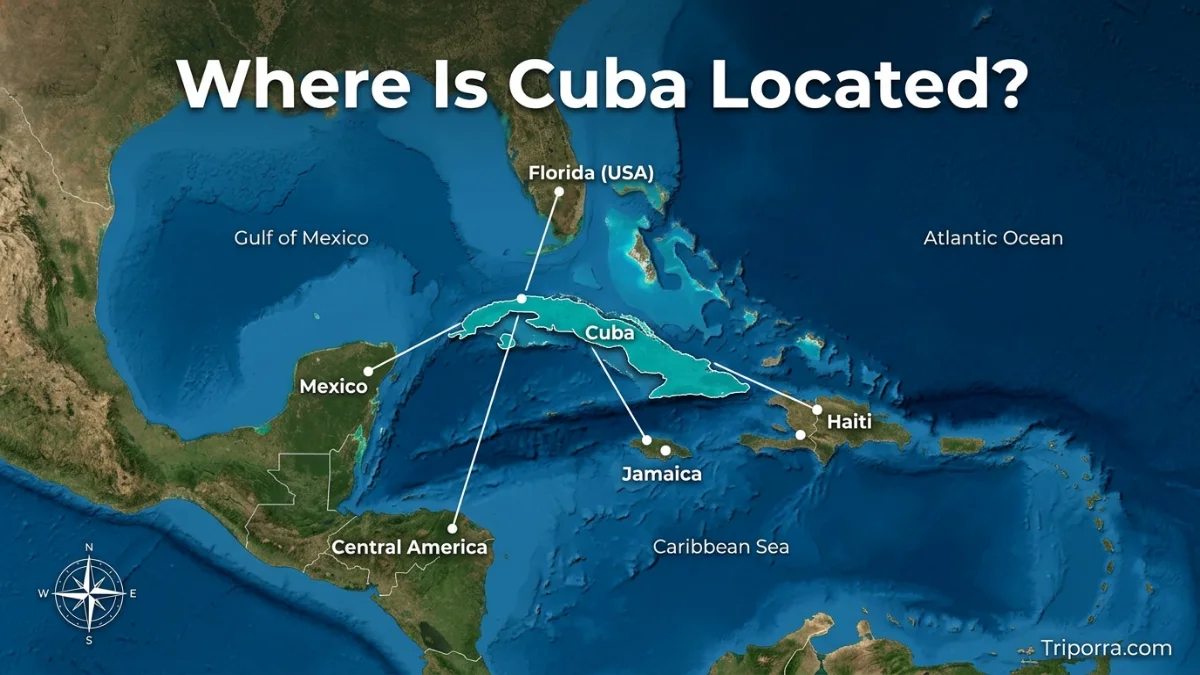
If you’re wondering where is Cuba located, the short answer is that Cuba is an island country in the northern Caribbean Sea. It lies south of the United States and The Bahamas, west of Haiti and the Dominican Republic, and east of Mexico’s Yucatán Peninsula. Because of its central location between North America, Central America, and the Caribbean, Cuba has played an important role in trade, history, and culture for centuries.
Cuba is the largest island in the Caribbean by both land area and population. It consists of the main island of Cuba, the Isle of Youth, and thousands of smaller islands and cays. The country’s capital, Havana, sits on the northwest coast and is one of the Caribbean’s best-known cities.
Whether you’re planning a trip, studying geography, or simply curious about the Caribbean, understanding Cuba’s location makes it easier to see why the country has such strategic and cultural importance.
Cuba is located in the northern Caribbean Sea, about 90 miles (145 km) south of Florida, United States. It is the largest island in the Caribbean and sits between the Gulf of Mexico, the Atlantic Ocean, and the Caribbean Sea, making it a key link between North America and the Caribbean.
| Quick Fact | Information |
| Official Name | Republic of Cuba |
| Region | Caribbean |
| Continent | North America (Caribbean region) |
| Capital City | Havana |
| Largest City | Havana |
| Area | Approximately 42,426 sq mi (109,884 sq km) |
| Population | Approximately 9.7 million (2025 estimate) |
| Official Language | Spanish |
| Currency | Cuban Peso (CUP) |
| Government | Socialist republic |
| Time Zone | Cuba Standard Time (UTC−5) |
| Highest Point | Pico Turquino – 6,476 ft (1,974 m) |
| Coastline | Approximately 2,320 miles (3,735 km) |
| Driving Side | Right |
| International Calling Code | +53 |
Where Is Cuba Located on the Map?
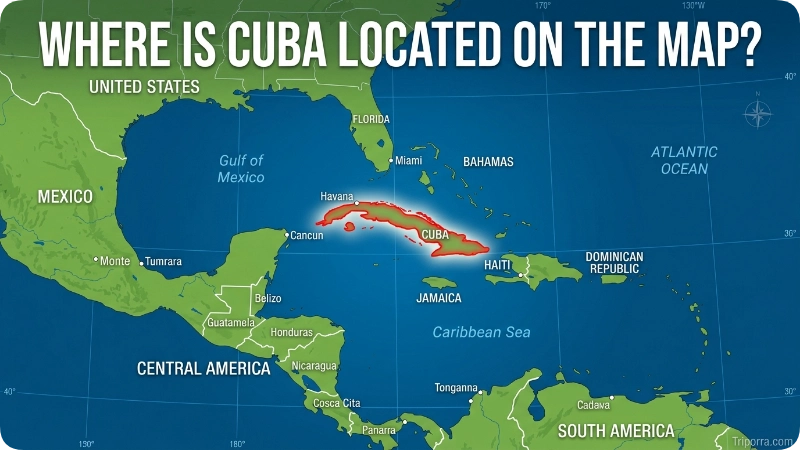
Cuba is located in the northern Caribbean Sea, where three major bodies of water meet:
- The Gulf of Mexico
- The Caribbean Sea
- The Atlantic Ocean
This position places Cuba at one of the most important maritime crossroads in the Americas. Ships traveling between the Atlantic Ocean and the Gulf of Mexico often pass near Cuban waters.
If you look at a world map, Cuba appears as a long, narrow island stretching from northwest to southeast.
Cuba’s Geographic Coordinates
- Latitude: Approximately 21° North
- Longitude: Approximately 80° West
These coordinates place Cuba within the tropical zone, giving it warm weather throughout the year.
⭐ Did You Know?
Cuba is the largest island in the Caribbean and the 17th-largest island in the world.
Which Continent Is Cuba In?
Cuba belongs to North America, even though it is located in the Caribbean.
Many people mistakenly believe Cuba is part of South America because of its tropical climate. In reality, the Caribbean islands, including Cuba, Jamaica, and The Bahamas, are geographically considered part of the North American continent.
The Caribbean itself is a region made up of island nations and territories spread across the Caribbean Sea.
Which Countries Are Near Cuba?
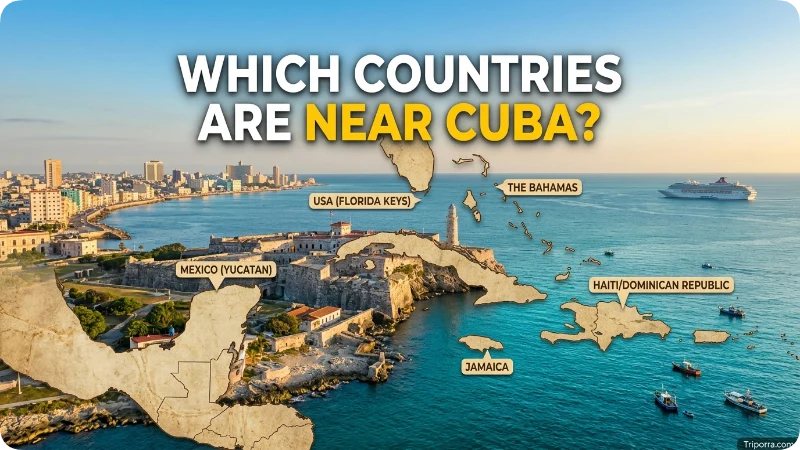
Cuba is surrounded by several countries and island nations.
| Country | Approximate Straight-Line Distance |
| United States (Florida) | About 90 miles (145 km) |
| The Bahamas | About 13 miles (21 km) from the nearest islands |
| Mexico (Yucatán Peninsula) | About 130 miles (210 km) |
| Haiti | About 50 miles (80 km) across the Windward Passage |
| Jamaica | About 87 miles (140 km) |
| Cayman Islands | About 150 miles (240 km) |
These are approximate straight-line distances. Actual flight routes, ferry services, and travel times vary depending on weather, transportation options, and border requirements.
Is Cuba an Island or Part of a Mainland?
Cuba is an island country, not part of any mainland.
The Republic of Cuba includes:
- The main island of Cuba
- Isla de la Juventud (Isle of Youth)
- More than 4,000 smaller islands, cays, and islets
Together, these islands form the Cuban archipelago.
Because Cuba is completely surrounded by water, all international travel arrives by air or sea.
What Bodies of Water Surround Cuba?
Cuba is bordered by three important bodies of water.
Gulf of Mexico
The northwestern coast faces the Gulf of Mexico.
Atlantic Ocean
The northeastern coast opens toward the Atlantic Ocean.
Caribbean Sea
The southern coastline borders the Caribbean Sea.
These waters support fishing, tourism, shipping, coral reefs, and marine biodiversity.
⭐ Did You Know?
Cuba has one of the longest coastlines in the Caribbean, stretching about 2,320 miles (3,735 km).
Why Is Cuba’s Location Important?
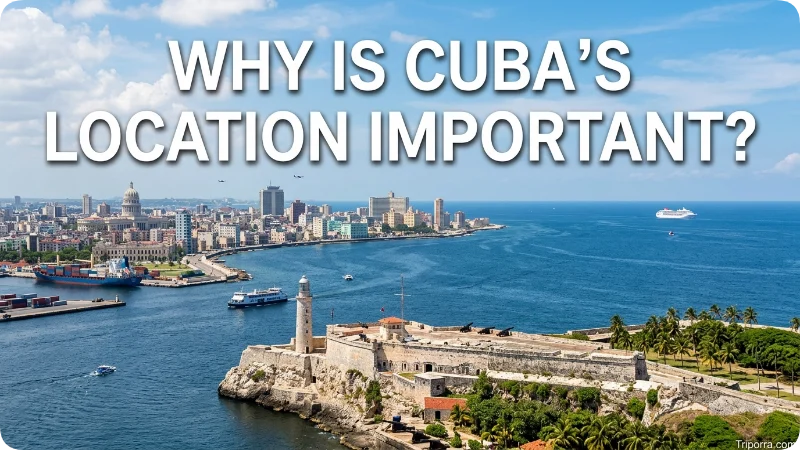
Cuba’s location has influenced its history, economy, and international relations for hundreds of years.
Strategic Trade Routes
Because Cuba sits between the Atlantic Ocean and the Gulf of Mexico, it has long been important for shipping and naval travel.
Historical Importance
During the colonial era, Spain used Havana as a major port for fleets traveling between Europe and the Americas.
Later, Cuba became strategically significant during events such as:
- The Spanish-American War
- The Cuban Missile Crisis (1962)
- Cold War diplomacy
Tourism
Its tropical climate and Caribbean beaches attract visitors from around the world.
Popular attractions include:
- Havana’s Old Town
- Varadero Beach
- Viñales Valley
- Trinidad
- Cayo Coco
Natural Resources
Its location also supports:
- Agriculture
- Fishing
- Nickel mining
- Marine conservation
- Ecotourism
What Are Cuba’s Major Cities?
Cuba has several large cities, but Havana is the country’s capital, largest city, and main economic center.
Havana
Havana is located on Cuba’s northwest coast along the Gulf of Mexico. It is home to around two million people in the metropolitan area and is known for its colonial architecture, historic plazas, classic cars, and waterfront boulevard called the Malecón.
Highlights include:
- Old Havana (a UNESCO World Heritage Site)
- El Capitolio
- Plaza Vieja
- National Museum of Fine Arts
Santiago de Cuba
Santiago de Cuba lies on the southeastern coast. It is Cuba’s second-largest city and has played an important role in the country’s history, music, and culture.
Camagüey
Camagüey is located in central Cuba. It is famous for its winding streets, colorful squares, and well-preserved colonial buildings.
Holguín
Holguín is a major city in eastern Cuba and serves as a gateway to nearby beaches and natural parks.
Santa Clara
Santa Clara sits in central Cuba. It is widely known for its connection to the Cuban Revolution and the memorial dedicated to Ernesto “Che” Guevara.
⭐ Did You Know?
Havana was founded in 1519, making it one of the oldest continuously inhabited European-established cities in the Americas.
What Is Cuba’s Climate Like?
Cuba has a tropical climate, meaning warm temperatures throughout the year.
There are two main seasons:
Dry Season
- November through April
- Less rainfall
- Comfortable humidity
- Popular time for tourism
Average daytime temperatures range from 75°F to 82°F (24°C to 28°C).
Rainy Season
- May through October
- Higher humidity
- Frequent afternoon showers
- Warm temperatures
Average daytime temperatures range from 82°F to 90°F (28°C to 32°C).
Hurricane Season
The Atlantic hurricane season runs from June through November, with the greatest chance of tropical storms and hurricanes between August and October. Weather conditions can change quickly during this period.
How Can You Get to Cuba?
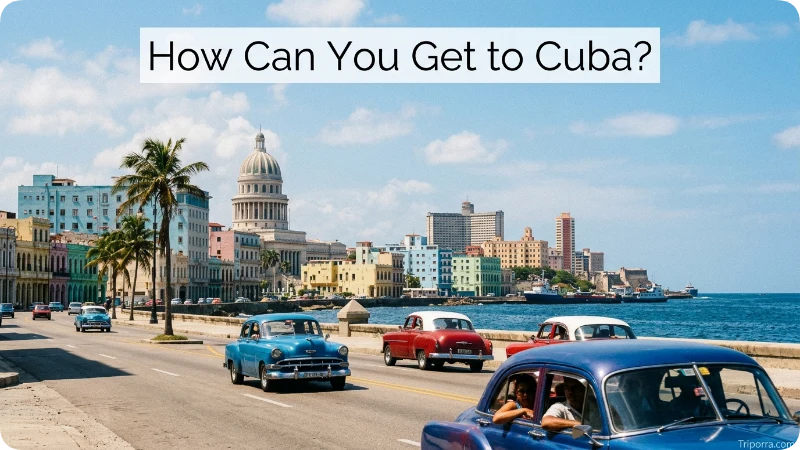
Most international visitors arrive in Cuba by air.
Major International Airports
- José Martí International Airport (Havana)
- Juan Gualberto Gómez Airport (Varadero)
- Antonio Maceo Airport (Santiago de Cuba)
- Frank País Airport (Holguín)
Direct flights are available from many countries in the Caribbean, Europe, Canada, and parts of Latin America. Flight availability varies by airline and government regulations.
By Cruise Ship
Some cruise operators include Cuba on Caribbean itineraries when permitted by current travel policies. Availability depends on government regulations and cruise company schedules.
By Sea
Private boats and yachts can enter Cuba through designated ports after completing customs and immigration procedures.
What Are Cuba’s Population, Language, and Currency?
Cuba is home to approximately 9.7 million people (2025 estimate).
Official Language
Spanish is the official language and is spoken throughout the country.
Visitors in major tourist areas may also find people who speak English, especially in hotels and tourist attractions.
Currency
Cuba’s official currency is the Cuban Peso (CUP).
Payment systems and accepted methods can change over time. Travelers should check the latest official guidance before visiting, as international bank cards may not work everywhere.
Religion
Cuba has religious freedom. Common faiths include:
- Christianity
- Roman Catholicism
- Protestant churches
- Afro-Cuban religions such as Santería
Many people also identify as having no religious affiliation.
What Is Cuba Known For?
Cuba is recognized around the world for its culture, history, music, and natural beauty.
Some of its best-known features include:
Music
Cuba has influenced many musical styles, including:
- Salsa
- Son Cubano
- Rumba
- Mambo
- Latin Jazz
Classic Cars
Many classic American cars from the 1940s and 1950s are still seen on Cuban roads, especially in Havana.
Cigars
Cuban cigars are among the most famous in the world due to the country’s long tradition of tobacco farming.
Beaches
Popular beach destinations include:
- Varadero
- Cayo Coco
- Cayo Santa María
- Guardalavaca
UNESCO World Heritage Sites
Cuba has several UNESCO-listed sites, including:
- Old Havana and its fortifications
- Trinidad and the Valley de los Ingenios
- Viñales Valley
- Alejandro de Humboldt National Park
A Brief History of Cuba
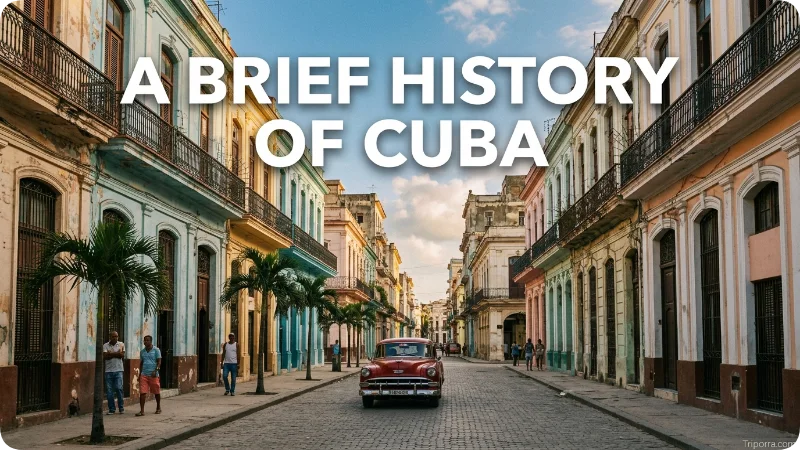
People have lived on the island for thousands of years. Before European arrival, Indigenous groups such as the Taíno and Ciboney inhabited Cuba.
Spanish Colonization
Christopher Columbus reached Cuba in 1492 during his first voyage. Spain later established colonies across the island, and Havana became an important port for Spanish ships.
Independence
After years of conflict, Cuba gained independence from Spain in 1902 following the Spanish-American War and a period of U.S. military administration.
Cuban Revolution
In 1959, Fidel Castro and his revolutionary movement overthrew the government of Fulgencio Batista. Cuba then became a socialist state.
Modern Cuba
Today, Cuba remains a socialist republic with a centrally planned political system. It continues to maintain diplomatic and economic relationships with countries around the world.
Is Cuba Safe to Visit?
Yes, many travelers visit Cuba safely each year, but safety depends on local conditions and following official travel advice.
Common tips include:
- Keep valuables secure.
- Use licensed transportation.
- Follow local laws and customs.
- Carry identification when required.
- Stay informed about weather conditions during hurricane season.
Travel advisories may change because of weather, health events, or political developments. Always check your government’s latest travel guidance before planning your trip.
⭐ Travel Tip:
Purchase travel insurance that covers medical emergencies, trip cancellations, and unexpected delays.
When Is the Best Time to Visit Cuba?
For most visitors, the best time to visit Cuba is from November through April.
During these months:
- Rainfall is lower.
- Humidity is more comfortable.
- Beaches are enjoyable.
- Outdoor sightseeing is easier.
If you prefer fewer crowds and lower prices, consider visiting during May or early June, while keeping an eye on weather forecasts.
Common Misconceptions About Cuba
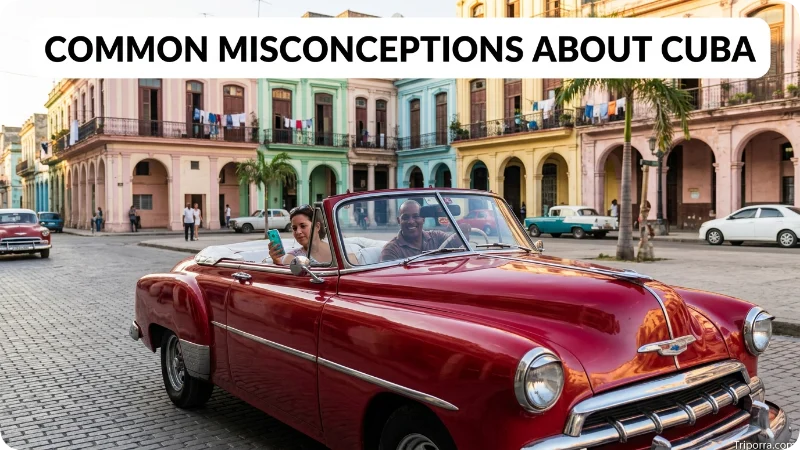
Many people have questions about Cuba. Here are a few common misunderstandings.
Cuba Is Not Part of South America
Although it is close to Central America and South America, Cuba is geographically part of North America.
Cuba Is More Than One Island
The Republic of Cuba includes the main island plus thousands of smaller islands and cays.
Cuba Is Close to the United States
The nearest point between Cuba and Florida is only about 90 miles (145 km) across the Florida Straits.
Cuba Is in the Caribbean
Some people confuse Cuba with countries in Central America. Cuba is an island nation in the Caribbean region.
FAQs
Is Cuba in North America or South America?
Cuba is in North America. It belongs to the Caribbean region, which is geographically part of the North American continent.
What ocean is Cuba in?
Cuba lies between the Atlantic Ocean, the Caribbean Sea, and the Gulf of Mexico. Its location gives it access to all three major bodies of water.
How far is Cuba from Florida?
At the closest point, Cuba is about 90 miles (145 km) from Florida across the Florida Straits. Actual travel distance depends on the departure and arrival locations.
What country owns Cuba?
No country owns Cuba. Cuba is an independent sovereign nation officially known as the Republic of Cuba.
Is Cuba part of the Caribbean?
Yes. Cuba is one of the largest and most influential countries in the Caribbean region and is the largest island in the Caribbean by land area.
What language do people speak in Cuba?
Spanish is the official language of Cuba. English is spoken in some tourist areas, but Spanish is the primary language throughout the country.
What is the capital of Cuba?
The capital of Cuba is Havana, located on the island’s northwest coast. It is also the country’s largest city and main cultural center.
Why is Cuba famous?
Cuba is famous for its music, cigars, colonial architecture, classic cars, beaches, baseball, and rich cultural traditions. It is also known for its role in world history, including the Cuban Revolution and the Cuban Missile Crisis.
Can tourists travel to Cuba?
Yes, tourists can visit Cuba, although entry requirements vary depending on nationality and current government regulations. Travelers should always check the latest visa and travel requirements before booking.
Which countries are closest to Cuba?
The closest countries are The Bahamas, the United States, Mexico, Haiti, Jamaica, and the Cayman Islands. Cuba’s central location makes it a key island in the northern Caribbean.
Conclusion
Cuba is located in the northern Caribbean Sea, where the Atlantic Ocean, the Gulf of Mexico, and the Caribbean Sea meet. It sits about 90 miles (145 km) south of Florida and is surrounded by neighboring countries such as Mexico, The Bahamas, Haiti, and Jamaica. As the largest island in the Caribbean, Cuba has long served as an important link between North America and the rest of the Caribbean.
Beyond its location, Cuba is known for its fascinating history, Spanish-speaking culture, tropical climate, beautiful beaches, and vibrant music. Whether you’re studying world geography, planning a vacation, or simply satisfying your curiosity, knowing where Cuba is located provides a better understanding of its role in the region and why it continues to attract interest from travelers, historians, and geography enthusiasts around the world.

Silas Vance is a geography enthusiast, travel researcher, and location-focused content writer dedicated to helping readers better understand the world around them on triporra.com. He specializes in creating informative guides about cities, countries, islands, landmarks, universities, and other notable destinations. His work combines geographic accuracy, historical context, and practical insights to answer location-based questions in a simple and engaging way.