Swahili, also called Kiswahili, is mainly spoken in East Africa. Tanzania and Kenya are its main centers. It is also widely used in Uganda and parts of the Democratic Republic of the Congo, Rwanda, Burundi, Somalia, Mozambique, Malawi, Zambia, and South Sudan. Swahili is both a first language and a common second language across the region.
Introduction
If you are searching for where is Swahili spoken, the main answer is East Africa. Swahili is one of the most important languages in this part of Africa. It is closely connected with Tanzania and Kenya, but its geographic reach is much wider.
Swahili is used across several countries. In some places, people speak it at home as their first language. In other areas, people learn it as a second language because it helps them communicate with people who speak different local languages.
The language has a strong connection with the East African coast, especially Tanzania, Kenya, Zanzibar, and nearby islands. From the coast, Swahili has spread inland across large parts of East and Central Africa.
Today, you can hear Swahili in cities, towns, villages, schools, markets, government offices, media, businesses, and regional organizations.
Understanding where Swahili is spoken is easier when you look at the language as a regional network rather than as the language of only one country.
Quick Facts About Swahili

| Fact | Information |
|---|---|
| Language | Swahili |
| Native Name | Kiswahili |
| Main Region | East Africa |
| Main Countries | Tanzania and Kenya |
| Other Major Areas | Uganda, eastern DRC, Rwanda, Burundi |
| Other Areas | Southern Somalia, northern Mozambique, Malawi, Zambia, South Sudan |
| Language Family | Niger-Congo |
| Language Branch | Bantu |
| Main Geographic Connection | East African coast and Great Lakes region |
| Important Island Area | Zanzibar |
| Writing System | Latin alphabet |
| Main Use | First language and regional lingua franca |
| Major Regional Role | Communication across different language groups |
Where Is Swahili Spoken?
Swahili is mainly spoken in East Africa.
The strongest geographic centers are Tanzania and Kenya. These two countries are especially important when looking at the history, everyday use, education, media, and national role of the language.
From Tanzania and Kenya, Swahili extends west into the Great Lakes region. It is widely used in parts of Uganda, Rwanda, Burundi, and the eastern Democratic Republic of the Congo.
The language also extends north toward southern Somalia and south toward northern Mozambique. Smaller Swahili-speaking communities and users can also be found in places such as Malawi, Zambia, and South Sudan.
The exact level of use is different in every country. Swahili may be a major national language in one country, while it may be mainly a second language in another.
This is an important point. Saying that a country “speaks Swahili” does not always mean that Swahili is the first language of most people there. In many places, people use Swahili because it provides a common way to communicate across different language groups.
Which Countries Speak Swahili?
Swahili has a significant presence in several countries across East and parts of Central and Southern Africa.
The main countries and areas include:
- Tanzania
- Kenya
- Uganda
- Democratic Republic of the Congo
- Rwanda
- Burundi
- Somalia
- Mozambique
- Malawi
- Zambia
- South Sudan
Tanzania and Kenya are the two most important countries for understanding the geographic heart of Swahili.
Uganda, Rwanda, Burundi, and eastern DRC form another important part of the wider Swahili-speaking area.
Other countries have smaller or more regional connections with the language.
Swahili in Tanzania
Tanzania is one of the main centers of Swahili.
Swahili is widely used across the country. It is an important language for everyday communication and has a major role in public life.
People use Swahili in schools, government, media, business, markets, and ordinary conversations.
Tanzania is especially important because the language is not limited to one small coastal community. It is used across much of the country and provides a common language for people from different ethnic and linguistic backgrounds.
The country’s connection with the Indian Ocean is also important. Tanzania has a long coastline, and Swahili has deep roots in the coastal areas.
Zanzibar and Swahili
It has a particularly strong connection with Swahili.
Zanzibar is an archipelago in the Indian Ocean that forms part of Tanzania. Its location off the coast of mainland Tanzania places it within the historic Swahili coastal region.
Swahili is closely connected with the culture and everyday life of Zanzibar.
When looking at where Swahili is spoken, Zanzibar is therefore an important geographic point to remember.
Swahili in Kenya
Kenya is another major Swahili-speaking country.
Swahili is widely used throughout Kenya. It is an official language along with English.
People use Swahili in many parts of daily life. It is common in cities, towns, schools, workplaces, public communication, and media.
Kenya’s position along the Indian Ocean also gives it a strong connection with the traditional Swahili coast.
Nairobi and Swahili
Nairobi, the capital of Kenya, is one of the major cities where Swahili is commonly used.
It is located inland, far from the coast, but Swahili is still an important language there. This shows how far the language has spread beyond its original coastal setting.
Mombasa and Swahili
Mombasa, a major coastal city in southeastern Kenya, has long been closely connected with the Swahili language and culture. Its position along the East African coast has made it an important center of Swahili life and heritage. Its position on the Indian Ocean places it within the historic Swahili coastal area.
The city has strong cultural and linguistic connections with Swahili.
Swahili in Uganda
Swahili is also spoken in Uganda, which lies west of Kenya and north of Tanzania.
Uganda has many local languages, so a common language can be useful when people from different communities need to communicate.
Swahili has been used in different parts of Ugandan society and has regional importance because Uganda shares borders and close connections with several countries where Swahili is widely used.
Uganda’s location makes it an important link between the main Swahili-speaking areas of Kenya and Tanzania and the Great Lakes region farther west.
Swahili in the Democratic Republic of the Congo
Swahili is widely used in the eastern Democratic Republic of the Congo, often called eastern DRC.
This is one of the most important areas for Swahili outside Tanzania and Kenya.
The eastern DRC is close to the Great Lakes region. It also has many different ethnic groups and languages.
Swahili provides a common form of communication for many people in this part of the country.
The language is especially important in eastern cities and communities that have strong economic and social links with neighboring East African countries.
It is useful to distinguish eastern DRC from the rest of the country. The DRC is enormous, but Swahili is not used equally across the entire country. Its strongest role is in the east.
Swahili in Rwanda
Swahili is also used in Rwanda.
Rwanda is located in the Great Lakes region of Africa. It sits between several countries that have strong connections with Swahili.
The language has gained greater importance in Rwanda because of the country’s regional connections.
Swahili is used in education, business, communication, and regional interaction.
Rwanda’s location shows how Swahili has moved beyond the East African coast and into the inland Great Lakes region.
Swahili in Burundi
Burundi is another country where Swahili is used.
Burundi is located south of Rwanda and west of Tanzania. Its position puts it close to several important Swahili-speaking areas.
Swahili can be useful in trade and communication, especially when people interact with communities across national borders.
Although Burundi has other major languages, Swahili forms part of the wider regional language network.
Swahili in Somalia
Swahili is also found in southern Somalia.
Somalia is located in the Horn of Africa, to the northeast of Kenya.
Swahili is not the main language of Somalia as a whole. However, it has a presence in southern areas because of geographic and historical connections with the East African coast.
The southern part of Somalia is closer to the main Swahili-speaking areas of Kenya and the western Indian Ocean.
This helps explain why Swahili is found there even though Somalia is usually associated with the Somali language.
Swahili in Mozambique
Swahili is also spoken in parts of northern Mozambique.
Mozambique is located along the southeastern coast of Africa. Its northern region is close to Tanzania.
This geographic connection helps explain the presence of Swahili in northern Mozambique.
Swahili is not the main language of all Mozambique. Portuguese is the country’s official language, and many local African languages are also used.
The Swahili connection is stronger in the north, particularly in areas close to the wider East African cultural and linguistic zone.
Swahili in Malawi
Swahili also has some use in Malawi.
Malawi is a landlocked country south of Tanzania and west of Mozambique.
Its northern position brings it closer to the wider East African region. Swahili can be used as a regional language, although it does not have the same level of use as it does in Tanzania or Kenya.
The connection is more regional than national.
Swahili in Zambia
Swahili also reaches parts of Zambia.
Zambia is located farther south of the main Swahili-speaking center. As a result, Swahili is not the country’s main everyday language.
However, it has some regional and cross-border use.
This is another example of how the language has spread beyond its strongest geographic center.
Swahili in South Sudan
Swahili is also found in parts of South Sudan.
South Sudan lies north and northwest of the main East African Swahili area.
Swahili has some regional use, particularly because of connections with neighboring countries.
It is important not to treat South Sudan as a major Swahili-speaking country in the same way as Tanzania or Kenya. Its Swahili use is more limited and varies by area and community.
Where Is Swahili Spoken on a Map?
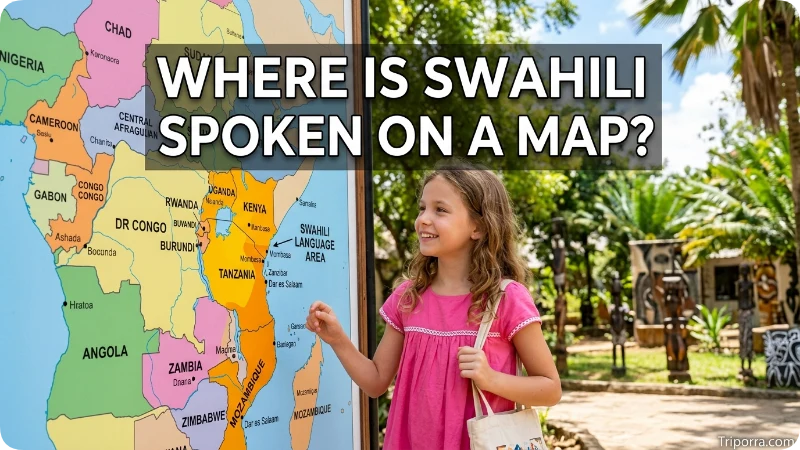
A simple mental map can make the language’s location easier to understand.
Start with Tanzania and Kenya on the eastern side of Africa.
These countries form the main center of the Swahili-speaking region.
Now look around them.Mombasa and Swahili
The coastal city of Mombasa is an important part of the Swahili cultural world in southeastern Kenya. For centuries, its location on the East African shoreline has helped shape strong connections with Swahili language, traditions, and coastal culture. Today, Mombasa remains one of the key places associated with Swahili heritage in the region.
Farther south, Swahili is also found in parts of northern Mozambique.
The Indian Ocean lies to the east of the main Swahili-speaking coast.
This gives you a useful mental picture:
Indian Ocean → Kenya and Tanzania → Uganda and Great Lakes region → eastern DRC
The Swahili-speaking area is therefore centered in East Africa and spreads into nearby regions.
Is Swahili a Coastal Language?
Swahili has strong coastal roots, but it is not only a coastal language today.
The language developed and grew along the East African coast, where communities interacted through trade and other forms of contact.
The coastal area includes parts of present-day Kenya and Tanzania, along with nearby islands such as Zanzibar.
Over time, Swahili spread inland.
Today, people use Swahili far from the Indian Ocean. Nairobi is one example. Eastern DRC is another.
This inland spread is one of the main reasons Swahili is now such an important regional language.
What Region Is Swahili Associated With?
Swahili is most strongly associated with East Africa.
East Africa generally includes countries such as:
- Kenya
- Tanzania
- Uganda
- Rwanda
- Burundi
- South Sudan
- Somalia
The exact definition of East Africa can vary depending on the geographic or political context.
Swahili also extends into parts of Central Africa and Southern Africa.
The Great Lakes region is especially important because Swahili is widely used in areas around the large lakes and neighboring countries.
Is Swahili Spoken in Central Africa?
Yes, especially in the eastern part of the Democratic Republic of the Congo.
The DRC is often classified as a Central African country, but its eastern areas have strong geographic and cultural links with East Africa.
This creates an important connection between Central Africa and the Swahili-speaking world.
Eastern DRC is therefore one of the clearest examples of Swahili crossing the usual regional boundaries.
Is Swahili Spoken in Southern Africa?
Swahili has a smaller presence in parts of Southern Africa.
It can be found in areas of Malawi, Zambia, and northern Mozambique.
However, these countries should not be considered the main center of Swahili.
The strongest concentration remains in East Africa, especially Tanzania and Kenya.
The language becomes less dominant as you move farther south from its main geographic center.
Why Is Swahili Spoken Across So Many Countries?
There are several reasons for the wide geographic reach of Swahili.
One important reason is trade.
For centuries, people from different communities met along the East African coast and inland trade routes. They often spoke different local languages.
A shared language made communication easier.
Swahili became useful for these interactions.
Over time, its use expanded beyond trade.
Education helped spread the language. Government also played a role. Religious communication, migration, business, media, and regional cooperation added to its reach.
Swahili became more than a local coastal language. It developed into a major language of communication across a large part of Africa.
Is Swahili a First Language or a Second Language?
Swahili can be both.
For some communities, especially along parts of the East African coast, Swahili is a first language.
For many other people, it is a second language.
This is one of the reasons the number of Swahili speakers is so large.
A person may grow up speaking another African language at home but learn Swahili at school or through daily communication.
Someone else may speak Swahili as their first language.
Both groups contribute to the large Swahili-speaking population.
Where Is Swahili Most Important?
Swahili has its strongest national role in Tanzania and Kenya.
Tanzania is especially important because Swahili is widely used across the country.
Kenya is also a major center because Swahili is an official language and is used by people from many different communities.
The language is also highly important in the Great Lakes region, especially in eastern DRC and neighboring areas.
Its importance comes not only from the number of native speakers but also from the large number of people who use it as a second language.
Is Swahili an Official Language?

Swahili has official or national importance in several parts of East Africa.
In Kenya, Kiswahili and English are official languages.
In Tanzania, Swahili has a major national role and is used widely in public life and education.
Swahili also has an important regional role through the East African Community.
At the continental level, Kiswahili is also one of the official languages of the African Union.
This official recognition shows how important the language has become beyond individual communities.
What Is the Relationship Between Swahili and Kiswahili?
Swahili and Kiswahili refer to the same language.
“Swahili” is the name commonly used in English.
“Kiswahili” is the name used in the language itself.
The word ki- is connected with the way languages are named in Swahili grammar.
So if you see “Swahili” in English and “Kiswahili” in an African or local context, they generally refer to the same language.
What Language Family Does Swahili Belong To?
Swahili belongs to the Bantu branch of the Niger-Congo language family.
This places Swahili among many other Bantu languages spoken across large parts of Africa.
Swahili also has vocabulary influenced by contact with other languages over many centuries.
Arabic has had a strong influence on Swahili vocabulary because of long-term contact between East African coastal communities and the wider Indian Ocean world.
However, Swahili remains a Bantu language in its basic structure and classification.
Is Swahili the Same Everywhere?
Not exactly.
Swahili has different forms and regional varieties.
The Swahili spoken along the coast can differ from forms used farther inland.
Different countries and communities also have their own accents, vocabulary, and speech patterns.
There is a widely used standard form of Swahili for education, media, and formal communication.
This helps people from different regions understand one another even when their everyday speech is different.
What Cities Are Important for Swahili?
Several cities are closely connected with the language.
Dar es Salaam, Tanzania
Dar es Salaam is one of Tanzania’s largest cities and an important center for Swahili.
It is located on the Indian Ocean coast.
Zanzibar City, Tanzania
Zanzibar City is located on the island of Unguja in the Zanzibar archipelago.
It has a strong cultural and historical connection with Swahili.
Mombasa, Kenya
Mombasa is a major coastal city in Kenya.
Its location on the Indian Ocean makes it an important part of the Swahili coastal region.
Nairobi, Kenya
Nairobi is inland but has a strong Swahili-speaking population.
It shows how Swahili has spread well beyond the coast.
Kampala, Uganda
Kampala is Uganda’s capital and one of the major urban centers where Swahili is used.
These cities help show the geographic range of the language, from the Indian Ocean coast to the inland areas of East Africa.
Does Swahili Reach the Indian Ocean Islands?

Yes.
Swahili has strong connections with islands in the western Indian Ocean, especially Zanzibar.
It is also associated with other islands and coastal communities in the region.
The Indian Ocean played an important role in communication between East African coastal communities and people from other parts of the ocean region.
This coastal setting helped shape the development and spread of Swahili.
Why Is Zanzibar Important to Swahili?
Zanzibar is important because it lies within the traditional Swahili coastal region.
The islands are located off the coast of Tanzania in the western Indian Ocean.
Swahili has been deeply connected with life on Zanzibar for generations.
The language is therefore not simply associated with mainland East Africa. It also has an important island identity.
When you think about the geographic roots of Swahili, the East African coast and Zanzibar are two key places to remember.
Is Swahili Widely Spoken in Africa?
Yes.
Swahili is one of the most widely used African languages.
Its importance comes from both native speakers and people who use it as a second language.
The language connects people across national borders and different ethnic communities.
This makes it especially useful in countries where many different languages are spoken.
Swahili’s regional role also continues to grow through education, media, trade, and cooperation between East African countries.
How Far Does the Swahili-Speaking Area Stretch?
There is no single exact border around the Swahili-speaking area.
Languages do not stop at national borders in a neat line.
The strongest Swahili zone stretches across Tanzania and Kenya and continues into neighboring areas.
From there, it reaches Uganda, Rwanda, Burundi, eastern DRC, southern Somalia, northern Mozambique, and smaller areas farther south and west.
The language therefore covers a broad area of eastern Africa.
Where Is Swahili Spoken Compared With English?

English and Swahili have different geographic roles in East Africa.
English is widely used in government, education, business, and international communication in several countries.
Swahili has a stronger role as a regional African language.
In many communities, Swahili helps people communicate when they do not share the same first language.
This makes Swahili especially important for everyday and regional communication.
Is Swahili Spoken in the United States?
Swahili is not a main language of the United States.
However, Swahili speakers and learners can be found in the United States because of migration, education, universities, African communities, and cultural organizations.
Several American universities and educational programs also teach Swahili.
Its strongest concentration remains in Africa, particularly East Africa.
FAQs
Where is Swahili spoken?
Swahili is mainly spoken in East Africa. Tanzania and Kenya are its main centers. It is also used in Uganda, eastern DRC, Rwanda, Burundi, southern Somalia, northern Mozambique, Malawi, Zambia, and parts of South Sudan.
What country is Swahili from?
Swahili is not limited to one modern country. Its roots are strongly connected with the East African coast, especially areas that are now part of Tanzania and Kenya.
What country speaks the most Swahili?
Tanzania is one of the most important Swahili-speaking countries. Swahili has a major national role there and is widely used throughout the country.
Is Swahili spoken in Kenya?
Yes. Swahili is widely spoken in Kenya and is one of the country’s official languages.
Is Swahili spoken in Tanzania?
Yes. Swahili is widely spoken throughout Tanzania and is an important language in education, government, media, business, and daily life.
Is Swahili spoken in Uganda?
Yes. Swahili is used in Uganda, particularly for communication between people from different language backgrounds.
Is Swahili spoken in the Democratic Republic of the Congo?
Yes. Swahili is especially important in eastern DRC. It is widely used for communication in several eastern areas.
Is Swahili spoken in Rwanda?
Yes. Swahili is spoken in Rwanda and has gained importance through the country’s links with the wider East African region.
Is Swahili spoken in Burundi?
Yes. Swahili is used in Burundi, particularly as a language of wider communication and regional interaction.
Is Swahili spoken in Somalia?
Yes. Swahili has a presence in southern Somalia, although Somali is the country’s main language.
Is Swahili spoken in Mozambique?
Yes. Swahili is spoken in parts of northern Mozambique, especially in areas closer to Tanzania and the wider East African region.
Is Swahili spoken in Malawi?
Yes, but its use is more limited than in Tanzania or Kenya. Swahili has some regional use in Malawi.
Is Swahili spoken in Zambia?
Yes. Swahili has some use in Zambia, although it is not the country’s main language.
Is Swahili spoken in South Sudan?
Yes, Swahili is used in some parts of South Sudan. Its role is more limited than in the main Swahili-speaking countries.
Is Swahili a language of East Africa?
Yes. Swahili is one of the most important regional languages in East Africa.
Is Swahili a coastal language?
Swahili has strong coastal roots, especially along the East African coast. However, it has spread far inland and is now widely used in cities and regions far from the ocean.
Is Zanzibar a Swahili-speaking place?
Yes. Zanzibar has a very strong connection with Swahili and is an important part of the traditional Swahili-speaking region.
What is Swahili called by its speakers?
Swahili is commonly called Kiswahili by its speakers.
Is Swahili an African language?
Yes. Swahili is an African language from the Bantu branch of the Niger-Congo language family.
How many people speak Swahili?
Estimates vary depending on whether first-language and second-language speakers are counted. Swahili is commonly estimated to have more than 200 million speakers worldwide.
Is Swahili an official language?
Swahili has official or national importance in several countries. It is an official language of Kenya and has a major national role in Tanzania. Kiswahili is also an official language of the African Union.
Is Swahili spoken only in Africa?
Most Swahili speakers live in Africa, especially East Africa. Swahili can also be found among African communities and language learners in other parts of the world.
What region has the most Swahili speakers?
The largest and most important Swahili-speaking region is East Africa, especially Tanzania and Kenya.
Conclusion
So, where is Swahili spoken? Swahili is mainly spoken in East Africa, with Tanzania and Kenya at the center of its geographic range.
The language also reaches Uganda, eastern Democratic Republic of the Congo, Rwanda, Burundi, southern Somalia, northern Mozambique, Malawi, Zambia, and parts of South Sudan.
A simple way to picture Swahili is to place Tanzania and Kenya at the center, with the language spreading west into the Great Lakes region, north toward southern Somalia, and south into parts of Mozambique and nearby countries.
Swahili began with strong connections to the East African coast, but it is now much more than a coastal language. It is a major regional language that helps people communicate across countries, communities, and different first languages.
For anyone asking where is Swahili spoken, the clearest answer is: mostly across East Africa, especially Tanzania and Kenya, with a much wider reach into Central and nearby parts of Southern Africa.

About Leo Sterling
Leo Sterling is a geography and travel writer at Triporra.com who believes understanding a place starts with knowing exactly where it is. He turns geographic details on countries, regions, islands, and cities into clear, engaging content for everyday readers.
For Leo, a good location article does more than mark a spot on a map. It shows what borders a place, which region it belongs to, and how it connects to the world around it—an approach reflected in guides like where is Anguilla, where solid research meets a simple, conversational style.
Whether readers are planning a trip, studying, or just curious, Leo’s goal is the same: deliver accurate, easy-to-understand information without unnecessary complexity.
Areas of Focus: Geography | Countries & Regions | Caribbean Islands | Travel Destinations | Location Research | “Where Is?” Content