Kosovo is a small landlocked country in Southeastern Europe, located in the Balkan Peninsula. If you are wondering where is Kosovo, it lies between Serbia, North Macedonia, Albania, and Montenegro. Its capital, Pristina, is also the country’s largest city and its main political and economic center.
Although Kosovo is small, it has a varied landscape. For example, the country features mountains, valleys, forests, plains, and historic towns. In addition, it is known for its medieval monasteries, traditional food, and lively urban culture.
However, it also has a complicated modern political status. The country declared independence from Serbia on February 17, 2008. Since then, many countries have recognized Kosovo as an independent state, while Serbia and several other countries continue to reject that position.
Therefore, understanding where Kosovo is requires looking at both its geographic location and political status. This guide explains Kosovo’s location, map position, borders, capital, climate, population, language, currency, attractions, safety, and travel information.
Featured Snippet
It is a small landlocked country in the Balkan Peninsula of Southeastern Europe. It is located between Serbia, North Macedonia, Albania, and Montenegro. Its capital and largest city is Pristina. Kosovo declared independence in 2008, although its political status remains disputed internationally.
Quick Facts About Kosovo
| Fact | Information |
|---|---|
| Official Name | Republic of Kosovo |
| Type | Landlocked country in Southeastern Europe |
| Region | Balkan Peninsula |
| Capital City | Pristina |
| Largest City | Pristina |
| Coordinates | Approximately 42.6° N, 21.1° E |
| Area | Approximately 4,212 square miles (10,887 square kilometers) |
| Population | Approximately 1.6 million people (2024 estimate) |
| Official Languages | Albanian and Serbian |
| Currency | Euro (€) |
| Independence Declaration | February 17, 2008 |
| Government Type | Parliamentary republic |
| Highest Point | Gjeravica Mountain – approximately 8,714 feet (2,656 meters) |
| Time Zone | Central European Time (UTC+1), UTC+2 during daylight saving time |
| Main Religious Traditions | Islam and Christianity |
| Known For | Balkan mountains, medieval monasteries, Pristina, cultural heritage, and natural landscapes |
Where Is Kosovo Located on the Map?
It is located in Southeastern Europe, within the Balkan Peninsula. More specifically, it sits in the central part of the Balkans and is surrounded by four countries. Because of this position, Kosovo has strong geographic connections with several parts of southeastern Europe.
Unlike coastal Balkan countries, however, Kosovo has no direct access to the sea. Instead, it is a landlocked country surrounded by mountains, valleys, forests, and plains.
On a map of Europe, you can find Kosovo:
- In Europe
- In the southeastern part of the continent
- North of Greece
- West of Bulgaria
- South of Serbia
- East of Montenegro
- Northeast of Albania
Furthermore, It sits roughly between the Adriatic Sea and Aegean Sea regions. Although it does not have a coastline, its central Balkan location places it relatively close to several coastal countries.
Kosovo also covers a relatively small area. As a result, it is one of Europe’s smaller countries by land size.
Did You Know? The name Kosovo is linked to the Serbian word kos, meaning “blackbird.” Over time, the region has been known by different names and has developed a diverse cultural identity.
What Country Is Kosovo In?
It is not located inside another country today. Instead, it operates as the Republic of Kosovo, a self-governing political entity.
However, its international status remains disputed. Kosovo declared independence from Serbia on February 17, 2008. Since then, many countries, including the United States and numerous European Union members, have recognized Kosovo as independent.
On the other hand, Serbia does not recognize Kosovo’s independence. Several other countries also maintain that Kosovo is part of Serbia or have not formally recognized its independence.
As a result, Kosovo has its own:
- Government
- Political institutions
- Border controls
- Passport
- Currency system
- International relations
Nevertheless, recognition policies differ from country to country. Therefore, travelers and businesses should check the rules that apply to their nationality or destination.
Which Countries Border Kosovo?
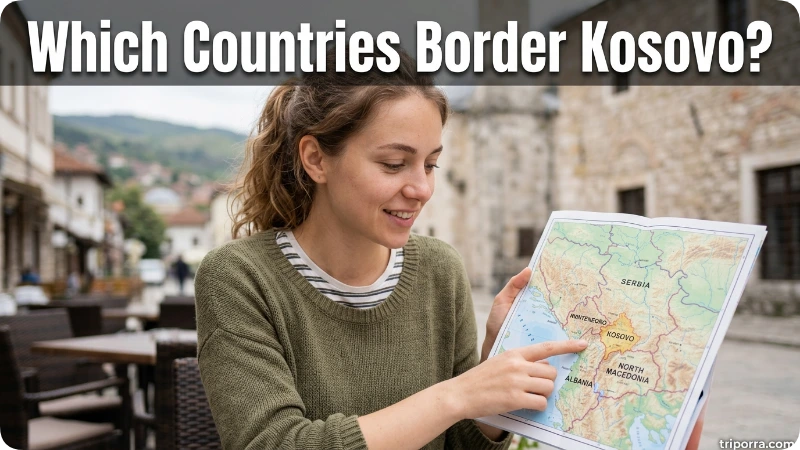
It shares land borders with four countries. These neighboring countries help explain its central position in the Balkans.
| Neighboring Country | Direction from Kosovo |
|---|---|
| Serbia | North and east |
| North Macedonia | South |
| Albania | Southwest |
| Montenegro | West |
Because of these borders, Kosovo has close geographic and cultural connections with both Albanian-speaking and Slavic-speaking parts of the Balkans.
Moreover, several major Balkan cities are located relatively close to Pristina. Consequently, Kosovo can be included in a wider regional trip through Southeastern Europe.
Approximate straight-line distances from Pristina include:
- Pristina to Skopje, North Macedonia: about 50 miles (80 km)
- Pristina to Tirana, Albania: about 120 miles (190 km)
- Pristina to Podgorica, Montenegro: about 120 miles (190 km)
- Pristina to Belgrade, Serbia: about 150 miles (240 km)
However, actual driving distances are longer. Border crossings, road conditions, and the selected route can also affect travel times.
What Is Kosovo’s Capital City?
Pristina is the capital and largest city of it . It is also the country’s main center for government, business, education, and culture.
The city lies in the eastern-central part of Kosovo. In addition, Pristina has grown into a lively urban center with universities, cafés, restaurants, museums, parks, and cultural venues.
Some notable places in Pristina include:
- Newborn Monument
- Kosovo National Library
- Mother Teresa Square
- Pristina City Center
- Germia Park
The city therefore offers a mixture of modern architecture and older neighborhoods. At the same time, its cafés, universities, and cultural spaces give Pristina a youthful atmosphere.
What Countries Are Near Kosovo?
It is surrounded by four neighboring countries. Each one has a different geographic and cultural relationship with Kosovo.
Albania
Albania lies southwest of Kosovo. The two areas share strong cultural and linguistic connections because most of Kosovo’s population is ethnically Albanian.
Furthermore, families, businesses, and travelers regularly cross the border. Because of these connections, Albania and Kosovo have close social and economic ties.
North Macedonia
North Macedonia lies directly south of Kosovo. Its capital, Skopje, is one of the closest major cities to Pristina.
Therefore, the route between Pristina and Skopje is important for regional travel, business, and transportation.
Montenegro
Montenegro lies west of Kosovo. The border connects Kosovo with Montenegro’s mountainous interior.
As a result, travelers interested in mountain landscapes can combine destinations in both countries.
Serbia
Serbia borders Kosovo to the north and east. However, the relationship between Kosovo and Serbia remains politically sensitive.
For this reason, travelers should check current border and entry information before planning routes between the two areas.
How Far Is Kosovo From Major Cities?
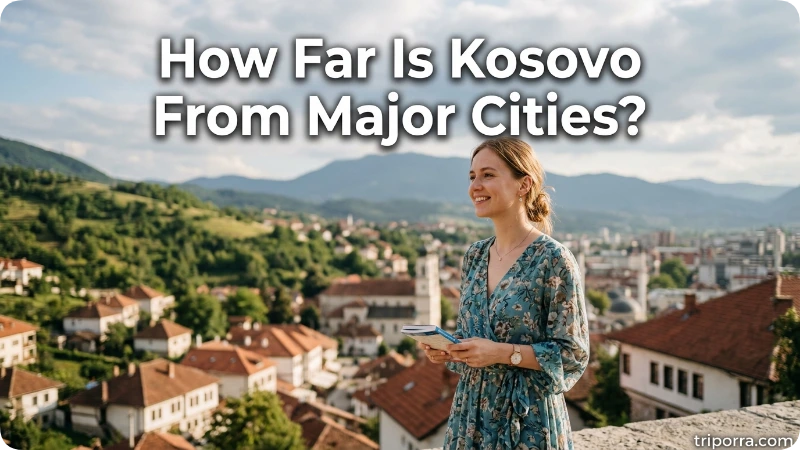
Kosovo’s central location makes it relatively close to several important Balkan and European cities.
The following figures are approximate straight-line distances from Pristina:
| City | Country | Distance From Pristina |
|---|---|---|
| Skopje | North Macedonia | About 50 miles (80 km) |
| Tirana | Albania | About 120 miles (190 km) |
| Sofia | Bulgaria | About 130 miles (210 km) |
| Belgrade | Serbia | About 150 miles (240 km) |
| Sarajevo | Bosnia and Herzegovina | About 120 miles (190 km) |
| Athens | Greece | About 250 miles (400 km) |
These are straight-line measurements, so driving distances are usually greater. In addition, travel times can change because of traffic, weather, road conditions, and border procedures.
For example:
- Pristina to Skopje usually takes around 1.5–2.5 hours by road.
- Pristina to Tirana usually takes around 3–5 hours, depending on the route.
- Pristina to Belgrade can take longer depending on border conditions.
Therefore, travelers should allow extra time when crossing international borders.
How Do You Get to Kosovo?
It can be reached mainly by air or road. Because the country is landlocked, there are no direct sea routes.
By Air
The main international airport is Pristina International Airport.
The airport connects Kosovo with several European destinations. In particular, many routes serve cities with large Kosovo diaspora communities.
Common connections include:
- Zurich
- Vienna
- Istanbul
- Munich
- London
- Frankfurt
However, flight schedules change by season and airline. Therefore, travelers should check current schedules before booking.
By Road
It can also be reached by buses and private vehicles from neighboring countries.
Common routes include:
- Albania to Kosovo through mountain roads
- North Macedonia to Kosovo through Skopje
- Montenegro to Kosovo through western border crossings
- Serbia to Kosovo through northern and eastern routes
Because border policies can change, travelers should always check current entry requirements before starting their journey.
What Is Kosovo Known For?
Kosovo is known for its mountains, cultural heritage, historic sites, traditional cuisine, and modern city life.
Although the country is small, it offers a surprisingly varied landscape. In addition, its cultural heritage reflects centuries of different influences.
Balkan Mountains
It contains several mountainous regions that are popular with outdoor enthusiasts.
Important mountain areas include:
- Accursed Mountains (Bjeshkët e Nemuna)
- Šar Mountains
- Gjeravica Mountain
These areas feature forests, lakes, hiking routes, and winter sports opportunities. Therefore, Kosovo can be appealing to visitors who enjoy hiking, skiing, and nature.
Medieval Monasteries
It is home to several important Orthodox Christian monasteries from the medieval period.
Notable examples include:
- Visoki Dečani Monastery
- Patriarchate of Peć Monastery
- Gračanica Monastery
Several of these sites have been recognized as UNESCO World Heritage locations. Consequently, they are important parts of Kosovo’s cultural landscape.
Pristina’s Modern Culture
Meanwhile, Pristina represents the country’s modern side. The city is known for:
- Cafés and restaurants
- Universities
- Contemporary art
- A young population
- Music and cultural events
As a result, visitors can experience both traditional culture and modern urban life in the same trip.
Traditional Food
Kosovo cuisine combines Balkan, Ottoman, and Mediterranean influences.
Popular dishes include:
- Flija – a layered pastry
- Tavë kosi – baked meat with yogurt
- Qebapa – small grilled meat pieces
- Fresh breads and dairy products
In addition, burek and other Balkan pastries are widely enjoyed throughout the country.
What Is Kosovo’s Climate Like?
It has a continental climate, so summers are generally warm while winters can be cold.
Typical conditions include:
- Summer: around 75°F to 85°F (24°C to 29°C)
- Winter: around 25°F to 40°F (-4°C to 4°C)
However, temperatures vary by elevation. Mountain regions are generally colder and receive more snow than lower areas.
For sightseeing, late spring and early autumn are often comfortable periods. In particular, May through June and September through October can offer pleasant conditions for exploring cities and outdoor attractions.
On the other hand, winter is a better choice for travelers interested in snow and skiing.
What Is the Population of Kosovo?
It has an estimated population of approximately 1.6 million people.
The population includes several ethnic communities, although ethnic Albanians form the majority.
Major communities include:
- Ethnic Albanians
- Serbs
- Bosniaks
- Turks
- Roma communities
- Other smaller groups
Albanian is the most widely spoken language. Meanwhile, Serbian is also an official language.
In addition, many younger Kosovars speak English. This is especially common in Pristina, universities, hotels, restaurants, and tourist areas.
Kosovo’s History: From Ancient Settlements to Modern Independence
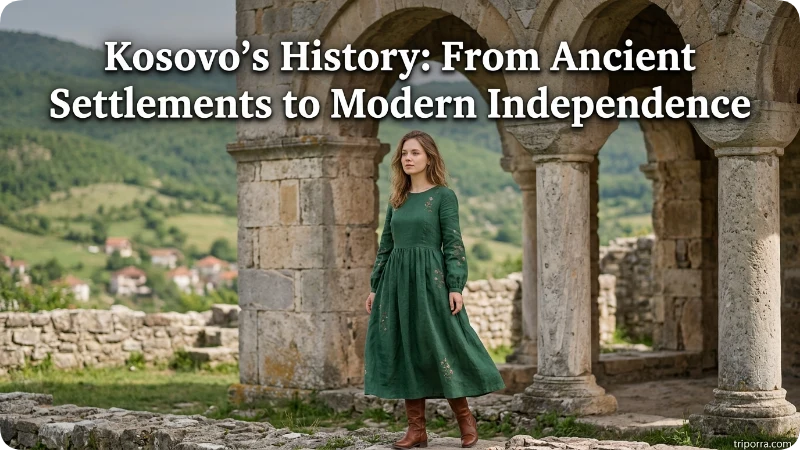
Kosovo has a long and complex history. Because of its location in the Balkans, the region has been influenced by different civilizations, kingdoms, and empires.
Ancient populations, including Illyrian and Thracian groups, lived in the wider Balkan region before Roman rule. Later, the area became part of the Roman Empire.
Over time, Kosovo experienced Byzantine, Slavic, and Ottoman influences. During the medieval period, the region became an important center of Serbian Orthodox Christianity and medieval Serbian states.
As a result, several monasteries and churches from this period remain important cultural landmarks.
Later, the Ottoman Empire controlled Kosovo from the 15th century until the early 20th century. During this period, the region developed a diverse population with different religious and cultural traditions.
In the 20th century, Kosovo became part of Yugoslavia. However, tensions between ethnic Albanian and Serbian communities increased during the 1990s as Yugoslavia began to break apart.
Eventually, the Kosovo War took place in 1998–1999. Following the conflict, it was placed under United Nations administration.
Finally, it declared independence from Serbia on February 17, 2008.
Today, Kosovo operates as a self-governing state. Nevertheless, its independence remains disputed by Serbia and several other countries.
Is Kosovo a Country?
Kosovo is considered an independent country by many nations, although its international status remains disputed.
The Republic of Kosovo declared independence in 2008. Since then, more than 100 United Nations member states have recognized its independence.
At the same time:
- Serbia does not recognize Kosovo as an independent state.
- Several other countries also do not recognize its independence.
- Kosovo maintains diplomatic relations with numerous countries.
- It participates in various international organizations.
The dispute mainly concerns Kosovo’s declaration of independence and whether the territory should be treated as an independent state or as part of Serbia.
For travelers, however, Kosovo functions separately in practical terms. It has its own:
- Government
- Border controls
- Institutions
- International airport
- Currency system
Therefore, travelers should treat Kosovo as a separate destination when checking entry and travel requirements.
What Currency Does Kosovo Use?
Kosovo uses the euro (€) as its currency, even though it is not a member of the European Union.
The euro has been used in Kosovo since 2002. Consequently, visitors from eurozone countries generally do not need to exchange their currency.
Common payment methods include:
- Bank cards in cities and tourist areas
- Cash euros in small shops and markets
However, card payments may not always be available in rural communities or mountain villages. For that reason, carrying some cash is a good idea when traveling outside major cities.
What Languages Are Spoken in Kosovo?
It has two official languages:
- Albanian
- Serbian
Albanian is the most widely spoken language because ethnic Albanians make up the majority of the population.
Meanwhile, Serbian is mainly spoken within the Serbian community and has official status. Other community languages include:
- Bosnian
- Turkish
- Romani
Furthermore, English is commonly understood by younger people, especially in Pristina, universities, hotels, and tourist businesses.
What Are the Best Places to Visit in Kosovo?
It offers a combination of historic towns, mountain landscapes, cultural attractions, and modern city life.
Therefore, visitors can choose from both urban and outdoor experiences.
Pristina
Pristina is the starting point for many visitors. The capital combines modern city life with cultural attractions.
Popular places include:
- Newborn Monument
- Kosovo Museum
- Mother Teresa Square
- National Library of Kosovo
- Germia Park
In addition, the city has cafés, restaurants, nightlife, universities, and cultural events.
Prizren
Prizren is one of Kosovo’s most popular historic cities. It sits near the Šar Mountains and is especially known for its Ottoman-era architecture.
Visitors can explore:
- Prizren Fortress
- Sinan Pasha Mosque
- Stone Bridge
- Old town streets
Moreover, Prizren hosts cultural events such as Dokufest, an international documentary film festival.
Because of its historic setting and lively atmosphere, Prizren is often one of the highlights of a Kosovo trip.
Rugova Valley
Rugova Valley is a scenic mountain region near Peja. It is especially popular among travelers who enjoy outdoor activities.
Activities include:
- Hiking
- Rock climbing
- Nature photography
- Adventure activities
The Rugova Canyon is one of Kosovo’s best-known natural attractions. Therefore, it is a strong choice for visitors who want to experience the country’s mountain scenery.
Peja (Peć)
Peja lies near the Accursed Mountains and serves as an important gateway to outdoor destinations.
Nearby attractions include:
- Patriarchate of Peć Monastery
- Rugova Valley
- Mountain hiking routes
As a result, Peja is a useful base for combining cultural sightseeing with outdoor adventures.
Brezovica Ski Resort
Brezovica is one of Kosovo’s main winter destinations. Located in the Šar Mountains, the resort attracts visitors during the snowy season.
Popular activities include:
- Skiing
- Snowboarding
- Mountain sightseeing
Therefore, winter travelers can include Brezovica in a Kosovo itinerary focused on snow and mountain activities.
What Is Kosovo’s Food Like?
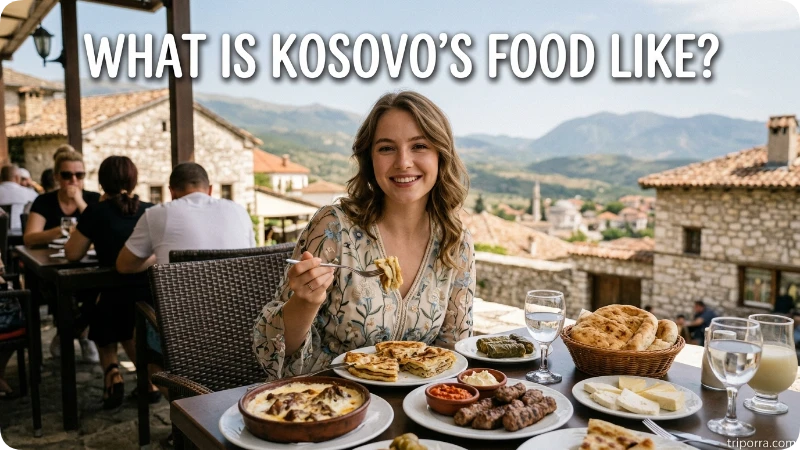
Kosovo cuisine reflects Balkan, Ottoman, and Mediterranean influences. As a result, meals often include grilled meat, pastries, dairy products, vegetables, and rich baked dishes.
Flija
Flija is a traditional layered pastry. It is made by cooking thin layers of batter and is often served with yogurt or other dairy products.
Tavë Kosi
Tavë kosi is a baked dish made with meat, yogurt, and eggs. It is also popular in neighboring Albania.
Qebapa
Qebapa are small grilled pieces of meat. They are commonly served with bread, onions, and sauces.
Burek
Burek is a popular Balkan pastry that can contain meat, cheese, or vegetables.
In addition, food prices in it are generally lower than in many Western European destinations, particularly outside major tourist areas.
Is Kosovo Safe to Visit?
It is generally considered safe for visitors, particularly in major cities and popular tourist areas.
Most travelers visit without serious problems. Nevertheless, normal travel precautions are still important.
For example:
- Keep an eye on personal belongings in crowded places.
- Follow local advice near political demonstrations.
- Take care when hiking in remote mountain areas.
- Avoid entering unknown areas where land mines or unexploded weapons could remain from past conflicts.
Because local conditions can change, travelers should check current government travel advisories before their trip.
What Is the Best Time to Visit Kosovo?
The best time to visit it depends on what you want to do. Each season offers a different experience.
Spring: April–June
Spring is a good season for:
- City sightseeing
- Hiking
- Visiting cultural sites
The weather is usually mild. Moreover, mountain landscapes become greener during this period.
Summer: July–August
Summer is popular for:
- Outdoor activities
- Festivals
- Mountain trips
However, lower areas can become quite warm, especially during the afternoon.
Autumn: September–October
Autumn is often one of the best times to visit because of:
- Comfortable weather
- Colorful mountain landscapes
- Fewer crowds
Therefore, travelers who want pleasant sightseeing conditions may prefer early autumn.
Winter: December–February
Winter is best for:
- Skiing
- Snow activities
- Mountain scenery
Mountain areas can receive significant snowfall. As a result, winter sports become an important seasonal attraction.
Common Misconceptions About Kosovo
Because it has a complicated political background, several common misconceptions exist.
Is Kosovo Part of Russia?
No. It is not part of Russia. Instead, it is located in Southeastern Europe, within the Balkan Peninsula.
Is Kosovo Part of Albania?
No. Kosovo and Albania are separate political entities. However, they share strong cultural and language connections because many people in Kosovo are ethnic Albanians.
Is Kosovo in Eastern Europe?
It is generally classified as part of Southeastern Europe and the Balkan Peninsula. Although definitions of European subregions can vary, Southeastern Europe is the most common geographic classification.
Does Kosovo Have a Coastline?
No. It is landlocked. Therefore, it has no direct coastline or access to the sea.
Why Is Kosovo Important in Balkan Geography?
Kosovo’s importance comes from its central Balkan location, cultural connections, mountains, and political significance.
Historically, its position placed it along routes connecting different parts of the Balkans. Today, the country remains connected to surrounding states through roads, trade, transportation, and cultural exchange.
Kosovo plays a role in:
- Regional trade
- Balkan transportation routes
- Cultural exchange
- European political discussions
Furthermore, its mountains, historic sites, and central position make it geographically important despite its relatively small size.
FAQs
Is Kosovo a country or part of Serbia?
It is a self-declared independent country recognized by many nations, but its status remains disputed. Kosovo declared independence from Serbia in 2008. However, Serbia and several other countries continue to consider Kosovo part of Serbia.
Where is Kosovo located in Europe?
Kosovo is located in Southeastern Europe, within the Balkan Peninsula. It is surrounded by Serbia, Albania, North Macedonia, and Montenegro. In addition, it is landlocked and lies near several major Balkan regions.
What continent is Kosovo in?
Kosovo is in Europe. More specifically, it is located in Southeastern Europe and the Balkan region.
What is the capital of Kosovo?
The capital of it is Pristina. It is also the country’s largest city and serves as the main center for government, business, education, and culture.
What language do people speak in Kosovo?
The main languages spoken in Kosovo are Albanian and Serbian. Albanian is the most widely spoken language, while Serbian is also an official language.
What currency is used in Kosovo?
Kosovo uses the euro (€) as its currency. The euro has been used there since 2002, even though Kosovo is not a member of the European Union.
Is Kosovo safe for tourists?
Yes, Kosovo is generally safe for tourists. Nevertheless, visitors should follow normal travel precautions and remain informed about local conditions, particularly near politically sensitive areas.
What is Kosovo famous for?
Kosovo is famous for its Balkan mountains, medieval monasteries, Pristina, Prizren’s historic architecture, traditional food, and important role in Balkan geography and history.
Do I need a visa to visit Kosovo?
Visa requirements depend on your nationality. Therefore, travelers should check the latest entry rules before visiting because visa and border requirements can change.
What is the best city to visit in Kosovo?
Prizren and Pristina are among the most popular cities for visitors. Prizren is known for its historic architecture and cultural sites, while Pristina offers modern attractions, museums, cafés, and city life.
Conclusion
It is a small landlocked country in Southeastern Europe, located in the Balkan Peninsula between Serbia, Albania, North Macedonia, and Montenegro. Its capital, Pristina, serves as the country’s political, economic, educational, and cultural center.
Although it is relatively small, it offers a wide range of landscapes and experiences. For example, visitors can explore mountain regions, historic towns, medieval monasteries, traditional food, and modern urban areas.
Furthermore, cities such as Prizren and Peja provide easy access to cultural and natural attractions. Meanwhile, destinations such as Rugova Valley and Brezovica offer opportunities for hiking, mountain activities, and winter sports.
Kosovo’s modern identity has also been shaped by its complex political history and its declaration of independence in 2008. However, its international status remains disputed because Serbia and several other countries do not recognize its independence.
Even so, Kosovo functions as a self-governing state with its own institutions, borders, and currency. Ultimately, its central Balkan location, diverse landscapes, and cultural heritage make it an important part of Southeastern Europe.
About Leo Sterling
Leo Sterling is a geography and travel writer at Triporra.com who believes understanding a place starts with knowing exactly where it is. He turns geographic details on countries, regions, islands, and cities into clear, engaging content for everyday readers.
For Leo, a good location article does more than mark a spot on a map. It shows what borders a place, which region it belongs to, and how it connects to the world around it—an approach reflected in guides like where is Anguilla, where solid research meets a simple, conversational style.
Whether readers are planning a trip, studying, or just curious, Leo’s goal is the same: deliver accurate, easy-to-understand information without unnecessary complexity.
Areas of Focus: Geography | Countries & Regions | Caribbean Islands | Travel Destinations | Location Research | “Where Is?” Content