If you’ve ever needed to set up direct deposit, pay bills online, or send money through your bank, you’ve probably been asked for your routing number. Many people wonder where is routing number on check because it is not always obvious at first glance.
The routing number is a special nine-digit code that identifies your bank or credit union in the United States. It appears in a standard location on almost every paper check. Once you know where to look, finding it takes only a few seconds.
Featured Snippet
Where is routing number on check? The routing number is the first group of nine digits printed along the bottom-left corner of a personal or business check. It identifies the financial institution that issued the check and is used for direct deposits, wire transfers, electronic payments, and check processing.
Quick Facts
| Fact | Details |
|---|---|
| What It Is | A 9-digit bank identification number used to identify a financial institution in the United States. |
| Found On | Personal and business checks, typically at the bottom-left corner. |
| Location on a Check | Bottom-left corner, printed in magnetic ink (MICR line). |
| Length | 9 digits |
| Used For | Direct deposits, ACH transfers, wire transfers, bill payments, and check processing. |
| Issued By | American Bankers Association (ABA) |
| Country | United States |
| Also Called | ABA Routing Number or Routing Transit Number (RTN) |
| Needed For | Payroll deposits, tax refunds, electronic payments, and bank transfers. |
| Different From | Your account number and check number, which identify your specific bank account rather than the bank itself. |
Where Is Routing Number on Check?
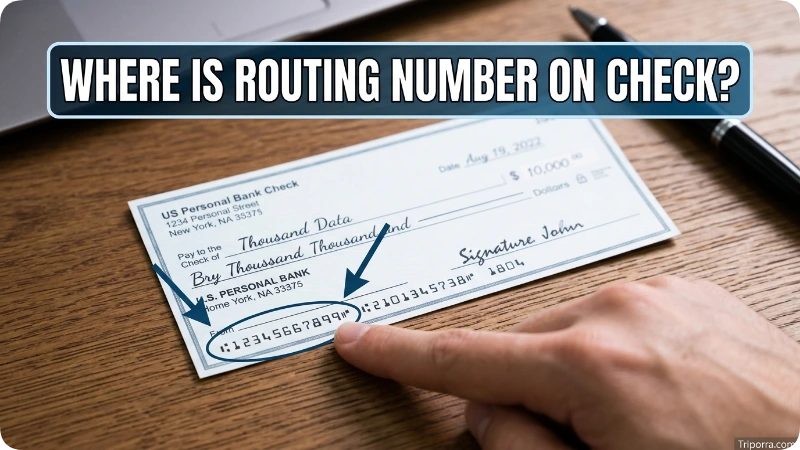
The answer is simple. The routing number is printed on the bottom left side of every standard paper check.
At the bottom of your check, you’ll usually see three groups of numbers printed in magnetic ink. The first group is your routing number, the second group is your account number, and the last group is the individual check number.
A standard check looks something like this:
| Routing Number | Account Number | Check Number | | 123456789 | 987654321012 | 1056 |
The routing number always comes first. It contains exactly nine digits.
Travellers often overlook small details on maps, and bank customers often make a similar mistake with checks. Many people accidentally copy the account number instead of the routing number because both appear together at the bottom.
What most guides miss is that some banks print the check number twice—once in the upper-right corner and again at the bottom. This can confuse people who think the last group of digits is another routing number.
Understanding the Three Numbers on a Check
Before entering banking information online, it’s helpful to know what each number means.
NumberPurposeRouting NumberIdentifies the bankAccount NumberIdentifies your personal bank accountCheck NumberIdentifies that specific check
The routing number tells payment systems which bank should receive or send money.
The account number identifies your individual account within that bank.
The check number simply helps keep track of each check you write.
A common mistake is using the account number where a routing number is requested. Since the account number is often longer, checking the number of digits can help. If it has exactly nine digits and appears first, it is almost certainly the routing number.
What Is a Routing Number?
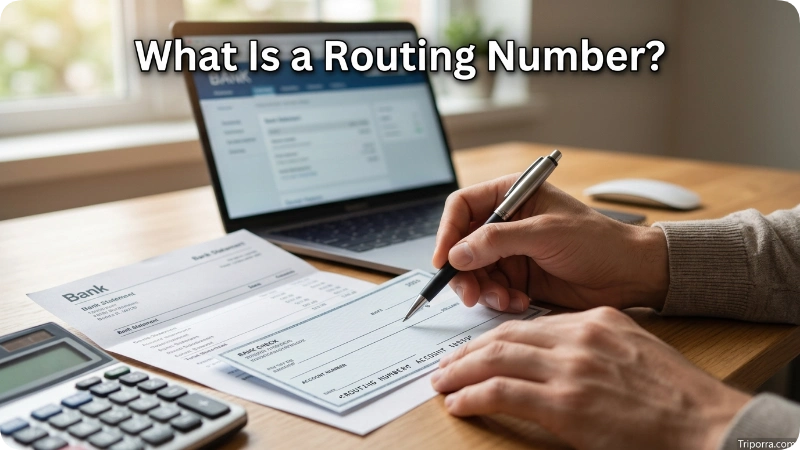
A routing number is a unique nine-digit code assigned to banks and credit unions in the United States.
It was created so banks could process checks more efficiently. Today, routing numbers are used for much more than paper checks.
They help process:
- Direct deposits
- Payroll payments
- Tax refunds
- ACH transfers
- Online bill payments
- Electronic fund transfers
- Some domestic wire transfers
Every financial institution has at least one routing number, although larger banks may use different routing numbers in different states.
Why Do Banks Use Routing Numbers?
Banks handle millions of transactions every day.
Without routing numbers, electronic payments would have no reliable way to identify the correct bank.
Think of a routing number as the bank’s mailing address. Your account number is like your house number. Together, they ensure money reaches the right destination.
Where Else Can You Find Your Routing Number?
Even if you don’t have a paper check, you can still find your routing number in several places.
Bank Mobile App
Most banking apps list your routing number under your account details.
Online Banking
Log into your account and view your checking account information.
Monthly Statements
Many printed and electronic statements include the routing number.
Customer Service
Your bank can provide the correct routing number after verifying your identity.
Bank Website
Many banks publish routing numbers on their official websites, especially if they use different numbers by state.
What most guides miss is that searching online without using your bank’s official website can lead to outdated information. Always verify the routing number directly with your financial institution.
Does Every Check Have the Same Routing Number?
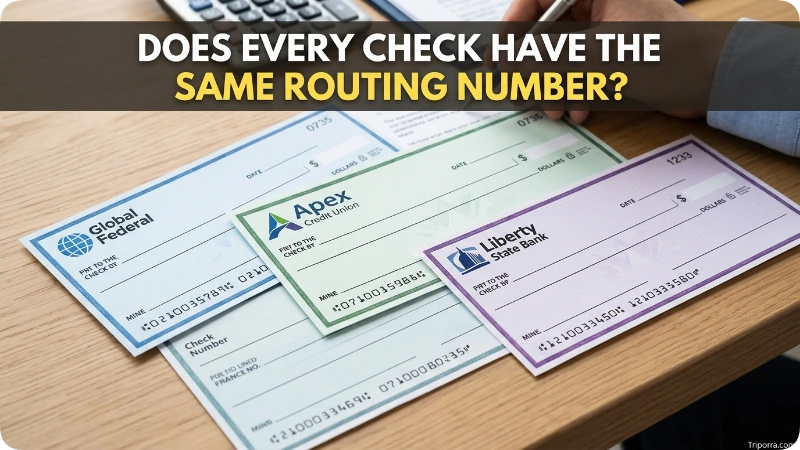
Yes and no.
If all your checks belong to the same checking account at the same bank branch, the routing number usually stays the same.
However, banks that operate across multiple states often assign different routing numbers depending on where you opened your account.
For example, two customers using the same national bank may have completely different routing numbers because they opened accounts in different states.
This is one of the most common facts people get wrong. They assume a bank has only one routing number nationwide, but many large banks use several.
Can Savings Accounts Have Different Routing Numbers?
Sometimes.
Many banks use the same routing number for both checking and savings accounts.
Others assign different routing numbers depending on the account type or the state where the account was opened.
If you’re unsure, check your online banking account or contact your bank directly.
Why You Might Need Your Routing Number
You’ll need your routing number for many everyday banking tasks.
These include:
- Setting up direct deposit
- Receiving your salary
- Paying bills automatically
- Sending ACH transfers
- Receiving tax refunds
- Linking bank accounts
- Ordering new checks
- Automatic loan payments
- Government benefit payments
Fortunately, once you know where is routing number on check, finding it becomes quick and easy whenever these services ask for it.
What Is the Difference Between a Routing Number and an Account Number?
Many people confuse these two numbers.
Here are the key differences.
Routing NumberAccount NumberIdentifies the bankIdentifies your accountAlways 9 digitsUsually 8–17 digitsShared by many customersUnique to youAppears firstAppears second
Using the wrong number may cause payment delays or rejected transactions.
Can You Use the Same Routing Number for Wire Transfers?
Not always.
Many banks use one routing number for ACH transfers and another for wire transfers.
Before sending a large payment, confirm with your bank which routing number should be used.
This is especially important for international transfers, where additional codes such as SWIFT or BIC numbers may also be required.
What If You Don’t Have a Checkbook?
Many people no longer use paper checks.
If that’s the case, you can still locate your routing number by:
- Logging into online banking
- Opening your mobile banking app
- Reviewing your monthly statement
- Calling customer service
- Visiting a local bank branch
There is no need to order checks just to find this information.
Common Mistakes When Looking for a Routing Number
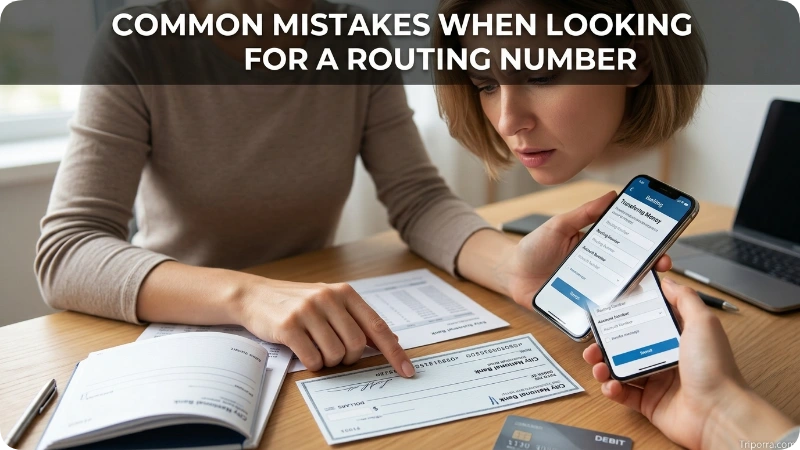
Several errors happen regularly.
- Entering the account number instead.
- Using a routing number from another state.
- Using an outdated routing number after changing banks.
- Searching random websites instead of official bank sources.
- Assuming every bank has only one routing number.
Taking a few extra seconds to verify the correct number can prevent payment problems later.
What Else Do People Want to Know?
People often ask whether routing numbers are private. The answer is no. Routing numbers identify banks, not individual customers, so they are not considered secret information.
Another common question is whether routing numbers ever change. They usually remain the same, but banks can change routing numbers after mergers, acquisitions, or major organizational changes. Customers are normally informed if this happens.
Some people also wonder whether routing numbers work internationally. In most cases, they do not. Routing numbers are mainly used within the United States, while international transfers generally rely on SWIFT or BIC codes.
Finally, many people ask whether checking and savings accounts always share the same routing number. The answer depends on the bank. Some use one routing number for all accounts, while others assign different numbers based on account type or location.
FAQs

1. Where is the routing number located on a check?
It is the first nine-digit number printed at the bottom-left corner of a standard check.
2. Is the routing number always nine digits?
Yes. An ABA routing number always contains exactly nine digits.
3. Can two people have the same routing number?
Yes. Thousands or even millions of customers at the same bank may share the same routing number.
4. Is the routing number the same as my account number?
No. The routing number identifies the bank, while the account number identifies your personal account.
5. Can I find my routing number without a check?
Yes. You can find it through online banking, your mobile app, bank statements, or customer service.
6. Do all banks have only one routing number?
No. Many large banks have multiple routing numbers depending on the state or account type.
7. Is it safe to share my routing number?
Yes, the routing number itself is public information. However, you should protect your account number and other personal banking details.
8. Can a routing number change?
Yes. It may change if a bank merges with another institution or reorganizes its operations.
9. Do routing numbers work outside the United States?
Generally, no. International transfers usually require a SWIFT or BIC code instead.
10. Why is my routing number not working?
You may have entered the wrong digits, used an old routing number, or selected the incorrect routing number for your state or transaction type.
Closing
Knowing where is routing number on check can save time whenever you need to receive payments, set up direct deposits, or complete online banking tasks. The routing number is always the first nine-digit number printed at the bottom-left of a standard check, making it easy to identify once you know what to look for.
Understanding the difference between the routing number, account number, and check number helps prevent common banking mistakes. Before submitting any financial information, take a moment to verify the numbers with your bank to ensure your transactions are processed smoothly.

Elena Rostova bridges the gap between premium hospitality and authentic local experiences. Armed with a background in luxury hospitality management and a passion for fine architecture, she spent years evaluating elite resorts before transitioning into travel journalism. Elena heads the luxury and boutique travel vertical on Triporra.com. Her meticulous guides strip away the guesswork from high-end travel, showcasing unique five-star escapes, fine regional dining, and bespoke private tours that elevate a standard vacation into an unforgettable journey.