Many places around the world are named Vienna, including towns in the United States. This article is about Vienna, Austria, the country’s capital and largest city.
Vienna is one of Europe’s most famous capital cities. It sits in northeastern Austria along the Danube River and has long been a center of music, culture, history, and government. Today, it attracts millions of visitors every year who come to see its grand palaces, museums, coffee houses, and historic streets.
Featured Snippet
Vienna is the capital city of Austria, located in the northeastern part of the country near the borders of Slovakia and Hungary. It lies on the Danube River and serves as Austria’s political, cultural, and economic center. The city is known worldwide for classical music, imperial history, elegant architecture, and a high quality of life.
Quick Facts
| Fact | Details |
| Official Name | Vienna (Wien in German) |
| Country | Austria |
| Region | Northeastern Austria |
| Population | Approximately 2 million |
| Area | Approximately 415 square kilometers (160 square miles) |
| Elevation | Approximately 171 meters (561 feet) |
| Coordinates | 48.2082° N, 16.3738° E |
| Time Zone | Central European Time (CET/CEST) |
| Nearest Major City | Bratislava, Slovakia |
| Known For | Classical music, imperial palaces, coffee culture, museums |
| Language | German |
| Currency | Euro (€) |
Where Is Vienna?
Vienna is located in the northeastern corner of Austria. It stands on the banks of the Danube River, one of Europe’s longest rivers, and is only about 60 kilometers (37 miles) from Slovakia. Hungary is also nearby, making Vienna one of the closest European capitals to another national capital.
The city is almost in the center of Europe, which has made it an important meeting point for trade, politics, and culture for hundreds of years. It is around a three-hour drive from Budapest and less than an hour by train from Bratislava.
Travellers often overlook how close Vienna is to several countries. Because of its location, it is easy to take day trips to Slovakia, Hungary, or even the Czech Republic. This central position has helped shape Vienna into an international city with influences from many cultures.
Is Vienna in Eastern or Western Europe?
Although Vienna is located in the eastern part of Austria, it is generally considered part of Central Europe, not Eastern Europe. Austria shares borders with Germany, the Czech Republic, Slovakia, Hungary, Slovenia, Italy, Switzerland, and Liechtenstein, placing Vienna at an important crossroads between Western and Eastern Europe.
Because Vienna sits so close to Slovakia and Hungary, many travelers mistakenly think it belongs to Eastern Europe. In reality, Austria is a Central European country, and Vienna has long served as a meeting point for cultures, trade, and politics across the continent.
Administrative Status
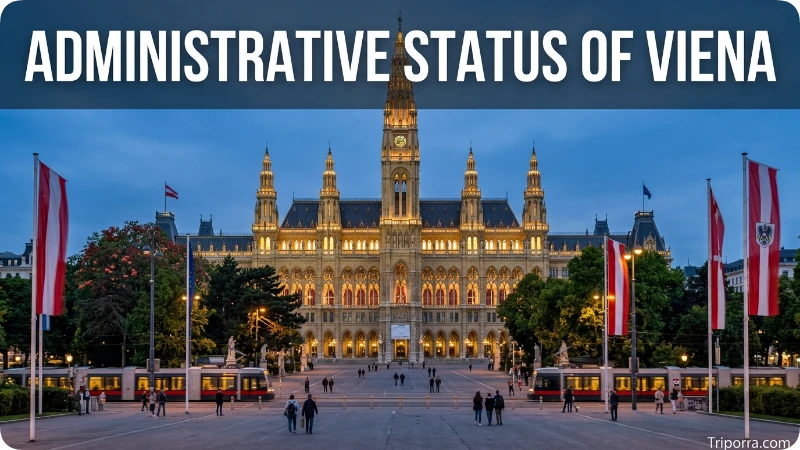
Vienna is both the capital of Austria and one of the country’s nine federal states. This means it works as a city and a state at the same time, with its own local government while also serving as the national capital.
The Austrian Parliament, the President’s offices, the Federal Chancellery, and many international organizations are based here. Vienna also hosts important United Nations offices and several global agencies.
Since Austria is part of the Schengen Area, many international visitors can travel freely between Austria and neighboring countries once they enter the zone, depending on their nationality. The city follows Central European Time and switches to daylight saving time during the summer.
Vienna on the Map
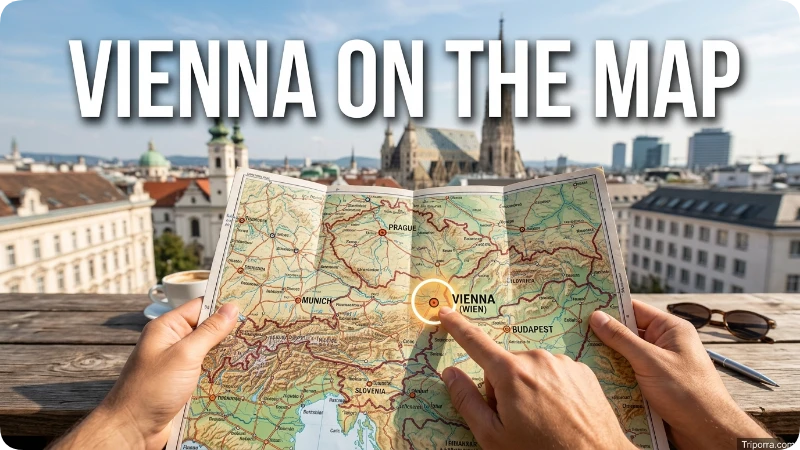
Vienna lies in northeastern Austria, close to the Slovakian border and not far from Hungary. To the west are the Austrian Alps, while flatter landscapes stretch toward Central and Eastern Europe.
North of Vienna are the rolling hills of Lower Austria and the Czech Republic beyond them. East of the city lies Bratislava, one of Europe’s nearest neighboring capitals. Southward, the landscape gradually rises toward vineyards and mountain regions.
What most guides miss is that Vienna is not surrounded by mountains like many people imagine. Although Austria is famous for the Alps, Vienna itself sits mostly on a broad plain beside the Danube River.
H3 Nearby Countries and Major Cities
Vienna’s location makes it one of the best-connected capitals in Europe. Within a few hours, travelers can reach several countries by train, car, or boat.
Nearby destinations include:
- Bratislava, Slovakia – about 60 km (37 miles)
- Budapest, Hungary – about 240 km (150 miles)
- Brno, Czech Republic – about 135 km (84 miles)
- Salzburg, Austria – about 300 km (186 miles)
This central location makes Vienna an excellent base for exploring multiple European countries during one trip.
Why Is Vienna Famous?
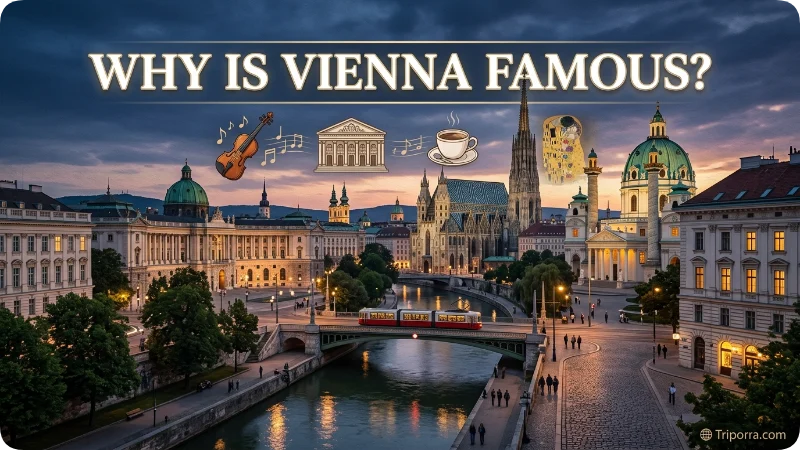
Vienna is best known for its connection to classical music. Famous composers such as Mozart, Beethoven, Schubert, Haydn, and Johann Strauss either lived or worked here. Concert halls like the Musikverein continue this musical tradition today.
The city’s imperial history also draws visitors from around the world. The Habsburg dynasty ruled much of Central Europe for centuries, leaving behind magnificent buildings such as Schönbrunn Palace and the Hofburg Palace. These landmarks show how powerful the Austrian Empire once was.
Vienna is equally famous for its café culture. Traditional coffee houses are more than places to drink coffee—they are part of everyday life. Many locals spend hours reading newspapers, meeting friends, or working in these historic cafés.
Art lovers enjoy museums such as the Kunsthistorisches Museum, Albertina Museum, and Belvedere Palace, which display works by artists including Gustav Klimt.
Another reason people admire Vienna is its excellent public transportation. Trams, buses, underground trains, and bicycles make it easy to travel throughout the city.
Travellers often overlook Vienna’s vineyards. Few world capitals have active vineyards within the city limits, yet locals regularly visit them to enjoy fresh Austrian wine in traditional wine taverns known as Heurigen.
Why Millions of Tourists Visit Vienna Every Year
Vienna attracts millions of international visitors because it combines imperial history with modern city life. Travelers come to experience UNESCO-listed historic districts, world-famous concert halls, grand palaces, Christmas markets, museums, and one of Europe’s best public transportation systems.
The city is also regularly ranked among the world’s most livable cities thanks to its clean streets, reliable services, green spaces, and high quality of life. Whether visitors are interested in history, music, architecture, or food, Vienna offers attractions for every type of traveler.
One common mistake is assuming Vienna is expensive in every way. While luxury hotels and fine dining can cost more, public transport, museums, and local restaurants often provide good value compared with many other major European capitals.
History
Vienna’s history stretches back more than 2,000 years. The Romans first established a military camp called Vindobona here to protect the frontier of their empire.
During the Middle Ages, Vienna grew into a major trading center because of its location along important European trade routes.
The city’s greatest period of growth came under the Habsburg rulers. From the 13th century until the early 20th century, Vienna became the capital of one of Europe’s most powerful empires. Grand palaces, churches, theaters, and public buildings were constructed during this period.
By the late 1800s, Vienna had become one of Europe’s leading centers for music, science, philosophy, and art. Many influential thinkers, artists, and composers lived in the city.
After World War I, Austria-Hungary dissolved, and Vienna became the capital of the new Republic of Austria. The city experienced major changes during World War II before rebuilding into the modern, peaceful capital seen today.
Its long history can still be seen in nearly every neighborhood, where medieval streets stand beside elegant imperial buildings and modern architecture.
Climate & Weather
Vienna has a temperate continental climate with four distinct seasons.
Spring brings mild temperatures and blooming parks. Average daytime temperatures range from about 10°C to 20°C (50°F to 68°F).
Summers are warm, with temperatures usually between 24°C and 30°C (75°F to 86°F). Heat waves occasionally push temperatures above 35°C (95°F).
Autumn offers comfortable weather, colorful trees, and fewer crowds. Many visitors consider this one of the most pleasant seasons.
Winters are cold, with temperatures often between -1°C and 5°C (30°F to 41°F). Snow falls some years, although heavy snowfall is not guaranteed.
What most guides miss is that summer afternoons can become surprisingly hot, while evenings often cool down quickly. Carrying a light jacket even during warm months is a smart idea.
How to Get to Vienna
Vienna is one of Europe’s easiest capitals to reach thanks to its central location and excellent transportation network.
By Air
Vienna International Airport is located about 18 kilometers (11 miles) southeast of the city center. Direct flights connect Vienna with hundreds of destinations across Europe, North America, Asia, and the Middle East. Airport trains, buses, and taxis make it easy to reach downtown.
By Train
International rail services connect Vienna with cities such as Budapest, Prague, Munich, Zurich, Bratislava, and Venice. High-speed trains make traveling between these destinations comfortable and convenient.
By Car
Austria’s motorway network provides easy road access from neighboring countries. Drivers should remember that Austrian highways require a motorway vignette (road toll sticker).
By River
Danube River cruises often stop in Vienna, making it a popular destination for travelers exploring Central Europe by boat.
Things to See & Do
Imperial Landmarks
- Schönbrunn Palace
- Hofburg Palace
- Belvedere Palace
These former royal residences provide a close look at Austria’s imperial past, beautiful gardens, and impressive art collections.
Museums & Culture
- Kunsthistorisches Museum
- Albertina Museum
- Vienna State Opera
These attractions showcase world-famous paintings, sculptures, and musical performances throughout the year.
Historic City Center
Walk through St. Stephen’s Cathedral, Graben Street, and Kärntner Straße to experience Vienna’s historic heart, elegant shops, and centuries-old buildings.
Parks & Nature
Visit Prater Park, home to the famous Giant Ferris Wheel, or explore the peaceful Danube Island, which is popular for cycling, swimming, and outdoor recreation.
Food & Coffee
Enjoy Wiener Schnitzel, Sachertorte, Apfelstrudel, and traditional Viennese coffee in one of the city’s historic cafés. Local markets such as Naschmarkt also offer fresh produce and international cuisine.
Local Vineyards
Spend an afternoon in the vineyards on the city’s outskirts, where traditional wine taverns serve locally produced wines with regional dishes.
Best Day Trips from Vienna
Many travelers use Vienna as a base for exploring nearby destinations.
Popular day trips include:
- Bratislava, Slovakia
- Wachau Valley
- Melk Abbey
- Budapest (long day trip)
- Hallstatt (best as an overnight visit)
These destinations can be reached by train, car, or organized tour and showcase more of Central Europe’s history and landscapes.
Best Time to Visit
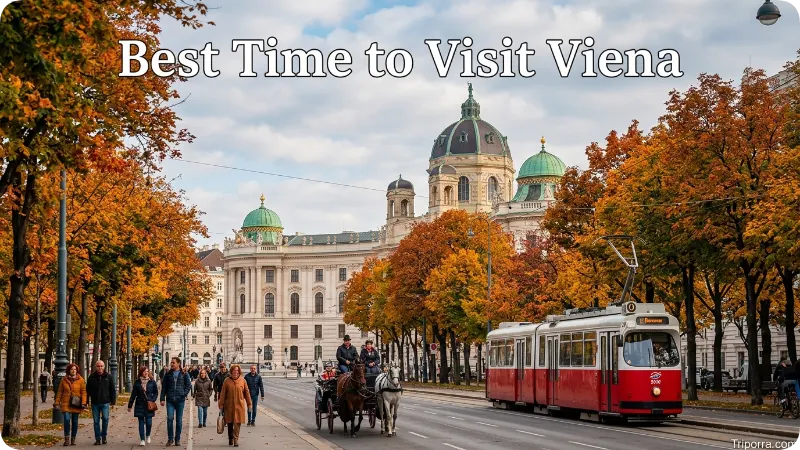
Many travelers enjoy Vienna throughout the year because each season offers a different experience.
Spring, from April to May, brings comfortable temperatures, blooming gardens, and smaller crowds. It is an excellent time for sightseeing and walking tours.
Summer is the busiest season. Outdoor concerts, festivals, and long daylight hours create a lively atmosphere, but accommodation prices are usually higher. Booking early is important during this period.
Autumn is often the sweet spot. Mild weather, colorful parks, wine festivals, and shorter lines at popular attractions make September and October especially enjoyable.
Winter transforms the city with Christmas markets, festive lights, and seasonal treats. However, daylight hours are shorter, and temperatures can feel quite cold, especially in the evenings.
One seasonal trap many visitors miss is December hotel pricing. Christmas markets attract large crowds, so rooms can sell out well before the holiday season.
Best Month to Visit Vienna
For many travelers, May, September, and October offer the best balance of pleasant weather, smaller crowds, and comfortable sightseeing conditions. These months provide mild temperatures that are ideal for walking through the city’s historic streets, visiting gardens, and enjoying outdoor cafés.
If you want to experience Vienna’s famous Christmas markets, plan your visit from late November through December, but be prepared for higher accommodation prices and larger crowds.
Common Misconceptions
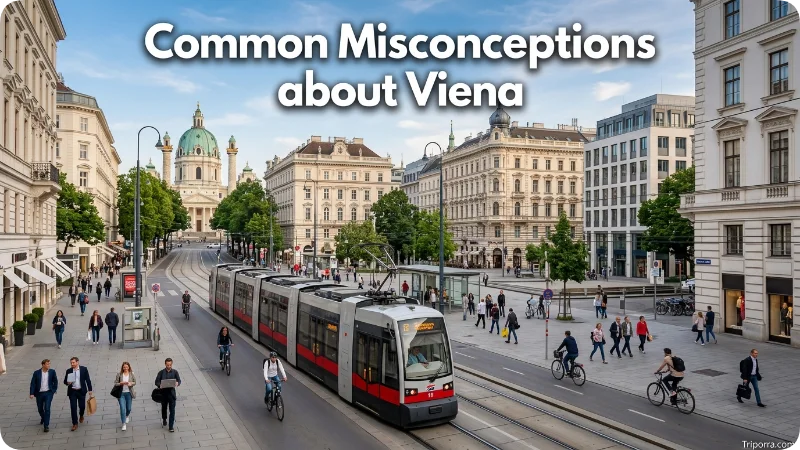
Many people assume Vienna is surrounded by the Austrian Alps. While the Alps cover much of western Austria, Vienna is located on a broad plain in the country’s northeast. The nearest mountains are outside the city and require a short drive or train ride.
Another common misunderstanding is that Vienna and Bratislava are far apart. In reality, they are only about 60 kilometers (37 miles) from each other, making them two of the closest national capitals in Europe.
Some visitors also think everyone speaks only English. While English is widely understood in tourist areas, German is the official language, and learning a few basic German greetings is always appreciated by locals.
Is Vienna Safe to Visit?
Vienna is widely considered one of the safest capital cities in Europe. Violent crime is rare, and most visitors enjoy trouble-free trips. The biggest concern for tourists is petty theft, especially pickpocketing in crowded areas such as public transportation, popular attractions, and busy shopping streets.
Visitors can stay safe by keeping valuables secure, remaining aware of their surroundings, and using licensed taxis or official public transportation. Emergency services are reliable, and the city’s well-maintained infrastructure makes it comfortable for both solo travelers and families.
Related Places
Bratislava, Slovakia
Located less than an hour from Vienna by train or boat, Bratislava is one of the easiest international day trips in Europe. Its medieval Old Town and hilltop castle make it a popular addition to a Vienna itinerary.
Wachau Valley
About an hour west of Vienna, the Wachau Valley is known for vineyards, charming riverside villages, and historic monasteries along the Danube River. It is especially beautiful during spring and autumn.
Salzburg
Famous as the birthplace of Mozart, Salzburg offers stunning Baroque architecture, mountain scenery, and connections to The Sound of Music. It pairs well with a longer Austria trip.
Budapest, Hungary
Around two and a half to three hours from Vienna by train, Budapest is known for its thermal baths, grand parliament building, and scenic views along the Danube.
Melk Abbey
This impressive Benedictine monastery overlooks the Danube River and is one of Austria’s best-known historical landmarks. It is often included on Danube River cruises.
What Else Do People Want to Know?
Vienna is considered one of the safest major cities in Europe. Violent crime is uncommon, although visitors should still watch for pickpockets in crowded tourist areas and on public transportation.
Compared with cities like London or Paris, Vienna offers good value for many travelers. Public transportation is affordable, drinking water from public fountains is clean, and many parks and outdoor attractions are free to enjoy.
The city is also easy to explore without a car. Vienna’s metro, tram, and bus network connects nearly every neighborhood, making travel simple even for first-time visitors.
Austria is part of the Schengen Area, so visa requirements depend on your nationality. Many visitors from Europe and several other countries can enter for short stays without needing a separate Austrian visa.
Local customs are polite but relaxed. Greeting shop staff, waiting your turn, and respecting quiet hours in residential areas help visitors fit in comfortably.
Travel Tips for First-Time Visitors
If you’re visiting Vienna for the first time, a few simple tips can make your trip easier.
- Buy a public transport pass if staying several days.
- Carry comfortable walking shoes for the historic center.
- Many museums are closed on certain weekdays, so check opening hours.
- Credit cards are widely accepted, but carrying some cash is useful at smaller cafés and markets.
- Learn a few basic German greetings such as “Hallo” and “Danke.”
FAQs
1. Where is Vienna located?
Vienna is located in northeastern Austria on the Danube River, close to the borders of Slovakia and Hungary.
2. What country is Vienna the capital of?
Vienna is the capital city of Austria and serves as the country’s political, cultural, and economic center.
3. Is Vienna close to Bratislava?
Yes. Bratislava is approximately 60 kilometers (37 miles) from Vienna, making it one of the closest neighboring capitals in Europ
4. What language do people speak in Vienna?
German is the official language. Many people working in tourism, hotels, restaurants, and shops also speak Englis
5. What is Vienna best known for?
Vienna is famous for classical music, imperial palaces, museums, coffee houses, historic architecture, and its connection to composers such as Mozart, Beethoven, and Strauss.
6. Is Vienna expensive to visit?
Vienna can fit different budgets. Luxury hotels are available, but affordable public transportation, local restaurants, and city passes help many travelers keep costs reasonable.
7. How many days should I spend in Vienna?
Three to four days allow enough time to visit the main palaces, museums, historic center, and traditional cafés while enjoying the city’s relaxed atmosphere.
8. Does it snow in Vienna?
Yes. Snowfall usually occurs during winter, although the amount varies from year to year. December through February is the most likely period for snow.
9. Can you drink tap water in Vienna?
Yes. Vienna’s tap water is among the cleanest in Europe and comes from protected alpine spring sources. It is safe to drink throughout the city.
10. Is Vienna a good destination for families?
Yes. Families can enjoy Schönbrunn Zoo, Prater amusement park, museums designed for children, large parks, and an easy-to-use public transportation system.
Is Vienna worth visiting?
Yes. Vienna is considered one of Europe’s top travel destinations because of its imperial palaces, museums, classical music, coffee culture, clean streets, and excellent public transportation. Many visitors combine Vienna with nearby cities such as Bratislava and Budapest.
What continent is Vienna in?
Vienna is located in Europe. It is the capital of Austria, a country in Central Europe.
Is Vienna bigger than Salzburg?
Yes. Vienna is Austria’s largest city, with around two million residents, while Salzburg has a much smaller population.
What river runs through Vienna?
The Danube River flows through Vienna. It is Europe’s second-longest river and has played an important role in the city’s history, trade, and transportation.
Is Vienna walkable?
Yes. Vienna is one of Europe’s most walkable capital cities. Many major attractions in the historic center are within walking distance, and an extensive public transportation network makes it easy to explore areas farther away.
Do I need a car in Vienna?
No. Most visitors do not need a car because Vienna has an excellent network of metro trains, trams, buses, and suburban rail services that connect nearly every part of the city.
Final Thoughts
Vienna offers far more than grand palaces and classical concerts. Its location in the heart of Europe, deep imperial history, welcoming coffee culture, and efficient public transportation make it one of the continent’s easiest capitals to explore.
Whether you’re interested in history, art, food, music, or simply walking through beautiful streets, Vienna provides experiences that suit every type of traveler. Many visitors arrive for a few days but leave wishing they had stayed longer.
If you’re planning a trip to Austria or simply wanted to answer the question “Where Is Vienna?”, you now know not only where the city is on the map but also why it continues to be one of Europe’s most admired destinations.

Silas Vance is a geography enthusiast, travel researcher, and location-focused content writer dedicated to helping readers better understand the world around them on triporra.com. He specializes in creating informative guides about cities, countries, islands, landmarks, universities, and other notable destinations. His work combines geographic accuracy, historical context, and practical insights to answer location-based questions in a simple and engaging way.