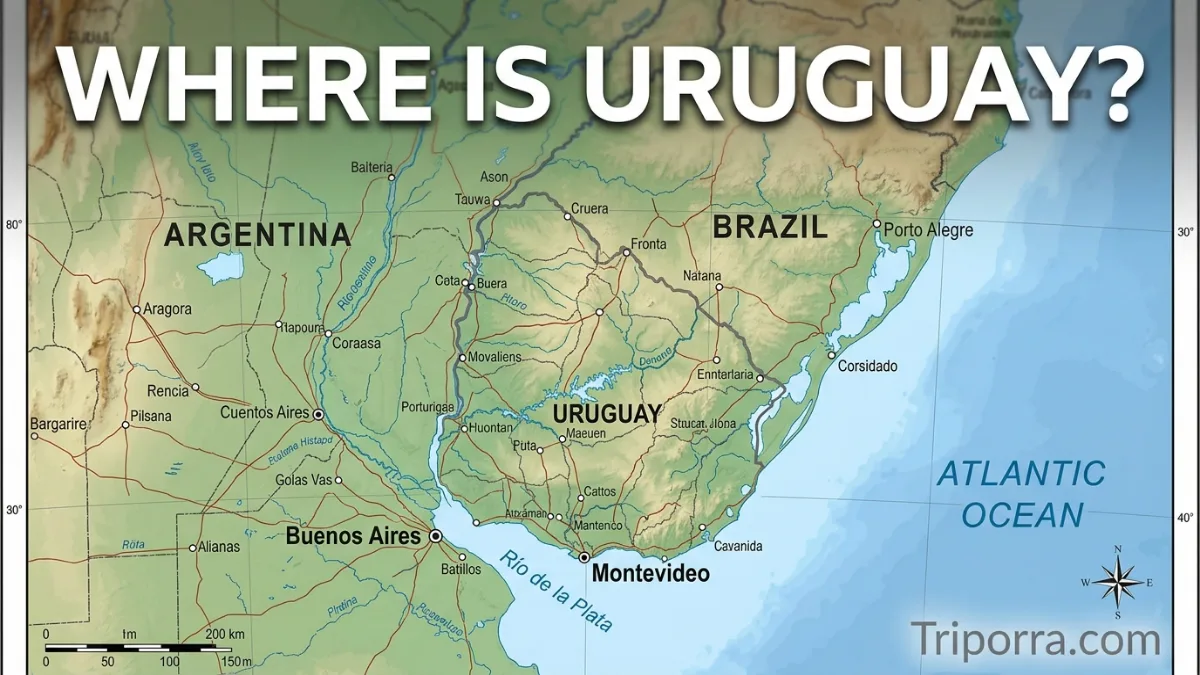
If you’re wondering where is Uruguay, the short answer is that Uruguay is a country in southeastern South America. It lies between Argentina to the west and Brazil to the north and east. The country’s southern coastline meets the Río de la Plata estuary, while its southeastern coast borders the Atlantic Ocean. Although Uruguay is South America’s second-smallest independent country after Suriname, it is known for its stable democracy, high quality of life, beautiful beaches, strong agricultural economy, and welcoming culture.
Uruguay covers about 68,037 square miles (176,215 square kilometers) and has a population of approximately 3.5 million people (2025 estimate). Its capital and largest city is Montevideo, where nearly half of the country’s population lives. Spanish is the official language, and the Uruguayan peso (UYU) is the national currency. Thanks to its central location between two of South America’s largest countries, Uruguay serves as an important cultural and economic bridge in the region.
Featued Snippet
Uruguay is a sovereign country in southeastern South America, bordered by Brazil to the north and northeast, Argentina to the west across the Uruguay River, the Río de la Plata to the south, and the Atlantic Ocean to the southeast. Its capital is Montevideo, and it is known for its democratic government, Atlantic coastline, and high standard of living.
Quick Fact
Details
| Quick Fact | Details |
|---|---|
| Official Name | Oriental Republic of Uruguay (República Oriental del Uruguay) |
| Entity Type | Sovereign Country |
| Continent | South America |
| Region | Southeastern South America |
| Capital | Montevideo |
| Largest City | Montevideo |
| Area | 68,037 sq mi (176,215 sq km) |
| Population (2025) | Approximately 3.5 million |
| Official Language | Spanish |
| Currency | Uruguayan Peso (UYU) |
| Time Zone | Uruguay Standard Time (UTC−3) |
| Driving Side | Right |
| Calling Code | +598 |
| Internet Domain | .uy |
| Highest Point | Cerro Catedral – 1,683 ft (514 m) |
| Major River | Uruguay River |
| Coastline | Atlantic Ocean and Río de la Plata |
Where Is Uruguay Located on the Map?
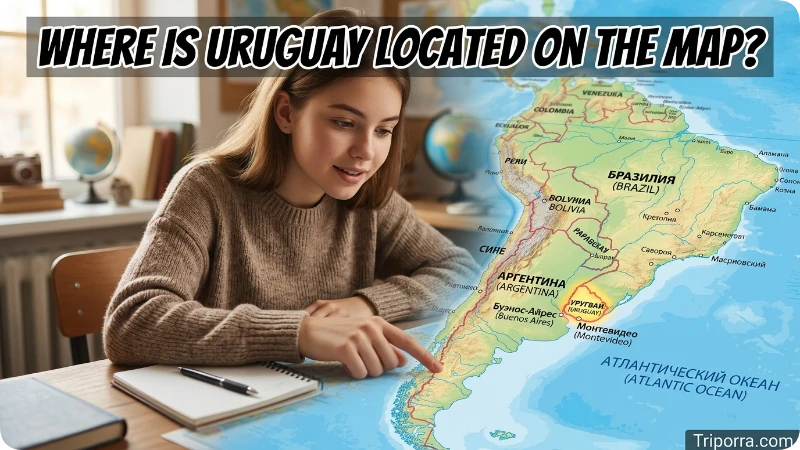
🌍 Uruguay is located in the southeastern part of South America. On a world map, it appears on the eastern side of the continent, below Brazil and across the Uruguay River from Argentina.
The country stretches from approximately 30° to 35° south latitude and 53° to 58° west longitude. Because of its location in the Southern Hemisphere, Uruguay experiences seasons opposite to those in North America and Europe. For example, summer lasts from December through February, while winter runs from June through August.
Uruguay occupies a strategic position along the Atlantic coast. Its southern shoreline follows the Río de la Plata, one of the world’s widest estuaries, while its eastern shoreline opens directly to the Atlantic Ocean.
Unlike many South American countries, Uruguay has no high mountain ranges or tropical rainforests. Instead, the landscape consists mainly of rolling plains, fertile grasslands, rivers, and gentle hills that support agriculture and livestock farming.
⭐ Did You Know? Uruguay is one of only two South American countries that lie entirely outside the tropics. The other is Chile.
What Country Is Uruguay In?
Uruguay is not located inside another country. It is an independent nation with its own government, constitution, laws, currency, and international borders.
The official name of the country is the Oriental Republic of Uruguay. The word “Oriental” does not refer to Asia. Instead, it means “eastern”, describing the country’s position east of the Uruguay River.
Uruguay gained independence after a long struggle involving both Argentina and Brazil. Today, it is a member of major international organizations, including:
- United Nations (UN)
- Organization of American States (OAS)
- MERCOSUR
- World Trade Organization (WTO)
- Community of Latin American and Caribbean States (CELAC)
Its stable democratic institutions have made Uruguay one of the region’s most respected countries.
Which Countries Border Uruguay?
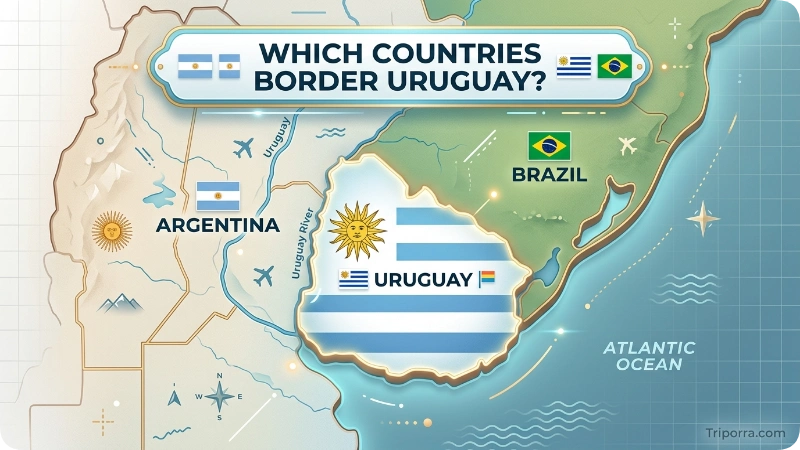
Uruguay shares land borders with only two countries.
| Neighbor | Direction from Uruguay | Border Type |
|---|---|---|
| Brazil | North and Northeast | Land Border |
| Argentina | West | Natural border formed by the Uruguay River |
To the south lies the Río de la Plata, while the southeastern coastline opens onto the Atlantic Ocean.
The international border with Brazil extends for about 649 miles (1,043 km), while the Uruguay River naturally separates much of Uruguay from Argentina.
Several bridges connect Uruguay and Argentina across the Uruguay River, making travel between the two countries relatively easy.
Despite its modest size, Uruguay’s location has historically made it an important gateway for trade between neighboring nations.
How Far Is Uruguay From Major Cities?
📍 Uruguay is well connected to major South American cities by air. Travel times vary depending on airline schedules, weather conditions, and stopovers.
| City | Approximate Straight-Line Distance from Montevideo | Typical Flight Time* |
|---|---|---|
| Buenos Aires, Argentina | 127 miles (204 km) | About 1 hour |
| São Paulo, Brazil | 975 miles (1,570 km) | Around 2.5–3 hours |
| Rio de Janeiro, Brazil | 1,140 miles (1,835 km) | Around 3 hours |
| Santiago, Chile | 848 miles (1,365 km) | Around 2.5 hours |
| Asunción, Paraguay | 665 miles (1,070 km) | Around 2 hours |
Buenos Aires is the closest major capital city. Ferries also connect Montevideo with Buenos Aires across the Río de la Plata, offering another popular travel option.
Driving times depend on border crossings, road conditions, and traffic.
Geography and Landscape of Uruguay
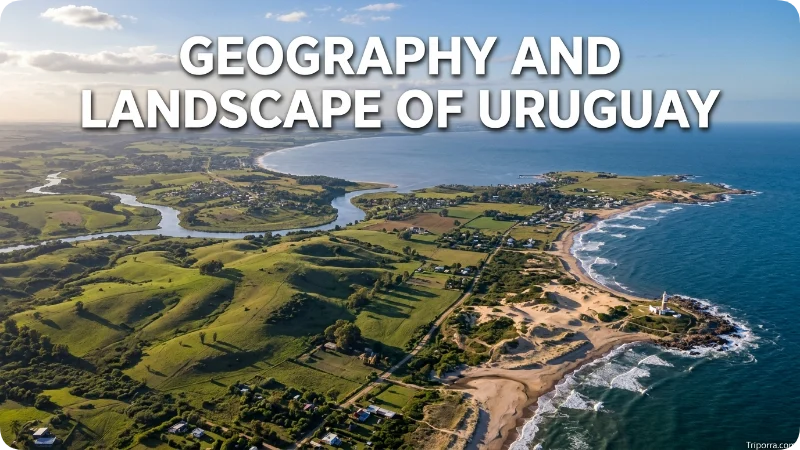
🌎 Uruguay is mostly a country of rolling plains, low hills, fertile farmland, and rivers. Unlike many South American countries, it does not have the Andes Mountains, active volcanoes, or dense tropical rainforests. Instead, its gentle landscape makes it one of the easiest countries in the region for farming and transportation.
Most of the land is covered by natural grasslands called the Pampas, which support millions of cattle and sheep. These grasslands have made Uruguay one of the world’s leading producers of high-quality beef and wool.
The country’s highest point is Cerro Catedral, which rises to about 1,683 feet (514 meters) above sea level. Although it is the tallest point in Uruguay, it is considered a low hill compared with mountain ranges elsewhere in South America.
Several important rivers flow through the country, including:
- Uruguay River – Forms much of the western border with Argentina.
- Río Negro – The country’s longest river that flows entirely within Uruguay.
- Yí River – An important tributary of the Río Negro.
- Santa Lucía River – Supplies drinking water to much of Montevideo.
Uruguay also has more than 400 miles (660 kilometers) of coastline along the Atlantic Ocean and the Río de la Plata. The coast features sandy beaches, dunes, lagoons, wetlands, and small fishing towns.
⭐ Did You Know? Nearly all of Uruguay’s land is suitable for agriculture, making it one of South America’s most productive farming countries.
Major Cities in Uruguay
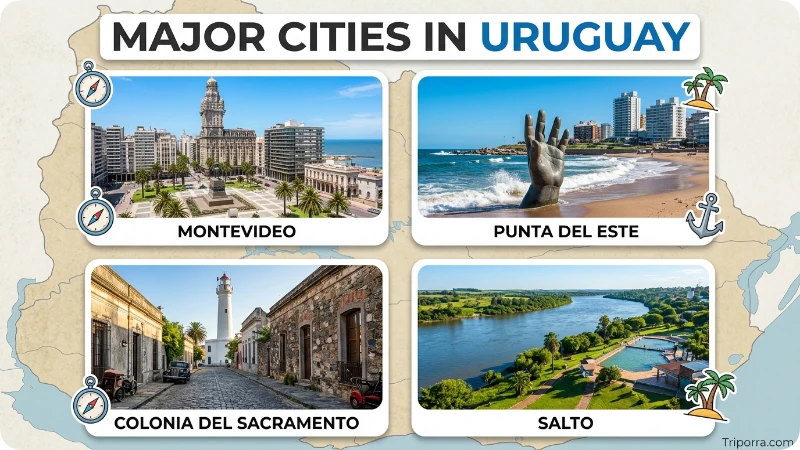
🏙️ Although Uruguay is relatively small, it has several important cities that serve as cultural, economic, and regional centers.
Montevideo
Montevideo is the capital, largest city, and main seaport of Uruguay. Located on the northern shore of the Río de la Plata, it is home to nearly half of the country’s population. The city is known for its historic Old Town, long waterfront promenade (La Rambla), museums, universities, and busy commercial districts.
Salto
Salto is Uruguay’s second-largest city. It sits along the Uruguay River near the Argentine border and is famous for its hot springs, citrus farming, and hydroelectric projects.
Paysandú
Paysandú is another important river city in western Uruguay. It has a strong manufacturing sector and serves as a transportation hub for nearby farming communities.
Punta del Este
Often called Uruguay’s premier beach destination, Punta del Este attracts visitors from around the world. It is well known for its beaches, marinas, luxury resorts, nightlife, and public art, including the famous sculpture La Mano.
Maldonado
Located just inland from Punta del Este, Maldonado is one of the country’s fastest-growing cities. It supports tourism, commerce, and local government in the surrounding region.
Other notable cities include:
- Rivera
- Tacuarembó
- Melo
- Mercedes
- Colonia del Sacramento
- Durazno
- Rocha
Each city reflects a different part of Uruguay’s culture, economy, and history.
Climate and Weather in Uruguay
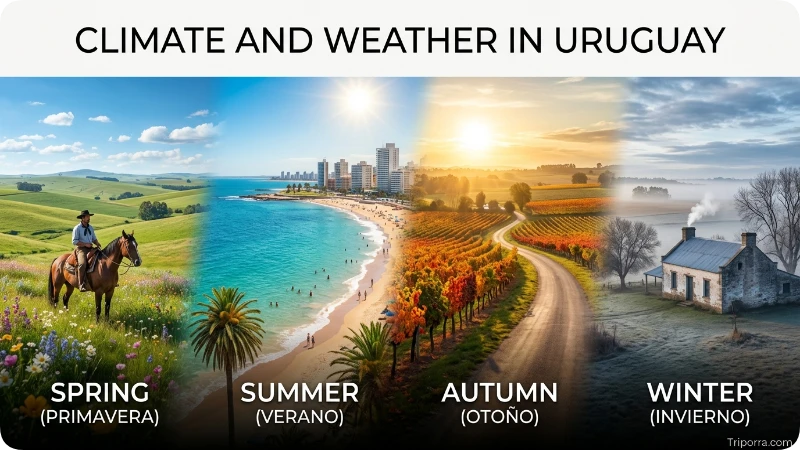
☀️ Uruguay has a humid subtropical climate, with four distinct seasons. Because the country lies in the Southern Hemisphere, its seasons are opposite those in North America and Europe.
Summer (December–February)
Summer temperatures usually range from 77–90°F (25–32°C). Coastal areas often feel cooler because of Atlantic Ocean breezes, making beach destinations especially popular during this season.
Autumn (March–May)
Autumn brings milder temperatures and colorful scenery. Average daytime temperatures generally range from 59–77°F (15–25°C).
Winter (June–August)
Winter is cool rather than severe. Temperatures commonly range from 41–59°F (5–15°C). Snow is extremely rare across most of the country, although frost may occur inland.
Spring (September–November)
Spring is pleasant, with warming temperatures, blooming flowers, and greener landscapes. It is one of the best times to explore both cities and the countryside.
Rain falls throughout the year rather than during a single rainy season. Strong winds occasionally affect coastal regions, especially during seasonal weather changes.
| Season | Average Temperature |
|---|---|
| Summer (December–February) | 77–90°F (25–32°C) |
| Autumn (March–May) | 59–77°F (15–25°C) |
| Winter (June–August) | 41–59°F (5–15°C) |
| Spring (September–November) | 59–77°F (15–25°C) |
⭐ Did You Know? Uruguay experiences very little temperature variation between different parts of the country because its terrain is mostly flat.
Population, Language, and Currency
👥 As of 2025, Uruguay has an estimated population of about 3.5 million people. Despite its modest population, it has one of the highest urbanization rates in South America, with more than 90% of residents living in towns and cities.
Official Language
Spanish is the official language spoken throughout Uruguay. The local accent shares similarities with the Spanish spoken in neighboring Argentina, particularly around the Río de la Plata region.
Near the Brazilian border, some communities also speak Portuñol, a blend of Spanish and Portuguese used in everyday communication.
Currency
Uruguay’s official currency is the Uruguayan Peso (UYU). Credit and debit cards are widely accepted in cities, while cash remains useful in smaller towns and rural areas.
Religion
Uruguay is one of the most secular countries in Latin America. While many people identify as Roman Catholic, a significant portion of the population does not follow any organized religion. The country also has communities of Protestants, Jews, Muslims, and followers of other faiths.
Education and Literacy
Uruguay is recognized for its strong public education system and high literacy rate, which is among the highest in South America. Education is free and compulsory for children through much of their schooling.
Economy
The country’s economy is driven by:
- Agriculture
- Livestock farming
- Forestry
- Renewable energy
- Manufacturing
- Financial services
- Tourism
- Information technology
Uruguay is also recognized internationally for generating a large share of its electricity from renewable sources, including wind, hydroelectric, and solar power.
What Is Uruguay Known For?
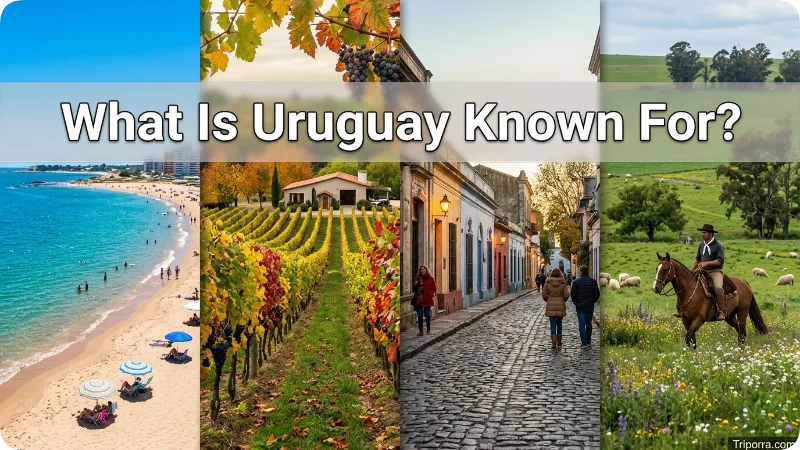
🇺🇾 Uruguay is known for its peaceful lifestyle, stable democracy, beautiful Atlantic beaches, cattle ranching, football tradition, renewable energy, and high quality of life. Although it is one of South America’s smallest countries, it has earned an international reputation for good governance, strong social policies, and a modern economy.
Here are some of the things Uruguay is best known for:
Beautiful Beaches
Uruguay’s Atlantic coastline stretches for more than 400 miles (660 km). It includes busy resort towns, quiet fishing villages, protected sand dunes, and long natural beaches.
Popular beach destinations include:
- Punta del Este
- La Paloma
- José Ignacio
- Piriápolis
- Cabo Polonio
- Punta del Diablo
Many beaches become especially busy during the Southern Hemisphere summer from December to February.
Football (Soccer)
Football is the country’s most popular sport. Uruguay has a proud international record despite its relatively small population.
Some major achievements include:
- Winner of the first FIFA World Cup in 1930
- FIFA World Cup champion again in 1950
- Multiple Copa América titles
- Home to legendary footballers such as Luis Suárez, Diego Forlán, Edinson Cavani, and José Nasazzi
Football remains an important part of daily life across the country.
High-Quality Beef
Uruguay is one of the world’s leading exporters of grass-fed beef. Most cattle are raised on natural pastures rather than in large feedlots.
Traditional barbecue, known locally as asado, is one of the country’s best-loved meals.
Yerba Mate
Drinking mate, a hot herbal beverage made from yerba mate leaves, is a daily habit for many Uruguayans. It is common to see people carrying a thermos of hot water and a mate cup while walking, working, or relaxing in parks.
Renewable Energy
Uruguay has become a global example of renewable electricity generation. Most of its electricity now comes from renewable sources such as:
- Wind power
- Hydroelectric power
- Solar energy
- Biomass
This transition has reduced dependence on imported fossil fuels.
Stable Democracy
Uruguay consistently ranks among the strongest democracies in Latin America. It is widely recognized for political stability, press freedom, low corruption compared with many regional neighbors, and respect for civil rights.
⭐ Did You Know? Uruguay was one of the first countries in the world to legalize and regulate the recreational use of cannabis under national law.
A Brief History of Uruguay
📜 Uruguay’s history reflects the influence of Indigenous peoples, European colonization, struggles for independence, and democratic development.
Indigenous Peoples
Before European arrival, the region was home to several Indigenous groups, including the Charrúa, who lived by hunting, fishing, and gathering.
Spanish and Portuguese Influence
During the 16th and 17th centuries, both Spain and Portugal claimed parts of the region because of its strategic location between their colonies.
In 1726, the Spanish founded Montevideo to strengthen their presence along the Río de la Plata.
Independence
After years of conflict involving Spain, Portugal, Brazil, and the United Provinces of the Río de la Plata (modern Argentina), Uruguay declared independence in 1825.
Its independence was formally recognized in 1828 through international agreements.
Modern Uruguay
The country experienced periods of economic growth, political reform, military rule during the 1970s and early 1980s, and eventually a return to democracy in 1985.
Today, Uruguay is considered one of Latin America’s most stable democratic nations.
Best Places to Visit in Uruguay
✈️ Uruguay offers a mix of beaches, historic towns, nature reserves, vineyards, and cultural attractions.
Montevideo
The capital combines history with modern city life.
Top attractions include:
- Plaza Independencia
- Ciudad Vieja (Old Town)
- Mercado del Puerto
- La Rambla waterfront
- Teatro Solís
Punta del Este
Known for luxury hotels, beaches, shopping, and nightlife, Punta del Este is one of South America’s most famous seaside resorts.
Popular attractions include:
- Playa Brava
- Playa Mansa
- La Mano sculpture
- Punta del Este Lighthouse
Colonia del Sacramento
This historic city is one of Uruguay’s oldest settlements and a UNESCO World Heritage Site. Its cobblestone streets and colonial architecture reflect Portuguese and Spanish influences.
Cabo Polonio
Cabo Polonio is famous for its remote beaches, large sea lion colony, sand dunes, and absence of conventional roads leading directly into the village.
José Ignacio
This quiet coastal village has become a favorite destination for visitors seeking peaceful beaches, seafood restaurants, and boutique accommodations.
Termas del Daymán
Located near Salto, these natural hot springs attract visitors looking for relaxation and wellness experiences throughout the year.
⭐ Travel Tip: December through March is the busiest tourism season. If you prefer fewer crowds and mild weather, consider visiting during spring (September–November) or autumn (March–May).
How to Get to Uruguay and the Nearest Airports
🛫 Uruguay is easily accessible by air, ferry, road, and international bus services.
Main International Airport
The country’s primary international gateway is:
Carrasco International Airport (MVD)
Located about 12 miles (20 km) east of downtown Montevideo, the airport handles flights from destinations across South America, North America, and, through connecting services, Europe and other regions.
Major airlines provide connections via cities such as:
- São Paulo
- Santiago
- Buenos Aires
- Panama City
- Lima
- Madrid (seasonal or connecting services depending on airline schedules)
Ferry Services
Many travelers arrive from Argentina using passenger ferries across the Río de la Plata.
Common ferry routes include:
- Buenos Aires to Montevideo
- Buenos Aires to Colonia del Sacramento
Travel times vary depending on the ferry service, weather conditions, and route selected.
By Road
Uruguay has well-maintained highways connecting it with neighboring Brazil and Argentina. International buses operate regular services between major cities in the region.
Domestic Transportation
Getting around Uruguay is straightforward thanks to:
- Long-distance buses
- Rental cars
- Domestic flights (limited)
- Taxis
- Ride-hailing services in larger cities
Road conditions are generally good, making self-driving a practical option for exploring the countryside and coastal towns.
⭐ Did You Know? Uruguay’s compact size allows travelers to drive from Montevideo to Punta del Este in roughly 2 hours, depending on traffic and road conditions.
Is Uruguay Safe to Visit?
🛡️ Yes, Uruguay is generally considered one of the safest countries in South America for travelers. It consistently ranks highly for political stability, rule of law, and quality of life. Most visits are trouble-free, especially in popular tourist areas.
Like any destination, visitors should still take normal precautions.
Safety Tips for Travelers
- Keep valuables out of sight in crowded places.
- Use licensed taxis or trusted ride-hailing services.
- Stay aware of your surroundings, especially at night in unfamiliar areas.
- Avoid leaving bags or electronics unattended on beaches.
- Follow local weather advisories if visiting coastal areas during storms.
Emergency services are widely available in major cities, and healthcare facilities in Montevideo are among the best in the region.
⭐ Did You Know? Uruguay is frequently ranked among the most peaceful and politically stable countries in Latin America.
Best Time to Visit Uruguay
🌤️ The best time to visit Uruguay depends on what you want to do. Thanks to its mild climate, the country can be visited throughout the year.
Summer (December–February)
This is the busiest tourist season.
Best for:
- Beach vacations
- Swimming
- Surfing
- Festivals
- Outdoor dining
Average temperatures range from 77–90°F (25–32°C).
Autumn (March–May)
Autumn offers pleasant weather and fewer crowds.
Best for:
- City sightseeing
- Wine tourism
- Road trips
- Nature photography
Average temperatures range from 59–77°F (15–25°C).
Winter (June–August)
Winter is cool but rarely severe.
Best for:
- Museums
- Historic towns
- Hot springs
- Lower hotel prices
Average temperatures range from 41–59°F (5–15°C).
Spring (September–November)
Spring brings blooming landscapes and comfortable temperatures.
Best for:
- Hiking
- Wildlife watching
- Exploring vineyards
- Outdoor markets
Average temperatures range from 59–77°F (15–25°C).
Why Uruguay Stands Out in South America
Although Uruguay is smaller than many of its neighbors, it stands out for several reasons. It has a strong democratic tradition, a high literacy rate, and one of the highest standards of living in Latin America. The country is also recognized for producing most of its electricity from renewable sources and for its commitment to environmental sustainability.
Uruguay’s economy relies heavily on agriculture, livestock, forestry, technology, tourism, and financial services. Its grass-fed beef, dairy products, wool, and wine are exported to markets around the world. Combined with its peaceful atmosphere and well-developed infrastructure, these strengths make Uruguay an attractive destination for both visitors and investors.
Did You Mean a Different Place?
The search term “where is Uruguay” almost always refers to the country in South America. However, you may occasionally come across other uses of the name.
These include:
- Uruguay River — A major river that forms part of the border between Uruguay and Argentina and between Argentina and Brazil.
- Uruguay Department Names — Some organizations, sports clubs, and businesses around the world use “Uruguay” in their names, but they are not separate geographic locations.
If your search was about the Uruguay River or another place with a similar name, be sure to include that in your search for more specific results.
FAQ
Is Uruguay in South America?
Yes. Uruguay is located in southeastern South America, between Brazil and Argentina. It borders the Atlantic Ocean and the Río de la Plata, giving it an important position along the continent’s southeastern coast.
What is the capital of Uruguay?
The capital of Uruguay is Montevideo. It is also the country’s largest city, main seaport, and economic center. Nearly half of Uruguay’s population lives in the metropolitan area.
What language do people speak in Uruguay?
The official language is Spanish. Most people speak Rioplatense Spanish, a regional variety also common in parts of Argentina. In some northern border areas, people also use Portuñol, a mix of Spanish and Portuguese.
What currency does Uruguay use?
Uruguay uses the Uruguayan Peso (UYU) as its official currency. Credit and debit cards are widely accepted in cities and tourist destinations, although carrying some cash is useful when visiting smaller towns.
Why is Uruguay famous?
Uruguay is famous for its Atlantic beaches, football history, grass-fed beef, mate culture, stable democracy, renewable energy, and high quality of life. It is also well known for the historic city of Colonia del Sacramento and the beach resort of Punta del Este.
Is Uruguay a good place to visit?
Yes. Uruguay is a popular destination for travelers seeking beaches, historic towns, nature, and local culture. Good roads, reliable public services, and a generally safe environment make it easy to explore.
Which countries border Uruguay?
Uruguay shares land borders with Brazil to the north and northeast and Argentina to the west across the Uruguay River. It also borders the Atlantic Ocean and the Río de la Plata to the south and southeast.
What is the population of Uruguay?
As of 2025, Uruguay has an estimated population of approximately 3.5 million people. Most residents live in urban areas, with Montevideo serving as the country’s largest metropolitan center.
Does Uruguay have beaches?
Yes. Uruguay has more than 400 miles (660 kilometers) of Atlantic and estuary coastline. Popular beach destinations include Punta del Este, La Paloma, José Ignacio, Cabo Polonio, and Punta del Diablo.
What continent is Uruguay in?
Uruguay is part of South America. It lies in the southeastern portion of the continent between Brazil and Argentina and is entirely south of the Equator.
Conclusion
Uruguay is an independent country in southeastern South America, bordered by Brazil, Argentina, the Uruguay River, the Río de la Plata, and the Atlantic Ocean. While it is one of the continent’s smaller nations, it offers a remarkable combination of political stability, modern cities, scenic coastlines, productive farmland, and a rich cultural heritage.
Whether you are looking at a world map, planning a vacation, studying South American geography, or simply wondering where Uruguay is located, the answer is straightforward: it sits on the Atlantic coast between two of South America’s largest countries. From the lively streets of Montevideo and the historic charm of Colonia del Sacramento to the famous beaches of Punta del Este and the peaceful countryside, Uruguay has much more to offer than its size suggests. Its welcoming people, reliable infrastructure, and strong democratic traditions continue to make it one of the region’s most respected and enjoyable destinations.

Silas Vance is a geography enthusiast, travel researcher, and location-focused content writer dedicated to helping readers better understand the world around them on triporra.com. He specializes in creating informative guides about cities, countries, islands, landmarks, universities, and other notable destinations. His work combines geographic accuracy, historical context, and practical insights to answer location-based questions in a simple and engaging way.