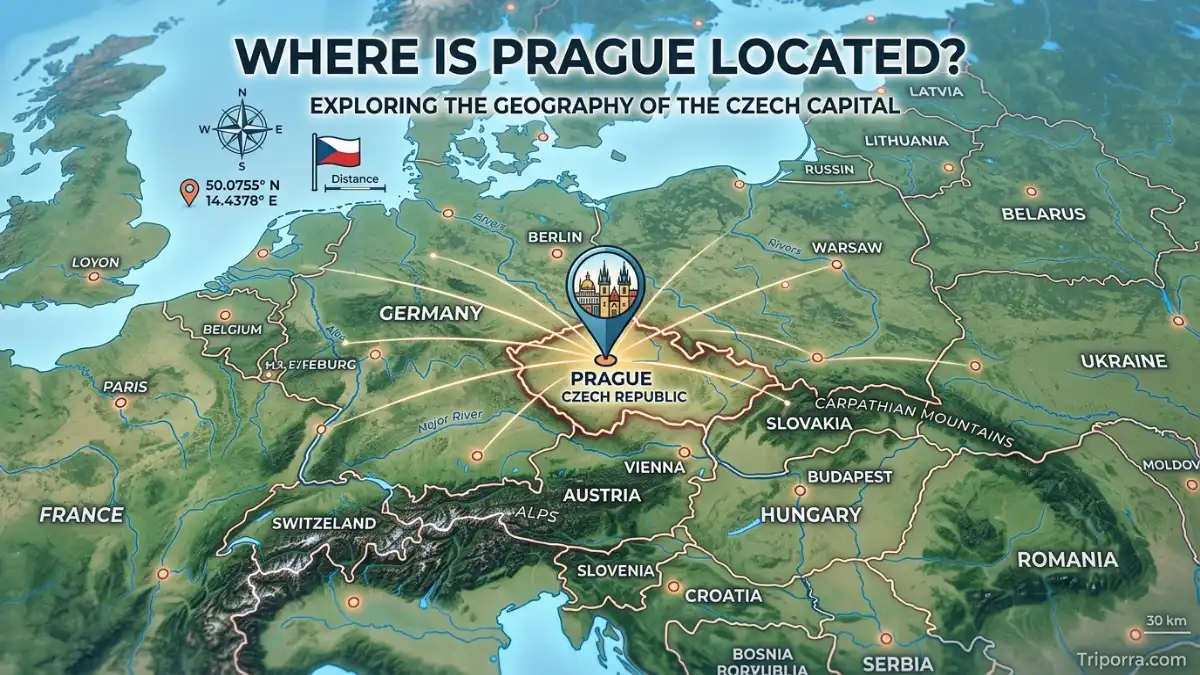
If you’re wondering where is Prague located, the short answer is that Prague is the capital city of the Czech Republic in Central Europe. It sits along the Vltava River and is one of Europe’s best-known historic cities. Prague is about 180 miles (290 km) southeast of Berlin, Germany, and around 205 miles (330 km) northwest of Vienna, Austria.
Millions of travelers visit Prague every year because of its medieval architecture, famous bridges, castles, museums, and cultural attractions. Whether you are planning a vacation, studying geography, or simply curious about its location, understanding where Prague sits on the map helps explain why it has been an important European city for more than a thousand years.
Prague is also the political, cultural, and economic center of the Czech Republic. Its central location makes it easy to reach from many European countries by plane, train, bus, or car.
Featured Snippet
Prague is located in the Czech Republic, a landlocked country in Central Europe. The city lies on the Vltava River, about 180 miles (290 km) southeast of Berlin and around 205 miles (330 km) northwest of Vienna. As the country’s capital and largest city, Prague serves as the political, cultural, and economic heart of the Czech Republic.
Quick fact
| Quick Fact | Information |
| Official Name | Prague (Praha) |
| Country | Czech Republic |
| Region | Central Europe |
| Status | Capital and largest city |
| Population | Approximately 1.4 million (city, 2025 estimate) |
| Metropolitan Population | Approximately 2.3 million |
| River | Vltava River |
| Elevation | About 770 feet (235 m) above sea level |
| Coordinates | 50.0755° N, 14.4378° E |
| Time Zone | Central European Time (CET, UTC+1); Central European Summer Time (CEST, UTC+2) |
| Currency | Czech Koruna (CZK) |
| Official Language | Czech |
| UNESCO Status | Historic Centre of Prague (since 1992) |
Where Is Prague Located on the Map?
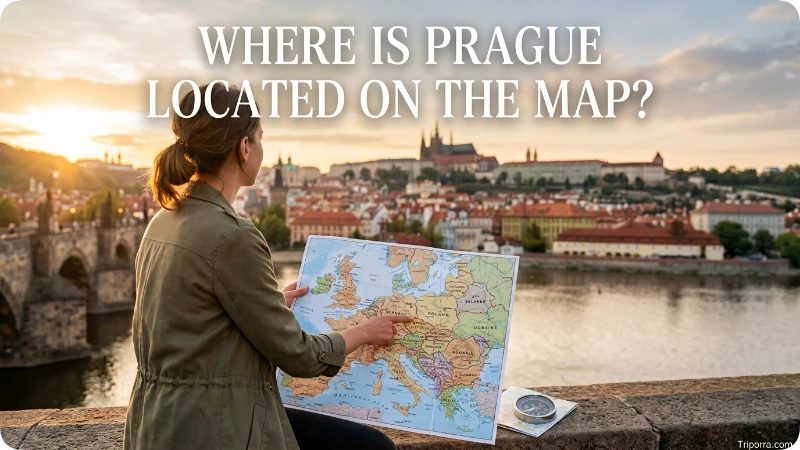
Prague is located almost in the middle of Europe, making it one of the continent’s most accessible capitals. Although many visitors think Prague is in Eastern Europe, geographers and most international organizations classify it as being in Central Europe.
On a map, Prague sits in the western part of the Czech Republic along the Vltava River. Because it is centrally positioned, travelers can easily visit nearby countries such as Germany, Austria, Poland, and Slovakia during the same trip.
Its strategic location has made Prague an important crossroads for trade, politics, and culture since medieval times.
Prague is located at approximately 50.0755° N latitude and 14.4378° E longitude. These coordinates place the city in the heart of Central Europe, along the Vltava River. Its position has helped Prague become an important transportation, cultural, and economic hub for centuries.
⭐ Did You Know?
Prague is often called the “City of a Hundred Spires,” although today researchers have counted well over 500 towers and spires throughout the city.
Where Is Prague Located in the World?
Prague is located in the Northern Hemisphere on the continent of Europe. More specifically, it is in Central Europe, where it serves as the capital and largest city of the Czech Republic.
The city lies along the Vltava River in the western part of the country at approximately 50.0755° N latitude and 14.4378° E longitude. Its central location places it within easy reach of Germany, Austria, Poland, and Slovakia, making Prague one of Europe’s best-connected capitals for international travel.
What Country Is Prague In?
Prague is in the Czech Republic, an independent country in Central Europe.
The Czech Republic became an independent nation on January 1, 1993, after the peaceful dissolution of Czechoslovakia, an event commonly known as the Velvet Divorce.
Today, Prague serves as the country’s:
- Capital city
- Seat of the President
- Home of the Parliament
- Largest economic center
- Main transportation hub
- Cultural capital
Many government ministries, universities, museums, and international organizations are headquartered in Prague.
Is Prague in Europe?
Yes. Prague is located in Europe, specifically Central Europe.
Because of its central location, Prague is often included in popular European travel routes alongside cities like:
- Vienna
- Budapest
- Berlin
- Munich
- Kraków
- Bratislava
Its location allows visitors to explore multiple countries without long travel times.
For example:
| City | Approximate Driving Distance |
| Berlin | 218 miles (350 km) |
| Vienna | 206 miles (331 km) |
| Munich | 236 miles (380 km) |
| Bratislava | 205 miles (330 km) |
| Kraków | 335 miles (540 km) |
Driving times depend on traffic, border conditions, and road routes.
Which Region of the Czech Republic Is Prague In?
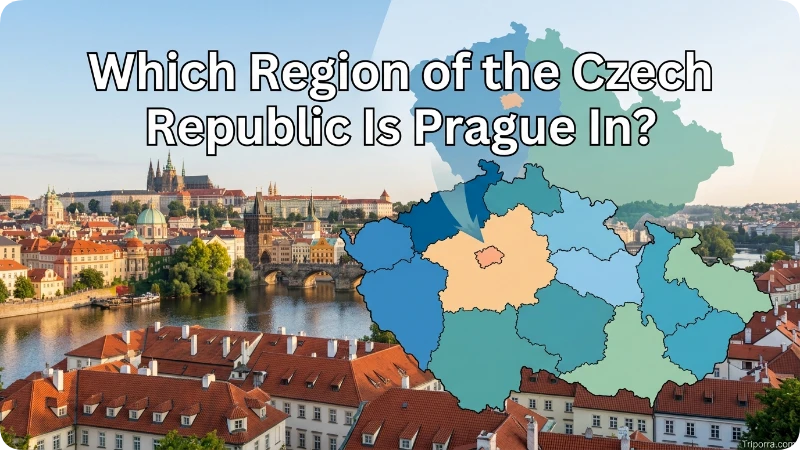
Prague forms its own administrative region known as the Capital City of Prague.
Unlike most Czech cities, Prague is both:
- A municipality
- A self-governing region
This special status means Prague manages many local government functions independently while also serving as the national capital.
The city is divided into numerous municipal districts and administrative areas, making local services easier to manage.
What Is Near Prague?
Prague is surrounded by several interesting towns, castles, forests, and historical sites.
Some nearby destinations include:
Karlštejn Castle
About 20 miles (32 km) southwest of Prague.
This medieval castle was built by Holy Roman Emperor Charles IV and remains one of the Czech Republic’s most visited landmarks.
Kutná Hora
Approximately 50 miles (80 km) east of Prague.
Known for:
- Sedlec Ossuary (Bone Church)
- Historic old town
- St. Barbara’s Cathedral
Český Krumlov
Around 110 miles (177 km) south of Prague.
A UNESCO World Heritage town famous for its castle, colorful streets, and Renaissance architecture.
Bohemian Switzerland National Park
Approximately 80 miles (130 km) north of Prague.
Popular for hiking, sandstone rock formations, and natural scenery.
Dresden, Germany
Located about 95 miles (150 km) north of Prague, Dresden is one of Germany’s most beautiful historic cities. It is well known for its restored Old Town, museums, and riverside architecture, making it a popular day trip from Prague.
Brno
Brno is the Czech Republic’s second-largest city, approximately 130 miles (210 km) southeast of Prague. It is famous for its historic center, Špilberk Castle, and lively university atmosphere.
Plzeň (Pilsen)
Around 55 miles (90 km) southwest of Prague, Plzeň is internationally known as the birthplace of Pilsner beer. Visitors often explore its historic breweries, old town, and underground tunnels.
How Far Is Prague From Major European Cities?
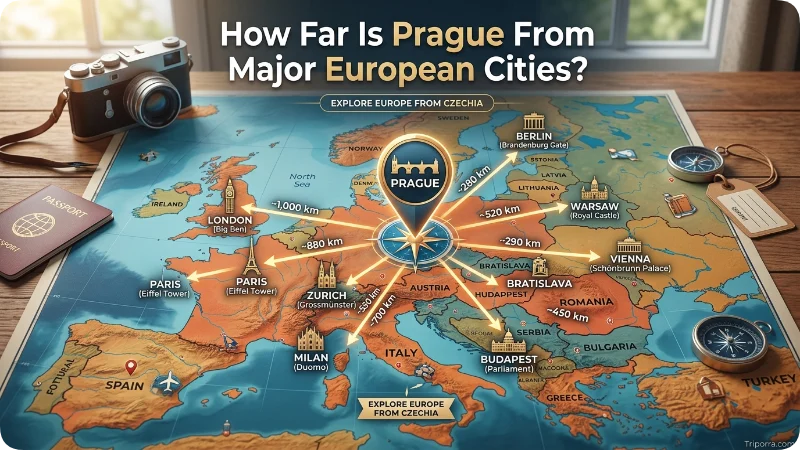
Prague’s central position makes it easy to reach from many famous European destinations.
| City | Approximate Distance | Typical Travel Time |
| Berlin | 218 miles (350 km) | About 4 hours by train or car |
| Vienna | 206 miles (331 km) | Around 4 hours |
| Munich | 236 miles (380 km) | Around 5 hours |
| Budapest | 328 miles (528 km) | Around 6–7 hours |
| Warsaw | 425 miles (685 km) | Around 8 hours |
Travel times vary depending on transportation, traffic, weather, and schedules.
Why Is Prague’s Location Important?
Prague’s location has shaped its history for more than one thousand years.
Being in the center of Europe allowed the city to become:
- A major medieval trading center
- A political capital
- A center of education
- A crossroads connecting western and eastern Europe
Throughout history, merchants, scholars, kings, and artists passed through Prague, helping it become one of Europe’s great cultural cities.
Its central location continues to benefit tourism, business, education, and international travel.
Which River Flows Through Prague?
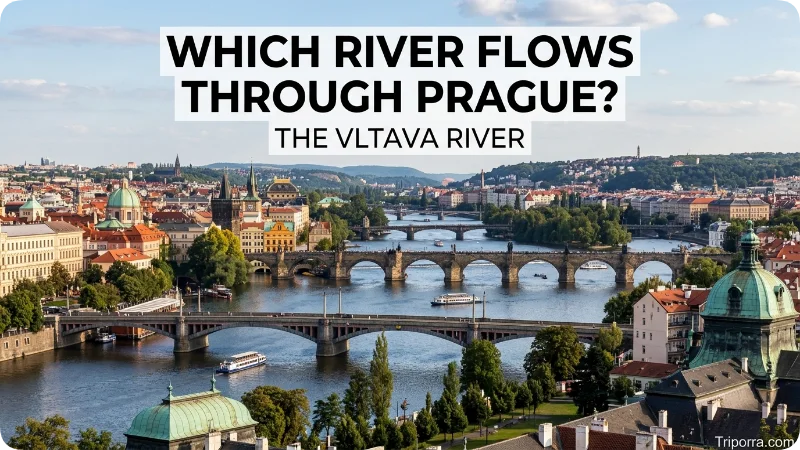
Prague is built along the Vltava River, the longest river in the Czech Republic.
The river stretches approximately 270 miles (430 km) before joining the Elbe River.
The Vltava divides Prague into eastern and western sections while providing beautiful waterfront views.
Some of Prague’s most famous attractions sit beside the river, including:
- Charles Bridge
- Prague Castle
- Kampa Island
- National Theatre
- Old Town riverfront
The river also supports sightseeing cruises throughout much of the year.
How Do You Get to Prague?
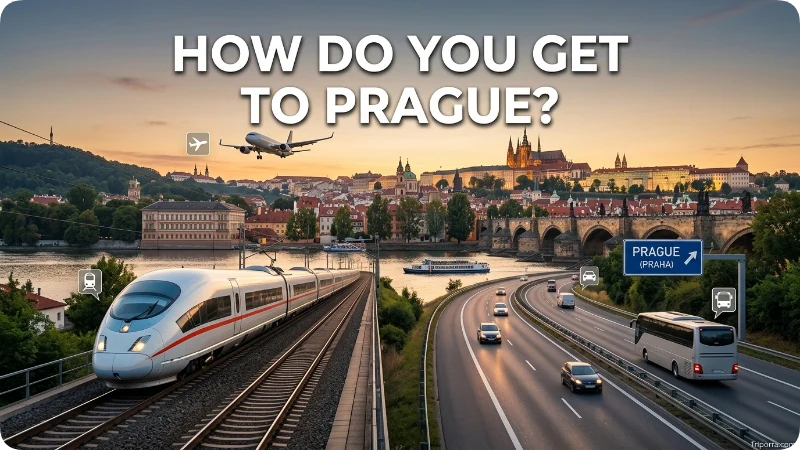
Prague is one of the easiest cities in Central Europe to reach. It has excellent air, rail, and road connections with major European destinations, making it a popular stop on multi-country trips.
By Air
The main airport serving Prague is Václav Havel Airport Prague (PRG), located about 10 miles (16 km) west of the city center. The drive usually takes 25–40 minutes, depending on traffic.
The airport offers direct and connecting flights to destinations across Europe, North America, the Middle East, and Asia. Travelers can reach the city center by:
- Airport Express bus
- Public buses connected to the Prague Metro
- Taxi
- Ride-sharing services
- Private airport transfers
By Train
Prague’s Praha hlavní nádraží (Prague Main Railway Station) connects the city with many European capitals.
Popular train routes include:
- Berlin
- Vienna
- Budapest
- Bratislava
- Munich
- Warsaw
Modern rail services make train travel one of the most convenient ways to visit Prague.
By Car
Prague is connected to the Czech motorway network. Major highways link the city with Germany, Austria, Poland, and Slovakia.
Driving times can vary because of traffic, weather, roadwork, and border conditions.
By Bus
International bus companies operate regular services to Prague from many European cities. Bus travel is often one of the most affordable transportation options.
Traveling Within the Schengen Area
The Czech Republic is part of the Schengen Area, which allows passport-free travel between most participating European countries. Travelers arriving from another Schengen country can usually enter Prague without routine border checks, although identification may still be required. Visitors arriving from outside the Schengen Area must follow the applicable visa and entry requirements.
What Is Prague Famous For?
Prague is famous for its well-preserved historic center, impressive architecture, and centuries of cultural heritage.
Some of its best-known landmarks include:
Prague Castle
One of the world’s largest ancient castle complexes, Prague Castle has been the seat of Czech rulers and presidents for centuries. The complex includes churches, museums, gardens, and government buildings.
Charles Bridge
Built in the 14th century, Charles Bridge crosses the Vltava River and connects the Old Town with the Lesser Town. It is one of the city’s most photographed landmarks.
Old Town Square
Old Town Square is the historic heart of Prague. Visitors come here to see colorful buildings, cafés, churches, and the famous Astronomical Clock.
Astronomical Clock
Installed in 1410, Prague’s Astronomical Clock is one of the oldest working astronomical clocks in the world.
St. Vitus Cathedral
Located inside Prague Castle, this Gothic cathedral is known for its stained-glass windows, royal tombs, and impressive architecture.
Jewish Quarter (Josefov)
This historic district preserves several synagogues, museums, and one of Europe’s oldest Jewish cemeteries.
⭐ Did You Know?
The Historic Centre of Prague has been a UNESCO World Heritage Site since 1992 because of its outstanding architectural and cultural importance.
What Is the Weather Like in Prague?
Prague has a temperate continental climate, which means it experiences four distinct seasons.
Spring (March to May)
Spring brings mild temperatures and blooming parks. Average daytime temperatures range from 50°F to 68°F (10°C to 20°C).
Summer (June to August)
Summers are warm but generally comfortable. Average highs range between 72°F and 81°F (22°C to 27°C), although occasional heat waves occur.
Autumn (September to November)
Autumn offers cooler weather and colorful foliage. Temperatures usually range from 45°F to 68°F (7°C to 20°C).
Winter (December to February)
Winters are cold, with average temperatures between 28°F and 41°F (-2°C to 5°C). Snowfall is possible but varies from year to year.
When Is the Best Time to Visit Prague?
The best time depends on your travel preferences.
Spring
Ideal for pleasant weather, gardens, and fewer crowds.
Summer
Best for festivals, outdoor dining, river cruises, and longer daylight hours. It is also the busiest tourist season.
Autumn
A great choice for comfortable temperatures and smaller crowds while still enjoying many attractions.
Winter
Perfect if you enjoy Christmas markets, festive decorations, and lower hotel prices outside the holiday peak.
Is Prague Cheap to Visit?
Prague is generally considered one of the more affordable capital cities in Europe, although travel costs have increased in recent years. Compared with destinations such as Paris, London, Amsterdam, or Zurich, visitors often spend less on accommodation, dining, and public transportation.
Approximate daily travel budgets include:
- Budget travelers: $60–100 per day
- Mid-range travelers: $120–220 per day
- Luxury travelers: $300 or more per day
Traveling during spring or autumn can help reduce accommodation costs while providing pleasant weather and fewer crowds. Prague’s extensive public transportation system also makes it easy to explore the city without spending much on transportation.
Is Prague Safe for Tourists?
Yes. Prague is generally considered one of the safest capital cities in Europe for visitors.
Violent crime affecting tourists is uncommon. However, as with any major city, travelers should stay aware of their surroundings.
Common precautions include:
- Keep valuables secure in busy tourist areas.
- Watch for pickpockets on crowded public transport.
- Use licensed taxis or trusted ride-sharing services.
- Be cautious when exchanging currency and use reputable exchange offices or ATMs.
Emergency services are reliable, and tourist information centers are available throughout the city.
What Languages and Currency Are Used in Prague?
Official Language
The official language is Czech.
English is widely spoken in hotels, restaurants, tourist attractions, and many shops, especially in central Prague. German and other European languages are also commonly understood in tourist areas.
Currency
Prague uses the Czech Koruna (CZK).
Although the Czech Republic is a member of the European Union, it does not use the euro as its official currency. Some businesses accept euros, but change is often given in Czech koruna.
Credit and debit cards are accepted at most hotels, restaurants, and larger stores.
How Big Is Prague?
Prague is the largest city in the Czech Republic.
According to recent estimates:
- City population: approximately 1.4 million people
- Metropolitan population: approximately 2.3 million people
The city covers around 193 square miles (496 square kilometers).
Despite its size, Prague’s efficient public transportation system makes it easy to explore.
A Brief History of Prague
Prague’s history dates back more than 1,000 years.
The city grew around Prague Castle during the 9th century and became an important center of the Kingdom of Bohemia. During the reign of Charles IV in the 14th century, Prague flourished as one of Europe’s leading political and cultural capitals.
Over the centuries, Prague experienced periods under the Holy Roman Empire, the Habsburg monarchy, Nazi occupation during World War II, and Communist rule after the war.
In 1989, the peaceful Velvet Revolution helped end Communist rule in Czechoslovakia. Four years later, in 1993, Prague became the capital of the newly independent Czech Republic.
Today, Prague is recognized worldwide for preserving its historic architecture while serving as a modern European capital.
Common Misconceptions About Prague
Many first-time visitors have misconceptions about Prague. Here are some of the most common.
Prague Is Not in Germany
Because Prague is close to Germany, some people mistakenly believe it is a German city. It is the capital of the Czech Republic.
Prague Is Not in Russia
Prague is not located in Russia. It is the capital of the Czech Republic, an independent country in Central Europe. Although both countries are in Europe, they are separate nations with different languages, governments, and cultures.
Prague Is Not in Italy
Prague is not in Italy. Italy is located in Southern Europe, while Prague lies much farther north in Central Europe. Travelers can easily visit both countries during the same trip, but they are in different parts of the continent.
Prague Is Not in France
Prague is not part of France. France is situated in Western Europe, whereas Prague is located in the Czech Republic in Central Europe. The two countries share strong tourism and cultural connections but are entirely separate nations.
Prague Is Not in Eastern Europe
Modern geographic and political classifications place Prague in Central Europe, not Eastern Europe.
Prague Is Not the Capital of Czechoslovakia
Czechoslovakia no longer exists. Since 1993, Prague has been the capital of the Czech Republic.
Prague Uses Czech Koruna
Many travelers expect to use euros everywhere, but the official currency remains the Czech Koruna (CZK).
Interesting Facts About Prague
⭐ Did You Know?
- Prague Castle is one of the largest ancient castle complexes in the world.
- Charles Bridge contains 30 statues and has connected both sides of the city for more than 650 years.
- The Prague Astronomical Clock has been operating since 1410.
- The city’s historic center survived World War II with much of its architecture intact.
- Prague is home to one of the oldest universities in Europe, Charles University, founded in 1348.
- More than eight million international visitors travel to Prague in many recent tourism years, making it one of Europe’s most visited cities.
Did You Mean a Different Place?
Most people searching “where is Prague located” are looking for the capital of the Czech Republic. However, there are several other places with the same name.
These include:
- Prague, Oklahoma, USA — a small city in Lincoln County.
- Prague, Nebraska, USA — a village in Saunders County.
- Other communities and neighborhoods named Prague in different countries.
If your search relates to one of these locations, check the country or state to make sure you are viewing the correct place.
FAQ
Is Prague the capital of the Czech Republic?
Yes. Prague is the capital and largest city of the Czech Republic. It serves as the country’s political, cultural, and economic center. The President, Parliament, Supreme institutions, and many national organizations are based in Prague, making it the most important city in the country.
Where is Prague located in Europe?
Prague is located in Central Europe, not Eastern Europe. It lies in the western part of the Czech Republic on the Vltava River. Its central position places it close to Germany, Austria, Poland, and Slovakia, making it a convenient destination for European travel.
Is Prague in Germany?
No. Prague is not in Germany. It is the capital of the Czech Republic, an independent country in Central Europe. Although Prague is only about 218 miles (350 km) from Berlin by road, it is located entirely within Czech territory.
Which river flows through Prague?
The Vltava River flows through Prague. It is the longest river in the Czech Republic, stretching approximately 270 miles (430 km). The river divides the city into eastern and western sections and passes several famous landmarks, including Charles Bridge and Prague Castle.
What language do people speak in Prague?
The official language spoken in Prague is Czech. However, English is widely spoken in hotels, restaurants, tourist attractions, and many businesses, especially in the city center. Visitors can usually communicate easily in popular tourist areas.
What currency is used in Prague?
Prague uses the Czech Koruna (CZK) as its official currency. Although the Czech Republic is a member of the European Union, it has not adopted the euro. Many businesses accept credit cards, and some tourist locations may accept euros, but payments are generally made in Czech koruna.
How far is Prague from Vienna?
Prague is approximately 206 miles (331 km) from Vienna by road. Driving usually takes around 4 hours, depending on traffic and border conditions. Direct trains and flights also connect the two capitals, with travel times varying by service and schedule.
What is Prague best known for?
Prague is best known for its medieval architecture, Prague Castle, Charles Bridge, Old Town Square, the Astronomical Clock, and its UNESCO-listed historic center. The city also has a long history in art, music, education, and European politics, making it one of the continent’s most visited capitals.
Is Prague a good place to visit?
Yes. Prague is considered one of Europe’s top travel destinations. Visitors enjoy its historic landmarks, walkable streets, museums, river cruises, local cuisine, and efficient public transportation. Every season offers different experiences, from spring gardens to festive winter Christmas markets.
What is the nearest airport to Prague?
The nearest major airport is Václav Havel Airport Prague (PRG). It is located about 10 miles (16 km) west of the city center. The airport offers domestic and international flights and is connected to central Prague by buses, taxis, ride-sharing services, and airport transfer options.
Is Prague in Russia?
No. Prague is not in Russia. It is the capital city of the Czech Republic, an independent country in Central Europe. Russia lies much farther east and does not share a border with the Czech Republic.
Is Prague in Italy?
No. Prague is located in the Czech Republic, not Italy. Italy is in Southern Europe, while Prague is in Central Europe. The two destinations are popular stops on many European travel itineraries but are in different countries.
Is Prague in France?
No. Prague is not in France. It is the capital of the Czech Republic. France is located west of Germany, while Prague lies farther east in Central Europe.
Is Prague expensive for tourists?
Prague is generally considered moderately priced compared with many Western European capitals. Hotels, restaurants, and public transportation are often more affordable than in cities such as Paris, London, or Amsterdam, making Prague a popular destination for travelers seeking good value.
Conclusion
Prague is located in the Czech Republic, a landlocked country in Central Europe, where it serves as the nation’s capital and largest city. Built along the Vltava River, Prague is about 180 miles (290 km) southeast of Berlin and 205 miles (330 km) northwest of Vienna. Its central location has made it an important center of trade, government, education, and culture for more than a thousand years.
Today, Prague attracts millions of visitors with its well-preserved historic center, UNESCO World Heritage status, famous landmarks, and excellent transportation links. Whether you’re planning a European vacation, learning about world geography, or simply asking where is Prague located, the answer is straightforward: Prague is the historic and modern heart of the Czech Republic, positioned at the crossroads of Central Europe. Its rich history, beautiful architecture, and easy accessibility continue to make it one of Europe’s most memorable and rewarding cities to explore.

Silas Vance is a geography enthusiast, travel researcher, and location-focused content writer dedicated to helping readers better understand the world around them on triporra.com. He specializes in creating informative guides about cities, countries, islands, landmarks, universities, and other notable destinations. His work combines geographic accuracy, historical context, and practical insights to answer location-based questions in a simple and engaging way.