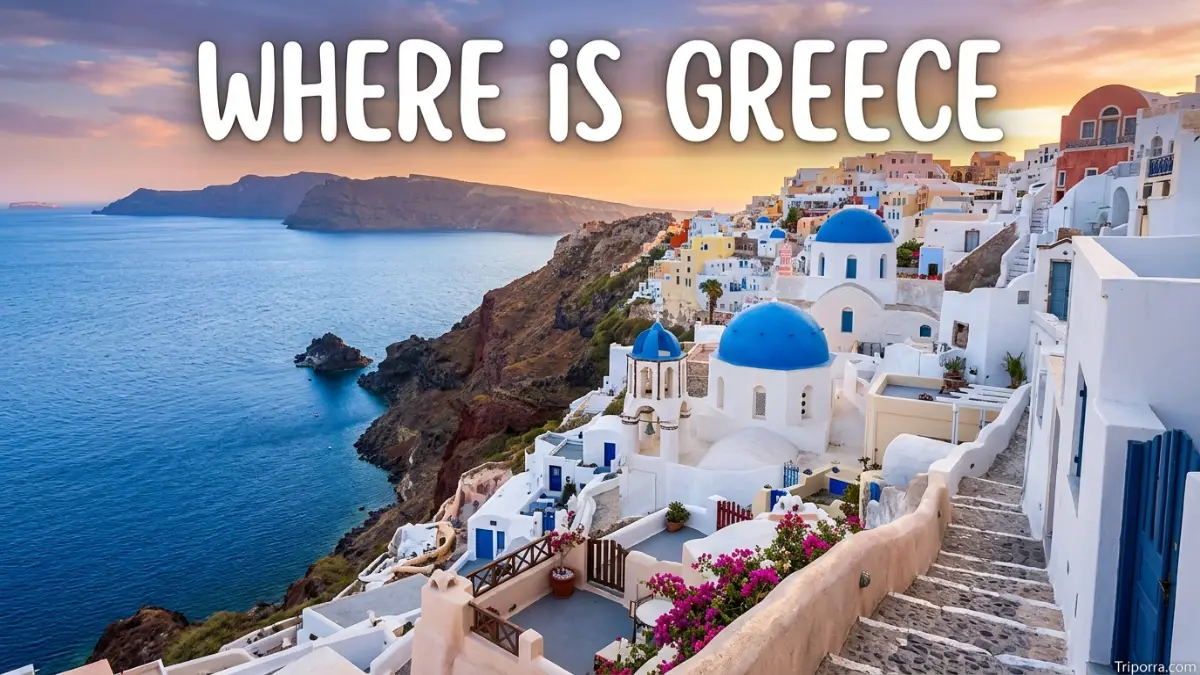
If you are wondering where is Greece, the short answer is that Greece is a country in southeastern Europe, located on the southern end of the Balkan Peninsula. It sits between the Mediterranean Sea and the Aegean Sea, connecting Europe, Asia, and Africa through its strategic location.
It is famous for its ancient civilization, thousands of islands, beautiful coastlines, historic landmarks, and its influence on Western culture, democracy, philosophy, and science.
Featured Snippet Answer
Where is Greece? It is a sovereign country in southeastern Europe, situated at the southern tip of the Balkan Peninsula. It borders Albania, North Macedonia, Bulgaria, and Turkey and is surrounded by the Aegean Sea, Ionian Sea, and Mediterranean Sea. Greece is known worldwide for its ancient history, islands, archaeological sites, and cultural heritage.
Where Is Greece Located?
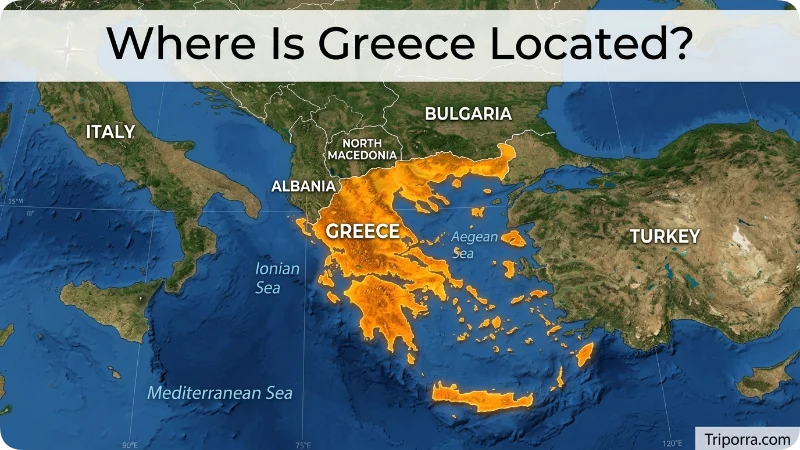
It is located in southeastern Europe and forms the southernmost part of the Balkan Peninsula. The country occupies a strategic position between Europe, Asia, and Africa, making it an important crossroads for trade, culture, and history.
Greece occupies the southeastern corner of Europe and forms the southern tip of the Balkan Peninsula. Its strategic location connects Europe with Asia and Africa, making it one of the continent’s most historically important countries.
It shares land borders with:
- Albania to the northwest
- North Macedonia to the north
- Bulgaria to the northeast
- Turkey to the east
The country is surrounded by water on three sides:
- Aegean Sea to the east
- Ionian Sea to the west
- Mediterranean Sea to the south
Athens serves as the capital and largest city of Greece.
Quick Facts About Greece
| Fact | Details |
|---|---|
| Official Name | Hellenic Republic |
| Continent | Europe |
| Region | Southeastern Europe |
| Capital City | Athens |
| Population | Approximately 10 million+ |
| Time Zone | Eastern European Time (EET) |
| Coordinates | Approximately 39° N, 22° E |
| Nearby Major Cities | Athens, Thessaloniki, Patras, Heraklion |
| Known For | Ancient history, islands, democracy, tourism |
| Official Language | Greek |
| Currency | Euro (€) |
Greece on the Map
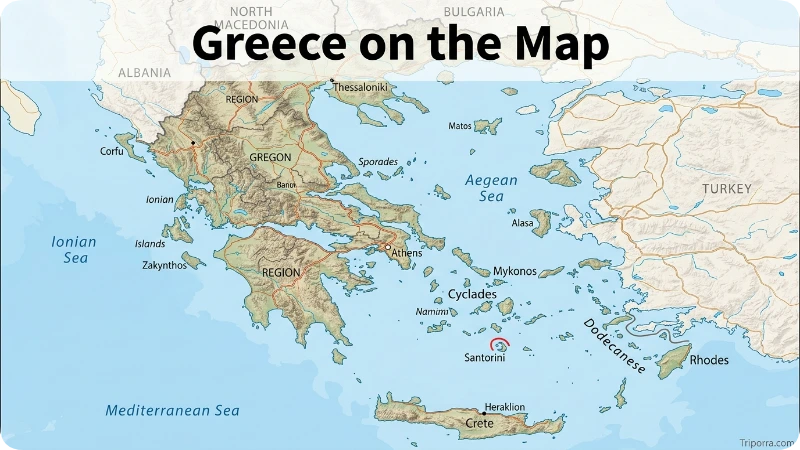
Picture Europe on a world map. Move toward the southeastern corner of the continent, and you will find Greece extending into the Mediterranean region.
The country consists of a mainland section and more than 6,000 islands and islets, although only around 200 are inhabited. Greece’s coastline stretches for thousands of kilometers, making it one of Europe’s most coastal nations.
On a world map, Greece appears in southeastern Europe between Italy and Turkey. It extends into the eastern Mediterranean and includes both the Greek mainland and thousands of islands spread across the Aegean and Ionian Seas, making it easy to identify on most political and physical maps.
To the east lies Turkey across the Aegean Sea. Italy sits across the Ionian Sea to the west. Crete, Greece’s largest island, marks the country’s southern reach in the Mediterranean.
Its position allows easy maritime connections between Europe, the Middle East, and North Africa.
Which Region Does Greece Belong To?
It belongs to the region known as Southern or Southeastern Europe.
Administratively, the country is divided into 13 regions, including:
- Attica
- Central Macedonia
- Crete
- Thessaly
- Peloponnese
- Epirus
- Western Greece
- South Aegean
- North Aegean
Athens, located in the Attica Region, functions as the political, economic, and cultural center of the country.
It is also a member of:
- European Union (EU)
- Eurozone
- NATO
- United Nations
These memberships strengthen its role within Europe and the international community.
How Does Greece Compare to Nearby Places?
Compared with neighboring countries, Greece offers a unique combination of mainland landscapes and island destinations.
LocationComparison with GreeceItalySimilar Mediterranean culture but Greece has more islandsTurkeyShares historical connections and Aegean coastlineBulgariaMore mountainous and less coastal than GreeceAlbaniaSmaller population and tourism industryCyprusIsland nation with close cultural ties to Greece
Tourism is one area where Greece stands out. Millions of international visitors travel to Greek destinations every year, attracted by beaches, archaeological sites, and island life.
How to Reach Greece
It is well connected to the rest of the world through air, sea, rail, and road networks.
By Air
Major international airports include:
- Athens International Airport (ATH)
- Thessaloniki Airport (SKG)
- Heraklion Airport (HER)
- Rhodes International Airport (RHO)
Direct flights operate from Europe, North America, the Middle East, and parts of Asia.
By Road
Travelers can drive into Greece from:
- Albania
- Bulgaria
- North Macedonia
- Turkey
By Sea
Ferries connect Greece with:
- Italy
- Turkey
- Cyprus
- Numerous Greek islands
By Rail
International rail links connect Greece with neighboring Balkan countries, although services vary by route.
Why Is Greece Famous?
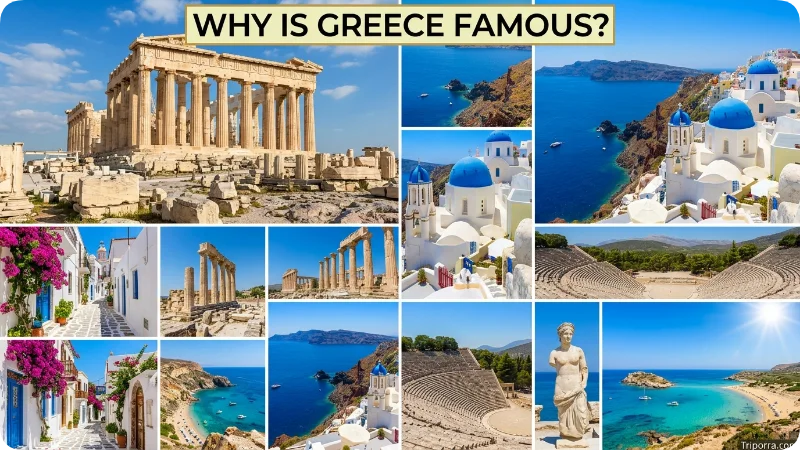
It is famous for many reasons that extend far beyond its geographic location.
Ancient Civilization
Ancient Greece produced influential thinkers such as:
- Socrates
- Plato
- Aristotle
These philosophers helped shape modern education, politics, and science.
Democracy
Athens is widely recognized as the birthplace of democracy, a system of government that influences countries worldwide.
Archaeological Sites
Popular historic attractions include:
- Acropolis of Athens
- Parthenon
- Delphi
- Olympia
- Knossos
Islands
World-famous islands include:
- Santorini
- Mykonos
- Crete
- Rhodes
- Corfu
Mediterranean Lifestyle
Greek cuisine, hospitality, festivals, and traditions attract visitors from across the globe.
History of Greece
The history of Greece spans thousands of years.
Ancient Era
The earliest advanced civilizations emerged around:
- Minoan Civilization on Crete
- Mycenaean Civilization on mainland Greece
Later, city-states such as Athens and Sparta became dominant powers.
Classical Greece
This period saw major achievements in:
- Philosophy
- Mathematics
- Politics
- Art
- Architecture
Hellenistic Age
Following Alexander the Great’s conquests, Greek culture spread across large parts of Europe, Asia, and Africa.
Roman and Byzantine Periods
It became part of the Roman Empire and later the Byzantine Empire.
Ottoman Rule
Much of Greece remained under Ottoman control for centuries.
Modern Greece
It gained independence in the 19th century and evolved into the modern republic that exists today.
Climate and Weather
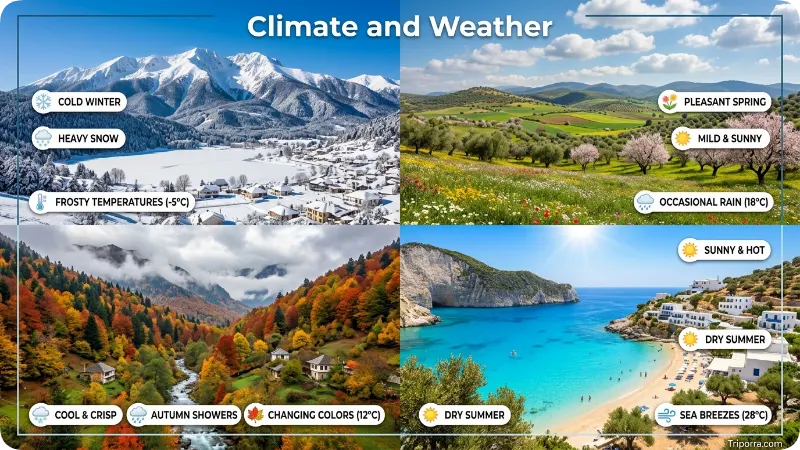
Greece generally experiences a Mediterranean climate.
Summer (June–August)
- Hot and sunny
- Temperatures often exceed 30°C (86°F)
- Peak tourist season
Autumn (September–November)
- Pleasant temperatures
- Fewer crowds
- Ideal for sightseeing
Winter (December–February)
- Mild in coastal areas
- Snow in mountainous regions
Spring (March–May)
- Flowers bloom across the countryside
- Comfortable weather for outdoor activities
The diverse geography creates local climate variations between islands, mountains, and mainland regions.
Things to See and Do Nearby
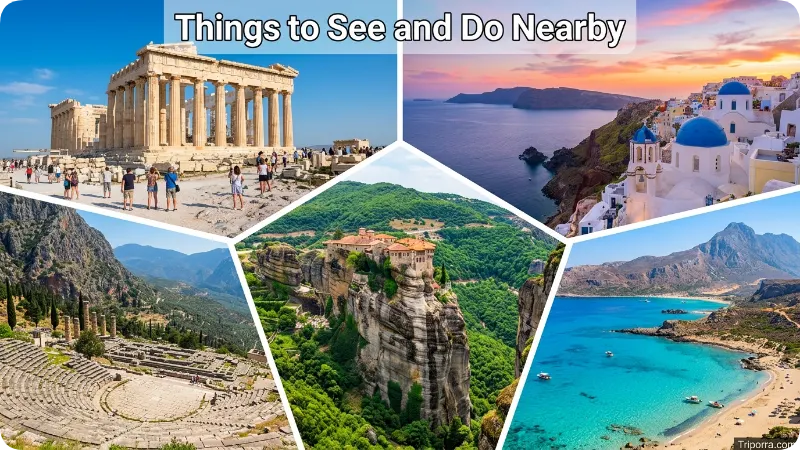
Visitors to Greece can explore countless attractions.
Athens
Highlights include:
- Acropolis
- Parthenon
- Ancient Agora
- National Archaeological Museum
Santorini
Known for:
- Whitewashed buildings
- Volcanic landscapes
- Sunset views
Mykonos
Popular for:
- Beaches
- Nightlife
- Traditional windmills
Crete
Offers:
- Historic ruins
- Mountain villages
- Beautiful beaches
Meteora
Famous for monasteries built atop towering rock formations.
Delphi
One of the most significant archaeological sites in the ancient world.
Best Time to Visit
The ideal time depends on travel goals.
Peak Season (June–August)
Best for:
- Beach vacations
- Island hopping
- Outdoor festivals
Shoulder Season (April–May, September–October)
Best for:
- Comfortable temperatures
- Lower prices
- Fewer tourists
Off-Season (November–March)
Best for:
- Budget travelers
- Cultural sightseeing
- Exploring major cities
Many travelers consider spring and early autumn the most balanced times to visit.
Common Misconceptions
Greece Is Only Islands
Although famous for islands, most of Greece’s population lives on the mainland.
Athens Represents All of Greece
Athens is important, but each region has distinct traditions, landscapes, and attractions.
It Has Tropical Weather Everywhere
The country has varied climates. Northern and mountainous regions can experience cold winters and snowfall.
Greece and Cyprus Are the Same Country
They share historical and cultural ties but are separate sovereign states.
Places Related to Greece
Readers interested in It often explore these destinations:
- Turkey
- Italy
- Cyprus
- Albania
- Bulgaria
- North Macedonia
- Crete
- Santorini
- Mykonos
- Rhodes
Each destination offers historical or geographic connections to Greece.
What Else Do People Want to Know?
Is Greece Safe for Tourists?
It is generally considered a safe destination for international visitors. Travelers should still follow normal safety precautions.
Is Greece Expensive?
Costs vary by destination. Islands such as Santorini and Mykonos can be expensive, while many mainland regions remain affordable.
Do People Speak English?
English is widely spoken in tourist areas, hotels, restaurants, and major cities.
What Food Is Greece Known For?
Popular dishes include:
- Moussaka
- Souvlaki
- Greek salad
- Tzatziki
- Baklava
Is Greece Good for Families?
Yes. Many destinations offer family-friendly beaches, historical attractions, and outdoor activities.
FAQs
Where Is Greece Located in the World?
Greece is located in southeastern Europe at the southern end of the Balkan Peninsula. It borders Albania, North Macedonia, Bulgaria, and Turkey and is surrounded by the Aegean, Ionian, and Mediterranean Seas.
Where Is Greece on a Map?
On a map, Greece is found in southeastern Europe between Italy and Turkey. It has a mainland and thousands of islands spread across the Aegean and Ionian Seas.
Where Is Greece Located in Europe?
Greece is in the southeastern corner of Europe, where Europe meets Asia and Africa. Its location has made it an important cultural and historical crossroads for centuries.
What Is the Currency of Greece?
The official currency of Greece is the euro (€). Greece adopted the euro in 2001, replacing the Greek drachma.
Is Greece in Europe or Asia?
It is officially a European country. Although it is close to Asia and shares historical and cultural ties with both continents, it is politically and geographically part of Europe.
Is Greece in Italy?
No, it is not in Italy. They are separate countries, with the Ionian Sea lying between western Greece and southern Italy.
What Is the Official Name of Greece?
The official name of Greece is the Hellenic Republic. The country is commonly called Greece in English, while its people refer to it as Hellas or Ellada.
What Is the Capital of Greece?
The capital of it is Athens. It is the country’s largest city and is widely known as the birthplace of democracy and one of the world’s oldest continuously inhabited cities.
Why is Greece important historically?
It played a major role in the development of democracy, philosophy, science, and Western civilization.
What is it most famous for?
It is famous for ancient ruins, islands, beaches, mythology, and Mediterranean culture.
When is the best time to visit Greece?
Spring and autumn are often considered the best times due to pleasant weather and smaller crowds.
Is Greece a good tourist destination?
Yes. it consistently ranks among the world’s most popular travel destinations.
______________________________________________________________________
Conclusion
Understanding where is Greece helps explain why the country has played such an important role throughout history. Positioned in southeastern Europe at the crossroads of three continents, it combines strategic geography, ancient heritage, stunning coastlines, and vibrant culture. Whether you are studying world geography, planning a vacation, or exploring history, it remains one of the most fascinating and influential countries on Earth.

About Leo Sterling
Leo Sterling is a geography and travel writer at Triporra.com who believes understanding a place starts with knowing exactly where it is. He turns geographic details on countries, regions, islands, and cities into clear, engaging content for everyday readers.
For Leo, a good location article does more than mark a spot on a map. It shows what borders a place, which region it belongs to, and how it connects to the world around it—an approach reflected in guides like where is Anguilla, where solid research meets a simple, conversational style.
Whether readers are planning a trip, studying, or just curious, Leo’s goal is the same: deliver accurate, easy-to-understand information without unnecessary complexity.
Areas of Focus: Geography | Countries & Regions | Caribbean Islands | Travel Destinations | Location Research | “Where Is?” Content