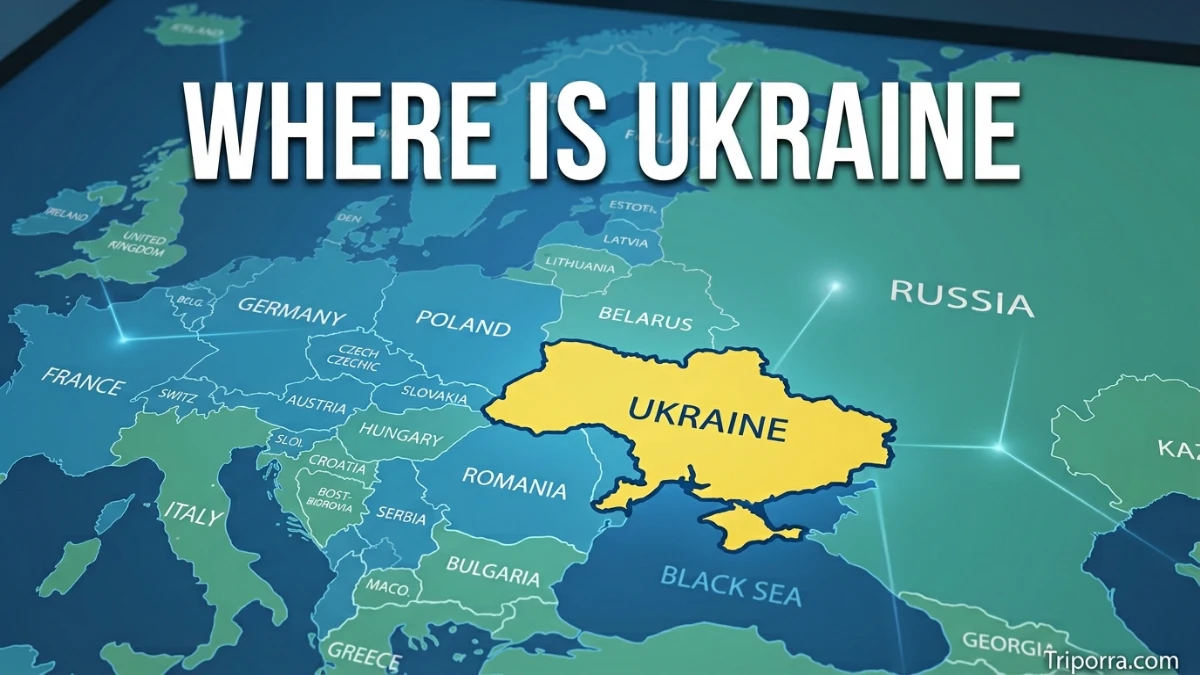
Ukraine is located in Eastern Europe. It is the second-largest country entirely in Europe after Russia by land area. Ukraine shares borders with seven countries and has coastlines along the Black Sea and the Sea of Azov. Because of its position between Central Europe, Eastern Europe, and Western Asia, Ukraine has long been an important crossroads for trade, culture, and history.
Today, many people search for where is Ukraine located because of its geography, its role in European affairs, and recent world events. Understanding Ukraine’s location makes it easier to see why it has strategic, economic, and cultural importance. This guide explains where Ukraine is on the map, what countries surround it, its major cities, climate, landscapes, and other key facts in simple language.
Ukraine is located in Eastern Europe. It borders Russia to the east and northeast, Belarus to the north, Poland, Slovakia, and Hungary to the west, and Romania and Moldova to the southwest. Ukraine also has coastlines along the Black Sea and the Sea of Azov, making it one of Europe’s largest countries.
Ukraine Quick Facts
| Detail | Information |
|---|---|
| Official Name | Ukraine |
| Continent | Europe |
| Region | Eastern Europe |
| Capital City | Kyiv |
| Total Area | Approximately 233,031 sq mi (603,628 sq km) |
| Population | Approximately 37 million (2024 estimate) |
| Official Language | Ukrainian |
| Currency | Ukrainian Hryvnia (UAH) |
| Government | Unitary semi-presidential republic (constitutional framework) |
| Time Zone | Eastern European Time (UTC+2); EEST (UTC+3) |
| Coastline | Black Sea and Sea of Azov |
| Neighboring Countries | Poland, Slovakia, Hungary, Romania, Moldova, Belarus, Russia |
| Highest Point | Hoverla – 6,762 ft (2,061 m) |
| ISO Country Code | UA |
| Driving Side | Right |
Where Is Ukraine Located?
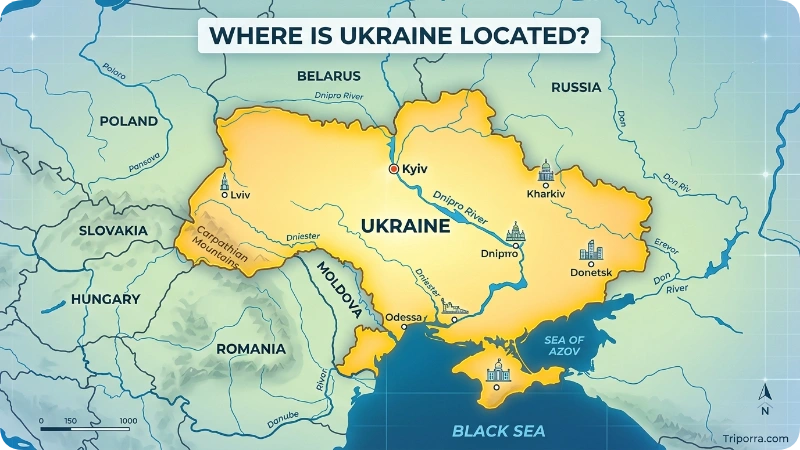
Ukraine is located in Eastern Europe. It stretches from the borders of Central Europe to the northern shores of the Black Sea, making it one of the largest countries on the continent.
Its central position connects Europe with parts of Eurasia. Because of this location, Ukraine has historically been an important route for trade, migration, and transportation.
Ukraine lies roughly between 44° and 53° north latitude and 22° and 41° east longitude.
Ukraine’s neighbors
- North: Belarus
- East and Northeast: Russia
- West: Poland, Slovakia, Hungary
- Southwest: Romania and Moldova
- South: Black Sea and Sea of Azov
⭐ Did You Know?
Ukraine is the second-largest country located entirely in Europe. Only Russia is larger, but much of Russia’s territory lies in Asia.
What Continent Is Ukraine In?
Ukraine is entirely located in Europe.
Although people sometimes associate Ukraine with both Europe and Asia because of nearby Russia, Ukraine itself is geographically part of the European continent.
Its western border is only a short distance from several Central European countries, while its southern coastline opens to the Black Sea, linking it with southeastern Europe and beyond.
Ukraine is also a member of many European organizations and continues to strengthen its ties with Europe.
Why Ukraine is considered European
- It lies completely west of the traditional Europe-Asia boundary.
- It shares borders with several European Union countries.
- Its geography, history, and culture are closely connected with Europe.
- Kyiv has been an important European city for over a thousand years.
Which Countries Border Ukraine?
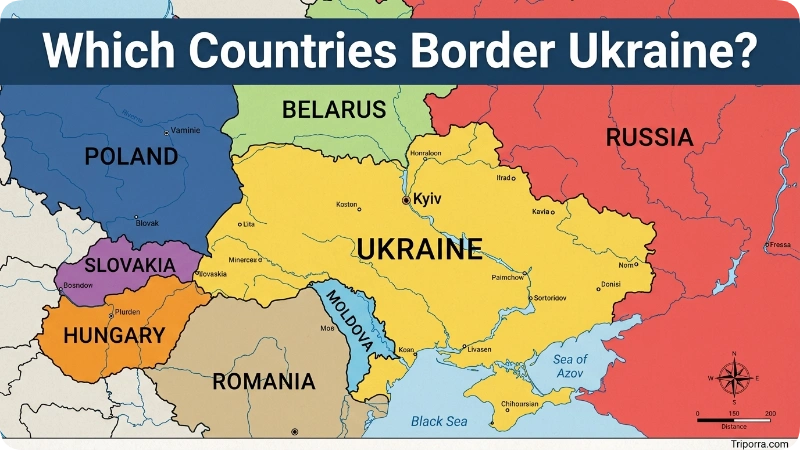
Ukraine shares land borders with seven countries.
Each neighboring country plays a role in Ukraine’s trade, transportation, and regional relationships.
Ukraine’s Neighboring Countries
| Neighbor | Direction from Ukraine |
|---|---|
| Belarus | North |
| Russia | East and Northeast |
| Poland | West |
| Slovakia | West |
| Hungary | West |
| Romania | Southwest |
| Moldova | Southwest |
| Black Sea | South |
| Sea of Azov | Southeast |
Note: Ukraine’s southern coastline borders the Black Sea and the Sea of Azov.
Because of ongoing conflict following Russia’s invasion in 2022, control of some border areas and territories remains disputed. Internationally, Ukraine’s internationally recognized borders remain unchanged under international law.
Is Ukraine in Europe or Asia?
Ukraine is in Europe, not Asia.
This question often comes up because Ukraine borders Russia, which spans both Europe and Asia. However, Ukraine itself is entirely on the European side of the traditional continental boundary.
Geographers classify Ukraine as an Eastern European country.
Its culture has influences from neighboring countries across Europe, while its location has also made it a meeting point between different civilizations throughout history.
Common misconception
Some people think Ukraine is partly in Asia because of its proximity to Russia.
That is incorrect.
Ukraine is fully within Europe.
Ukraine’s Location on the World Map
Ukraine occupies a large area in eastern Europe between Central Europe and western Russia.
If you look at a world map, Ukraine sits:
- East of Poland
- South of Belarus
- West of Russia
- North of the Black Sea
- Northeast of Romania and Moldova
Its capital city, Kyiv, is located in the north-central part of the country along the Dnipro River.
Ukraine’s central location has made it one of Europe’s major transportation corridors for centuries.
Approximate straight-line distances
Destination
Distance from Kyiv
Warsaw
About 430 miles (690 km)
Budapest
About 560 miles (900 km)
Bucharest
About 460 miles (740 km)
Berlin
About 750 miles (1,200 km)
Istanbul
About 660 miles (1,060 km)
These are approximate straight-line distances. Actual driving distances and travel times vary depending on routes, border crossings, and transportation options.
Size and Geographic Features
Ukraine covers approximately 233,031 square miles (603,628 square kilometers).
Its landscape is mostly broad plains, making it one of Europe’s leading agricultural regions.
However, Ukraine also has mountains, forests, rivers, wetlands, and coastal areas.
Major geographic features
- Carpathian Mountains in the west
- Crimean Mountains in the south
- Dnipro River, one of Europe’s longest rivers
- Black Sea coastline
- Sea of Azov coastline
- Fertile steppe grasslands
- Large forest regions in the north
The country’s fertile black soil, called chernozem, is among the richest agricultural soils in the world.
Because of this, Ukraine has long been known as one of Europe’s major grain-producing countries.
What Is Ukraine Known For?
Ukraine is known for its fertile farmland, long history, beautiful churches, rich culture, and important role in Europe. It is one of the world’s leading producers and exporters of grains and sunflower oil. The country’s location between Europe and Asia has also made it an important trade and transportation route for centuries.
Ukraine is home to several UNESCO World Heritage Sites, vibrant cities, and diverse natural landscapes.
Things Ukraine is famous for
- Kyiv, one of Europe’s oldest capitals
- Fertile black soil (chernozem)
- Wheat, corn, barley, and sunflower production
- Traditional embroidered clothing called vyshyvanka
- Colorful Easter eggs known as pysanky
- Historic Orthodox churches and monasteries
- The Dnipro River
- The Carpathian Mountains
- Classical music, literature, and folk traditions
- World-class engineering and aerospace industries
⭐ Did You Know?
Ukraine is often called one of Europe’s “breadbaskets” because of its highly fertile farmland and large agricultural production.
What Is the Capital of Ukraine?
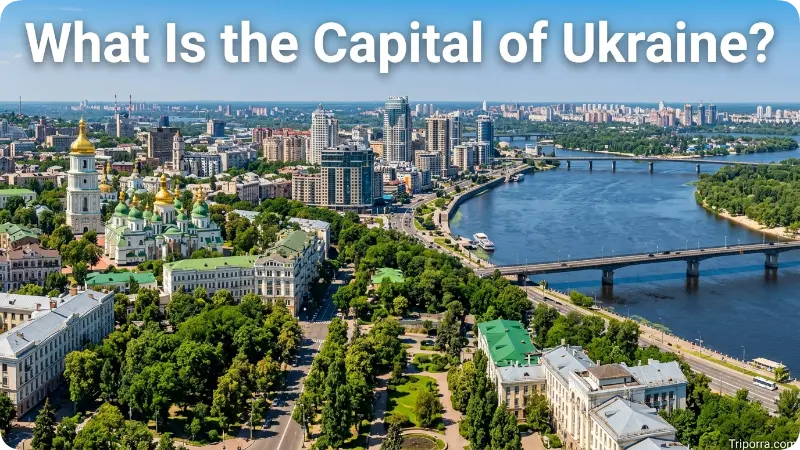
The capital of Ukraine is Kyiv.
Kyiv is the country’s largest city and serves as its political, economic, educational, and cultural center. It lies along the Dnipro River in north-central Ukraine and has a history dating back more than 1,400 years.
Today, Kyiv is home to government institutions, major universities, museums, theaters, and many historic landmarks.
Highlights of Kyiv
- Capital and largest city
- Population of approximately 3 million (latest estimates vary due to wartime displacement)
- Located on both sides of the Dnipro River
- Home to the Ukrainian Parliament and Presidential Office
- Major transportation hub with international rail and road connections
Popular attractions include:
- Saint Sophia Cathedral
- Kyiv Pechersk Lavra (Monastery of the Caves)
- Independence Square (Maidan Nezalezhnosti)
- Golden Gate
- Mother Ukraine Monument
Major Cities in Ukraine
Ukraine has many large and historic cities spread across different regions.
Each city has its own economy, architecture, and cultural traditions.
City
Region
Known For
Kyiv
North-central
Capital city, government, history
Kharkiv
Northeast
Education, science, engineering
Odesa
South
Black Sea port, beaches, architecture
Lviv
West
Historic Old Town, cafés, culture
Dnipro
Central-east
Industry, technology, riverfront
Zaporizhzhia
Southeast
Hydroelectric dam, Cossack history
Because of the ongoing war, conditions and population estimates in some cities continue to change.
What Is the Climate Like in Ukraine?
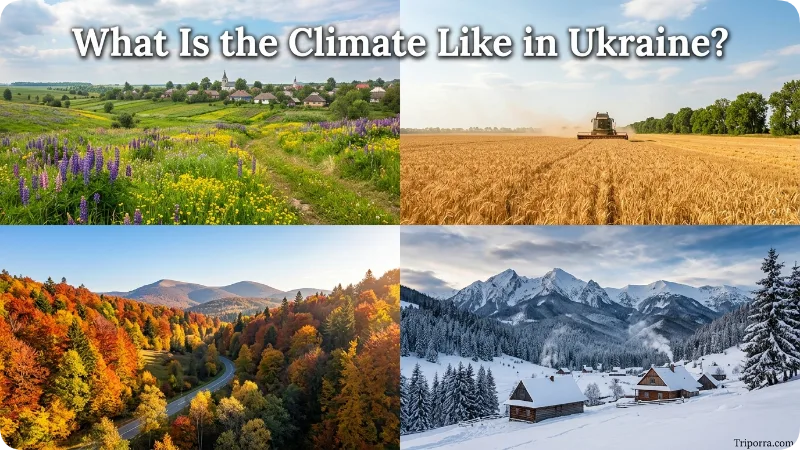
Ukraine has a temperate continental climate across most of the country. This means it experiences four distinct seasons with warm summers and cold winters.
The southern coastal areas near the Black Sea have milder winters than inland regions.
Average weather
Season
Typical Conditions
Spring
Mild temperatures with increasing rainfall
Summer
Warm to hot, about 75–90°F (24–32°C) in many areas
Autumn
Cooler with colorful foliage
Winter
Cold, often 14–32°F (-10–0°C), colder in northern and eastern regions
The Carpathian Mountains receive more snowfall than the plains and are popular for winter sports.
Best time to visit
The most comfortable months for sightseeing are:
- May
- June
- September
- Early October
These months usually offer pleasant temperatures and fewer weather extremes.
How to Travel to Ukraine
Travel to Ukraine depends on current security conditions.
Since the full-scale Russian invasion began in February 2022, Ukraine’s airspace has remained closed to civilian flights. Travelers currently enter the country mainly through neighboring European countries by train, bus, or car.
Common entry routes
Many international travelers first arrive in:
- Poland
- Romania
- Slovakia
- Hungary
- Moldova
From there, they continue into Ukraine using:
- International trains
- Long-distance buses
- Private vehicles
Travel conditions may change, so visitors should always check the latest government travel advisories before planning a trip.
Is Ukraine Safe to Visit?
Safety varies greatly across Ukraine.
Because of the ongoing war that began with Russia’s full-scale invasion in 2022, many governments advise against travel to Ukraine or recommend avoiding all non-essential travel.
Some western regions are generally considered less affected than areas closer to active front lines. However, missile and drone attacks can occur across the country, and the security situation can change quickly.
Before traveling
- Check official government travel advisories.
- Follow local emergency instructions.
- Monitor transportation updates.
- Ensure you have travel insurance that covers your destination, if available.
- Register with your embassy if recommended.
⭐ Did You Know?
Even areas far from active fighting may experience temporary security alerts or transportation disruptions. Travelers should always rely on official government guidance before making plans.
A Brief History of Ukraine
Ukraine has a long and complex history that stretches back thousands of years.
The medieval state of Kyivan Rus’, centered in present-day Kyiv, became one of Europe’s most influential states between the 9th and 13th centuries.
Over later centuries, different parts of Ukraine came under the control of various states and empires, including the Polish-Lithuanian Commonwealth, the Ottoman Empire, the Austro-Hungarian Empire, and the Russian Empire.
Key historical milestones
- 882: Kyiv becomes the center of Kyivan Rus’.
- 988: Christianity officially adopted in Kyivan Rus’.
- 1917–1921: Ukrainian struggle for independence.
- 1922: Ukraine becomes one of the founding republics of the Soviet Union.
- 1991: Ukraine declares and confirms independence following the dissolution of the Soviet Union.
- 2014: Russia illegally annexes Crimea, a move not recognized by most countries and the United Nations.
- 2022: Russia launches a full-scale invasion of Ukraine, leading to ongoing conflict.
Ukraine’s internationally recognized borders remain unchanged under international law, even though parts of its territory are under temporary Russian occupation.
Economy and Natural Resources
Ukraine has one of Europe’s largest agricultural sectors and an important industrial base. Before the full-scale war began in 2022, agriculture, manufacturing, mining, information technology, and transportation were major contributors to the economy. Although the conflict has caused significant damage, these sectors continue to play an important role.
Major industries
- Agriculture
- Information technology (IT)
- Steel production
- Machinery manufacturing
- Mining
- Food processing
- Energy production
- Chemical manufacturing
Main agricultural products
- Wheat
- Corn (maize)
- Barley
- Sunflowers
- Sugar beets
- Potatoes
- Rapeseed
Ukraine is also rich in natural resources, including:
- Iron ore
- Coal
- Natural gas
- Manganese
- Titanium
- Uranium
- Graphite
⭐ Did You Know?
Ukraine has some of the world’s largest deposits of high-quality black soil, making it one of the leading agricultural regions in Europe.
Population, Language, and Culture
Ukraine has an estimated population of about 37 million people (2024 estimate). Exact figures are difficult to determine because millions of people have been displaced by the ongoing war and some areas remain under temporary Russian occupation.
Official language
The official language is Ukrainian.
Many people also speak other languages, including Russian, especially in some eastern and southern regions. English is becoming more common among younger people, particularly in larger cities and tourist areas.
Religion
The main religions include:
- Eastern Orthodox Christianity
- Greek Catholic Christianity
- Roman Catholic Christianity
- Protestant churches
- Judaism
- Islam
- Other faiths
Ukraine protects freedom of religion under its constitution.
Cultural traditions
Ukraine is known for:
- Traditional folk music
- Colorful dance performances
- Embroidered clothing (vyshyvanka)
- Decorative Easter eggs (pysanky)
- Handcrafted woodwork
- Poetry and literature
- Classical music
- Seasonal festivals
Food is also an important part of Ukrainian culture. Popular dishes include:
- Borscht (beet soup)
- Varenyky (dumplings)
- Holubtsi (stuffed cabbage rolls)
- Deruny (potato pancakes)
- Banosh (cornmeal dish from the Carpathians)
Interesting Facts About Ukraine
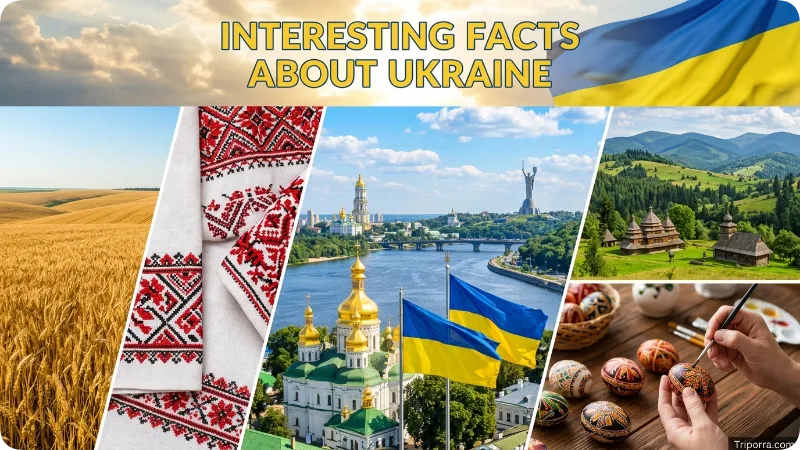
Ukraine has many features that surprise first-time learners. Its size, history, and natural landscapes make it one of Europe’s most fascinating countries.
Interesting facts
- Ukraine is the second-largest country entirely in Europe.
- Kyiv is among the oldest continuously inhabited capitals in Europe.
- The Dnipro River is one of Europe’s longest rivers.
- Ukraine has seven UNESCO World Heritage Sites.
- The country’s flag represents a blue sky over golden wheat fields.
- The Carpathian Mountains are home to bears, lynx, and rare plant species.
- Ukraine has hundreds of castles, fortresses, and historic churches.
- The world’s deepest metro station, Arsenalna Station in Kyiv, is about 346 feet (105.5 meters) below ground.
- The Chornobyl Exclusion Zone remains one of the world’s most well-known restricted areas following the 1986 nuclear disaster.
⭐ Did You Know?
Ukraine’s national flag features blue above yellow. The colors are commonly understood to symbolize the sky above fields of wheat.
Common Misconceptions About Ukraine
Many people have questions about Ukraine because of its location and recent history. Here are some common misunderstandings.
Is Ukraine part of Russia?
No. Ukraine is an independent sovereign country. It declared independence in 1991 after the dissolution of the Soviet Union and is internationally recognized as a separate state.
Is Ukraine part of the European Union?
No. As of 2026, Ukraine is not a member of the European Union, although it is an official EU candidate country and continues the accession process.
Is Ukraine part of NATO?
No. Ukraine is not a NATO member as of 2026. It cooperates closely with NATO but has not joined the alliance.
Is Crimea part of Ukraine?
Under international law and according to the United Nations, Crimea is internationally recognized as part of Ukraine. Russia has occupied and claimed to annex Crimea since 2014, but this claim is not recognized by most countries.
Does Ukraine use the euro?
No. Ukraine uses the Ukrainian hryvnia (UAH) as its official currency.
Frequently Asked Questions
Is Ukraine in Europe?
Yes. Ukraine is entirely in Europe. It is classified as an Eastern European country and shares borders with several European nations, including Poland, Slovakia, Hungary, Romania, Moldova, Belarus, and Russia.
What countries surround Ukraine?
Ukraine has seven neighboring countries: Belarus to the north; Russia to the east and northeast; Poland, Slovakia, and Hungary to the west; and Romania and Moldova to the southwest. It also borders the Black Sea and the Sea of Azov.
What is the capital city of Ukraine?
The capital of Ukraine is Kyiv. It is the country’s largest city and serves as its political, economic, and cultural center. Kyiv is located on the Dnipro River in the north-central part of the country.
How big is Ukraine?
Ukraine covers approximately 233,031 square miles (603,628 square kilometers). It is the second-largest country located entirely within Europe.
What sea borders Ukraine?
Ukraine has coastlines along the Black Sea and the Sea of Azov. These waterways are important for shipping, trade, fishing, and regional transportation.
Why is Ukraine strategically important?
Ukraine’s location connects Central Europe, Eastern Europe, and the Black Sea region. Its transportation routes, fertile farmland, energy infrastructure, and access to the sea have made it strategically important throughout history.
What language do people speak in Ukraine?
The official language is Ukrainian. Russian is also spoken by many people, particularly in some regions, while English is increasingly common among younger generations and in major cities.
Can tourists visit Ukraine?
Travel is possible in some areas, but the security situation remains unpredictable because of the ongoing war. Many governments advise against non-essential travel. Anyone considering a visit should carefully review the latest official travel advisories before making plans.
Why is Ukraine called the breadbasket of Europe?
Ukraine is often called the “breadbasket of Europe” because of its fertile black soil and large production of wheat, corn, barley, and sunflower crops. Agriculture has been one of the country’s most important industries for generations.
Is Ukraine larger than France?
Yes. By land area, Ukraine is larger than metropolitan France and is the second-largest country entirely within Europe.
Conclusion
Ukraine is located in Eastern Europe, where it serves as a bridge between Central Europe, Eastern Europe, and the Black Sea region. It shares borders with Belarus, Russia, Poland, Slovakia, Hungary, Romania, and Moldova, while its southern coastline meets the Black Sea and the Sea of Azov. As the second-largest country entirely in Europe, Ukraine has diverse landscapes that include fertile plains, major rivers, forests, mountains, and coastal areas.
Beyond its location, Ukraine is known for its long history, rich culture, agricultural importance, and historic cities such as Kyiv, Lviv, and Odesa. Although the country continues to face challenges because of the ongoing war, its internationally recognized borders remain unchanged under international law. Whether you’re studying geography, planning future travel, or following world events, understanding where Ukraine is located provides valuable context about one of Europe’s most significant countries.

Elena Rostova bridges the gap between premium hospitality and authentic local experiences. Armed with a background in luxury hospitality management and a passion for fine architecture, she spent years evaluating elite resorts before transitioning into travel journalism. Elena heads the luxury and boutique travel vertical on Triporra.com. Her meticulous guides strip away the guesswork from high-end travel, showcasing unique five-star escapes, fine regional dining, and bespoke private tours that elevate a standard vacation into an unforgettable journey.