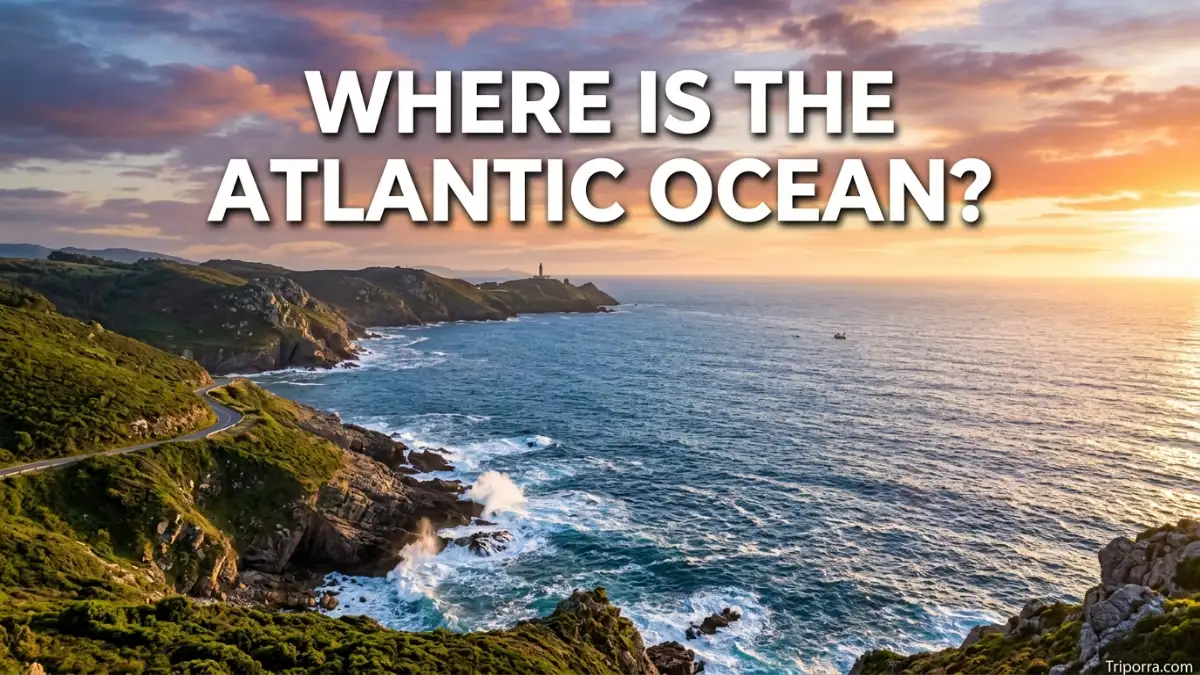
The Atlantic Ocean is the second-largest ocean on Earth. It lies between the continents of North and South America to the west and Europe and Africa to the east. It stretches from the Arctic Ocean in the north to the Southern Ocean around Antarctica in the south. Covering about 41 million square miles (106.5 million square kilometers), the Atlantic Ocean plays a major role in global trade, weather, climate, and marine life.
The Atlantic Ocean is located between the Americas on the west and Europe and Africa on the east. It extends from the Arctic Ocean in the north to the Southern Ocean in the south, covering approximately 41 million square miles (106.5 million square kilometers). It is the world’s second-largest ocean and connects hundreds of countries through important shipping routes.
Quick Facts About the Atlantic Ocean
| Quick Fact | Details |
|---|---|
| Ocean | Atlantic Ocean |
| Ocean Rank | Second-largest ocean on Earth |
| Total Area | Approximately 41 million sq mi (106.5 million sq km) |
| Location | Between the Americas and Europe/Africa |
| Northern Boundary | Arctic Ocean |
| Southern Boundary | Southern Ocean |
| Eastern Boundary | Europe and Africa |
| Western Boundary | North America and South America |
| Connected Waters | Arctic, Southern, Indian, and Pacific Oceans |
| Deepest Point | Puerto Rico Trench — about 27,500 ft (8,380 m) |
| Largest Island | Greenland |
| Average Depth | About 12,080 ft (3,682 m) |
| Main Uses | Shipping, fishing, tourism, energy, and scientific research |
| Bordering Countries | More than 100 countries and territories have Atlantic coastlines or connected waters |
| Major Features | Mid-Atlantic Ridge, Gulf Stream, Caribbean Sea, and Gulf of Mexico |
Where Is the Atlantic Ocean Located on the Map?
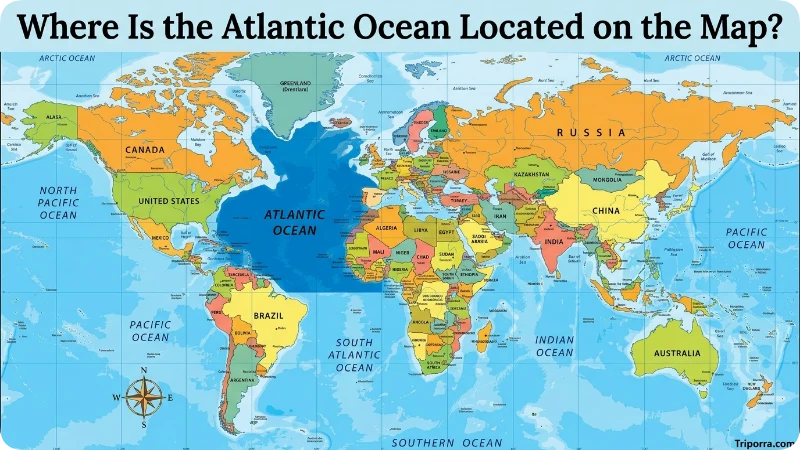
The Atlantic Ocean is found between four major continents. Looking at a world map, it separates the Americas from Europe and Africa.
Its boundaries include:
- North America on the northwest
- South America on the southwest
- Europe on the northeast
- Africa on the southeast
- Arctic Ocean to the north
- Southern Ocean surrounding Antarctica to the south
The Atlantic forms a long, narrow shape compared with the Pacific Ocean. It covers nearly one-fifth of Earth’s surface and is one of the world’s most important bodies of water.
⭐ Did You Know?
The name “Atlantic” comes from the Greek mythological figure Atlas, who was believed to hold up the sky.
Which Continents Border the Atlantic Ocean?
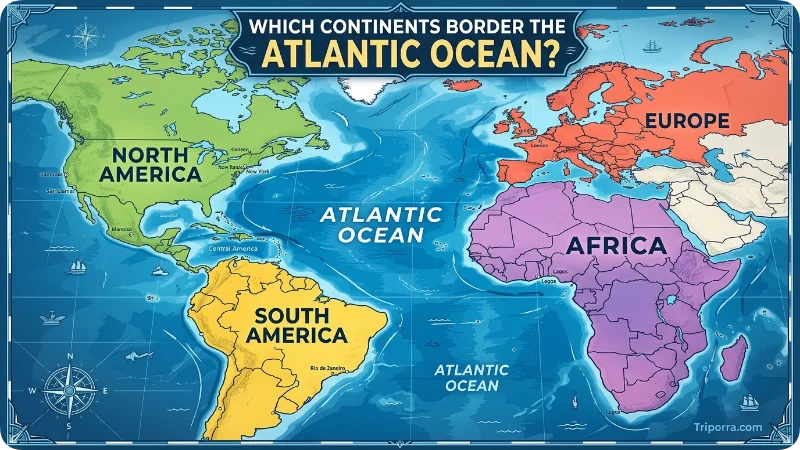
Four continents directly border the Atlantic Ocean.
North America
The eastern coast of North America faces the Atlantic. Countries include:
- Canada
- United States
- Mexico (through the Gulf of Mexico)
- Several Caribbean nations
Major Atlantic cities include:
- New York City
- Boston
- Miami
- Halifax
South America
The eastern side of South America borders the Atlantic Ocean.
Countries include:
- Brazil
- Argentina
- Uruguay
- Venezuela
- Guyana
- Suriname
Brazil has the longest Atlantic coastline in South America.
Europe
Western Europe faces the Atlantic Ocean.
Countries include:
- Portugal
- Spain
- France
- Ireland
- United Kingdom
- Iceland
- Norway
These coastlines have supported trade for thousands of years.
Africa
The western coast of Africa stretches along the Atlantic Ocean.
Countries include:
- Morocco
- Senegal
- Ghana
- Nigeria
- Angola
- Namibia
- South Africa
Many important ports are located along Africa’s Atlantic coast.
Which Countries Border the Atlantic Ocean?
More than 100 countries and territories have coastlines on the Atlantic Ocean or connected seas such as the Caribbean Sea, Gulf of Mexico, Mediterranean Sea, Baltic Sea, and North Sea.
Some of the best-known Atlantic countries include:
North America
- Canada
- United States
- Mexico
Central America and Caribbean
- Cuba
- Jamaica
- Bahamas
- Dominican Republic
- Haiti
- Barbados
- Trinidad and Tobago
South America
- Brazil
- Argentina
- Uruguay
- Colombia
- Venezuela
Europe
- Portugal
- Spain
- France
- Ireland
- United Kingdom
- Iceland
- Norway
Africa
- Morocco
- Mauritania
- Senegal
- Ghana
- Côte d’Ivoire
- Nigeria
- Angola
- Namibia
- South Africa
These countries rely on the Atlantic for shipping, fishing, tourism, and trade.
How Big Is the Atlantic Ocean?
The Atlantic Ocean is enormous. It is the world’s second-largest ocean after the Pacific Ocean.
Some key measurements include:
Measurement
Value
Area
Approximately 41 million sq mi (106.5 million sq km)
Average Depth
About 12,080 feet (3,682 meters)
Deepest Point
Around 27,500 feet (8,380 meters)
Coastline Length
More than 69,000 miles (111,000 km), depending on measurement methods
The ocean continues to grow slightly each year because tectonic plates are moving apart along the Mid-Atlantic Ridge.
⭐ Did You Know?
The Atlantic Ocean becomes a little wider every year as North America and Europe slowly move away from each other.
What Bodies of Water Connect to the Atlantic Ocean?
The Atlantic Ocean connects with many important seas and oceans around the world.
Major connected waters include:
- Arctic Ocean
- Southern Ocean
- Caribbean Sea
- Gulf of Mexico
- Mediterranean Sea
- North Sea
- Baltic Sea
- Norwegian Sea
- Labrador Sea
- Celtic Sea
It also connects indirectly to:
- Pacific Ocean through the Drake Passage and the Panama Canal
- Indian Ocean around southern Africa
These connections make the Atlantic one of the busiest waterways on Earth.
Why Is the Atlantic Ocean Important?
The Atlantic Ocean is essential for life, transportation, weather, and the global economy.
It supports:
- International shipping
- Commercial fishing
- Offshore oil and natural gas
- Renewable energy projects
- Tourism
- Marine biodiversity
- Scientific research
- Climate regulation
Around 90% of global trade by volume travels by sea, and many of the world’s busiest shipping lanes cross the Atlantic.
The Atlantic also helps move heat around the planet through powerful ocean currents such as the Gulf Stream, which influences weather across North America and Europe.
⭐ Did You Know?
Without the Gulf Stream, much of Western Europe would be significantly colder than it is today.
What Is the Climate Like in the Atlantic Ocean?
The Atlantic Ocean has many climate zones because it stretches from the Arctic to Antarctica. Water temperatures and weather conditions change greatly from north to south.
Northern Atlantic
The North Atlantic has cold winters and mild summers. Sea ice forms in some northern areas near Greenland and the Arctic Ocean. Winter storms are also common.
Tropical Atlantic
The tropical Atlantic is warm throughout the year. Water temperatures usually range from 77°F to 86°F (25°C to 30°C). This region is where many Atlantic hurricanes begin to develop during hurricane season.
Southern Atlantic
The South Atlantic generally has cooler waters than the tropical Atlantic but is milder than the far south near Antarctica. Strong winds and large waves are common, especially farther south.
Southern Ocean Region
Near Antarctica, the Atlantic becomes extremely cold. Icebergs, sea ice, and freezing temperatures are common for much of the year.
Major Ocean Currents
Several powerful currents influence the Atlantic Ocean’s climate.
- Gulf Stream
- North Atlantic Current
- Canary Current
- Brazil Current
- Benguela Current
- Labrador Current
These currents move warm and cold water around the world, helping regulate global temperatures.
⭐ Did You Know?
The Gulf Stream can move water at speeds of up to about 5.6 mph (9 km/h) in some areas, making it one of the fastest major ocean currents.
What Animals Live in the Atlantic Ocean?
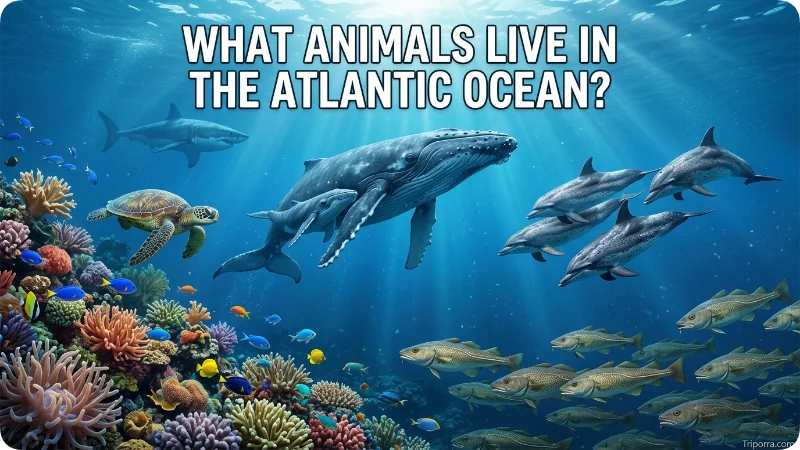
The Atlantic Ocean is home to thousands of marine species, from tiny plankton to the world’s largest animals.
Marine Mammals
Many whales and dolphins migrate through the Atlantic each year.
Common species include:
- Humpback whales
- Blue whales
- Fin whales
- Bottlenose dolphins
- Orcas
- Harbor seals
Fish
The Atlantic supports many important fish populations.
Examples include:
- Atlantic cod
- Tuna
- Mackerel
- Haddock
- Swordfish
- Herring
- Salmon
These species support commercial and recreational fishing around the world.
Sharks
Several shark species live in the Atlantic Ocean.
Some include:
- Great white shark
- Tiger shark
- Hammerhead shark
- Blue shark
- Whale shark
Most sharks avoid humans, and shark attacks remain very rare.
Sea Turtles
Several endangered sea turtle species use Atlantic beaches for nesting.
These include:
- Loggerhead turtle
- Green turtle
- Leatherback turtle
- Hawksbill turtle
Birds
The Atlantic Ocean is also home to many seabirds, including:
- Puffins
- Gannets
- Albatrosses
- Shearwaters
- Pelicans
- Terns
⭐ Did You Know?
The blue whale, which can be found in the Atlantic Ocean, is the largest animal ever known to have lived on Earth.
What Is the Atlantic Ocean Known For?
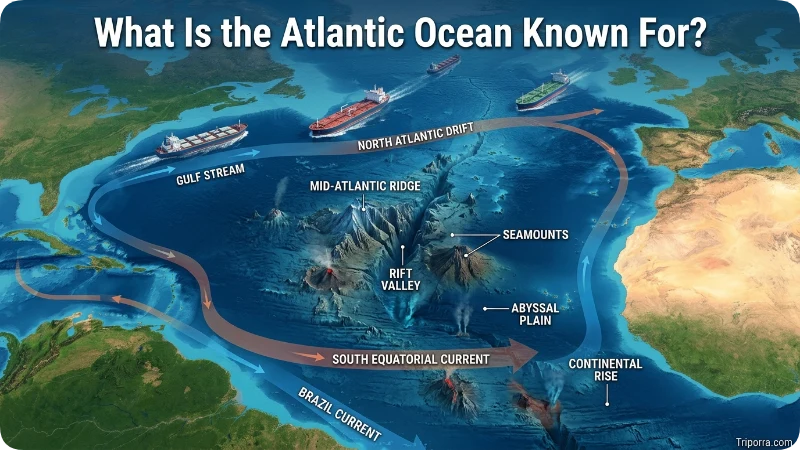
The Atlantic Ocean is famous for its history, trade routes, natural features, and scientific importance. It has shaped exploration, commerce, and world events for centuries.
Historic Voyages
European explorers crossed the Atlantic during the Age of Exploration.
Some well-known voyages include:
- Christopher Columbus reaching the Americas in 1492
- John Cabot exploring parts of North America
- Ferdinand Magellan’s expedition crossing the Atlantic before sailing around the world
These journeys changed global trade and connected continents in new ways.
The Mid-Atlantic Ridge
One of the Atlantic’s most remarkable features is the Mid-Atlantic Ridge, an underwater mountain range that runs nearly the entire length of the ocean.
Key facts include:
- More than 10,000 miles (16,000 km) long
- Formed by tectonic plates moving apart
- Creates new ocean floor through volcanic activity
- Includes Iceland, where parts of the ridge rise above sea level
The Bermuda Triangle
The Bermuda Triangle is a region in the western North Atlantic often linked to mysterious stories about ships and aircraft.
However, scientific studies have found no evidence that this area experiences more unexplained disappearances than other heavily traveled parts of the ocean. Most incidents can be explained by weather, navigation challenges, mechanical problems, or human error.
Major Shipping Routes
The Atlantic Ocean carries some of the busiest shipping lanes in the world.
Common cargo includes:
- Food products
- Oil and natural gas
- Vehicles
- Electronics
- Raw materials
- Manufactured goods
Large ports on both sides of the Atlantic help connect North America, South America, Europe, and Africa.
Offshore Energy
The Atlantic contains important offshore energy resources.
These include:
- Oil fields
- Natural gas reserves
- Offshore wind farms
- Wave and tidal energy projects
Many countries are also expanding renewable energy production along Atlantic coastlines.
⭐ Did You Know?
Thousands of underwater mountains, volcanoes, and deep valleys lie beneath the Atlantic Ocean, even though most people never see them.
How Do People Travel Across the Atlantic Ocean?
People cross the Atlantic Ocean every day by air and sea. Modern transportation has made travel much faster than it was centuries ago.
By Air
Flying is the quickest way to cross the Atlantic.
Some of the busiest transatlantic routes include:
- New York to London
- Boston to Dublin
- Toronto to Paris
- Miami to Madrid
Approximate nonstop flight times are:
Route
Approximate Flight Time*
New York to London
7–8 hours
Boston to Dublin
6–7 hours
Miami to Madrid
8–9 hours
*Flight times vary depending on winds, weather, airline routes, and airport conditions.
By Sea
Cargo ships carry goods across the Atlantic every day. Cruise ships also travel between North America and Europe, especially during the warmer months.
Crossing the Atlantic by cruise ship usually takes 6–14 days, depending on the itinerary, weather, and number of stops.
⭐ Did You Know?
Millions of shipping containers cross the Atlantic Ocean every year, carrying everything from food and clothing to vehicles and electronics.
Can You Visit the Atlantic Ocean?
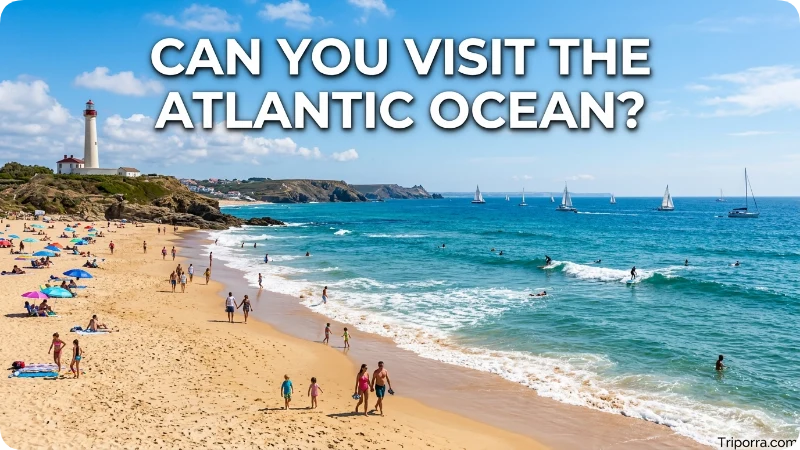
Yes. The Atlantic Ocean can be visited from hundreds of coastal destinations in North America, South America, Europe, Africa, and the Caribbean.
Popular activities include:
- Swimming
- Surfing
- Whale watching
- Fishing
- Sailing
- Snorkeling
- Scuba diving
- Beach vacations
- Wildlife photography
Some famous Atlantic destinations include:
- Miami Beach, Florida, USA
- Outer Banks, North Carolina, USA
- Algarve, Portugal
- Canary Islands, Spain
- Cape Town, South Africa
- Rio de Janeiro, Brazil
- Bahamas
- Bermuda
Best Time to Visit
The best time depends on the destination.
- North Atlantic beaches: Late spring through early fall.
- Caribbean: Winter and early spring offer warm weather with lower humidity.
- Southern Atlantic: Seasons are opposite those in the Northern Hemisphere.
Always check local weather forecasts and ocean conditions before entering the water.
What Are the Biggest Environmental Challenges Facing the Atlantic Ocean?
It faces several environmental threats. Governments, scientists, and conservation groups are working together to reduce their impact.
Plastic Pollution
Millions of tons of plastic enter the world’s oceans every year. Plastic waste can harm fish, seabirds, turtles, and marine mammals.
Climate Change
Rising global temperatures are warming the Atlantic Ocean. This can affect:
- Ocean currents
- Coral reefs
- Fish populations
- Sea levels
- Storm intensity
Overfishing
Some fish populations have declined because of excessive fishing. Many countries now use fishing quotas and conservation measures to help protect marine life.
Habitat Loss
Coastal development, pollution, and damaged wetlands reduce habitats for many species.
Ocean Conservation
Many organizations support Atlantic conservation through:
- Marine protected areas
- Sustainable fishing practices
- Beach cleanups
- Wildlife monitoring
- Scientific research
- International agreements
⭐ Did You Know?
Healthy oceans produce much of the oxygen people breathe and absorb large amounts of carbon dioxide from the atmosphere.
FAQ
Is the Atlantic Ocean bigger than the Pacific Ocean?
No. The Pacific Ocean is larger. The Atlantic Ocean is the second-largest ocean on Earth, covering about 41 million square miles (106.5 million square kilometers).
What countries touch the Atlantic Ocean?
More than 100 countries and territories have Atlantic coastlines or coastlines on connected seas, including the United States, Canada, Brazil, Portugal, Spain, Morocco, South Africa, and many Caribbean nations.
Where does the Atlantic Ocean begin and end?
It stretches from the Arctic Ocean in the north to the Southern Ocean surrounding Antarctica in the south. It lies between the Americas and Europe and Africa.
Why is the Atlantic Ocean called the Atlantic?
The name comes from Atlas in Greek mythology. Ancient Greek writers used the name to describe the sea beyond the Mediterranean.
What is the deepest place in the Atlantic Ocean?
The deepest known point is the Puerto Rico Trench, which reaches about 27,500 feet (8,380 meters) below sea level.
Can you swim in the Atlantic Ocean?
Yes. Many beaches along the Atlantic Ocean are safe for swimming when conditions are suitable. Always follow local safety advice, watch for currents, and obey lifeguard warnings.
Does the Atlantic Ocean have sharks?
Yes. Many shark species live in the Atlantic Ocean, including great white, tiger, blue, hammerhead, and whale sharks. Most sharks stay away from people, and attacks are uncommon.
What is the largest island in the Atlantic Ocean?
Greenland is the largest island in the Atlantic Ocean. It lies between the Arctic and North Atlantic Oceans and is an autonomous territory within the Kingdom of Denmark.
Why is the Atlantic Ocean important?
The Atlantic Ocean supports international trade, fishing, tourism, scientific research, weather systems, and marine ecosystems. It also helps regulate Earth’s climate through major ocean currents.
Which ocean is closest to Europe?
The Atlantic Ocean borders the western coast of Europe. It has influenced the continent’s climate, trade, exploration, and maritime history for thousands of years.
Conclusion
The answer to “where is the Atlantic Ocean” is simple: it lies between North and South America on the west and Europe and Africa on the east. It extends from the Arctic Ocean in the north to the Southern Ocean around Antarctica, making it the second-largest ocean on Earth.
The Atlantic Ocean is much more than a large body of water. It connects continents, supports global trade, influences weather and climate, and provides habitat for thousands of marine species. From busy shipping routes and famous beaches to underwater mountain ranges and powerful ocean currents, the Atlantic plays a central role in everyday life around the world. Whether you’re studying geography, planning a trip, or simply curious about the world’s oceans, understanding the Atlantic Ocean helps explain how our planet is connected.

About Leo Sterling
Leo Sterling is a geography and travel writer at Triporra.com who believes understanding a place starts with knowing exactly where it is. He turns geographic details on countries, regions, islands, and cities into clear, engaging content for everyday readers.
For Leo, a good location article does more than mark a spot on a map. It shows what borders a place, which region it belongs to, and how it connects to the world around it—an approach reflected in guides like where is Anguilla, where solid research meets a simple, conversational style.
Whether readers are planning a trip, studying, or just curious, Leo’s goal is the same: deliver accurate, easy-to-understand information without unnecessary complexity.
Areas of Focus: Geography | Countries & Regions | Caribbean Islands | Travel Destinations | Location Research | “Where Is?” Content