Syria is a country in the Middle East, located in Western Asia. It has been an important crossroads of trade, culture, and civilization for thousands of years. Today, Syria is widely known for its ancient cities, historical landmarks, and recent history, making many people curious about its exact location and significance.
Featured Snippet
Where is Syria? Syria is located in Western Asia, on the eastern coast of the Mediterranean Sea. It shares borders with Turkey, Iraq, Jordan, Israel, and Lebanon. Its capital city is Damascus, one of the world’s oldest continuously inhabited cities.
Quick Facts About Syria
| Fact | Details |
|---|---|
| Official Name | Syrian Arab Republic |
| Country | Syria |
| Region | Middle East (Western Asia) |
| Population | Approximately 24 million |
| Area | Approximately 185,180 sq km (71,500 sq mi) |
| Average Elevation | Approximately 518 m (1,699 ft) |
| Coordinates | Approximately 35° N, 38° E |
| Time Zone | UTC+3 |
| Capital City | Damascus |
| Known For | Ancient history, Roman ruins, Damascus, Aleppo, and the Mediterranean coast |
| Official Language | Arabic |
| Currency | Syrian Pound (SYP) |
Where Is Syria?
Syria is located in Western Asia, commonly called the Middle East. It sits along the eastern shore of the Mediterranean Sea, giving the country both coastal and inland landscapes.
Turkey lies to the north, Iraq borders the east, Jordan is to the south, while Lebanon and Israel are located to the southwest. This central location has made Syria a meeting point between Asia, Europe, and Africa for thousands of years.
The capital city, Damascus, is in the southwestern part of the country, close to the Lebanese border. Aleppo, one of Syria’s largest cities, lies farther north near the Turkish border.
Travellers often overlook how close many Middle Eastern capitals are to Damascus. Cities like Beirut and Amman are only a few hours away by road under normal border conditions, though current travel restrictions can make those journeys much longer.
What Continent Is Syria In?
Syria is located in Asia, specifically in Western Asia, a region commonly known as the Middle East. Although the Middle East is often discussed as its own region, it is geographically part of the Asian continent.
Because Syria lies close to both Europe and Africa, some people mistakenly think it belongs to another continent. However, internationally, Syria is recognized as an Asian country. Its location between the Mediterranean Sea and inland Asia has made it an important crossroads of trade, culture, and civilization for thousands of years.
Is Syria Part of the Middle East?
Yes. Syria is one of the countries that make up the Middle East, a region in Western Asia that includes countries such as Jordan, Lebanon, Iraq, Saudi Arabia, Israel, the United Arab Emirates, Qatar, Kuwait, Bahrain, Oman, and Yemen.
Its central location between the Mediterranean Sea and inland Asia has made Syria an important meeting point for trade routes, cultures, and civilizations throughout history. This strategic position has influenced the country’s history, economy, and cultural heritage for centuries.
Administrative Status
Syria is officially known as the Syrian Arab Republic. It is divided into 14 governorates, each managed by local administrative authorities under the national government.
Damascus serves as both the national capital and one of the country’s governorates. Major governorates include Aleppo, Homs, Hama, Latakia, Tartus, and Deir ez-Zor.
The country uses Arabia Standard Time (UTC+3) throughout the year and does not currently observe daylight saving time.
Entry requirements vary widely depending on nationality, and travel conditions can change quickly. Many governments currently advise against non-essential travel because of ongoing security concerns in parts of the country.
Syria on the Map
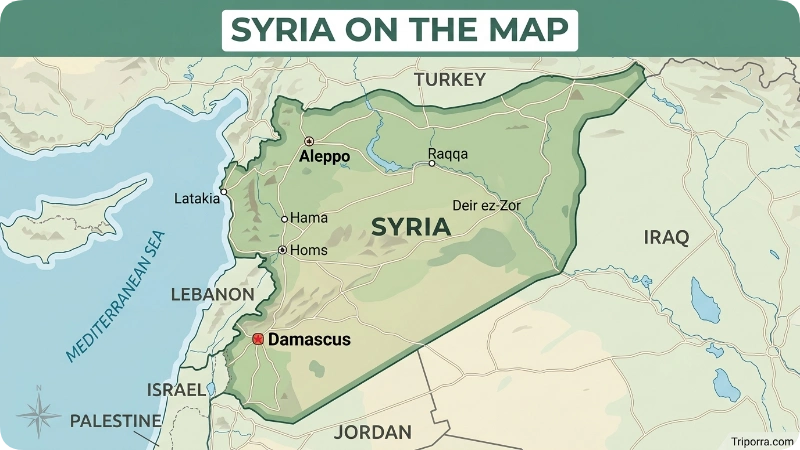
On a world map, Syria appears between the Mediterranean Sea and the deserts of Iraq.
To the north is Turkey, while Iraq forms Syria’s eastern border. Jordan lies to the south, and Lebanon and Israel are found to the southwest. Syria also has about 180 kilometers (112 miles) of Mediterranean coastline.
Syria is located northeast of Cairo, northwest of Riyadh, and directly south of Istanbul.
What most guides miss is that Syria’s landscapes change quickly over relatively short distances. Coastal mountains, fertile plains, dry steppe, and true desert all exist within the country’s borders.
Why Is Syria Famous?
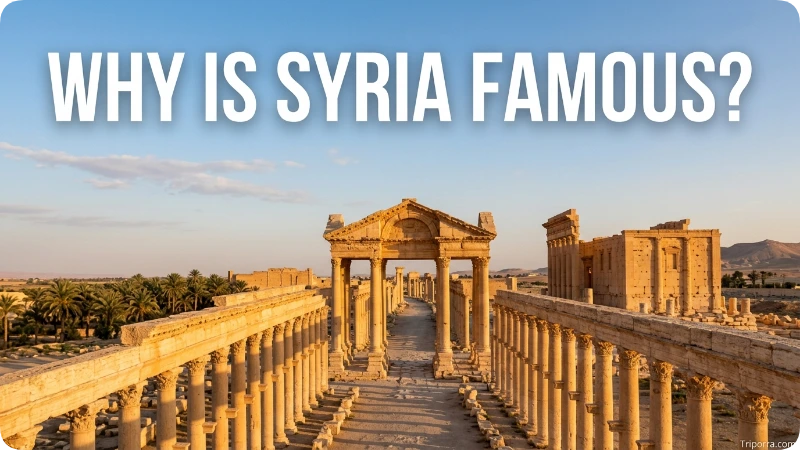
Syria is famous for its extraordinary historical importance. Some of the world’s earliest cities developed here, and countless civilizations—including the Assyrians, Romans, Byzantines, Umayyads, Crusaders, Ottomans, and others—left lasting marks on the country.
Damascus is widely recognized as one of the oldest continuously inhabited cities in the world. Its Old City contains historic mosques, churches, traditional markets, and narrow streets that reflect centuries of history.
Aleppo was once one of the Middle East’s greatest trading cities because it stood on major Silk Road routes connecting Asia and Europe. Although much of the city suffered severe damage during recent conflicts, restoration efforts continue in several historic districts.
Another highlight is Palmyra, an ancient desert city known for Roman architecture and monumental ruins. Despite damage during conflict, Palmyra remains one of the Middle East’s most historically significant archaeological sites.
The country is also known for traditional crafts such as handwoven textiles, mosaic work, olive soap, and detailed wood carving.
Travellers often overlook Syria’s Mediterranean coastline. Cities like Latakia and Tartus offer beaches, seafood, and mountain scenery that feel very different from the country’s desert image.
A commonly misunderstood fact is that Syria is not entirely desert. Large agricultural regions, forests, and mountain ranges cover significant parts of western Syria.
History of Syria
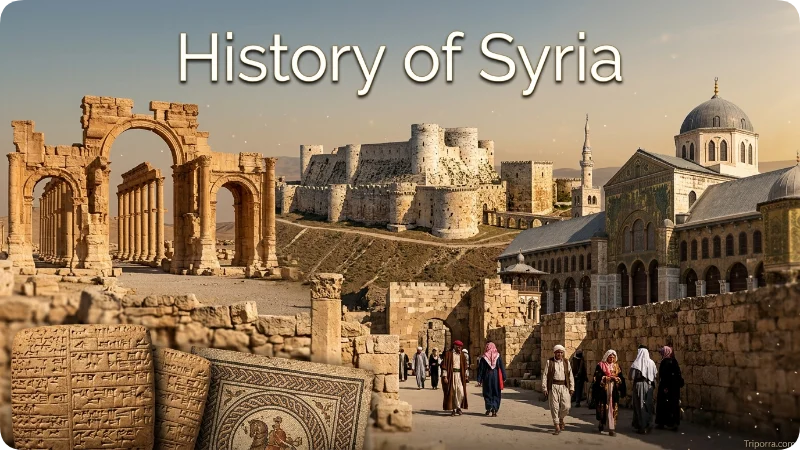
Human settlement in Syria dates back thousands of years. Archaeological discoveries show that some of the world’s earliest farming communities developed in this region.
Ancient kingdoms such as Ebla and Ugarit flourished here long before the Roman Empire. Ugarit is especially important because scholars discovered one of the world’s earliest alphabetic writing systems there.
Later, Syria became part of the Persian Empire before being conquered by Alexander the Great. It eventually came under Roman control, leaving behind impressive cities such as Palmyra, Bosra, and Apamea.
During the 7th century, Damascus became the capital of the Umayyad Caliphate, making Syria the political center of a vast empire stretching across three continents.
The Ottoman Empire ruled Syria for centuries until the end of World War I. Afterward, France administered the territory under a League of Nations mandate before Syria gained independence in 1946.
Since 2011, Syria has experienced a prolonged civil conflict that has caused major humanitarian challenges, widespread displacement, and extensive damage to infrastructure and cultural heritage. Recovery continues in some regions, while others remain unstable.
Climate & Weather (Syria)
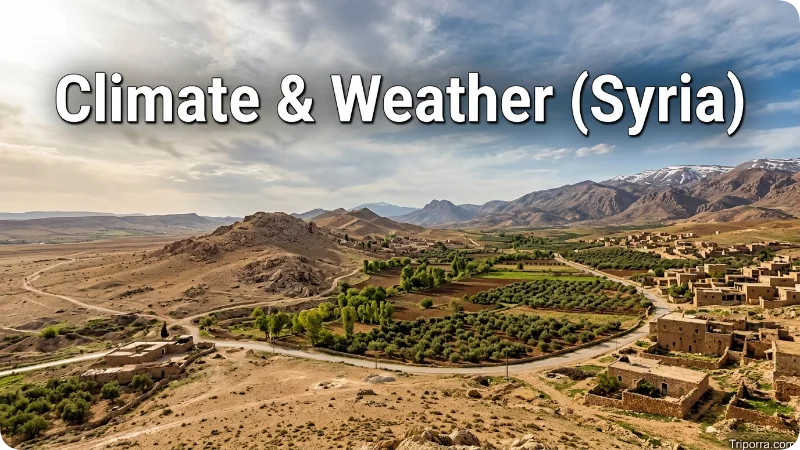
Syria has a mostly Mediterranean and semi-arid climate.
Coastal regions experience mild, rainy winters and warm, dry summers. Inland cities have hotter summers and colder winters, while eastern areas receive very little rainfall.
Summer temperatures often range between 30°C and 40°C (86°F–104°F) in many inland areas. Winters are generally mild, although mountain regions can receive snowfall.
One seasonal trap many visitors underestimate is the summer heat in central and eastern Syria. Temperatures can become extremely high during July and August, making outdoor sightseeing difficult during midday.
Spring and autumn usually bring more comfortable weather, with greener landscapes following winter rains.
Things to See & Do
Historic Cities
- Explore the Old City of Damascus
- Visit the Umayyad Mosque
- Walk through Souq Al-Hamidiyah
- Discover the historic districts of Aleppo
Ancient Ruins
- Visit Palmyra
- Explore Bosra Roman Theatre
- See the ancient columns of Apamea
Nature
- Enjoy the Mediterranean coast near Latakia
- Visit the mountains around Kassab
- Explore forests in western Syria
Food & Culture
- Taste traditional Syrian dishes like kibbeh, shawarma, fattoush, muhammara, and baklava.
- Shop for handmade soaps, spices, and traditional crafts in local markets.
Best Time to Visit (Syria)
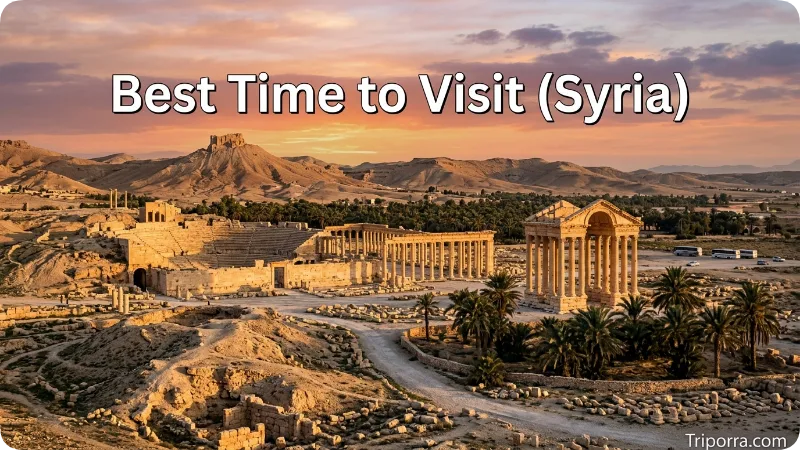
The most comfortable months are generally March to May and September to November.
Spring offers blooming landscapes, pleasant temperatures, and clearer skies. Autumn also provides comfortable weather with fewer weather extremes.
Summer is suitable mainly for coastal areas, where sea breezes help reduce the heat. Inland cities can become very hot.
Winter is cooler and quieter. Mountain regions occasionally receive snow, while coastal areas experience most of the country’s rainfall.
Current security conditions remain the biggest factor when planning any visit. Before making travel arrangements, always check official government travel advisories and local entry requirements.
Common Misconceptions
One common misconception is that Syria is entirely desert. In reality, western Syria includes fertile farmland, forests, mountains, and Mediterranean beaches.
Another misunderstanding is confusing Syria with Assyria, the ancient civilization. While Assyria once covered parts of modern Syria and neighboring countries, they are not the same political entity.
Many people also assume every historic site was completely destroyed during the conflict. Although several sites suffered damage, many important landmarks still exist and some restoration work continues.
Related Places
Lebanon
Located west of Syria, Lebanon shares strong historical, cultural, and culinary connections with its neighbor.
Jordan
Jordan borders southern Syria and is home to Petra, Wadi Rum, and the Dead Sea.
Turkey
Northern Syria connects directly with southern Turkey, where many cultural traditions overlap across the border.
Iraq
Iraq borders eastern Syria and shares centuries of shared Mesopotamian history.
Israel
Israel lies southwest of Syria. The internationally recognized border area includes the Golan Heights, a territory internationally recognized as Syrian but occupied by Israel since 1967 and effectively annexed by Israel in 1981, a move not recognized by most countries.
Where Is Syria in Relation to Palestine?
Syria lies north of Palestine. Modern-day Syria shares a border with Israel, while the Palestinian territories are located farther south. Because the two areas are close to each other in the eastern Mediterranean region, Syria has long played an important role in the history and politics of the Middle East
Where Is Syria in Relation to Iran?
Syria is located west of Iran. The two countries do not share a direct land border because Iraq lies between them. Despite this, Syria and Iran have maintained close political and strategic ties for many years due to their shared interests in the Middle East.
What Else Do People Want to Know?
Safety is the first concern for most travelers. Conditions differ greatly between regions, and many foreign governments continue to advise against travel to much of Syria because of ongoing security risks.
The cost of daily life inside Syria is generally lower than in many neighboring countries, although inflation and changing economic conditions affect prices.
Visa policies depend on nationality and may change without much notice. Travelers should confirm requirements before making plans.
Arabic is the official language, though English is spoken in some hotels and by some tourism professionals where tourism operates.
Respect for local customs is important. Modest clothing is appreciated, especially when visiting religious sites, and asking permission before photographing people is considered polite.
Frequently Asked Questions
Is Syria in Asia or Africa?
Syria is located in Western Asia, although it is part of the broader Middle East region.
What is the capital of Syria?
The capital is Damascus.
Which countries border Syria?
Turkey, Iraq, Jordan, Lebanon, and Israel border Syria.
Does Syria have beaches?
Yes. Syria has a Mediterranean coastline with several coastal cities.
Is Damascus one of the oldest cities?
Yes. Damascus is widely considered one of the oldest continuously inhabited cities in the world.
What language do people speak?
Arabic is the official language.
What currency is used?
The Syrian Pound (SYP) is the official currency.
Can tourists visit Syria?
Some travelers do visit, but security conditions and visa rules vary significantly. Official travel advice should always be checked before planning a trip.
What food is Syria known for?
Popular dishes include kibbeh, shawarma, hummus, fattoush, muhammara, and baklava.
Why is Syria historically important?
Syria has been home to some of the world’s earliest civilizations and has played a major role in trade, religion, and cultural exchange for thousands of years.
What country does Syria belong to?
Syria does not belong to another country. It is an independent sovereign nation officially known as the Syrian Arab Republic. Its capital city is Damascus, and it has been an independent state since 1946.
Final Thoughts
Syria occupies a unique place on the map of Western Asia. Its location between the Mediterranean Sea and the heart of the Middle East has shaped thousands of years of history, trade, and culture. While modern challenges have changed how people experience the country, its historical importance remains clear. Understanding where Syria is also helps explain why it has influenced civilizations for so long.

Elena Rostova bridges the gap between premium hospitality and authentic local experiences. Armed with a background in luxury hospitality management and a passion for fine architecture, she spent years evaluating elite resorts before transitioning into travel journalism. Elena heads the luxury and boutique travel vertical on Triporra.com. Her meticulous guides strip away the guesswork from high-end travel, showcasing unique five-star escapes, fine regional dining, and bespoke private tours that elevate a standard vacation into an unforgettable journey.