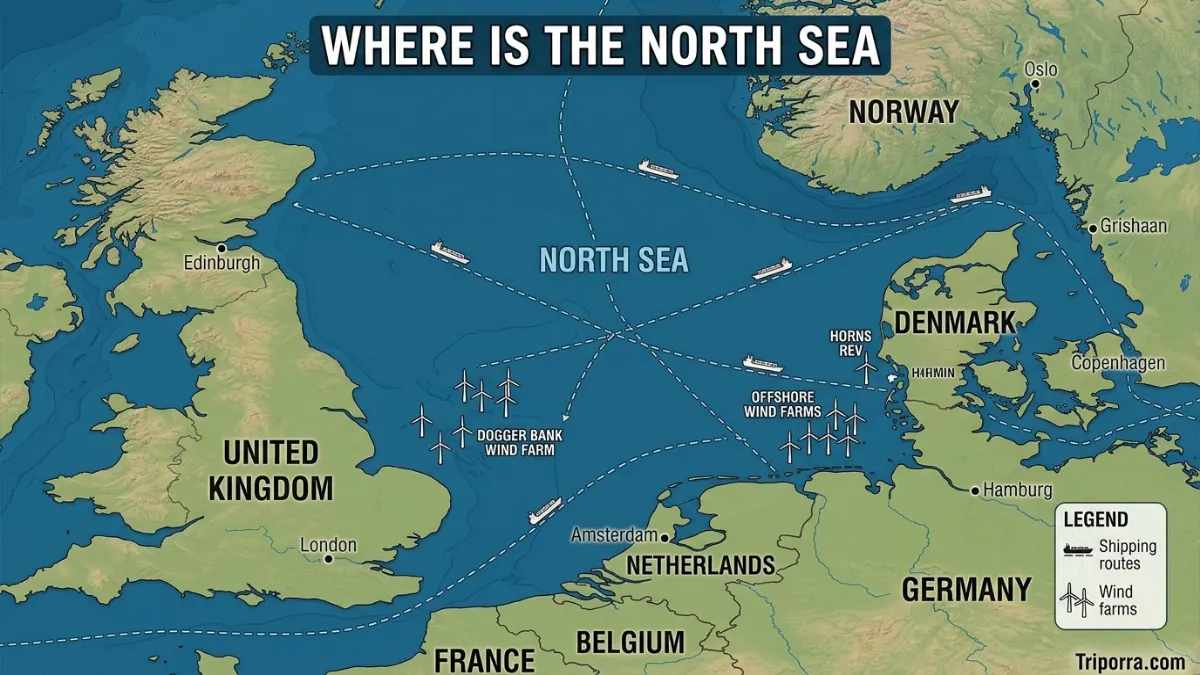
It is a large sea in northern Europe located between the United Kingdom, Norway, Denmark, Germany, the Netherlands, Belgium, and France. It forms part of the Atlantic Ocean and serves as one of the world’s most important maritime regions for shipping, fishing, energy production, and trade.
Millions of people live along its coastline, and many major European ports depend on the North Sea for economic activity. Its strategic location has shaped European history, commerce, and culture for centuries.
Featured Snippet Answer
It is a marginal sea of the Atlantic Ocean situated between Great Britain and mainland Europe. It borders the United Kingdom, Norway, Denmark, Germany, the Netherlands, Belgium, and France. Known for its busy shipping routes, offshore oil and gas fields, fisheries, and renewable energy projects, the North Sea is one of Europe’s most economically significant bodies of water.
Where Is the North Sea Located?
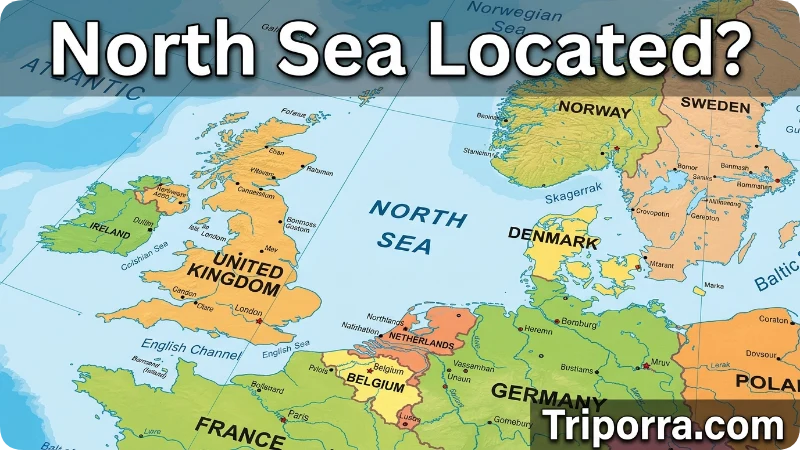
It lies in Northern Europe and forms part of the northeastern Atlantic Ocean.
It is positioned:
- East of Great Britain
- West of Norway and Denmark
- North of Germany, the Netherlands, Belgium, and France
- South of the Norwegian Sea
The sea connects to several neighboring bodies of water:
- Atlantic Ocean through the English Channel and northern passages
- Norwegian Sea to the north
- Baltic Sea through the Skagerrak and Kattegat straits
- English Channel to the southwest
Its central location makes it a major transportation corridor connecting northern European countries.
Quick Facts
| Fact | Details |
|---|---|
| Official Name | North Sea |
| Type | Marginal Sea of the Atlantic Ocean |
| Continent | Europe |
| Bordering Countries | United Kingdom, Norway, Denmark, Germany, Netherlands, Belgium, France |
| Approximate Area | 575,000 sq km (222,000 sq mi) |
| Maximum Depth | About 700 meters (2,300 feet) in the Norwegian Trench |
| Average Depth | Around 95 meters (312 feet) |
| Coordinates | Approximately 56°N, 3°E |
| Known For | Shipping, fishing, oil and gas production, offshore wind farms |
| Nearby Major Cities | London, Amsterdam, Rotterdam, Hamburg, Oslo, Bergen |
| Connected Waters | Atlantic Ocean, Baltic Sea, Norwegian Sea |
| Time Zones Nearby | GMT, CET, and related regional time zones |
North Sea on the Map
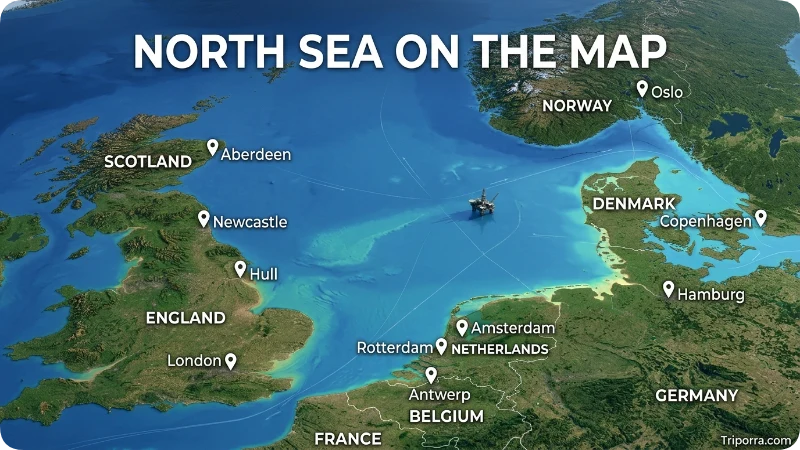
Imagine standing on the eastern coast of England and looking across the water. Beyond the horizon lies mainland Europe. That broad stretch of water is the North Sea.
The sea resembles an irregular basin surrounded by highly developed nations. To the west sits the United Kingdom. Norway forms much of the eastern northern boundary, while Denmark marks part of the eastern side. Germany, the Netherlands, Belgium, and northern France line the southern coastline.
Several important waterways connect through the North Sea, making it a central hub for European marine transportation.
Without looking at a map, you can think of it as a giant water corridor between Britain and continental Europe.
Which Region Does It Belong To?
Unlike a city or administrative district, the North Sea is an international body of water shared by multiple countries.
Its coastal areas fall under the jurisdictions of the surrounding nations. International maritime laws and agreements help regulate:
- Fishing rights
- Shipping routes
- Environmental protection
- Offshore energy development
- Maritime boundaries
Each bordering country controls territorial waters near its coast, while broader international regulations govern many offshore activities.
It is often considered part of the wider Northwestern European region.
How Does the North Sea Compare to Nearby Places?
It differs from neighboring seas in several ways.
In contrast to the Baltic Sea
- Saltier water
- Stronger tides
- More direct connection to the Atlantic Ocean
- Heavier international shipping traffic
Unlike the Norwegian Sea
- Shallower overall
- More enclosed
- Greater concentration of offshore oil and gas facilities
Compared with the English Channel
- Much larger
- Contains major fishing grounds
- Supports extensive wind energy projects
Compared with the Irish Sea
- Considerably larger
- More economically significant
- Greater international maritime activity
These characteristics make the North Sea one of Europe’s most influential marine regions.
How to Reach the North Sea
Because its borders several countries, there are many ways to access it.
By Air
Major airports near the coastline include:
- London Heathrow (UK)
- Amsterdam Schiphol (Netherlands)
- Oslo Airport (Norway)
- Copenhagen Airport (Denmark)
- Hamburg Airport (Germany)
From these airports, travelers can reach coastal towns within a few hours.
By Rail
Europe’s extensive rail networks connect major cities with North Sea destinations.
Popular routes include:
- London to Newcastle
- Amsterdam to Rotterdam
- Hamburg to coastal German resorts
- Copenhagen to Denmark’s western coast
By Road
Modern highways link coastal communities throughout the region.
By Ferry
Numerous ferry routes cross the North Sea between:
- England and the Netherlands
- England and Belgium
- Denmark and Norway
- Germany and Scandinavia
Why Is the It Famous?
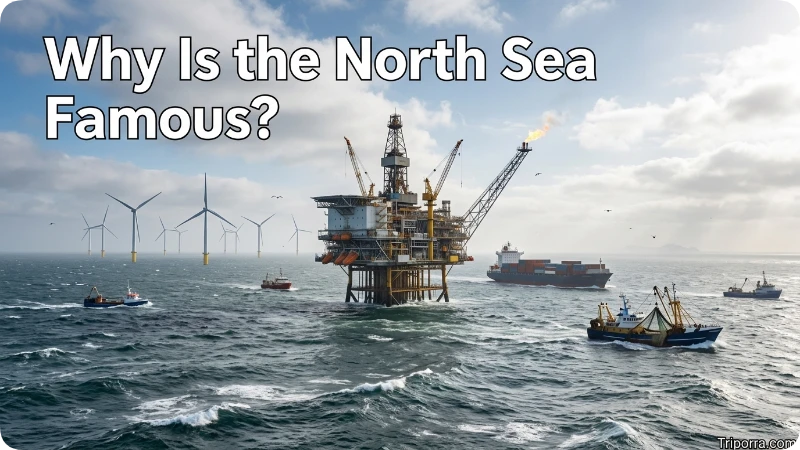
It is known for several important reasons.
Offshore Oil and Gas
Large oil and natural gas reserves were discovered beneath the seabed during the twentieth century.
These discoveries transformed the economies of countries such as:
- Norway
- United Kingdom
- Netherlands
Global Shipping
Some of the world’s busiest shipping routes pass through the North Sea.
Major ports include:
- Rotterdam
- Hamburg
- Antwerp
- Bremerhaven
Fishing Industry
The sea has supported commercial fishing for centuries.
Common catches include:
- Cod
- Herring
- Mackerel
- Plaice
Renewable Energy
It has become a global leader in offshore wind energy development.
Large wind farms now generate electricity for millions of European households.
History of the North Sea
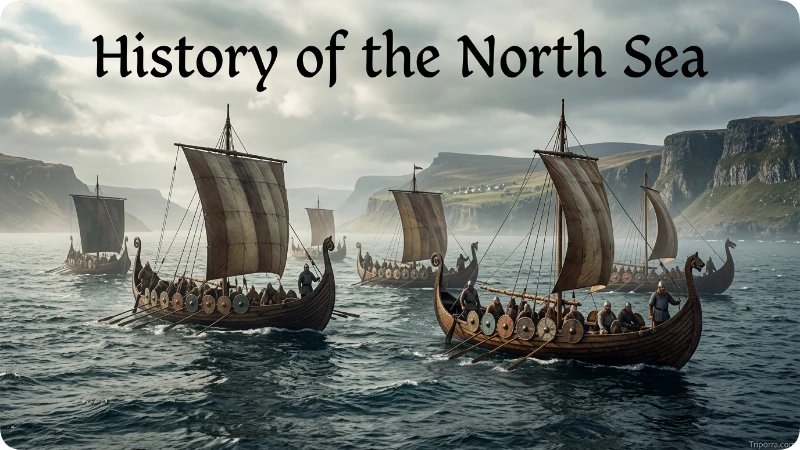
Human interaction with its dates back thousands of years.
Ancient communities settled along its shores because of:
- Fishing opportunities
- Trade routes
- Access to natural resources
During the Viking Age, Scandinavian sailors crossed the North Sea regularly, connecting Norway, Denmark, Britain, and beyond.
Throughout the Middle Ages, merchant ships transported goods between European trading centers.
The sea also played major roles during:
- The Napoleonic Wars
- World War I
- World War II
In modern times, offshore energy development and renewable power projects have become defining features of the region.
Climate and Weather
It experiences a temperate maritime climate.
Weather conditions are influenced by the Atlantic Ocean and prevailing westerly winds.
Spring
- Cool temperatures
- Increasing daylight
- Generally calmer conditions
Summer
- Mild temperatures
- Comfortable coastal weather
- Popular tourism season
Autumn
- Frequent storms
- Stronger winds
- Variable sea conditions
Winter
- Cold temperatures
- Rough seas
- Occasional snowfall in coastal regions
Conditions can change rapidly, particularly offshore.
Things to See and Do Nearby
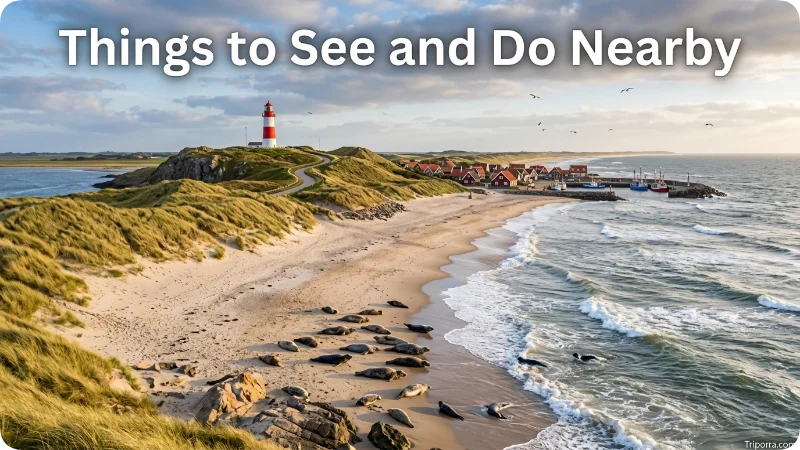
The coastlines surrounding the North Sea offer diverse attractions.
Visit Dutch Coastal Towns
The Netherlands features beaches, dunes, and historic ports.
Explore Norway’s Coast
Travelers can enjoy:
- Dramatic fjords
- Scenic islands
- Fishing villages
Discover British Seaside Destinations
Popular locations include:
- Scarborough
- Whitby
- Northumberland Coast
Experience Denmark’s Beaches
Denmark’s North Sea coast is known for wide sandy beaches and picturesque dunes.
Tour Historic Ports
Cities such as Rotterdam, Hamburg, and Antwerp provide fascinating insights into maritime history.
Wildlife Watching
Visitors may see:
- Seals
- Seabirds
- Dolphins
- Migratory species
Best Time to Visit
The ideal time depends on your travel goals.
Summer (June–August)
Best for:
- Beach visits
- Outdoor activities
- Coastal sightseeing
Late Spring (May)
Offers:
- Pleasant weather
- Fewer crowds
- Good wildlife viewing
Early Autumn (September)
Provides:
- Mild temperatures
- Lower tourist numbers
- Scenic coastal landscapes
Winter
Suitable for travelers interested in dramatic seascapes and storm watching.
Common Misconceptions
The North Sea Is Not an Ocean
Many people assume it is part of the Atlantic Ocean itself. It is actually a separate sea connected to the Atlantic.
It Is Not Entirely North of Europe
Although called the North Sea, it occupies a central position between Britain and mainland Europe.
It Is More Than an Energy Region
While oil and gas are important, the North Sea is equally significant for shipping, fishing, tourism, and renewable energy.
It Is Not Always Rough
Stormy weather occurs regularly, but many coastal areas enjoy calm and pleasant conditions during summer.
Places Related to the North Sea
Travelers and researchers often explore nearby locations connected to the North Sea.
Norwegian Sea
Located north of the North Sea and extending into the Arctic region.
Baltic Sea
Connected through Danish waterways and surrounded by Northern European countries.
English Channel
Links the North Sea with the Atlantic Ocean.
Shetland Islands
Scottish islands positioned between Scotland and Norway.
Dogger Bank
A shallow area of it known for fishing and offshore wind development.
Rotterdam
Europe’s largest port and one of the most important gateways to the North Sea.
What Else Do People Want to Know?
Is it Safe?
Generally yes. Coastal tourism is well developed, though offshore weather can become dangerous quickly.
Is It Expensive to Visit?
Costs vary by country. Norway tends to be more expensive, while some coastal areas in the Netherlands, Germany, and Belgium offer more affordable options.
Can You Swim in it?
Yes. Many beaches provide designated swimming areas, particularly during summer.
Is English Widely Spoken?
English is commonly understood in many North Sea countries, especially in tourism and business sectors.
Are Cruises Available?
Numerous cruise lines operate routes through the North Sea, connecting major European cities and ports.
FAQs
Where is it located?
It is located in Northern Europe between the United Kingdom and mainland Europe.
Which countries border the North Sea?
The United Kingdom, Norway, Denmark, Germany, the Netherlands, Belgium, and France.
Is it part of the Atlantic Ocean?
Yes. It is a marginal sea connected to the Atlantic Ocean.
Why is it important?
It supports shipping, fishing, offshore energy production, and international trade.
How deep is it ?
Its deepest point is approximately 700 meters (2,300 feet) in the Norwegian Trench.
Can you swim in it ?
Yes, many coastal beaches allow swimming, especially during summer months.
What is the largest port on it ?
Rotterdam in the Netherlands is generally considered the largest and busiest port connected to the North Sea.
Is it cold?
Water temperatures are generally cool throughout the year, though they become more comfortable in summer.
Are there islands in the North Sea?
Yes. Examples include the Shetland Islands, Orkney Islands, Frisian Islands, and Heligoland.
What animals live in the North Sea?
Marine life includes seals, dolphins, cod, herring, mackerel, seabirds, and many other species.
Does the North Sea have oil?
Yes. Significant oil and natural gas reserves exist beneath the seabed.
What connects the North Sea to the Baltic Sea?
The Skagerrak and Kattegat straits provide the main connection.
Conclusion
It is a major European sea located between Great Britain and mainland Europe. Bordering seven countries and connected to the Atlantic Ocean, it serves as a vital center for shipping, fishing, energy production, and tourism. Its strategic location, fascinating history, diverse coastlines, and growing renewable energy sector make it one of the most important bodies of water in the world.

Silas Vance is a geography enthusiast, travel researcher, and location-focused content writer dedicated to helping readers better understand the world around them on triporra.com. He specializes in creating informative guides about cities, countries, islands, landmarks, universities, and other notable destinations. His work combines geographic accuracy, historical context, and practical insights to answer location-based questions in a simple and engaging way.