Many people ask, where is the Black Sea, because it lies between Europe and Asia and touches several countries. It is a large body of salt water surrounded by Türkiye, Bulgaria, Romania, Ukraine, Russia, and Georgia.
The Black Sea is important for trade, fishing, travel, shipping, history, and military movement. It also has one of the most unusual underwater environments in the world.
Quick Answer
Where is the Black Sea? It is located between southeastern Europe and western Asia. Six countries have coastlines along it: Türkiye, Bulgaria, Romania, Ukraine, Russia, and Georgia. It connects to the Mediterranean Sea through the Bosphorus, the Sea of Marmara, and the Dardanelles.
Black Sea Quick Facts
| Fact | Details |
|---|---|
| Official Name | Black Sea |
| Type | Large, partly enclosed inland sea |
| Location | Between southeastern Europe and western Asia |
| Bordering Countries | Türkiye, Bulgaria, Romania, Ukraine, Russia, and Georgia |
| Approximate Area | 436,400 sq km (168,500 sq mi) |
| Maximum Depth | Approximately 2,212 m (7,257 ft) |
| Central Coordinates | Approximately 43° N, 35° E |
| Connected To | Mediterranean Sea via the Bosphorus, Sea of Marmara, and Dardanelles |
| Major Coastal Cities | Istanbul, Constanța, Varna, Burgas, Odesa, Sochi, Batumi, Trabzon, Samsun |
| Known For | Deep oxygen-free waters, beaches, trade routes, fishing, and ancient shipwrecks |
| Main Languages | Turkish, Bulgarian, Romanian, Ukrainian, Russian, Georgian, and others |
| Currencies | Vary by bordering country |
| Time Zones | Generally UTC+2 to UTC+4 (varies by country and season) |
Where Is the Black Sea?
The Black Sea lies east of the Balkan region, south of Ukraine, west of the Caucasus Mountains, and north of Türkiye.
Bulgaria and Romania are on its western side. Ukraine lies mainly to the north. Russia is on the northeastern coast, while Georgia is on the eastern coast. Türkiye forms most of the southern coastline.
The sea stretches for approximately 1,175 kilometres from east to west. It is wider than many people expect. It is not a small inland sea that can be crossed quickly.
The Black Sea begins at the northern end of the Bosphorus in Istanbul. Travelers can reach Romania’s Black Sea coast near Constanța from Bucharest in just a few hours by road, while Bulgaria’s coastal cities of Varna and Burgas are several hours’ drive from Sofia.
Some parts of the coast are flat and sandy. Other parts have cliffs, forests, hills, and mountains close to the water.
Is the Black Sea in Europe or Asia?
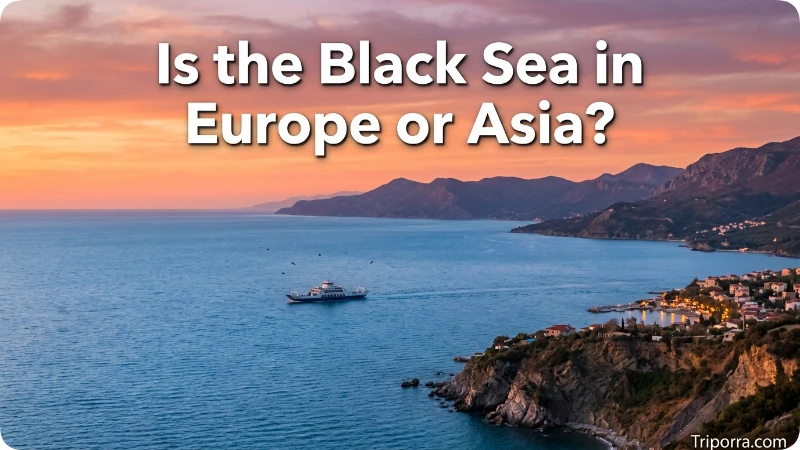
Many people wonder whether the Black Sea belongs to Europe or Asia. The answer is that it lies between both continents. Bulgaria and Romania are in southeastern Europe, while Türkiye, Georgia, and parts of Russia lie in western Asia. Ukraine borders the sea from the north.
Because it sits between two continents, the Black Sea has long served as an important route connecting Europe, Asia, and the Middle East.
Administrative Status
The Black Sea does not belong to one country. Each bordering country controls its own coastal waters, ports, beaches, and nearby sea areas.
There is no single Black Sea visa. Travellers must follow the visa and entry rules of the country they plan to visit. Bulgaria and Romania are members of the European Union, while Türkiye, Georgia, Ukraine, and Russia have their own entry systems.
The countries around the sea also use different currencies, languages, laws, and time zones. Travellers should check local rules before planning a trip.
Crimea is internationally recognised as part of Ukraine, although it is controlled by Russia. The area remains connected to a wider political and military dispute, so travellers should follow official safety advice.
The Black Sea on the Map
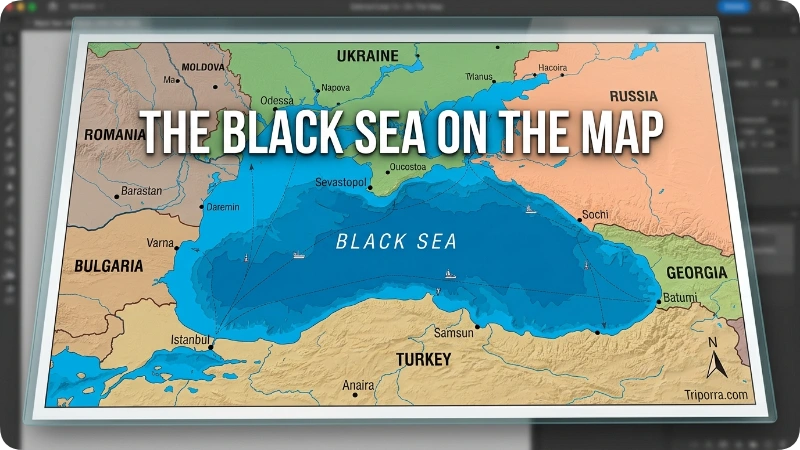
On a map, look directly north of Türkiye and east of Romania and Bulgaria. Ukraine is above the sea, while Georgia lies on its eastern edge.
The Black Sea connects to the Sea of Marmara through the Bosphorus Strait in Türkiye. From the Sea of Marmara, ships pass through the Dardanelles into the Aegean Sea and then the Mediterranean Sea.
The Sea of Azov lies northeast of the Black Sea. The Kerch Strait connects the two bodies of water.
Several large rivers flow into the sea. These include the Danube, Dniester, and Dnieper. They carry large amounts of freshwater from inland Europe.
This river water makes the surface of the Black Sea less salty than the Mediterranean Sea.
Why Is the Black Sea So Important?
The Black Sea is one of the world’s most strategic seas because it links Eastern Europe with the Mediterranean through the Bosphorus Strait. Every year, thousands of cargo ships transport grain, oil, natural gas, metals, and other goods through its waters.
Its location also makes it important for tourism, fishing, energy transport, and international trade.
Why Is the Black Sea Famous?
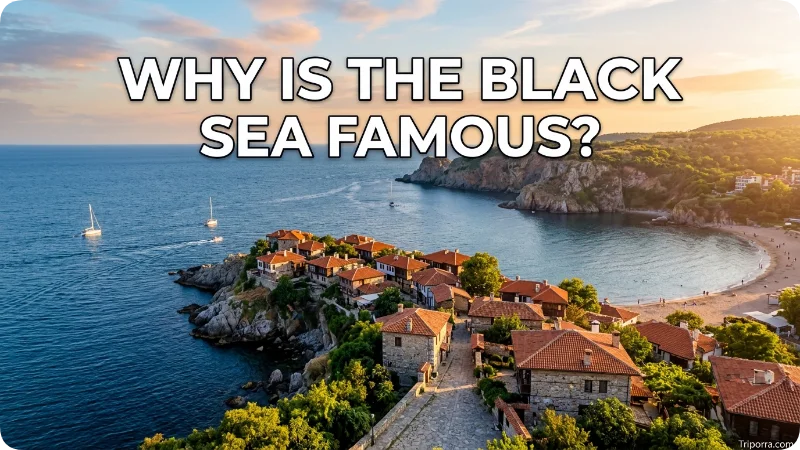
The Black Sea is famous for its unusual deep water. The upper part contains oxygen and supports fish, dolphins, plants, and other sea life. However, much of the deeper water has almost no oxygen.
This happens because the water forms separate layers. Fresher river water stays closer to the surface. Heavier and saltier water stays deeper. These layers do not mix easily.
Because there is little oxygen in deep water, wooden ships and other objects can remain preserved for a very long time. Archaeologists have discovered ancient shipwrecks in surprisingly good condition.
The sea is also famous for trade. Large ports around the coast move grain, oil, metals, food, machinery, and other goods. Important ports include Constanța, Varna, Burgas, Odesa, Batumi, Trabzon, Samsun, and Novorossiysk.
Travellers often overlook how different each coast feels. Bulgaria and Romania have long sandy beaches. Türkiye has green hills, tea-growing areas, fishing towns, and mountain roads. Georgia has a wetter coast with thick forests and subtropical plants.
What most guides miss is that the Black Sea does not feel like one single destination. Each country has its own food, language, building style, customs, and travel experience.
Why Is the Black Sea Important for Trade?
The Black Sea serves as one of Europe’s major shipping routes. Ports across Türkiye, Romania, Bulgaria, Ukraine, Georgia, and Russia handle millions of tonnes of grain, oil, fertilizers, coal, and manufactured goods every year.
The sea is especially important for agricultural exports from Ukraine and Romania, making it a key part of global food supply chains.
History of the Black Sea
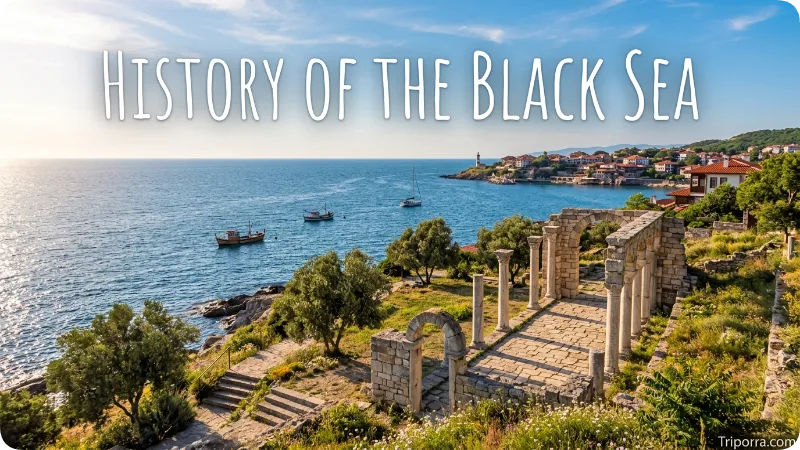
People have lived and traded around the Black Sea for thousands of years.
Ancient Greek settlers built towns and ports along many parts of the coast. They traded grain, fish, wine, timber, metals, and pottery with nearby communities.
Other groups and empires also shaped the region. These included the Thracians, Scythians, Persians, Romans, Byzantines, Bulgarians, Georgians, Genoese, Tatars, and Ottomans.
The sea became an important route between Europe, the Caucasus, Central Asia, and the Mediterranean. Ships carried people, goods, soldiers, and ideas between major ports.
Ancient Greek writers called it Pontos Euxeinos, often translated as the “Hospitable Sea.” The exact reason for the modern name “Black Sea” is still debated.
One idea is that old cultures used colours to describe directions, with black linked to the north. Another idea is that the name came from dark storms or rough water. No single explanation has been fully proved.
The sea still plays an important role today. Modern ports, national borders, shipping routes, and coastal cities continue to depend on it.
Why Is It Called the Black Sea?
No one knows exactly why the sea is called the Black Sea. One popular theory says ancient civilizations associated the color black with the north, while another suggests the name came from the sea’s dark appearance during storms.
Some historians also believe the deep, oxygen-poor water made the sea appear darker than nearby seas. Although several explanations exist, no single theory has been proven.
Climate and Weather
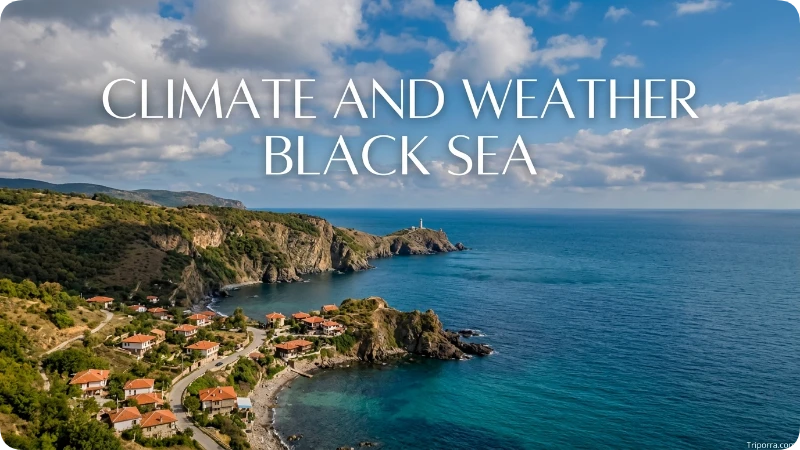
The weather around the Black Sea changes from one coast to another.
Northern areas usually have colder winters. The southern and eastern coasts are often milder. Parts of Türkiye and Georgia receive heavy rainfall because mountains rise close to the shore.
Summer temperatures are usually warm. Coastal daytime temperatures often reach between 25°C and 30°C, though heatwaves can push temperatures higher.
Winter temperatures depend on the location. Northern coastal areas may experience snow, frost, and strong winds. Southern areas are usually milder but can still have cold rain and rough seas.
Sea temperatures may reach approximately 23°C to 26°C during summer. Winter water is much colder.
A common seasonal trap is assuming that every coast has dry Mediterranean weather. Georgia and northeastern Türkiye can receive rain even in summer, so visitors should carry a light raincoat.
Things to See and Do Around the Black Sea
Nature and Wildlife
1. Danube Delta, Romania
The Danube Delta is one of Europe’s largest wetland areas. It has rivers, lakes, reed beds, forests, and small islands.
Visitors often take boat trips to see pelicans, herons, fish, and other wildlife. The area is peaceful and very different from a normal beach resort.
2. Cape Kaliakra, Bulgaria
Cape Kaliakra is a long, narrow headland with high cliffs above the sea. Visitors can walk along the cape and see old ruins, open water, and wide coastal views.
Strong winds are common, so comfortable shoes and a light jacket are useful.
3. Colchic Rainforests and Wetlands, Georgia
Georgia’s Black Sea coast has wet forests, rivers, lakes, and marshes. Protected areas near Kolkheti and Mtirala are known for their plants, birds, and humid climate.
The scenery feels greener than many other parts of the region.
History and Culture
4. Ancient Nessebar, Bulgaria
Nessebar is an old town built on a small rocky peninsula. It has ancient ruins, medieval churches, narrow streets, wooden houses, and sea views.
It is one of the best-known historic places on Bulgaria’s coast.
5. Constanța, Romania
Constanța is a large port city with Roman history, museums, beaches, religious buildings, and a long waterfront.
The historic Constanța Casino is one of the city’s most recognised buildings.
6. The Bosphorus, Türkiye
The Bosphorus connects the Black Sea with the Sea of Marmara. It also separates the European and Asian sides of Istanbul.
A ferry trip offers views of palaces, bridges, forts, fishing boats, and hillside neighbourhoods.
7. Trabzon and Sümela Monastery, Türkiye
Trabzon is a major city on Türkiye’s eastern coast. It is known for local food, markets, sea views, and access to green mountain areas.
Sümela Monastery stands on a steep mountain cliff inland from Trabzon. The journey from the coast passes through forests and valleys.
8. Batumi, Georgia
Batumi has a long seaside walkway, gardens, cafés, modern buildings, and older streets.
It is also a useful base for visiting waterfalls, forests, villages, and mountain areas in western Georgia.
Food Experiences
Food changes greatly around the coast.
In Türkiye, small anchovies called hamsi are very popular. They may be fried, baked, cooked with rice, or added to other dishes.
In Georgia, visitors often try Adjarian khachapuri, a boat-shaped bread filled with cheese, butter, and egg.
Romanian and Bulgarian coastal food often includes grilled fish, soups, fresh salads, bread, cheese, and dishes influenced by Balkan cooking.
What most guides miss is that there is no single “Black Sea cuisine.” Each coast has its own local ingredients and cooking style.
Best Time to Visit
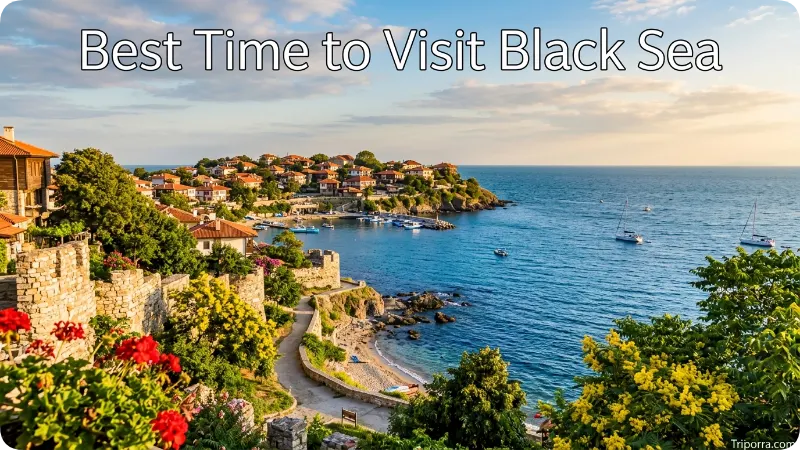
June, July, and August are the main beach months. The weather is warm, the sea is comfortable for swimming, and most hotels, restaurants, and attractions are open.
July and August are usually the busiest months. Beaches can become crowded, and hotel prices may rise.
Late May, early June, and September often offer a better balance. The weather can still be pleasant, but there are usually fewer visitors.
The sea may feel cold in May. September is often warm, but rain becomes more likely in some areas.
Travellers often overlook early autumn. September can be a good month for city walks, local food, nature trips, and quieter beaches.
Winter is better for cultural visits than beach holidays. Some small resorts close, ferry services may reduce, and coastal storms can affect travel.
Common Misconceptions
The Black Sea is not black. Its water may look blue, green, grey, or dark depending on the weather, sunlight, depth, and sea plants.
It is not a freshwater lake. It contains salt water, although its surface is less salty than the Mediterranean.
The whole sea is not without life. Fish, dolphins, plants, and other creatures live in the oxygen-rich upper waters.
The Sea of Azov is connected to it, but it is usually treated as a separate sea. This causes different area figures to appear on websites and maps.
Another common mistake is thinking Greece borders the Black Sea. Greece does not have a Black Sea coastline.
Related Places
Sea of Marmara
The Sea of Marmara lies between the Bosphorus and the Dardanelles. Ships cross it when travelling between the Black Sea and the Mediterranean.
Sea of Azov
The Sea of Azov is northeast of the Black Sea. It is much shallower and connects through the Kerch Strait.
The Caucasus
The Caucasus is a mountain region east of the sea. It includes parts of Georgia, Russia, Armenia, and Azerbaijan.
The Balkans
The Balkans lie west and southwest of the sea. Bulgaria and Romania connect the coast with the wider southeastern European region.
Istanbul
Istanbul stands along the Bosphorus. Its northern districts reach the Black Sea coast, while the city centre lies farther south.
Odesa
Odesa is a major Ukrainian port with important cultural and maritime history. Travel conditions may be affected by the war, so official safety advice should be checked.
What Else Do People Want to Know?
Travel costs depend on the country and city. Bulgaria, Romania, Türkiye, and Georgia may cost less than many popular western European beach destinations.
Prices often rise during July and August. Smaller towns are usually cheaper than famous resorts and large cities.
Roads, trains, buses, ferries, and flights connect many coastal areas. However, there is no simple tourist route that travels around the entire sea.
Local customs also change from country to country. Visitors should dress respectfully in religious places, learn a few local words, and check tipping rules.
Safety conditions are not the same across the whole region. Some coastal areas are normal tourist destinations, while others may be affected by conflict or travel restrictions.
Black Sea vs Mediterranean Sea
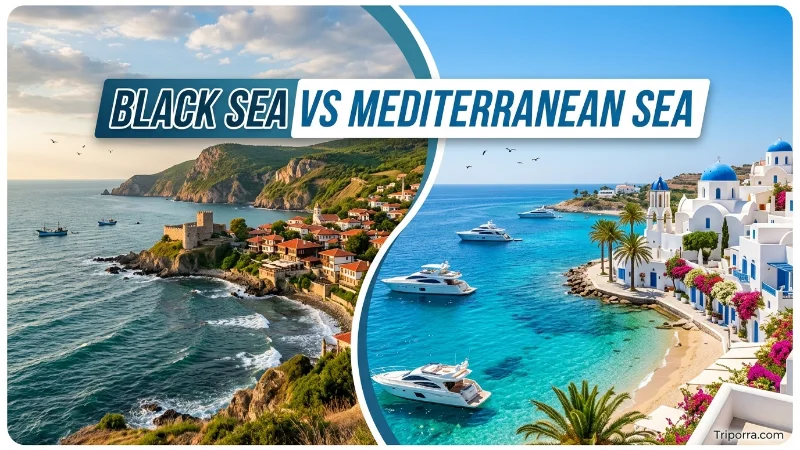
Although connected through the Bosphorus and Dardanelles, the Black Sea and Mediterranean Sea are quite different.
The Black Sea has lower surface salinity because many rivers flow into it. It is also famous for its oxygen-free deep water, while the Mediterranean is much saltier and supports marine life at greater depths.
FAQs
Where Is the Black Sea in the World?
The Black Sea lies between southeastern Europe and western Asia, bordered by six countries and connected to the Mediterranean Sea through the Bosphorus Strait.
Which Country Is the Black Sea In?
The Black Sea is not in a single country. It is bordered by Türkiye, Bulgaria, Romania, Ukraine, Russia, and Georgia.
Why Is the Black Sea So Dangerous?
The Black Sea can be dangerous because of sudden storms, strong currents, rough waves, and ongoing conflict affecting some northern coastal areas.
Where Can I Find the Black Sea on a Map?
On a map, the Black Sea is north of Türkiye, south of Ukraine, east of Bulgaria and Romania, and west of Georgia.
Why Is It Called the Black Sea?
The exact origin is uncertain, but many historians believe the name comes from ancient directional color traditions or the sea’s dark appearance during storms.
Is the Black Sea Dangerous?
Some parts of the Black Sea are safe for tourism, while others may be affected by rough weather or regional conflicts, so travelers should check local conditions.
What Is the Black Sea Movie About?
Black Sea is a 2014 adventure thriller about a submarine crew searching for sunken treasure at the bottom of the Black Sea.
Is the Black Sea a Lake?
No, the Black Sea is a saltwater sea connected to the Mediterranean through the Bosphorus, not a lake.
Is the water salty?
Yes. It is salt water, but the surface is less salty than the Mediterranean because large rivers flow into it.
What animals live there?
The sea supports dolphins, fish, jellyfish, seabirds, and many smaller sea creatures. Most marine life stays in the oxygen-rich upper water.
Which coast is best for beaches?
Bulgaria and Romania are known for long sandy beaches. Türkiye and Georgia offer beaches mixed with hills, forests, and city attractions.
How deep is the Black Sea?
Its deepest point is approximately 2,212 metres below the surface.
Final Thoughts
The Black Sea is a large sea between southeastern Europe and western Asia. It touches six countries and connects with the Mediterranean through Turkish waterways.
Its beaches, ports, forests, wetlands, old towns, and unusual deep water make it an important place for both travellers and scientists.
Before planning a visit, choose a specific country or coastal city. Then check the weather, visa rules, transport options, and current safety advice for that area.

About Leo Sterling
Leo Sterling is a geography and travel writer at Triporra.com who believes understanding a place starts with knowing exactly where it is. He turns geographic details on countries, regions, islands, and cities into clear, engaging content for everyday readers.
For Leo, a good location article does more than mark a spot on a map. It shows what borders a place, which region it belongs to, and how it connects to the world around it—an approach reflected in guides like where is Anguilla, where solid research meets a simple, conversational style.
Whether readers are planning a trip, studying, or just curious, Leo’s goal is the same: deliver accurate, easy-to-understand information without unnecessary complexity.
Areas of Focus: Geography | Countries & Regions | Caribbean Islands | Travel Destinations | Location Research | “Where Is?” Content