If you are asking where is Haiti, the direct answer is simple: Haiti is a country in the Caribbean. It is on the western part of the island of Hispaniola, which it shares with the Dominican Republic.
Haiti matters because it has one of the most important histories in the Americas. It became independent in 1804 after the Haitian Revolution, and it is known for its mountains, coastal cities, Creole culture, music, art, and strong national identity. Haiti is located between the Caribbean Sea and the North Atlantic Ocean, west of the Dominican Republic.
Featured Snippet Answer
Where is Haiti? Haiti is a sovereign Caribbean country on the western part of Hispaniola, an island it shares with the Dominican Republic. Its capital is Port-au-Prince. Haiti is known for its revolutionary history, Creole culture, mountain scenery, coastal towns, and the Citadelle Laferrière UNESCO World Heritage site.
Where Is Haiti Located?
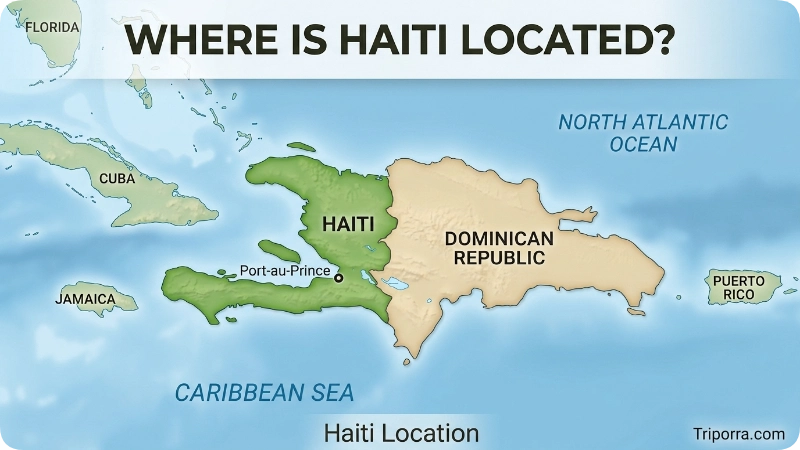
Haiti is located in the Caribbean region of North America. More specifically, it sits on the western side of Hispaniola, the second-largest island in the Greater Antilles after Cuba.
The Dominican Republic covers the eastern side of the same island. This means Haiti is not a separate island by itself. It is a country that shares an island with another country.
To the north of Haiti is the North Atlantic Ocean. To the south is the Caribbean Sea. Cuba lies northwest across the Windward Passage, while Jamaica is southwest across the Caribbean Sea.
Haiti’s capital city is Port-au-Prince, located on the Gulf of Gonâve in the western part of the country. Other major cities include Cap-Haïtien, Gonaïves, Les Cayes, Jacmel, Jérémie, Hinche, and Port-de-Paix.
Quick Facts About Haiti
| Fact | Details |
|---|---|
| Official Name | Republic of Haiti |
| Country Type | Sovereign Country |
| Region | Caribbean (Greater Antilles) |
| Continent | North America |
| Capital City | Port-au-Prince |
| Population | About 11.9 Million (2025) |
| Time Zone | UTC−5 (UTC−4 during daylight saving time) |
| Coordinates | Approximately 19° N, 72° W |
| Official Languages | Haitian Creole, French |
| Currency | Haitian Gourde (HTG) |
| Neighboring Country | Dominican Republic |
| Coastline | Atlantic Ocean and Caribbean Sea |
| Known For | Haitian Revolution, Creole Culture, Art, Music, Mountains, Citadelle Laferrière |
| Nearby Major Cities | Santo Domingo, Kingston, Santiago de Cuba, Miami |
| Main International Gateway | Port-au-Prince (when air service operates normally) |
Haiti on the Map
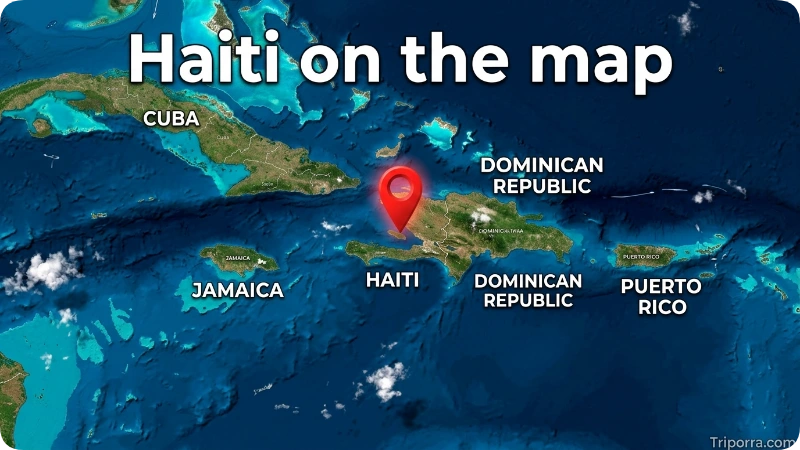
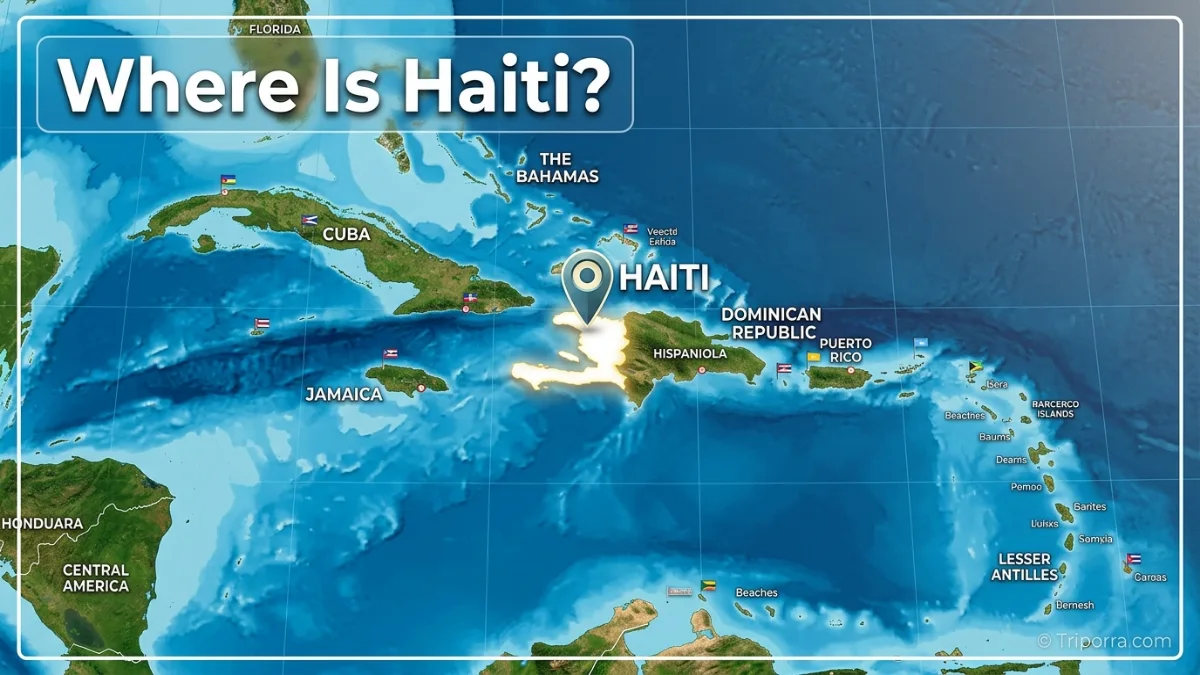
On a map, Haiti appears in the northern Caribbean. It sits between larger Caribbean landmarks that many people know: Cuba, Jamaica, Puerto Rico, and the Dominican Republic.
On a map, Haiti is located in the northern Caribbean, in the western part of Hispaniola. Its relative location is east of Cuba, west of the Dominican Republic, northwest of Jamaica, and southeast of the United States. Haiti faces the Atlantic Ocean to the north and the Caribbean Sea to the south.
Picture the island of Hispaniola as a long island stretching from west to east. Haiti covers the western section, while the Dominican Republic covers the eastern section. The border between them runs roughly north to south, from the Atlantic side down toward the Caribbean side.
Port-au-Prince is not on the border. It sits farther west, along the Gulf of Gonâve. Cap-Haïtien is in the north, close to the Atlantic coast. Les Cayes is in the southwest, near the Caribbean Sea. Jacmel is on the southern coast and is often linked with art, culture, and historic architecture.
The country is very mountainous. In fact, its name is often connected to the idea of “land of high mountains.” This fits the landscape well because mountains shape much of the country’s roads, valleys, towns, farming areas, and weather.
Which Region Does Haiti Belong To?
Haiti belongs to the Caribbean region. Geographically, it is part of the Greater Antilles, a group of larger Caribbean islands that includes Cuba, Jamaica, Hispaniola, and Puerto Rico.
Politically, Haiti is an independent republic. It is not a territory of another country. Its capital and largest city is Port-au-Prince.
Administratively, Haiti is divided into departments. These departments are then divided into smaller units, including arrondissements, communes, and communal sections. The department is the main first-level division, similar to how some countries use provinces or states.
This classification matters because Haiti is sometimes confused with an island, a city, or a territory. The correct answer is that Haiti is a country, and it occupies the western part of Hispaniola.
How Does Haiti Compare to Nearby Places?
Haiti is smaller than the Dominican Republic, which shares the same island. The Dominican Republic covers the eastern side and has a larger land area. Haiti covers the western side and has a very different history, language pattern, and culture.
Compared with Jamaica, Haiti is larger in land area and has a much bigger population. Jamaica is an island country by itself, while Haiti shares Hispaniola with the Dominican Republic.
Compared with Cuba, Haiti is much smaller. Cuba is the largest island in the Caribbean, while Haiti is one of the major countries of the Greater Antilles.
Compared with Puerto Rico, Haiti is much larger in population and land area. Puerto Rico is a U.S. territory, while Haiti is a fully independent country.
For travelers, Haiti has historically offered strong cultural tourism, mountain scenery, coastal towns, and major heritage sites. However, travel access and safety conditions can change quickly. As of 2026, several governments advise against travel to Haiti because of crime, kidnapping, civil unrest, and limited health care access.
How to Reach Haiti
The main way to reach Haiti from abroad is by air. Port-au-Prince has the country’s main international airport, Toussaint Louverture International Airport. Cap-Haïtien also has an international airport in northern Haiti.
In normal conditions, flights from Miami to Haiti can take around two hours. Flights from New York may take around four hours, depending on the route. From nearby Caribbean countries, travel times are often shorter.
Road travel is possible between Haiti and the Dominican Republic through official border crossings. However, road travel can be slow because of distance, border checks, traffic, and security conditions. A trip between Santo Domingo and Port-au-Prince may take most of a day by road, not just a few hours.
There is no useful international passenger rail route into Haiti. Public transport inside the country often includes buses, shared vans, taxis, motorcycles, and private vehicles. Conditions vary widely by area.
Air access has also been affected by security problems. Reuters reported that U.S. flight restrictions involving Port-au-Prince were extended into 2026 because of threats near the airport area, while some regional airport access has been treated differently.
Why Is Haiti Famous?
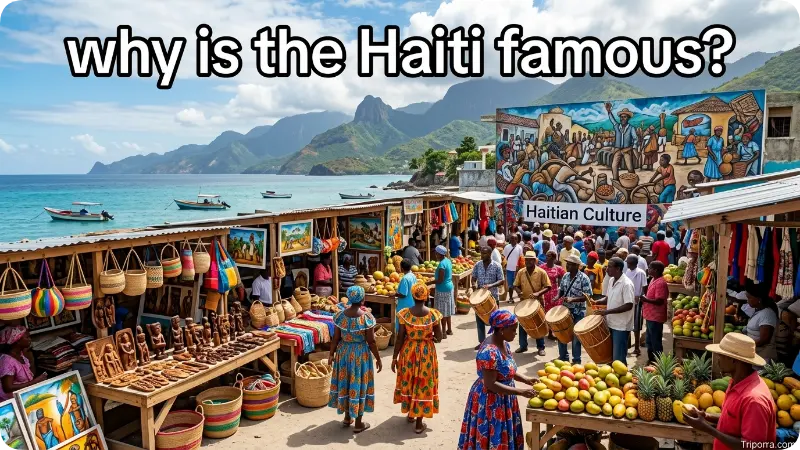
Haiti is famous for history, culture, art, music, food, mountains, and independence. Its story is known worldwide because the Haitian Revolution created the second independent country in the Americas after the United States.
The country is also known for the Citadelle Laferrière, Sans-Souci Palace, and Ramiers, which are part of a UNESCO World Heritage site. These monuments date from the early 19th century, after Haiti declared independence. UNESCO describes them as symbols linked to liberty and freedom.
Haitian art is another major reason people know the country. Bright paintings, metalwork, street murals, religious art, and handmade crafts are important parts of Haitian culture.
Music also plays a big role. Haitian kompa, rara, vodou rhythms, carnival music, and modern urban sounds all show the country’s creative energy.
Food is another cultural highlight. Common dishes include diri ak djon djon, griot, tassot, bannann peze, pikliz, soup joumou, rice and beans, and seafood in coastal areas.
History of Haiti
Haiti’s history begins long before European arrival. The island of Hispaniola was home to Indigenous Taíno communities. After Christopher Columbus reached the island in 1492, Spanish colonization began, followed later by French control of the western part of the island.
The French colony of Saint-Domingue became one of the world’s most profitable plantation colonies. Its wealth came from enslaved labor, especially on sugar and coffee plantations.
In 1791, enslaved people and free people of color began a major revolt. This struggle became the Haitian Revolution. It lasted more than a decade and involved local leaders, French forces, Spanish forces, British forces, and changing political conditions in Europe.
On January 1, 1804, Haiti declared independence. This made it the first independent Black republic and a major symbol of resistance against slavery and colonial rule.
Modern Haiti has faced many challenges, including political instability, debt, foreign occupation, natural disasters, earthquakes, hurricanes, poverty, and violence. Even so, Haitian culture, identity, language, and community life remain powerful.
Climate and Weather
Haiti has a tropical climate. Most lowland areas are warm or hot for much of the year. Mountain areas can feel cooler, especially at night.
Rainfall changes by region. Some areas receive more rain because mountains affect the movement of clouds and wind. Coastal areas can feel humid, while higher areas can feel fresher.
Haiti is also in the hurricane belt. Severe storms are most likely during the Atlantic hurricane season, especially from summer into autumn. The World Factbook profile notes that Haiti is subject to severe storms, flooding, earthquakes, and periodic drought.
For visitors, weather planning matters. Roads can become difficult during heavy rain. Mountain roads may be slow. Coastal areas can be hot. Travel plans should always allow extra time.
Things to See and Do Nearby
Haiti has many cultural and natural places that people search for, even when travel conditions are difficult. These places are best considered for future planning or local research when conditions allow safe movement.
Port-au-Prince is the capital and main urban center. It has markets, museums, art communities, restaurants, and historic sites.
Cap-Haïtien is a major northern city. It is often used as a base for visiting Citadelle Laferrière and Sans-Souci Palace.
Citadelle Laferrière is one of the most famous landmarks in the country. The huge mountain fortress is connected to Haiti’s independence period and is part of the UNESCO World Heritage listing.
Sans-Souci Palace near Milot is another important historical site. It was linked to King Henri Christophe, one of Haiti’s early leaders after independence.
Jacmel is known for art, culture, carnival traditions, and coastal scenery. Many travelers and writers have described it as one of Haiti’s most visually interesting towns.
Île-à-Vache is a small island off Haiti’s southern coast. It is known for beaches, fishing communities, and a quieter island setting.
Labadee, on the northern coast, is a private resort area used by cruise lines. It is geographically in Haiti but operates differently from normal independent travel.
Best Time to Visit
The best time to visit Haiti, in normal safe travel conditions, is usually during the drier and cooler months. Many travelers prefer November through March because temperatures can feel more comfortable than the hottest months.
The shoulder months can also be pleasant, but rain patterns vary. Mountain areas, coastal areas, and cities may not all have the same weather on the same day.
The hurricane-risk period is usually the time to watch most carefully. Heavy rain, storm alerts, and road problems can affect travel. Because Haiti’s current security situation is serious, safety advice should come before weather planning.
Anyone considering travel should check current advisories, airline service, local transport conditions, health access, and insurance rules before booking.
Common Misconceptions
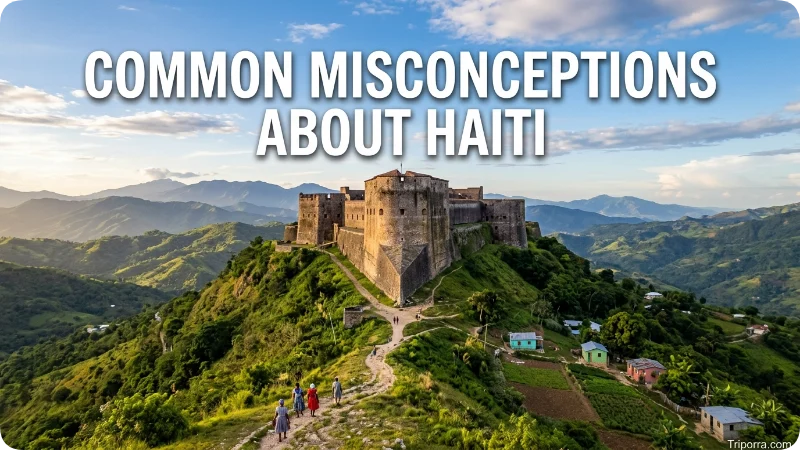
A common mistake is thinking Haiti is the whole island of Hispaniola. It is not. Haiti is the western part of Hispaniola, while the Dominican Republic is the eastern part.
Another mistake is thinking Haiti is in Africa because most Haitians are of African descent. Haiti is in the Caribbean, not Africa.
Some people confuse Haiti with Tahiti. Tahiti is in French Polynesia in the South Pacific. Haiti is in the Caribbean.
Others think Haiti is a territory of France because French is an official language. Haiti was once a French colony, but it became independent in 1804.
There is also a place-related confusion around Little Haiti. Little Haiti is a neighborhood name used in some cities, especially Miami. It is not the country itself.
Navassa Island can also cause confusion. It is an uninhabited island between Haiti, Jamaica, and Cuba. It is administered by the United States, while Haiti claims it. The U.S. Department of the Interior describes Navassa as lying west of Cape Tiburon, Haiti.
Places Related to Haiti
The Dominican Republic is the most closely related place geographically because it shares Hispaniola with Haiti.
Port-au-Prince is the capital and the main city many people search for after learning about the country.
Cap-Haïtien is important for history and northern travel routes.
Gonaïves is historically important because Haiti’s independence was declared there.
Jacmel is often linked with culture, art, and coastal tourism.
Les Cayes is a major city in the south and a gateway to nearby coastal areas.
Île de la Gonâve is a large island in the Gulf of Gonâve.
Île-à-Vache is a smaller island off the southern coast.
Cuba, Jamaica, Puerto Rico, and the Bahamas are nearby Caribbean places often searched together with Haiti.
What Else Do People Want to Know?
Many readers want to know whether Haiti is safe. The honest answer is that safety depends on the current situation, and the current situation is serious. The U.S. travel advisory says not to travel to Haiti because of crime, kidnapping, unrest, terrorism risk, and limited health care. Canada also advises avoiding all travel because of kidnapping, gang violence, and civil unrest.
People also ask if Haiti is expensive. Costs vary. Local expenses can be low compared with many countries, but safe transport, secure lodging, private drivers, and travel disruption can make a trip more costly.
Language is another common question. Haitian Creole is widely spoken in daily life. French is also an official language, especially in government, education, and formal settings.
Visitors also wonder about culture. Haitian culture is warm, expressive, artistic, religious, musical, and community-focused. Respect matters. Learning a few Creole greetings can help create a better connection.
Accessibility can be difficult. Some roads are rough, public services are limited in many areas, and medical care may not match the level visitors expect in larger countries.
Is Haiti a Poor or Rich Country?
Haiti is generally considered one of the poorest countries in the Americas. The country faces high levels of poverty and has experienced long-term economic, political, and infrastructure challenges. However, Haiti also has a strong cultural identity, skilled communities, natural resources, and a rich history that extends far beyond its economic difficulties.
Is It Safe to Go to Haiti Right Now?
Travel safety in Haiti can change quickly, and the current security situation is serious. Visitors should check the latest government travel advisories, local security conditions, airline service, transportation options, and access to medical care before planning a trip. Do not rely on older travel information because conditions can change rapidly.
FAQs
Is Haiti in Which Country?
Haiti is an independent country, not part of any other country. It shares the island of Hispaniola with the Dominican Republic.
What Continent Is Haiti In?
Haiti is in North America, specifically in the Caribbean region.
Is Haiti in South America?
No, Haiti is not in South America. It is located in the Caribbean, which is part of North America.
Is Haiti in Africa?
No, Haiti is not in Africa. It is a Caribbean nation located between Cuba and the Dominican Republic.
Where Is Haiti Located in the World?
Haiti is located in the Caribbean Sea on the western part of the island of Hispaniola, southeast of the United States.
Is Haiti in America?
Yes, Haiti is in the Americas. It is part of North America and belongs to the Caribbean region.
Is Haiti in the United States?
No. Haiti is not part of the United States. It is an independent country in the Caribbean region of North America. Haiti occupies the western part of Hispaniola, while the Dominican Republic occupies the eastern part of the island.
What Is the Population of Haiti?
Haiti has an estimated population of around 11.8 million people, making it one of the most populous countries in the Caribbean.
Where Is Haiti Located in Africa?
Haiti is not located in Africa. It is an independent country in the Caribbean, part of North America.
Is Haiti the same as the Dominican Republic?
No. Haiti and the Dominican Republic are separate countries. They share the island of Hispaniola.
What Is Haiti Most Famous For?
Haiti is most famous for its Haitian Revolution and independence, Creole culture, art, music, food, mountains, historic landmarks, and the Citadelle Laferrière. Its 1804 independence also made Haiti the first independent Black republic and an important symbol of resistance to slavery and colonial rule.
Is Haiti in Africa or America?
Haiti is in America, specifically North America, in the Caribbean region. It is not in Africa or South America. Haiti occupies the western part of the island of Hispaniola, which it shares with the Dominican Republic.
Conclusion: Haiti’s Location and Importance
Haiti is a Caribbean country on the western part of Hispaniola, sharing the island with the Dominican Republic. It faces the Atlantic Ocean to the north and the Caribbean Sea to the south.
Its capital is Port-au-Prince, and its culture is shaped by Haitian Creole, French, African heritage, Caribbean life, faith, music, food, art, and a powerful independence story.
For geography, Haiti is easy to place: look for the island of Hispaniola between Cuba, Jamaica, and Puerto Rico. Haiti is the western side. For history, it is much more than a map location. It is a country with deep meaning, major struggles, and a lasting place in world history.

Elena Rostova bridges the gap between premium hospitality and authentic local experiences. Armed with a background in luxury hospitality management and a passion for fine architecture, she spent years evaluating elite resorts before transitioning into travel journalism. Elena heads the luxury and boutique travel vertical on Triporra.com. Her meticulous guides strip away the guesswork from high-end travel, showcasing unique five-star escapes, fine regional dining, and bespoke private tours that elevate a standard vacation into an unforgettable journey.