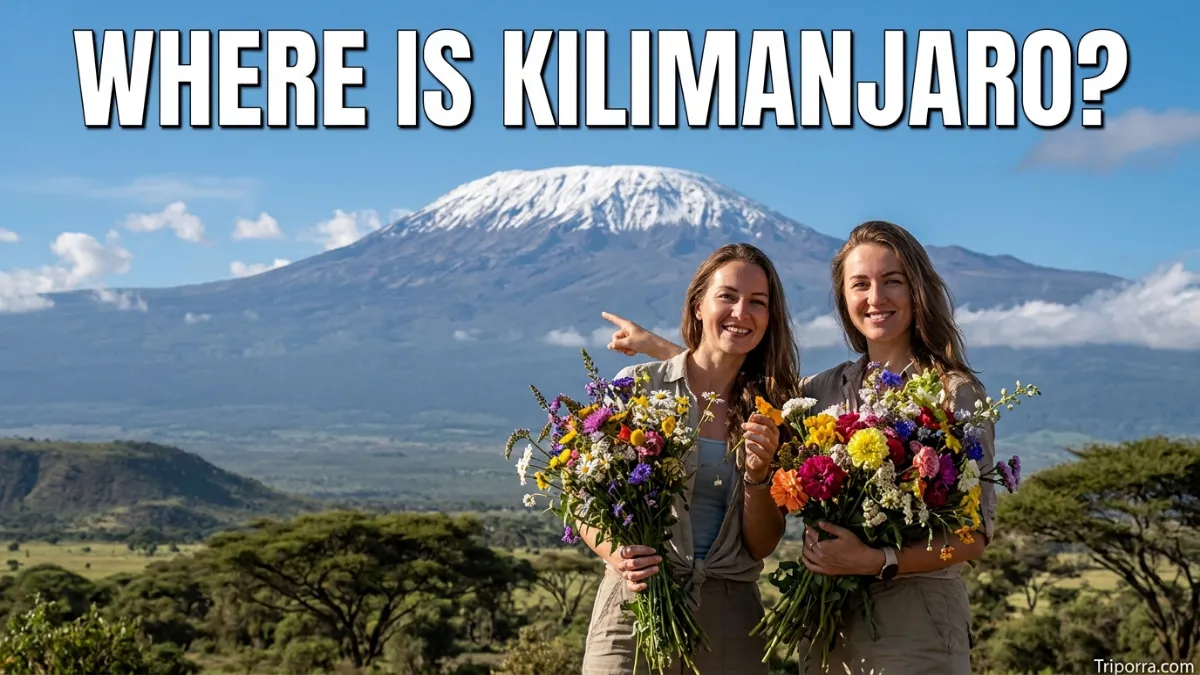
Mount Kilimanjaro is located in northeastern Tanzania, East Africa, near the border with Kenya. It is Africa’s highest mountain and one of the most famous natural landmarks in the world. Many people searching “Where is Kilimanjaro?” want to know its exact location, what country it is in, how tall it is, and why it attracts thousands of visitors every year.
Although Kilimanjaro stands close to Kenya, the mountain is entirely within Tanzania. Moreover, it rises dramatically above the surrounding plains, making it one of the world’s highest free-standing mountains. Because of its unique location, impressive height, and snow-capped summit near the equator, it continues to attract climbers, hikers, photographers, and nature enthusiasts from around the globe.
Quick Facts About Mount Kilimanjaro
| Fact | Information |
|---|---|
| Official Name | Mount Kilimanjaro |
| Country | Tanzania |
| Region | Kilimanjaro Region |
| Continent | Africa |
| Highest Point | Uhuru Peak |
| Height | 19,341 feet (5,895 meters) |
| Type | Dormant Stratovolcano |
| Main Peaks | Kibo, Mawenzi, Shira |
| Nearest Town | Moshi |
| Nearest Airport | Kilimanjaro International Airport (JRO) |
| Protected Area | Kilimanjaro National Park |
| Famous For | Highest mountain in Africa |
| Best Climbing Seasons | January–March and June–October |
Where Is Kilimanjaro Located on the Map?
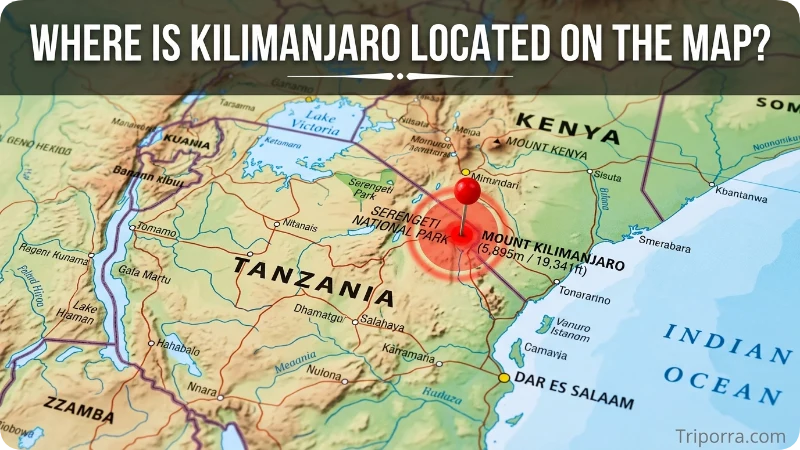
Mount Kilimanjaro is located in Tanzania, a country in East Africa. Specifically, it stands in the northeastern part of the country near the border with Kenya. Furthermore, it lies close to the towns of Moshi and Marangu, which serve as important gateways for visitors and climbers.
On a world map, Kilimanjaro can be found in eastern Africa, south of Kenya and west of the Indian Ocean. Because of its isolated position, the mountain is easily recognizable from great distances.
The approximate coordinates of Mount Kilimanjaro are:
- Latitude: 3.0674° South
- Longitude: 37.3556° East
As a result, Kilimanjaro sits only about 40 miles (65 kilometers) south of the equator.
What Country Is Mount Kilimanjaro In?
Mount Kilimanjaro is located entirely in Tanzania. Although the Kenya–Tanzania border is nearby, the mountain does not cross into Kenya at any point.
In fact, Kilimanjaro is one of Tanzania’s most important natural attractions. Additionally, it contributes significantly to tourism and supports local businesses, guides, hotels, and transportation services.
The mountain is protected within Kilimanjaro National Park, which was established to preserve its unique environment, forests, and wildlife. Consequently, visitors can experience one of Africa’s most remarkable landscapes while supporting conservation efforts.
Is Kilimanjaro in Kenya or Tanzania?
Many people mistakenly believe Kilimanjaro is in Kenya. However, the mountain is completely inside Tanzania.
This confusion exists because Kilimanjaro can be seen from parts of Kenya on clear days. Moreover, some of the most famous photographs of the mountain have been taken from Kenya’s Amboseli National Park.
Nevertheless, the mountain itself belongs entirely to Tanzania.
| Place | Location |
|---|---|
| Mount Kilimanjaro | Tanzania |
| Moshi | Tanzania |
| Kenya Border | North of Kilimanjaro |
| Nairobi | Kenya |
Therefore, the correct answer is simple: Mount Kilimanjaro is located in Tanzania.
What City Is Closest to Mount Kilimanjaro?
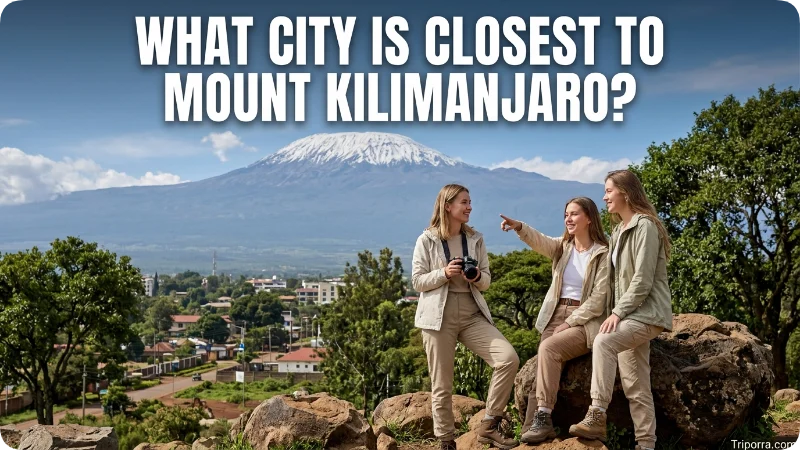
The nearest major town to Mount Kilimanjaro is Moshi. Because of its proximity to the mountain, Moshi serves as the primary base for climbers.
Visitors can find:
- Hotels
- Restaurants
- Tour operators
- Equipment rental shops
- Transportation services
Furthermore, most guided expeditions begin in Moshi before heading to one of the mountain’s official climbing routes.
Another important city nearby is Arusha. Although it is farther from Kilimanjaro than Moshi, many travelers use Arusha as a starting point for safaris and regional tours.
How Far Is Kilimanjaro From Major Cities?
Distances vary depending on travel methods and starting locations.
| Starting Point | Approximate Distance |
|---|---|
| Moshi | 25 miles (40 km) |
| Arusha | 50 miles (80 km) |
| Nairobi | 125 miles (200 km) |
| Dar es Salaam | 310 miles (500 km) |
| Zanzibar City | 250 miles (400 km) |
However, travel times may differ due to road conditions, traffic, and weather.
How Do You Get to Mount Kilimanjaro?
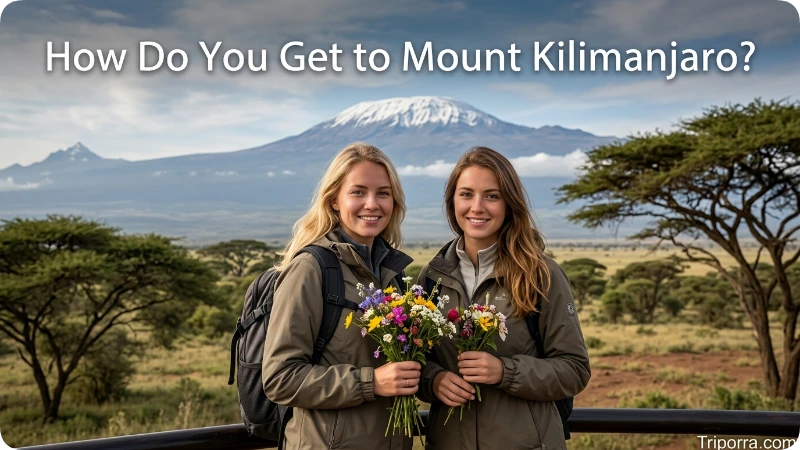
The easiest way to reach Kilimanjaro is by flying into Kilimanjaro International Airport (JRO).
After arriving, travelers typically:
- Travel to Moshi or Arusha.
- Meet their guide team.
- Obtain permits and complete preparations.
- Travel to a national park gate.
- Begin their climb.
Additionally, many international flights connect through cities such as:
- Doha
- Istanbul
- Addis Ababa
- Nairobi
- Amsterdam
Therefore, reaching Kilimanjaro is relatively straightforward for international visitors.
What Is Kilimanjaro Famous For?
Mount Kilimanjaro is famous for several reasons.
First, it is the highest mountain in Africa.
Second, it is the world’s highest free-standing mountain.
Third, its snow-covered summit rises above a tropical landscape near the equator.
Furthermore, Kilimanjaro is known for:
- Diverse climate zones
- Volcanic origins
- Unique ecosystems
- Stunning scenery
- Popular climbing routes
As a result, it remains one of the most recognized mountains on Earth.
The Three Volcanic Peaks of Kilimanjaro
Mount Kilimanjaro consists of three volcanic cones.
Kibo
Kibo is the highest and largest cone. Most importantly, it contains Uhuru Peak, the highest point on the mountain.
Mawenzi
Mawenzi is the second-highest peak. In contrast to Kibo, it features rugged terrain and steep rocky formations.
Shira
Shira is the oldest volcanic cone. Although it collapsed long ago, it now forms a broad plateau on the western side of the mountain.
Together, these three peaks form the Kilimanjaro massif.
Why Is Kilimanjaro Called a Free-Standing Mountain?
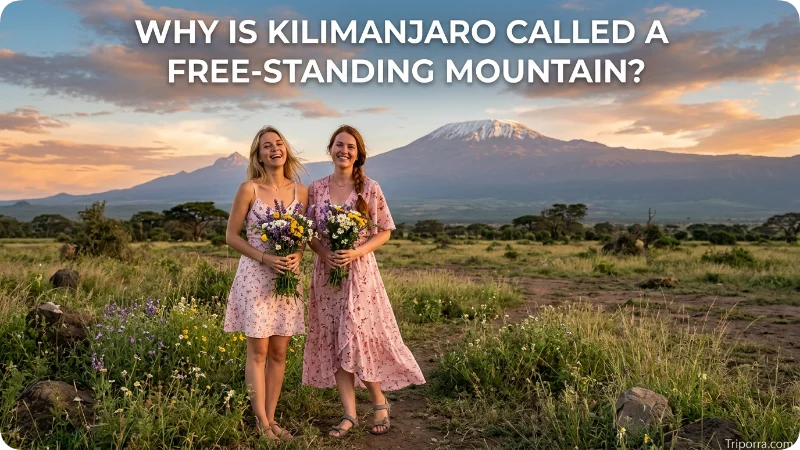
Unlike mountains in large ranges such as the Himalayas or Andes, Kilimanjaro stands alone.
Because it rises independently from the surrounding plains, it is considered a free-standing mountain.
Consequently, its enormous size appears even more impressive when viewed from a distance. This characteristic also makes it one of the most photographed mountains in Africa.
Climate Zones on Mount Kilimanjaro
One of Kilimanjaro’s most fascinating features is its variety of climate zones.
As climbers ascend the mountain, they pass through dramatically different environments.
Cultivation Zone
The lower slopes contain farms and villages. Additionally, crops such as coffee and bananas grow in this fertile region.
Rainforest Zone
Above the farms lies a dense rainforest. Here, visitors can find abundant plant and animal life.
Heath and Moorland Zone
As elevation increases, the landscape changes. Consequently, grasses, shrubs, and unique high-altitude plants become more common.
Alpine Desert Zone
This region is dry and rocky. Furthermore, temperatures can vary significantly between day and night.
Arctic Zone
At the summit, freezing temperatures dominate. Even though Kilimanjaro is near the equator, snow and ice remain present at the highest elevations.
What Is the Best Time to Visit Kilimanjaro?
The most popular climbing seasons are:
- January to March
- June to October
During these months, weather conditions are generally more stable. Therefore, visibility is often better and trails are easier to navigate.
However, weather on the mountain can change quickly at any time of year.
The primary rainy seasons are:
- March to May
- November
Nevertheless, climbs are possible throughout the year with proper planning.
Is Climbing Mount Kilimanjaro Difficult?
Climbing Kilimanjaro is challenging, yet it does not require technical mountaineering skills.
Unlike many high mountains, most routes do not require ropes or specialized climbing equipment.
However, altitude presents the greatest challenge.
Common difficulties include:
- Headaches
- Fatigue
- Shortness of breath
- Cold temperatures
- Altitude sickness
- Sleep difficulties
To improve success rates, climbers should:
- Train before the trip
- Stay hydrated
- Walk slowly
- Choose longer routes
- Follow guide instructions
As a result, many beginners successfully reach the summit each year.
Main Routes to Climb Kilimanjaro
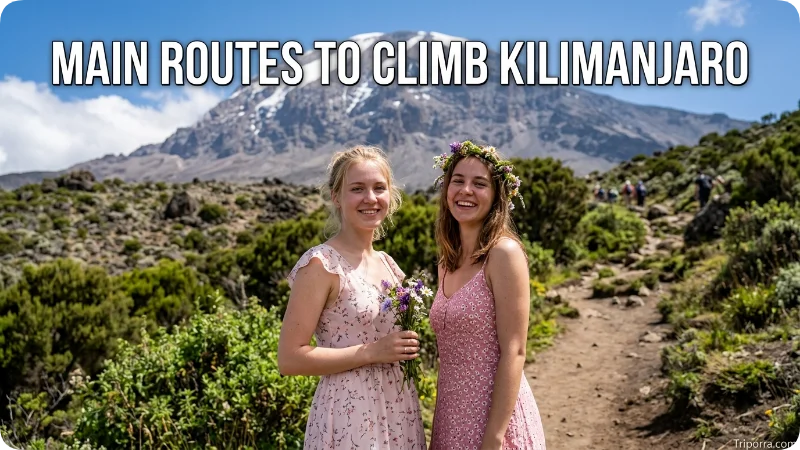
Marangu Route
The Marangu Route is one of the oldest and most popular options. Additionally, it provides hut accommodations rather than tents.
Machame Route
The Machame Route offers spectacular scenery. Furthermore, it allows better acclimatization than many shorter routes.
Lemosho Route
Many climbers choose Lemosho because it provides excellent scenery and more time to adapt to altitude.
Rongai Route
The Rongai Route approaches the mountain from the north. Consequently, it often experiences drier conditions than other routes.
Each route offers unique advantages depending on fitness level, schedule, and preferences.
Is Mount Kilimanjaro a Volcano?
Yes, Kilimanjaro is a dormant stratovolcano.
It consists of three volcanic cones: Kibo, Mawenzi, and Shira. Although it has not erupted in modern times, scientists classify it as dormant rather than extinct.
Therefore, it remains an important geological feature as well as a major tourist attraction.
Wildlife Around Kilimanjaro
The forests surrounding Kilimanjaro support diverse wildlife.
Animals commonly found in the region include:
- Elephants
- Buffalo
- Monkeys
- Antelope
- Numerous bird species
Furthermore, the mountain’s forests provide essential habitats and water sources for many animals.
What Is Kilimanjaro National Park?
Kilimanjaro National Park protects the mountain and its surrounding ecosystems.
The park preserves:
- Forests
- Wildlife
- Alpine environments
- Volcanic landscapes
Moreover, it is recognized as a UNESCO World Heritage Site because of its natural significance.
As a result, conservation efforts help ensure future generations can continue enjoying this remarkable destination.
History and Cultural Importance

For centuries, local communities have lived on Kilimanjaro’s slopes.
The Chagga people, in particular, have strong historical and cultural ties to the mountain. Additionally, the fertile volcanic soil supports farming and local livelihoods.
European explorers reached the summit area during the nineteenth century. Eventually, the first confirmed summit ascent occurred in 1889.
Today, Kilimanjaro remains a national symbol of Tanzania and a globally recognized landmark.
FAQs
Where is Kilimanjaro located?
Mount Kilimanjaro is located in northeastern Tanzania, East Africa, near the Kenya border.
Is Kilimanjaro in Kenya or Tanzania?
It is located entirely in Tanzania.
How tall is Kilimanjaro?
Its highest point, Uhuru Peak, reaches approximately 19,341 feet (5,895 meters).
What city is closest to Kilimanjaro?
Moshi is the closest major town and serves as the primary base for climbers.
Can beginners climb Kilimanjaro?
Yes. Although the climb is physically demanding, most routes do not require technical climbing skills.
Does Kilimanjaro have snow?
Yes. Despite being near the equator, snow and glaciers remain near the summit.
What is the best time to climb Kilimanjaro?
Generally, January–March and June–October offer the most favorable conditions.
Conclusion
Mount Kilimanjaro is located in northeastern Tanzania, East Africa, near the border with Kenya and close to the town of Moshi. As Africa’s highest mountain, it rises to approximately 19,341 feet (5,895 meters) above sea level and dominates the surrounding landscape.
Moreover, Kilimanjaro is famous for its volcanic peaks, diverse climate zones, unique wildlife, and world-renowned climbing routes. Although reaching the summit requires preparation and determination, the mountain continues to attract adventurers from every corner of the globe. Therefore, for anyone asking where Kilimanjaro is, the answer is clear: it stands proudly in Tanzania as one of Africa’s greatest natural treasures.

Elena Rostova bridges the gap between premium hospitality and authentic local experiences. Armed with a background in luxury hospitality management and a passion for fine architecture, she spent years evaluating elite resorts before transitioning into travel journalism. Elena heads the luxury and boutique travel vertical on Triporra.com. Her meticulous guides strip away the guesswork from high-end travel, showcasing unique five-star escapes, fine regional dining, and bespoke private tours that elevate a standard vacation into an unforgettable journey.