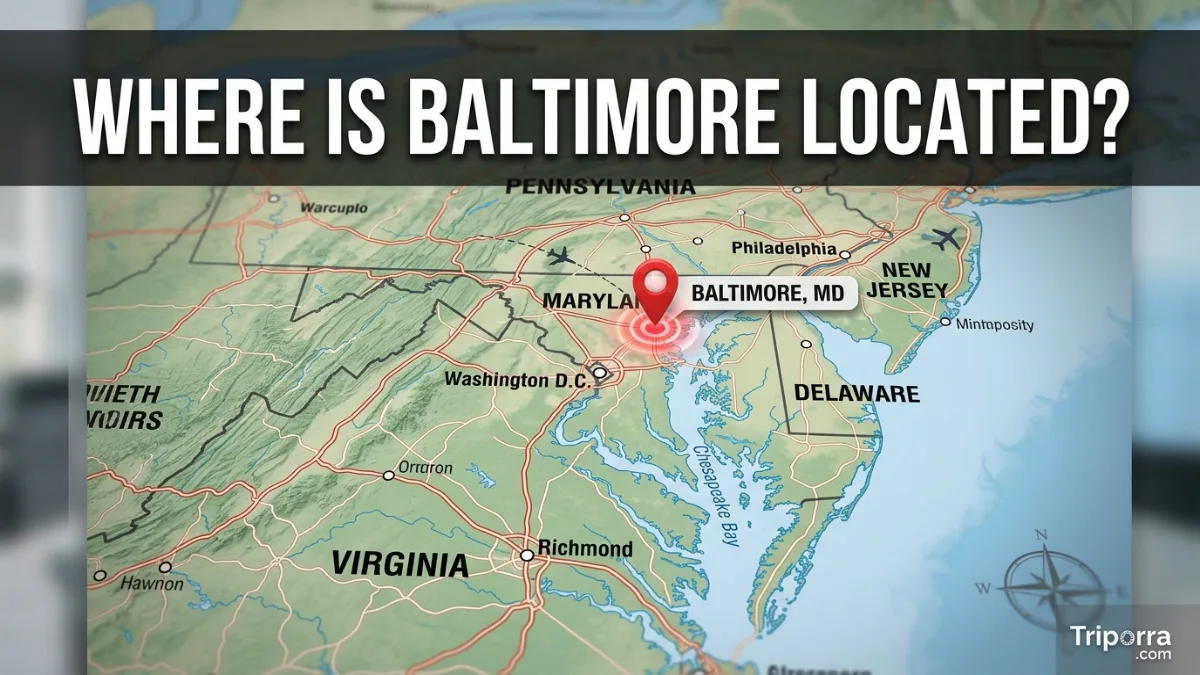
If you have ever wondered where is Baltimore located, the short answer is that Baltimore is a major city in the U.S. state of Maryland, on the East Coast of the United States. It sits along the Patapsco River, close to where the river flows into the Chesapeake Bay. Baltimore is about 40 miles (64 km) northeast of Washington, D.C. by road, making it one of the largest cities in the Mid-Atlantic region.
The city is famous for its historic harbor, professional sports teams, universities, museums, and one of the busiest ports in the United States. Baltimore also plays an important role in transportation, healthcare, education, and shipping. Whether you are planning a visit, studying U.S. geography, or simply searching for its location on a map, this guide explains everything you need to know about Baltimore, including nearby cities, climate, attractions, transportation, safety, and more.
Featured Snippet
Baltimore is located in the state of Maryland on the eastern coast of the United States. The city lies along the Patapsco River near the Chesapeake Bay, around 40 miles (64 km) northeast of Washington, D.C. It is Maryland’s largest city and an important economic, cultural, and transportation center.
Quick Fact
| Fact | Information |
|---|---|
| City | Baltimore |
| State | Maryland |
| Country | United States |
| Continent | North America |
| U.S. Region | South |
| State Region | Central Maryland |
| County/Independent City | Independent city; not part of a county |
| Location | Northern Maryland, along the Patapsco River and Chesapeake Bay |
| Nearest Major City | Washington, D.C. |
| Distance from Washington, D.C. | About 40 miles (64 km) northeast |
| Distance from Philadelphia | About 100 miles (161 km) southwest |
| Major Waterway | Chesapeake Bay |
| Major River | Patapsco River |
| Time Zone | Eastern Time (ET) |
| Approximate Coordinates | 39.29° N, 76.61° W |
| Nickname | Charm City |
| Founded | 1729 |
| Maryland’s Largest City | Yes |
| Nearby Cities | Annapolis, Washington, D.C., Philadelphia, Wilmington |
Where Is Baltimore Located on the Map?
Baltimore is located in the central part of Maryland on the eastern coast of the United States. It sits beside the Patapsco River, which connects to the Chesapeake Bay, the country’s largest estuary.
On a map of the United States, Baltimore is positioned between the Northeast and the South, making it a key transportation hub. Interstate highways, rail lines, and waterways all connect through the city.
⭐ Did You Know?
Baltimore is one of the few independent cities in the United States, meaning it is not part of any county.
What State Is Baltimore In?
Baltimore is in the state of Maryland.
Although many people assume Baltimore is Maryland’s capital because it is the largest city, the state capital is actually Annapolis, located about 30 miles (48 km) southeast of Baltimore by road.
Maryland itself borders:
- Pennsylvania to the north
- Delaware to the east
- Virginia to the south and west
- West Virginia to the west
- Washington, D.C. to the southwest
Where Is Baltimore Relative to Major U.S. Cities?

Baltimore is close to several major East Coast cities.
City
Approximate Driving Distance
Washington, D.C.
40 miles (64 km)
Annapolis
30 miles (48 km)
Philadelphia
100 miles (161 km)
Wilmington
70 miles (113 km)
Richmond
150 miles (241 km)
New York City
190 miles (306 km)
Pittsburgh
250 miles (402 km)
Driving times vary depending on traffic, weather, and road conditions.
What Is Baltimore Known For?
Baltimore is known for its rich maritime history, medical research, sports, seafood, and historic neighborhoods.
Some of its best-known features include:
- Inner Harbor waterfront
- Port of Baltimore
- Johns Hopkins University
- Johns Hopkins Hospital
- National Aquarium
- Fort McHenry
- Camden Yards baseball stadium
- Maryland blue crabs
- Edgar Allan Poe connections
The city combines colonial history with modern healthcare, education, and technology industries.
Why Is Baltimore Important?
Baltimore has played a major role in American history for centuries.
It became an important shipping center during the 18th and 19th centuries because of its deep-water harbor. Today, the Port of Baltimore remains one of the busiest ports in the United States for automobiles, heavy machinery, and cargo.
The city is also internationally recognized for:
- Medical research
- Biotechnology
- Higher education
- Maritime trade
- Government services
- Manufacturing
Geography and Natural Setting
Baltimore sits where the Piedmont Plateau meets the Atlantic Coastal Plain.
This creates rolling hills in the northern neighborhoods while the southern parts are flatter near the harbor.
Nearby natural features include:
- Chesapeake Bay
- Patapsco River
- Jones Falls
- Gwynns Falls
- Harbor wetlands
- State parks
These waterways helped Baltimore develop into one of America’s leading ports.
Climate and Weather

Baltimore has a humid subtropical climate.
Spring
Temperatures range from 55°F to 75°F (13°C to 24°C).
Summer
Warm and humid with average highs around 87°F (31°C).
Autumn
Comfortable temperatures and colorful foliage make this one of the most popular seasons.
Winter
Average daytime temperatures range from 40°F to 47°F (4°C to 8°C) with occasional snowfall.
Rain falls throughout the year.
How to Get to Baltimore
Baltimore is easy to reach by air, rail, highway, and sea.
By Air
The main airport is:
- Baltimore/Washington International Thurgood Marshall Airport (BWI)
Other nearby airports include:
- Ronald Reagan Washington National Airport
- Washington Dulles International Airport
- Philadelphia International Airport
By Train
Amtrak’s Northeast Corridor serves Baltimore Penn Station, connecting the city with:
- Boston
- New York
- Philadelphia
- Washington
- Richmond
By Car
Major highways include:
- Interstate 95
- Interstate 83
- Interstate 70
- Interstate 695 (Baltimore Beltway)
Top Places to Visit in Baltimore
Baltimore offers attractions for families, history lovers, and sports fans.
Popular places include:
- Inner Harbor
- National Aquarium
- Fort McHenry National Monument
- Maryland Science Center
- American Visionary Art Museum
- Walters Art Museum
- Baltimore Museum of Art
- Fell’s Point
- Federal Hill
- Camden Yards
- M&T Bank Stadium
Many attractions are located within a short distance of the harbor.
Population and People
Baltimore has an estimated population of about 565,000 residents (2024).
The metropolitan area includes nearly 2.9 million people, making it one of the largest urban areas on the East Coast.
The city has a diverse population with communities representing many cultural backgrounds.
English is the primary language, although many residents also speak Spanish and other languages.
Economy and Major Industries

Baltimore’s economy has changed significantly over the past century.
Today, major industries include:
- Healthcare
- Higher education
- Shipping
- Logistics
- Biotechnology
- Finance
- Government
- Tourism
- Information technology
Large employers include:
- Johns Hopkins University
- Johns Hopkins Health System
- University of Maryland Medical System
- Federal government agencies
Is Baltimore Safe?
Like many large American cities, safety varies by neighborhood.
Tourist areas such as:
- Inner Harbor
- Fell’s Point
- Federal Hill
generally have a noticeable police presence and attract many visitors.
Travelers should:
- Stay aware of surroundings.
- Avoid poorly lit areas at night.
- Secure valuables.
- Follow local advice.
Checking current local travel information before visiting is always recommended.
Best Time to Visit Baltimore
The best months are usually:
- April
- May
- September
- October
During these months, temperatures are pleasant, outdoor attractions are comfortable, and festivals are common.
Summer is popular but can be hot and humid.
Winter is quieter and often less expensive for hotels.
Interesting Facts About Baltimore
- Baltimore was founded in 1729.
- It became an independent city in 1851.
- “The Star-Spangled Banner” was inspired by the defense of Fort McHenry during the War of 1812.
- The first U.S. passenger railroad began operating from Baltimore.
- Baltimore is nicknamed Charm City.
- The city has more than 65 historic districts.
- Edgar Allan Poe lived and is buried in Baltimore.
Common Misconceptions About Baltimore
Many people mistakenly believe:
- Baltimore is the capital of Maryland.
- Baltimore is part of Washington, D.C.
- Baltimore is located directly on the Atlantic Ocean.
In reality:
- Annapolis is the state capital.
- Baltimore is an independent city.
- It lies inland on the Patapsco River near Chesapeake Bay rather than directly on the Atlantic coast.
Frequently Asked Questions
Is Baltimore located in Maryland?
Yes. Baltimore is the largest city in Maryland and is located in the central part of the state along the Patapsco River near the Chesapeake Bay.
How far is Baltimore from Washington, D.C.?
Baltimore is about 40 miles (64 km) from Washington, D.C. by road. Driving usually takes around one hour depending on traffic.
Is Baltimore on the East Coast?
Yes. Baltimore is part of the East Coast of the United States and belongs to the Mid-Atlantic region.
What body of water is Baltimore on?
Baltimore sits on the Patapsco River, which connects directly to the Chesapeake Bay.
What airport serves Baltimore?
The primary airport is Baltimore/Washington International Thurgood Marshall Airport (BWI), located about 10 miles (16 km) south of downtown.
Why is Baltimore famous?
Baltimore is known for the Inner Harbor, Port of Baltimore, Johns Hopkins University, Fort McHenry, seafood, professional sports, and historic neighborhoods.
Is Baltimore a county?
No. Baltimore is an independent city, meaning it operates separately from any county in Maryland.
What is the population of Baltimore?
Baltimore has an estimated population of approximately 565,000 residents (2024), while the metropolitan area has around 2.9 million people.
What is the best time to visit Baltimore?
Spring and fall are generally the best seasons because temperatures are comfortable and outdoor attractions are easier to enjoy.
Is Baltimore close to New York City?
Yes. Baltimore is about 190 miles (306 km) from New York City by road. Travel time depends on traffic and transportation.
Conclusion
Baltimore is located in Maryland on the East Coast of the United States, where the Patapsco River meets the Chesapeake Bay. Its position between Washington, D.C., and Philadelphia has made it an important transportation, shipping, healthcare, and education center for centuries. Visitors come to see landmarks like the Inner Harbor, Fort McHenry, and the National Aquarium, while residents benefit from world-class universities, hospitals, and a strong maritime economy.
Whether you are looking at a map, planning a trip, or learning about American geography, Baltimore stands out as one of the most historically significant and economically important cities in the Mid-Atlantic region. Its convenient location, rich history, and access to major highways, airports, and rail services make it easy to reach and worthwhile to explore.

Elena Rostova bridges the gap between premium hospitality and authentic local experiences. Armed with a background in luxury hospitality management and a passion for fine architecture, she spent years evaluating elite resorts before transitioning into travel journalism. Elena heads the luxury and boutique travel vertical on Triporra.com. Her meticulous guides strip away the guesswork from high-end travel, showcasing unique five-star escapes, fine regional dining, and bespoke private tours that elevate a standard vacation into an unforgettable journey.