Nepal is a landlocked nation in South Asia. It lies between China to the north and India on the south, east, and west. Moreover, the country is famous for the Himalayan mountain range, which includes Mount Everest, the highest mountain on Earth. In addition, Nepal attracts trekkers, nature enthusiasts, pilgrims, and travelers who want to explore its rich culture, history, and stunning landscapes.
Whether you are planning a trip, studying geography, or simply curious about the country, understanding where It is helps explain its unique culture, strategic location, and global significance.
Featured Snippet Answer
It is a sovereign country in South Asia situated between China and India. It lies along the Himalayan mountain range and is home to Mount Everest. The country’s capital city is Kathmandu. It is known worldwide for its mountains, trekking routes, Buddhist and Hindu heritage, and diverse landscapes ranging from high peaks to subtropical plains.
Where Is It Located?
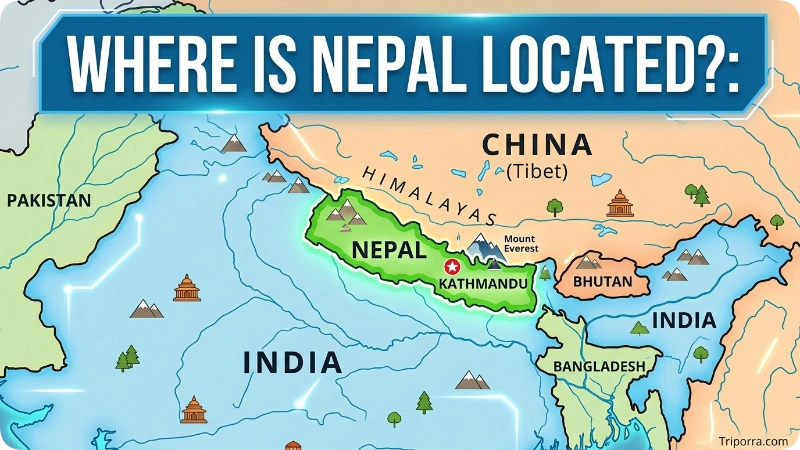
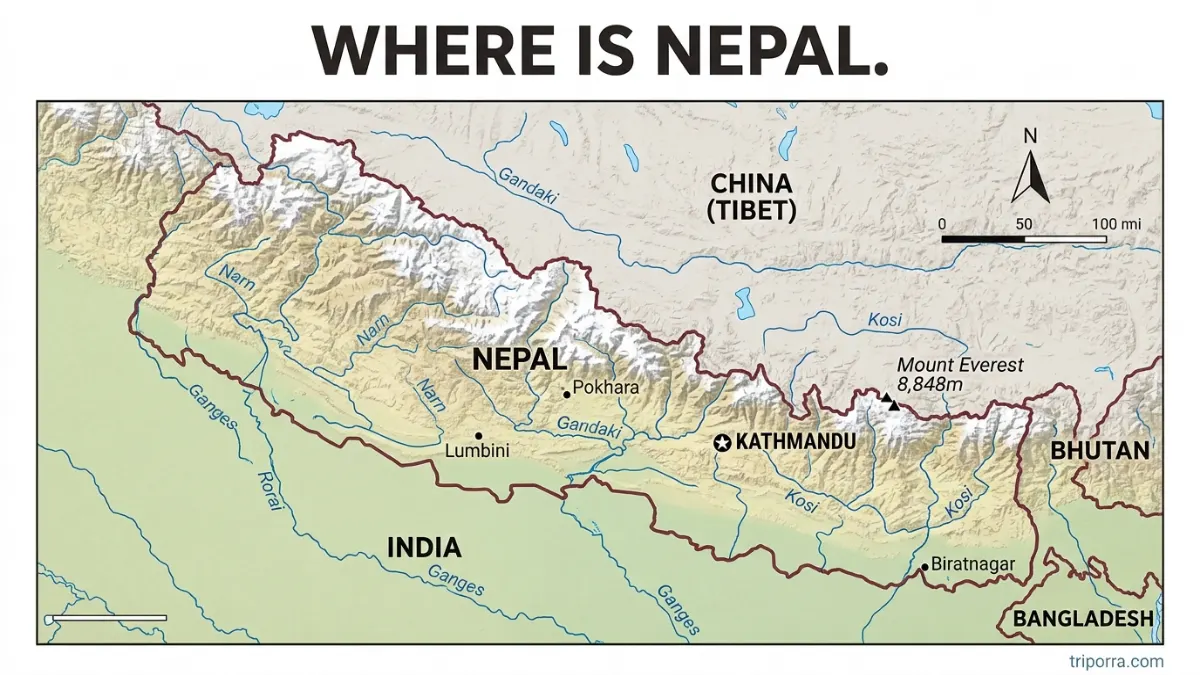
It is located in South Asia on the southern slopes of the Himalayan Mountains. It shares a border with:
- China (Tibet Autonomous Region) to the north
- India to the east, south, and west
The country stretches roughly east to west across the Himalayas and covers an area of approximately 147,516 square kilometers (56,956 square miles).
It does not have direct access to the sea, making it a landlocked country. Despite this, its location has historically made it an important cultural and trade bridge between the Indian subcontinent and the Tibetan Plateau.
Quick Facts
| Fact | Details |
|---|---|
| Official Name | Federal Democratic Republic of Nepal |
| Continent | Asia |
| Region | South Asia |
| Capital City | Kathmandu |
| Population | Approximately 30 million+ people |
| Time Zone | Nepal Standard Time (NST), UTC+5:45 |
| Coordinates | Approximately 28°N, 84°E |
| Nearby Major Cities | Kathmandu, Pokhara, Biratnagar, Bharatpur |
| Known For | Mount Everest, the Himalayas, trekking, temples, and rich cultural heritage |
| Official Language | Nepali |
| Currency | Nepalese Rupee (NPR) |
| Bordering Countries | India and China |
| Highest Point | Mount Everest (8,848.86 m / 29,031.7 ft) |
| Government Type | Federal Parliamentary Republic |
| Major Religions | Hinduism, Buddhism, Islam, Christianity |
| Famous Landmarks | Mount Everest, Pashupatinath Temple, Lumbini, Boudhanath Stupa |
| National Animal | Cow |
| National Flower | Rhododendron |
| Climate | Varies from subtropical lowlands to alpine and tundra regions |
| World Region | Himalayan Region of South Asia |
Nepal on the Map
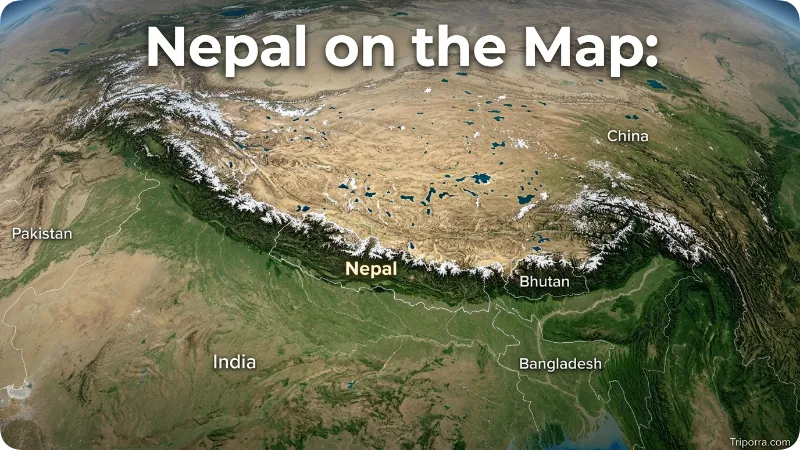
Looking at a map of Asia, it appears as a narrow country positioned between two of the world’s largest nations.
To visualize its location:
- China lies directly north beyond the Himalayan peaks.
- India surrounds it on three sides.
- Bangladesh is close to Nepal’s southeastern border, though the two countries do not share a direct border.
- Bhutan is located east of it.
- Pakistan lies farther west across northern India.
The country’s shape stretches from east to west and contains dramatic changes in elevation. Within a relatively short distance, travelers can move from lowland plains to some of the highest mountains on Earth.
Which Region Does Nepal Belong To?
It belongs to the South Asian region of Asia.
Administratively, It is divided into:
- 7 Provinces
- 77 Districts
- Hundreds of municipalities and rural municipalities
The seven provinces are:
- Koshi Province
- Madhesh Province
- Bagmati Province
- Gandaki Province
- Lumbini Province
- Karnali Province
- Sudurpashchim Province
Kathmandu, the capital, is located in Bagmati Province.
It operates as a federal democratic republic with authority shared between national, provincial, and local governments.
How Does Nepal Compare to Nearby Places?
Compared to neighboring countries, it is smaller in size but exceptionally diverse geographically.
How Nepal Compares to India
- Nepal is much smaller than India.
- Nepal has a higher concentration of Himalayan peaks.
- Cultural traditions overlap due to centuries of interaction.
Nepal and Bhutan: Key Differences
- Both are Himalayan countries.
- Nepal has a significantly larger population.
- Bhutan receives fewer tourists and follows different development policies.
Comparing Nepal With Tibet
- Tibet lies north of Nepal.
- Both share mountain landscapes and Buddhist influences.
- Nepal has greater ethnic and linguistic diversity.
Nepal vs Bangladesh
- Nepal is mountainous.
- Bangladesh is largely low-lying and delta-based.
- Nepal is landlocked while Bangladesh has a coastline.
How to Reach Nepal
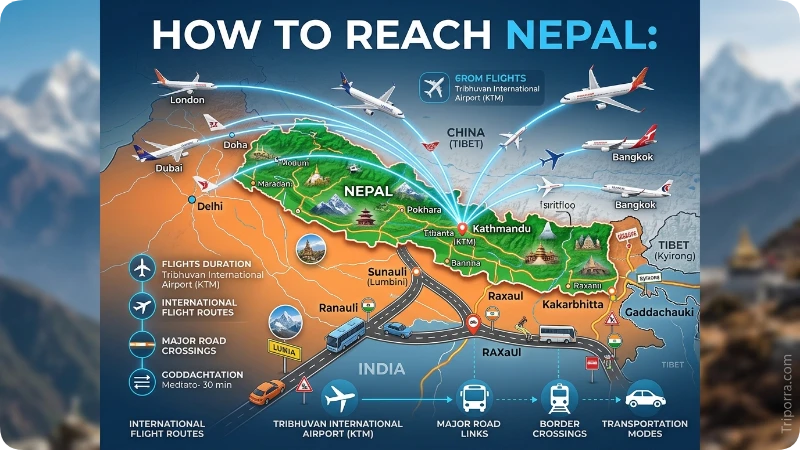
It is accessible by air and land.
By Air
The main international gateway is:
Tribhuvan International Airport (Kathmandu)
International flights connect it with:
- India
- China
- United Arab Emirates
- Qatar
- Thailand
- Malaysia
- Singapore
- Turkey and other destinations
Additional international airports are expanding services in other cities.
By Road
Travelers can enter it through several border crossings with India.
Popular crossing points include:
- Sunauli
- Kakarbhitta
- Raxaul–Birgunj
- Banbasa–Mahendranagar
By Rail
Nepal’s railway network is limited, but rail connections from India continue to develop, improving accessibility.
Why Is Nepal Famous?
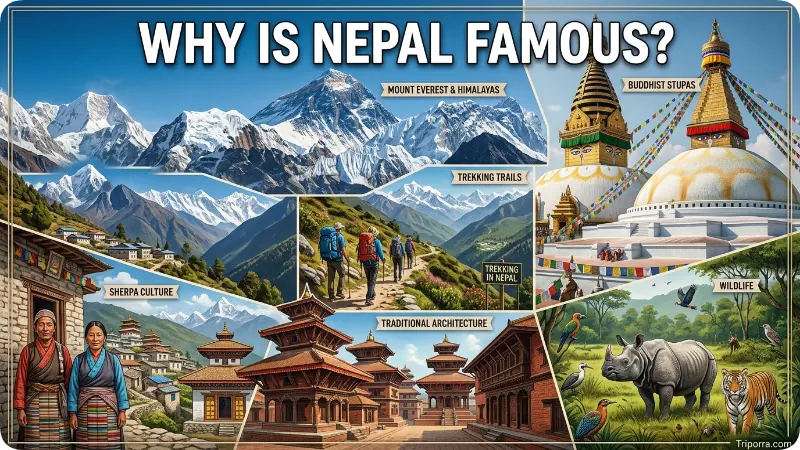
It is famous for several reasons.
Mount Everest
The world’s highest mountain, Mount Everest, stands on the border between Nepal and China.
Himalayan Mountains
Eight of the world’s fourteen peaks above 8,000 meters are located in it.
Trekking Adventures
Popular trekking destinations include:
- Everest Base Camp
- Annapurna Circuit
- Langtang Valley
- Manaslu Region
Religious Heritage
It is important to both Hinduism and Buddhism.
Notable sites include:
- Lumbini, the birthplace of Buddha
- Pashupatinath Temple
- Swayambhunath Stupa
- Boudhanath Stupa
Wildlife
National parks protect:
- Bengal tigers
- One-horned rhinoceroses
- Asian elephants
- Snow leopards
History of Nepal
Nepal’s history stretches back thousands of years.
Ancient kingdoms emerged in the Kathmandu Valley, creating centers of trade, religion, and art.
Unification
In the 18th century, King Prithvi Narayan Shah unified many small kingdoms into modern Nepal.
Relations with Britain
During the 19th century, it maintained independence while neighboring regions came under British colonial rule.
Democratic Development
The country experienced significant political changes during the 20th and early 21st centuries.
Major milestones include:
- End of absolute monarchy
- Democratic reforms
- Establishment of a federal republic in 2008
Today it functions as a democratic nation with elected institutions.
Climate and Weather
It experiences diverse climate zones because of its dramatic elevation differences.
Tropical Lowlands
Southern regions are warm and humid.
Temperate Hills
Central hill regions enjoy moderate temperatures.
Alpine and Arctic Conditions
High Himalayan areas remain cold year-round.
Main Seasons
Spring (March–May)
- Pleasant weather
- Flowering rhododendrons
- Popular trekking season
Summer/Monsoon (June–September)
- Heavy rainfall
- Lush landscapes
- Possible travel disruptions
Autumn (October–November)
- Clear skies
- Excellent mountain views
- Peak tourist season
Winter (December–February)
- Cold in mountains
- Comfortable in lower elevations
Things to See and Do Nearby
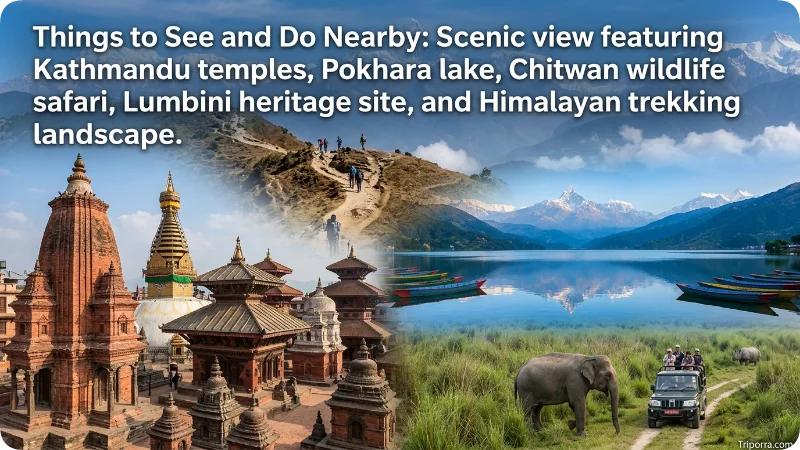
It offers attractions for nearly every type of traveler.
Kathmandu Valley
Explore:
- Ancient temples
- Palaces
- UNESCO World Heritage Sites
Pokhara
Known for:
- Lakes
- Mountain scenery
- Adventure sports
Chitwan National Park
Visitors can enjoy:
- Wildlife safaris
- Birdwatching
- Nature tours
Lumbini
A major pilgrimage destination linked to the life of Buddha.
Everest Region
Experience:
- Trekking routes
- Local culture
- Stunning mountain views
Annapurna Region
One of the world’s most popular trekking destinations.
Best Time to Visit
The best time depends on your interests.
Autumn (October–November)
Best for:
- Trekking
- Sightseeing
- Photography
Spring (March–May)
Ideal for:
- Mountain views
- Hiking
- Nature lovers
Winter (December–February)
Suitable for:
- Cultural tours
- Lower-altitude travel
Monsoon Season (June–September)
Good for:
- Green landscapes
- Fewer crowds
Less suitable for high-altitude trekking.
Common Misconceptions
Several misconceptions exist about it .
Although it shares a long border and strong cultural ties with India, it is an independent nation with its own government, constitution, and national identity.
It offers Much More Than Mount Everest
While Mount Everest is Nepal’s most famous landmark, the country also features ancient temples, diverse cultures, wildlife reserves, scenic valleys, and some of the world’s most spectacular trekking routes.
While Everest attracts global attention, the country also contains forests, rivers, cities, temples, and wildlife reserves.
Not Every Area Is Snowy
Many regions experience warm temperatures throughout the year.
Nepal Is Not Entirely Mountainous
The southern Terai region contains fertile plains and agricultural land.
Places Related to Nepal
Readers researching it often explore these related destinations:
Kathmandu
The capital and largest city.
Pokhara
A major tourism center.
Mount Everest
The world’s highest mountain.
Lumbini
Birthplace of Siddhartha Gautama (Buddha).
Tibet
Neighboring region north of it .
Bhutan
Another Himalayan country east of it.
India
Nepal’s largest neighbor and trading partner.
What Else Do People Want to Know?
Is Nepal Safe for Tourists?
It is generally considered safe for visitors. Travelers should follow local guidance and prepare properly for mountain activities.
Is Nepal Expensive?
It is often viewed as an affordable destination compared to many Western countries.
What Language Do People Speak?
Nepali is the official language, though many ethnic communities speak additional local languages.
What Religion Is Practiced?
Hinduism is the largest religion, followed by Buddhism and other faiths.
Do You Need a Visa?
Many visitors can obtain a tourist visa upon arrival, though requirements vary by nationality.
FAQs
Where is Nepal located exactly?
It is located in South Asia between China and India along the Himalayan mountain range.
Which continent is Nepal in?
It is part of the continent of Asia.
What is the capital of Nepal?
Kathmandu is the capital and largest city of Nepal.
Does Nepal border China?
Yes. Nepal shares its northern border with China.
Does Nepal border India?
Yes. India borders Nepal on the east, south, and west.
Is Nepal a country or a region?
Nepal is an independent country.
Why is Nepal famous worldwide?
Nepal is famous for Mount Everest, Himalayan trekking, religious heritage, and natural beauty.
What is the official language of Nepal?
The official language is Nepali.
What currency is used in Nepal?
Nepal uses the Nepalese Rupee (NPR).
Is Mount Everest entirely in Nepal?
Mount Everest sits on the border between Nepal and China’s Tibet Autonomous Region.
What is the best city to visit in Nepal?
Kathmandu and Pokhara are among the most popular destinations.
How long does it take to travel across Nepal?
Travel times vary greatly because of mountainous terrain, but crossing the country by road can take many hours or several days depending on the route.
__________________________________________________________________________
Conclusion
It is a landlocked country in South Asia situated between China and India. Its location along the Himalayas has shaped its culture, history, economy, and global reputation. From Mount Everest and ancient temples to wildlife parks and vibrant cities, Nepal offers far more than many people expect. Understanding where Nepal is provides insight into why this small nation remains one of the most fascinating destinations in Asia.

Elena Rostova bridges the gap between premium hospitality and authentic local experiences. Armed with a background in luxury hospitality management and a passion for fine architecture, she spent years evaluating elite resorts before transitioning into travel journalism. Elena heads the luxury and boutique travel vertical on Triporra.com. Her meticulous guides strip away the guesswork from high-end travel, showcasing unique five-star escapes, fine regional dining, and bespoke private tours that elevate a standard vacation into an unforgettable journey.