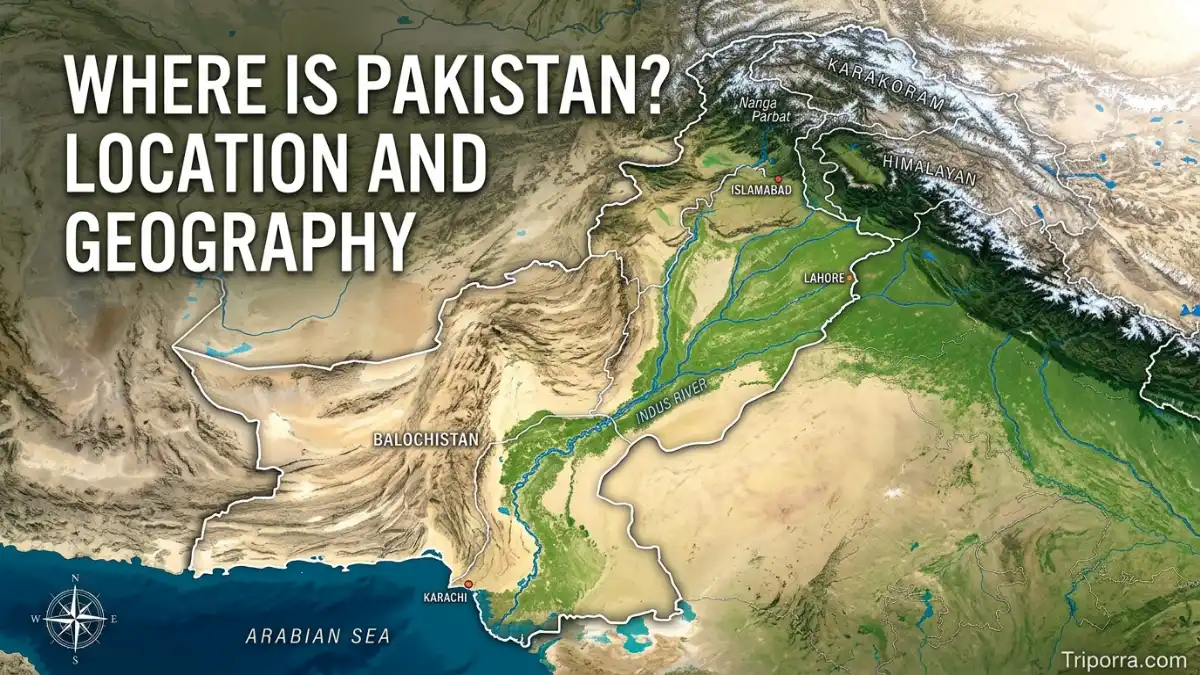
Pakistan is a country in South Asia. It sits at the meeting point of South Asia, Central Asia, and the Middle East, making it one of the world’s most important geographic crossroads. Its location has shaped its culture, trade, history, and strategic importance for thousands of years.
Featured Snippet
Where is Pakistan? Pakistan is located in South Asia. It shares borders with India to the east, China to the northeast, Afghanistan to the northwest, and Iran to the southwest. The country also has a long coastline along the Arabian Sea in the south. Pakistan covers approximately 881,913 square kilometers and has a population of around 250 million people.
Quick Facts
| Fact | Details |
| Official Name | Islamic Republic of Pakistan |
| Country | Pakistan |
| Region | South Asia |
| Population | Approximately 250 million |
| Area | Approximately 881,913 sq km |
| Highest Elevation | K2 – 8,611 m (28,251 ft) |
| Coordinates | Approximately 30.3753° N, 69.3451° E |
| Time Zone | Pakistan Standard Time (UTC+5) |
| Nearest Major City | Islamabad (Capital) |
| Known For | Mountains, Indus River, ancient civilizations, cricket, diverse cultures |
| Official Language | Urdu |
| Widely Spoken Language | English, Punjabi, Sindhi, Pashto, Balochi, and others |
| Currency | Pakistani Rupee (PKR) |
Total Area of Pakistan
Pakistan covers an area of approximately 881,913 square kilometers, making it one of the larger countries in Asia.
The country’s land area includes diverse landscapes such as mountains, plains, deserts, forests, and coastal regions. The northern mountains contain some of the world’s highest peaks, while the Indus River plains support much of Pakistan’s agriculture and population.
Where Is Pakistan?
Pakistan is located in the southern part of Asia. It stretches from the snow-covered peaks of the Himalayas, Karakoram, and Hindu Kush in the north to the warm waters of the Arabian Sea in the south. This gives the country a wide variety of landscapes, climates, and natural environments.
To the east lies India, Pakistan’s largest neighboring country. China borders Pakistan in the northeast through the famous Khunjerab Pass. Afghanistan sits along the northwest border, while Iran is found to the southwest. The Arabian Sea forms Pakistan’s southern coastline, giving the country access to major international shipping routes.
From London, Pakistan is roughly 6,000 kilometers away by air. From Dubai, the flight takes around two hours. Beijing is about five hours away by plane, while New Delhi is only a short flight from Lahore.
Travellers often overlook how large Pakistan really is. Driving from the northern mountains to the southern coast can take more than a full day without long stops. Many first-time visitors expect a small country but are surprised by the long distances between regions.
Administrative Status
Pakistan is a sovereign country made up of four provinces: Punjab, Sindh, Khyber Pakhtunkhwa, and Balochistan. It also includes the Islamabad Capital Territory, Gilgit-Baltistan, and Azad Jammu and Kashmir, each with different administrative arrangements. Parts of the Kashmir region remain disputed between Pakistan and India and are administered separately.
Islamabad serves as the national capital, while Karachi is the country’s largest city and financial center.
Pakistan follows Pakistan Standard Time (UTC+5) throughout the country and does not observe daylight saving time. Most international visitors need a visa before arrival, although many nationalities can now apply through Pakistan’s online visa system.
What Are the Main Areas of Pakistan?
Pakistan is divided into several major administrative areas. The country has four provinces, one federal territory, and additional regions with special administrative arrangements.
The five commonly discussed major areas are:
- Punjab – The most populated province and an important agricultural region.
- Sindh – Located in southeastern Pakistan and home to Karachi.
- Khyber Pakhtunkhwa – A mountainous region known for valleys and historic routes.
- Balochistan – The largest province by area, known for mountains, deserts, and coastline.
- Islamabad Capital Territory – The federal area containing Pakistan’s capital city.
It also includes Gilgit-Baltistan and Azad Jammu and Kashmir, which have their own administrative systems.
Pakistan on the Map
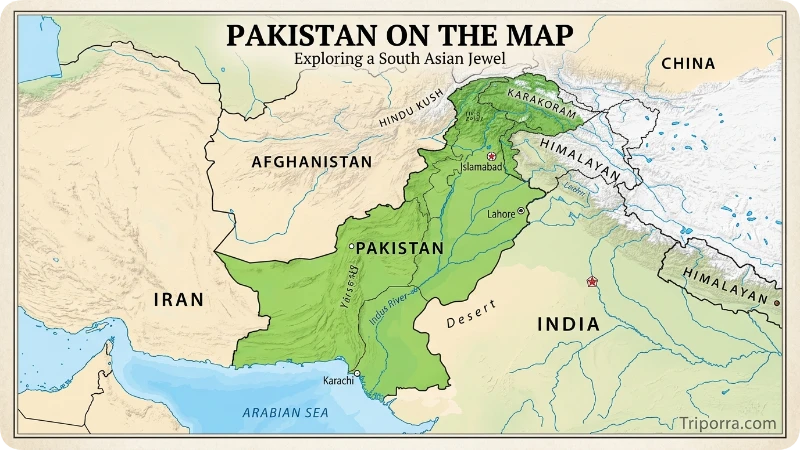
Pakistan sits between South Asia, Central Asia, and the Middle East. It borders four countries and the Arabian Sea, making it an important link between several regions.
The country stretches for more than 1,000 kilometers from north to south. China lies to the northeast beyond the Karakoram Mountains, while Iran borders the southwest through dry desert landscapes. India forms the eastern border, and Afghanistan stretches along much of the northwest.
The Indus River flows almost the entire length of Pakistan, beginning in the northern mountains before reaching the Arabian Sea near Karachi. What most guides miss is how this single river connects nearly every major farming area in the country and has supported life here for thousands of years.
Pakistan Geographical Location and Map
Pakistan is located in South Asia, in the northwestern part of the Indian subcontinent. On a world map, the country lies between approximately 23°N and 37°N latitude and 61°E and 78°E longitude.
Its geographical location places Pakistan at the crossroads of South Asia, Central Asia, and the Middle East. India is located to the east, China lies to the northeast, Afghanistan borders the northwest, and Iran is situated to the southwest. The Arabian Sea forms Pakistan’s southern coastline.
Pakistan’s location has made it an important connection point for trade, migration, and cultural exchange throughout history. Its geography includes mountain ranges in the north, fertile plains in the center, deserts in the west and south, and coastal areas along the Arabian Sea.
Why Is Pakistan Famous?
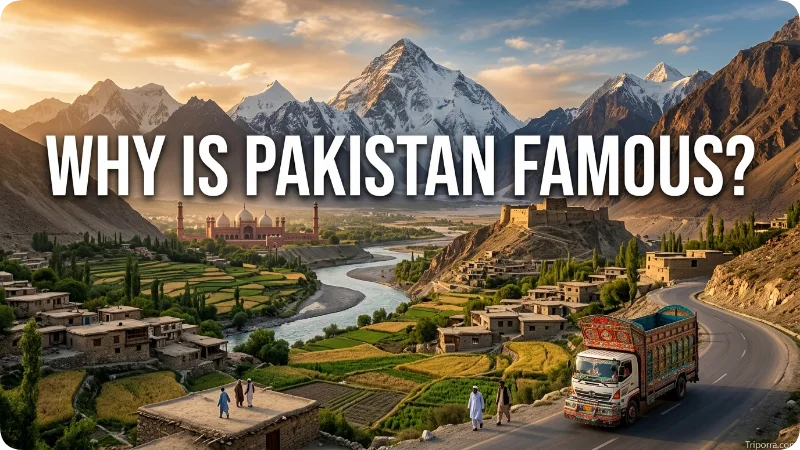
Pakistan is best known for its dramatic mountain scenery. The country is home to five of the world’s fourteen peaks above 8,000 meters, including K2, the world’s second-highest mountain. The Karakoram Highway, one of the highest paved international roads, connects Pakistan with China through breathtaking landscapes.
The country is also famous for the ancient Indus Valley Civilization. Archaeological sites such as Mohenjo-daro and Harappa show that one of the world’s earliest urban societies developed here more than 4,000 years ago.
Pakistan has a rich cultural mix shaped by Persian, Central Asian, South Asian, and Islamic traditions. This influence appears in its architecture, music, clothing, food, and languages.
Cricket is another major part of national life. Stadiums become lively during important matches, and local parks fill with children and adults playing the sport every day.
Food is another reason visitors remember Pakistan. Dishes such as biryani, nihari, chapli kebab, sajji, and various regional breads reflect the country’s diverse traditions.
Travellers often overlook the country’s changing landscapes. Within one trip, you can see glaciers, alpine lakes, green valleys, deserts, forests, fertile plains, and sandy beaches. Few countries offer such a wide variety of scenery in a relatively connected land area.
One commonly misunderstood fact is that Pakistan is only deserts or mountains. In reality, most of the population lives in fertile plains watered by the Indus River system.
History of Pakistan
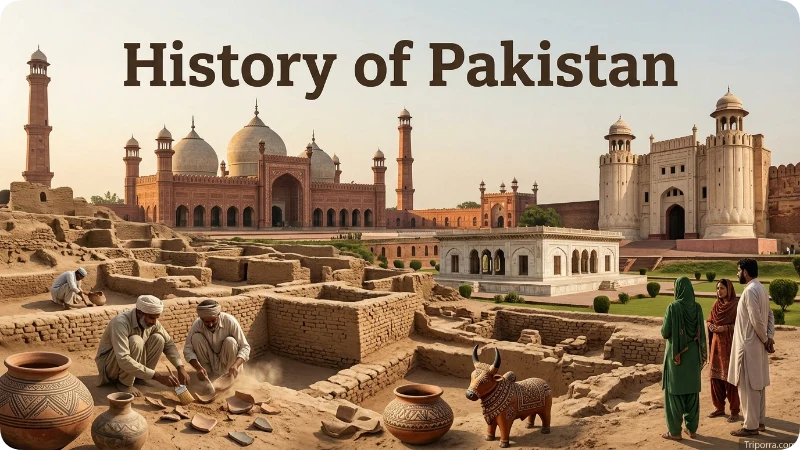
The land that is now Pakistan has been home to people for thousands of years. The Indus Valley Civilization flourished here around 2500 BCE, building advanced cities with planned streets, drainage systems, and organized trade.
Later, the region became part of several major empires, including the Persian Empire, the empire of Alexander the Great, the Mauryan Empire, the Kushans, and the Mughals. These periods introduced new ideas, religions, and trade networks.
Islam reached the region during the 8th century and gradually became a major cultural influence. Over the centuries, local kingdoms and larger empires shaped the country’s identity.
During the 19th century, the area became part of British India.
Pakistan gained independence on 14 August 1947, following the partition of British India. Muhammad Ali Jinnah became the country’s first Governor-General and played a leading role in its creation.
Since independence, Pakistan has continued to develop its economy, infrastructure, education, and international connections while facing political, economic, and environmental challenges.
Climate and Weather
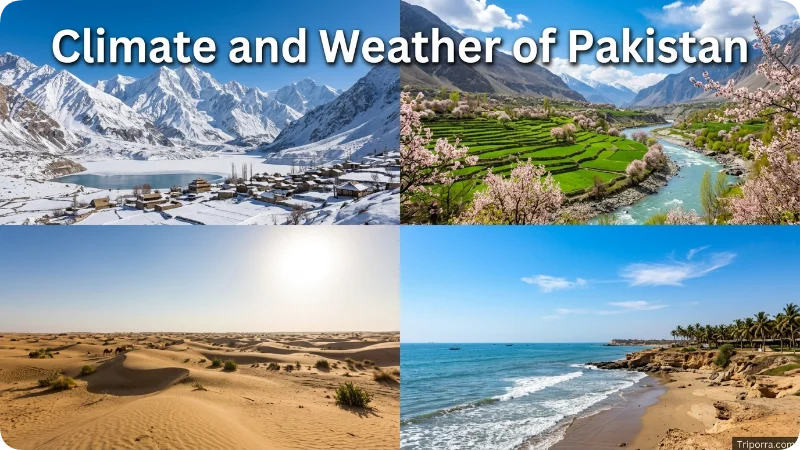
Pakistan has several climate zones because of its size and changing elevation.
Northern mountain areas experience cold winters with heavy snowfall. Summers are generally mild, making these regions popular for hiking and sightseeing.
Central plains have hot summers where temperatures often rise above 40°C. Winters are cooler and usually pleasant.
Southern coastal areas stay warmer throughout the year because of the Arabian Sea. Karachi experiences milder winters than most inland cities.
The summer monsoon usually arrives between July and September, bringing rain mainly to the eastern and northern parts of the country. One seasonal trap many visitors miss is planning mountain road trips during peak monsoon season, when landslides can temporarily close highways.
Things to See and Do
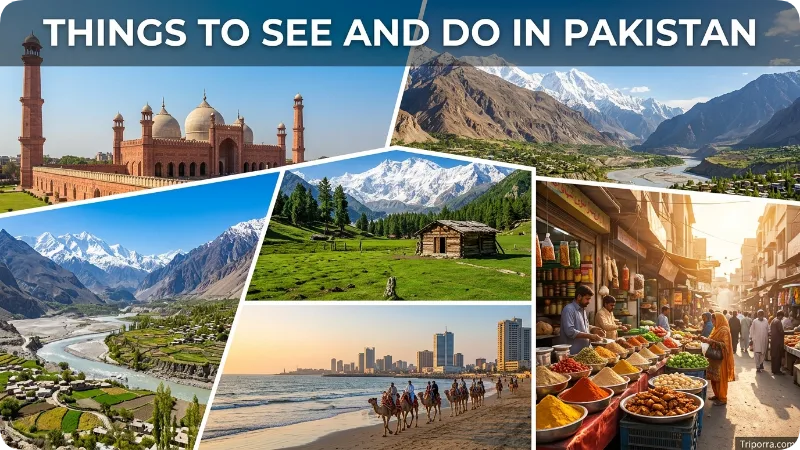
Mountains and Nature
- Visit Hunza Valley for mountain views and local villages.
- Explore Skardu as a gateway to K2 and Baltistan.
- Drive along the Karakoram Highway.
- See Fairy Meadows with views of Nanga Parbat.
- Visit Deosai National Park, one of the world’s highest plateaus.
History and Culture
- Explore Mohenjo-daro, one of the world’s oldest planned cities.
- Visit Lahore Fort and the nearby Badshahi Mosque.
- Walk through the historic streets of Old Lahore.
- See the Taxila archaeological sites.
Food and City Life
- Try street food in Lahore.
- Visit Karachi’s Clifton Beach and waterfront.
- Shop in Islamabad’s local markets.
- Taste regional dishes in Peshawar and Quetta.
Best Time to Visit
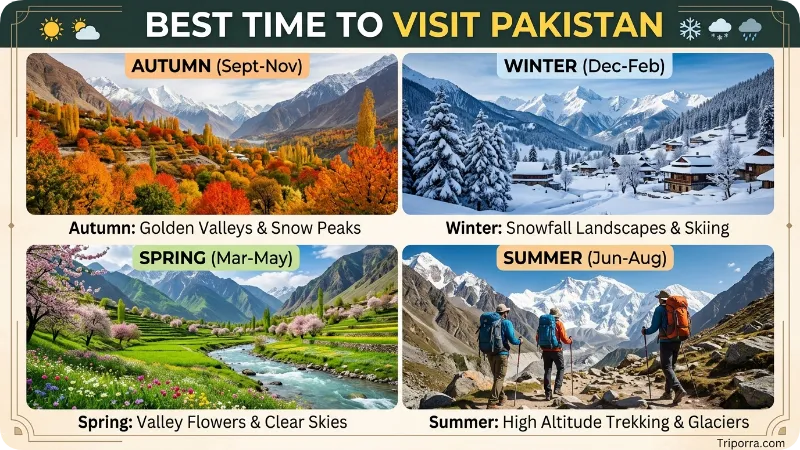
The best time to visit depends on where you plan to travel.
Spring, from March to May, offers comfortable weather across much of the country. Flowers bloom in northern valleys, while cities remain pleasant for sightseeing.
Autumn, between September and November, is another excellent choice. Mountain views are often clear after the monsoon, temperatures become comfortable, and tourist crowds are smaller.
Summer is the best season for high mountain adventures because roads to places like Hunza and Skardu are fully open. However, southern cities can become extremely hot.
Winter attracts visitors interested in snow-covered landscapes, particularly in northern Pakistan. Roads at very high elevations may close after heavy snowfall.
What most guides miss is that October often combines stable weather, colorful autumn scenery, and easier travel conditions across much of northern Pakistan.
Common Misconceptions
Many people mistakenly think Pakistan is located in the Middle East. It is officially part of South Asia, although its location connects several neighboring regions.
Another common misunderstanding is that everyone speaks Urdu as a first language. Urdu is the national language, but most Pakistanis grow up speaking regional languages such as Punjabi, Sindhi, Pashto, Balochi, Saraiki, or others before learning Urdu.
Some travelers also believe the entire country has the same climate. In reality, temperatures can vary from below freezing in the north to above 40°C in southern plains during the same season.
Which Port City Is Located in Pakistan?
Karachi is Pakistan’s largest port city and the country’s main center for maritime trade. Located along the Arabian Sea, Karachi has played an important role in connecting Pakistan with international markets.
The city contains major ports, including Karachi Port and Port Qasim, which handle a large share of the country’s imports and exports.
Gwadar is another important port city in Balochistan. It is known for its deep-sea port and strategic location near important shipping routes.
Related Places
Islamabad
Pakistan’s capital city is known for its planned layout, green spaces, and nearby natural attractions. The city provides easy access to places such as the Margalla Hills, making it a common starting point for travelers exploring northern Pakistan.
Lahore
Lahore is the cultural center of Pakistan. It is famous for Mughal-era buildings, traditional food streets, museums, and festivals. The city’s historic areas show centuries of architectural and cultural development.
Karachi
Karachi is Pakistan’s largest city and its main economic hub. Located along the Arabian Sea, it offers beaches, seafood, museums, markets, and a mix of communities from across the country.
Hunza Valley
Hunza is a mountainous region in Gilgit-Baltistan known for dramatic peaks, clear rivers, and traditional villages. It is one of the most popular destinations for visitors interested in nature and photography.
Peshawar
Peshawar is one of the oldest continuously inhabited cities in the region. It is known for its historic markets, Pashtun culture, and traditional foods such as chapli kebab.
What Else Do People Want to Know?
Is Pakistan safe for travelers?
Safety conditions vary by region and change over time. Popular tourist areas such as Islamabad, Lahore, Hunza, Skardu, and many cultural sites welcome visitors, but travelers should check current advice before visiting remote border areas.
Is Pakistan expensive to visit?
Pakistan is generally considered an affordable destination compared with many countries. Accommodation, local transport, and food can be budget-friendly, although costs increase for private tours, mountain expeditions, and luxury hotels.
Do people speak English in Pakistan?
English is widely used in government, education, business, and tourism. In major cities, many people working in hotels and travel services can communicate in English.
What currency is used in Pakistan?
The Pakistani Rupee (PKR) is the official currency. Major cities have banks, exchange services, and ATMs, but travelers visiting remote mountain areas should carry some cash.
Do I need a visa to visit Pakistan?
Most foreign visitors need a visa before traveling. Pakistan offers online visa services for many nationalities, but requirements depend on citizenship.
Is Pakistan easy to travel around?
Major cities are connected by roads, trains, and domestic flights. Mountain regions can take longer to reach because of difficult terrain and seasonal road conditions.
FAQs
Is Pakistan in India?
No. Pakistan is not located in India. Pakistan is an independent country in South Asia.
Pakistan and India were once part of British India, but Pakistan became a separate nation on 14 August 1947. Today, the two countries share a border but are separate sovereign states.
What Is the Geography of Pakistan? (Short Note)
Pakistan has a diverse geography that includes mountains, plains, deserts, rivers, and coastal areas.
The northern regions contain the Himalayas, Karakoram, and Hindu Kush mountain ranges. The Indus River flows through the country and supports fertile plains, while the southern coastline extends along the Arabian Sea.
Where Is Pakistan Located in Asia?
Pakistan is located in South Asia, bordered by India, China, Afghanistan, Iran, and the Arabian Sea.
Is Pakistan in the Middle East?
No. Pakistan is part of South Asia, although it has close cultural, economic, and political ties with many Middle Eastern countries.
Where Is Pakistan in Relation to Israel?
Pakistan lies east of Israel, with countries such as Jordan, Iraq, Iran, and others between them.
Where Is Pakistan in Relation to Iran?
Pakistan is directly east of Iran, and the two countries share a land border of about 560 miles (900 km).
Where Is Pakistan Located on the World Map?
Pakistan is in South Asia, between India to the east, Afghanistan and Iran to the west, China to the north, and the Arabian Sea to the south.
Which Continent Is Pakistan In?
Pakistan is located on the continent of Asia, specifically in the South Asian region.
Where Are Pakistan and Israel?
Pakistan is in South Asia, while Israel is in the Middle East on the eastern coast of the Mediterranean Sea.
What Is Pakistan’s Full Name?
The official name of Pakistan is the Islamic Republic of Pakistan.
The country uses this name in its constitution and official documents. Pakistan became independent on 14 August 1947 after the partition of British India.
When did Pakistan become an independent country?
Pakistan became independent on 14 August 1947 after the partition of British India.
What is the main river of Pakistan?
The Indus River is the country’s most important river. It supports agriculture and has played a central role in the region’s history.
What Is the Total Area of Pakistan Without Kashmir?
The commonly cited area of Pakistan is approximately 881,913 square kilometers. The exact figure can vary depending on whether disputed regions are included in calculations.
Different sources may provide different measurements because the Kashmir region has a disputed status between Pakistan and India.
What Are 5 Facts About Pakistan?
Five important facts about Pakistan are:
- Pakistan is located in South Asia.
- Islamabad is the capital city of Pakistan.
- Karachi is the largest city and a major port.
- Pakistan is home to K2, the world’s second-highest mountain.
- The Indus Valley Civilization developed in this region thousands of years ago.
Conclusion
Pakistan is located in South Asia and connects several important regions through its geography, history, and culture. From the high peaks of the Karakoram Mountains to the coastal areas along the Arabian Sea, the country offers a wide range of landscapes.
Its ancient civilizations, diverse languages, traditional foods, and historic cities make it a unique destination. Understanding where Pakistan is on the map also helps explain why the country has played such an important role throughout history.
For travelers, researchers, and curious readers, exploring Pakistan means discovering a country shaped by mountains, rivers, civilizations, and many different communities.

Elena Rostova bridges the gap between premium hospitality and authentic local experiences. Armed with a background in luxury hospitality management and a passion for fine architecture, she spent years evaluating elite resorts before transitioning into travel journalism. Elena heads the luxury and boutique travel vertical on Triporra.com. Her meticulous guides strip away the guesswork from high-end travel, showcasing unique five-star escapes, fine regional dining, and bespoke private tours that elevate a standard vacation into an unforgettable journey.