Introduction
The Caspian Sea is located between Europe and Asia, in the region between southern Russia, Kazakhstan, Turkmenistan, Iran, and Azerbaijan. It stretches about 1,200 kilometers (745 miles) from north to south and is the world’s largest inland body of water. Its shores are divided among five countries: Russia, Kazakhstan, Turkmenistan, Iran, and Azerbaijan.
Unlike an ocean, the Caspian Sea is completely enclosed by land and has no natural connection to the world’s oceans. Its position makes it an important geographic boundary between Eastern Europe, Central Asia, and Western Asia. National Geographic uses the Caspian Sea as part of the commonly accepted geographic division between Europe and Asia.
Featured Snippet Answer
The Caspian Sea is between Europe and Asia, bordered by Russia to the northwest, Kazakhstan to the northeast, Turkmenistan to the southeast, Iran to the south, and Azerbaijan to the southwest. It lies east of the Caucasus Mountains and west of Central Asia and is the world’s largest inland body of water.
Quick Facts
| Fact | Information |
|---|---|
| Name | Caspian Sea |
| Type | Inland, enclosed body of water |
| Geographic Position | Between Europe and Asia |
| Bordering Countries | Russia, Kazakhstan, Turkmenistan, Iran, Azerbaijan |
| Northern Shore | Russia and Kazakhstan |
| Western Shore | Russia and Azerbaijan |
| Southern Shore | Iran |
| Eastern Shore | Kazakhstan and Turkmenistan |
| Approximate Coordinates | 37°–47° N, 46°–54° E |
| Length | About 1,200 km (745 miles) north to south |
| Surface Area | About 371,000 sq km (143,200 sq mi) |
| Maximum Depth | About 1,025 m (3,363 ft) |
| Elevation | About 28 m (92 ft) below global sea level |
| Water Type | Saline |
| Largest Inland Water Body | Yes |
| Major Nearby City | Baku, Azerbaijan |
| Major River Entering It | Volga River |
| Nearby Mountain System | Caucasus Mountains |
| Geographic Region | Eastern Europe, Central Asia, and Western Asia |
Note: Measurements such as the Caspian Sea’s surface area, depth, length, and elevation can vary with water levels and measurement methods. Commonly cited figures place its area at about 371,000 square kilometers and its north–south length at about 1,200 kilometers.
Where Is the Caspian Sea Located?
The Caspian Sea occupies a large inland depression in Eurasia. It sits between the southern edge of the East European region and the northern and western parts of Asia.
Its location can be understood by looking at the five countries around its coastline:
- Russia is to the north and northwest.
- Kazakhstan is to the north and northeast.
- Turkmenistan is along the southeastern and eastern shore.
- Iran occupies the southern shore.
- Azerbaijan lies along the southwestern and western shore.
The sea runs mainly from north to south. Its northern end reaches into the broad lowlands around the lower Volga region, while its southern end approaches the mountains of northern Iran.
This gives the Caspian Sea a distinctive geographic position. It is not simply part of one country or one conventional region. Instead, it sits at a crossroads between Eastern Europe, the Caucasus, Central Asia, and Western Asia.
Is the Caspian Sea in Europe or Asia?
The Caspian Sea is generally described as being between Europe and Asia rather than being entirely within one continent.
The exact continental boundary in this part of Eurasia depends on the geographic convention being used. National Geographic identifies the Ural Mountains, Ural River, Caspian Sea, Caucasus Mountains, and Black Sea as part of the commonly accepted Europe-Asia division.
For a simple mental map, think of the Caspian Sea as being:
east of the Caucasus Mountains, south of Russia, west of Central Asia, and north of Iran.
That position explains why maps may label the surrounding area with different regional terms.
Which Countries Border the Caspian Sea?
Five countries have coastlines on the Caspian Sea.
Russia
Russia occupies the northwestern and northern part of the Caspian coastline. The Russian shore includes areas associated with the Volga delta and the North Caucasus.
The Volga River, Europe’s longest river, reaches the Caspian at its northern end. The large river system is one of the main reasons the northern Caspian is much shallower than the southern basin.
Kazakhstan
Kazakhstan borders the northeastern and eastern side of the Caspian Sea. Its coastline forms a large portion of the northern and eastern shore.
The Kazakh side includes the port city of Aktau, an important urban center on the eastern coast.
Turkmenistan
Turkmenistan occupies much of the southeastern and eastern coast. Its shoreline faces Azerbaijan across the southern-central part of the sea.
The Turkmen coast is closely associated with the Karakum Desert, which extends across much of the country’s interior.
Iran
Iran forms the southern coastline of the Caspian Sea. The shore lies north of the Alborz Mountains and includes Iran’s northern provinces.
The southern basin is the deepest section of the Caspian. Research describing the basin divides it into northern, central, and southern sections, with the southern basin reaching roughly 1,025 meters in depth.
Azerbaijan
Azerbaijan occupies the southwestern and western shore. Its capital, Baku, is located on the western side of the Caspian near the Absheron Peninsula.
Baku is one of the most recognizable cities for understanding the Caspian’s location on a world map. The city sits directly on the western shore, making it an important geographic reference point for the region.
What Is the Caspian Sea Near?
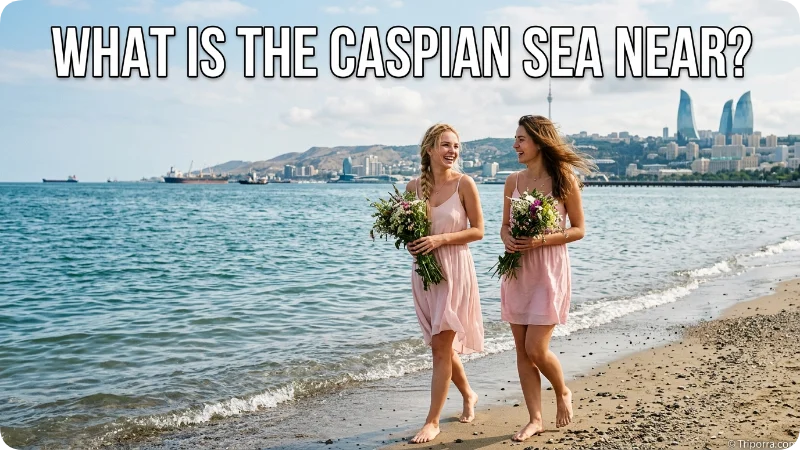
Several major geographic features help place the Caspian Sea on a map.
Caucasus Mountains
The Caucasus Mountains are west of the Caspian Sea. They extend between the Black Sea and Caspian Sea region.
The mountains help separate the Caspian basin from the Black Sea basin and form part of the commonly used geographic boundary between Europe and Asia.
Central Asia
Central Asia lies mainly east of the Caspian Sea. Kazakhstan and Turkmenistan provide the most direct geographic connection between the sea and the wider Central Asian region.
Beyond those countries are Uzbekistan, Kyrgyzstan, Tajikistan, and other parts of the broader Central Asian landmass.
Iran
Iran is directly south of the Caspian Sea. The sea’s southern coastline curves along northern Iran before reaching the country’s border with Azerbaijan and Turkmenistan.
The Alborz mountain range runs roughly parallel to much of Iran’s southern Caspian coast.
Black Sea
The Black Sea lies west of the Caspian Sea, beyond the Caucasus region.
The two bodies of water are relatively close on a Eurasian map, but they are not directly connected by a natural waterway. The land between them includes the Caucasus region.
Where Is the Caspian Sea on a World Map?
On a world map, look for the large enclosed body of water east of the Caucasus Mountains and north of Iran.
A simple way to locate it is to identify the following landmarks:
- Find the Black Sea between southeastern Europe and western Asia.
- Move east across the Caucasus region.
- The large inland water body beyond the Caucasus is the Caspian Sea.
- Kazakhstan and Russia are north of it.
- Turkmenistan is to the southeast.
- Iran is directly south.
- Azerbaijan is on the western side.
The Caspian’s approximate geographic position is between 37° and 47° north latitude and 46° and 54° east longitude.
How Large Is the Caspian Sea?
The Caspian Sea covers roughly 371,000 square kilometers (143,200 square miles). NASA identifies it as Earth’s largest inland water body by surface area.
It extends approximately 1,200 kilometers (745 miles) from north to south. Its width varies substantially, so it is much wider in some sections than others.
The size is one reason the Caspian is called a sea even though it is enclosed by land. From many locations along its shore, the opposite coastline is far beyond the normal visual range.
Its surface area is also comparable to the size of a large country. That scale makes it geographically different from most lakes.
Is the Caspian Sea a Sea or a Lake?
The name can be confusing because the Caspian Sea is technically a landlocked, enclosed body of water with characteristics of a lake.
It has no natural outlet to the world’s oceans. Water enters through rivers and is primarily lost through evaporation. For this reason, many geographic references describe it as the world’s largest lake or largest inland water body, even though its traditional name is “Caspian Sea.”
The classification also reflects its unusual size and water chemistry. Its water is salty, but its salinity is considerably lower than that of typical ocean water.
So both descriptions can appear in geographic sources:
- Caspian Sea — its traditional and widely used name.
- World’s largest lake — based on its enclosed inland-basin characteristics.
- Largest inland water body — a clear geographic description.
Why Is the Caspian Sea Below Sea Level?
The Caspian Sea sits in a deep continental depression. Its water surface is roughly 28 meters (92 feet) below global ocean level, although the exact level changes over time.
This low elevation is one of the most unusual geographic characteristics of the Caspian basin.
Because the Caspian has no natural outlet to an ocean, its water level depends on the balance between river inflow, precipitation, evaporation, and other environmental factors. NASA has documented changes in the shoreline and water level over recent decades.
The Volga River is especially important because it supplies a major share of the freshwater entering the northern Caspian.
How Deep Is the Caspian Sea?
The Caspian has major differences in depth from north to south.
The northern basin is shallow, with large areas only a few meters deep. The central basin becomes much deeper, while the southern basin contains the deepest water.
The southern basin reaches approximately 1,025 meters (3,363 feet) at its deepest point.
This creates a strong geographic contrast:
Northern Caspian → shallow and broad
Central Caspian → deeper
Southern Caspian → deepest basin
The three-part structure is useful when reading maps or comparing the northern and southern shores.
What Major Cities Are Near the Caspian Sea?
Several important cities sit directly on or near the Caspian coastline.
Baku, Azerbaijan
Baku is on the western shore and is the capital of Azerbaijan. Its location on the Absheron Peninsula makes it one of the clearest reference points for locating the Caspian Sea.
Aktau, Kazakhstan
Aktau is on Kazakhstan’s southwestern coast. It is an important port city and provides a useful reference point for the eastern side of the Caspian.
Turkmenbashi, Turkmenistan
Turkmenbashi is on the Turkmen coast in the southeastern part of the sea. It is one of the main coastal urban centers of Turkmenistan.
Makhachkala, Russia
Makhachkala lies on Russia’s western Caspian coast in the North Caucasus. Its location helps show how far north the Caspian extends into Russian territory.
Bandar-e Anzali, Iran
Bandar-e Anzali is a coastal city in northern Iran. It lies along the southern Caspian coast in a lowland area between the sea and the Alborz Mountains.
Together, these cities provide reference points around much of the Caspian’s shoreline.
What Geographic Regions Surround the Caspian Sea?
The Caspian sits at the meeting point of several major geographic regions.
Eastern Europe lies to the northwest, particularly around southern Russia.
The Caucasus is immediately west of the sea and includes Azerbaijan and the North Caucasus.
Central Asia extends east and northeast through Kazakhstan and Turkmenistan.
Western Asia includes Iran and the areas south and southwest of the Caspian.
This is why the Caspian Sea is often described as being at a geographic crossroads. It connects several land regions without being connected directly to an ocean.
What Rivers Flow Into the Caspian Sea?

The Caspian is fed by numerous rivers. The Volga River is the most important because it contributes a major share of the water entering the basin.
Other rivers include the Ural, Kura, Terek, Sulak, and Sefid Rud.
Because the Caspian is a closed basin, these rivers do not carry its water onward to an ocean. Instead, water remains within the Caspian system until it is removed mainly through evaporation.
This closed drainage system helps explain both the Caspian’s low elevation and its saline water.
Why Does the Caspian Sea Matter Geographically?
The Caspian Sea is important because of its unusual position, size, and physical geography.
It forms a major inland water boundary between five countries and sits near several major geographic regions. Its basin also contains important ecosystems, including habitats for fish and the endangered Caspian seal.
NASA notes that the Caspian supports important fisheries and that its ecosystem includes a large share of the world’s remaining sturgeon population.
The sea’s geography also influences transportation, coastal settlement, natural resources, and regional environmental conditions.
Caspian Sea Location in Simple Terms
If you need a quick mental map, picture the Caspian Sea as a large vertical body of water in the middle of Eurasia.
- Russia: north and northwest
- Kazakhstan: north and northeast
- Turkmenistan: east and southeast
- Iran: south
- Azerbaijan: west and southwest
- Caucasus Mountains: west
- Central Asia: east
- Black Sea: west
- Europe: northwest
- Asia: surrounding the southern, eastern, and western sides
That arrangement explains why the Caspian Sea is commonly described as lying between Europe and Asia.
FAQs
What country is the Caspian Sea in?
The Caspian Sea is not located in a single country. Its coastline is shared by five countries: Russia, Kazakhstan, Turkmenistan, Iran, and Azerbaijan.
Is the Caspian Sea part of Europe or Asia?
The Caspian Sea lies at the geographic boundary between Europe and Asia. The commonly used Europe-Asia boundary includes the Caspian Sea and the Caucasus region.
Which countries touch the Caspian Sea?
The five countries with Caspian coastlines are Russia, Kazakhstan, Turkmenistan, Iran, and Azerbaijan. Russia and Kazakhstan occupy much of the northern shore, while Iran forms the southern shore.
Is the Caspian Sea connected to the ocean?
No. The Caspian Sea is an enclosed inland basin with no natural connection to the world’s oceans. Water enters mainly through rivers and leaves primarily through evaporation.
Is the Caspian Sea a lake?
Geographically, it is often described as the world’s largest lake or largest inland water body because it is completely enclosed by land. Its traditional name remains the Caspian Sea.
Is the Caspian Sea saltwater?
Yes. The Caspian contains saline water, although it is less salty than typical ocean water. Salinity also varies considerably between different parts of the basin.
How far is the Caspian Sea from the Black Sea?
The Black Sea is west of the Caspian Sea, with the Caucasus region between them. The two bodies of water are geographically close compared with their distance from many other major seas, but they are not naturally connected.
Conclusion
The Caspian Sea is a large enclosed body of water between Europe and Asia, bordered by Russia, Kazakhstan, Turkmenistan, Iran, and Azerbaijan. Its long north-south shape, location east of the Caucasus, position north of Iran, and proximity to Central Asia make it easy to place on a world map. With an area of about 371,000 square kilometers, it is the world’s largest inland water body.

About Leo Sterling
Leo Sterling is a geography and travel writer at Triporra.com who believes understanding a place starts with knowing exactly where it is. He turns geographic details on countries, regions, islands, and cities into clear, engaging content for everyday readers.
For Leo, a good location article does more than mark a spot on a map. It shows what borders a place, which region it belongs to, and how it connects to the world around it—an approach reflected in guides like where is Anguilla, where solid research meets a simple, conversational style.
Whether readers are planning a trip, studying, or just curious, Leo’s goal is the same: deliver accurate, easy-to-understand information without unnecessary complexity.
Areas of Focus: Geography | Countries & Regions | Caribbean Islands | Travel Destinations | Location Research | “Where Is?” Content